Cooling system plumbing diagram

This site may earn a commission from merchant affiliate
links, including eBay, Amazon, Skimlinks, and others.

Joined
Oct 21, 2008
Threads
65
Messages
305
Location
brooklyn ny
Anyone have a diagram showing the cooling system plumbing. In particular the plumbing to the heaters. I see a pipe coming off the thermostat housing, does that go to the heater, and where does it return from the heater?

...my FSM PDF doesn't show it.

Thanks,
Carl
 
This may help see: post #3, along with your FSM. additionally a parts diagram can be useful see: part for your 100.
:idea:

Thanks 2001, and thanks for your response in the other post. I have seen both those diagrams before but they don't show the coolant path through the heating system clearly.

Do the feed and return pipes on the back of the motor emanate from the block? There is a hose coming off of the thermostat housing - does this go below the engine and feed the heater and return to the block?

I believe my issue is between the waterpump and the heater core and I'd like to isolate that line to check it.

Thanks again,
Carl
 
Coolant flow, parts & pic's links

You may be low on coolant, air in system or a host of other issues like improper functioning thermostat. Thermostat is the most likely culprit. By your question it appears you feel this is a blockage. Unlikely, unless contaminate in coolant system like mineral & chemical from improper maintenance, It may be, but history will help determine. Millage, temp gauge reading and maintenance what has/was going on etc... will help to diagnosis.

That said, according to the flow chart in post #10 below. It comes out of block teeing down and into heater core at fire wall. The coolant flows from heater core to hose tee at firewall, through connecting pipe see part #13 to water pump see pictures Also if you look close you'll see in this FSM diagram at the pipe end(s) "refer to fig 16.03 PNC 16206" & "PNC 61356". Use your FSM & part finder with diagrams and flow to confirm piping and my assumptions.

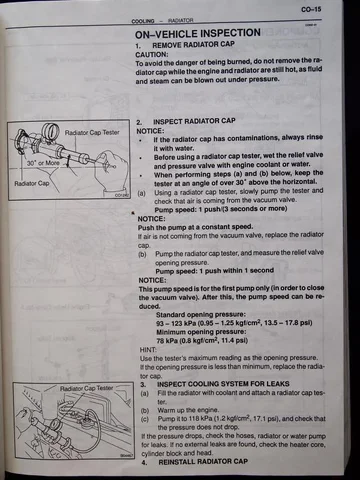
Also see post: #9 below for 2001 FSM thermostat bench, plus cap & coolant system pressure test.
 
Last edited:
Sure 2001LC,

The front heater greatly decreased its efficiency recently and coolant in not flowing to the heater core at idle. It does flow at increased RMP but I believe at a diminished capacity. This was discovered after a slew of investigation and system checks including;

- check of all air duct actuation servos - working as designed
- check of temp sensor near driver's knee - working as designed
- flush of the heater core at the firewall (isolated from the rest of the system) - flushed till clear - no blockage
- coolant level checked and purged of air pockets multiple times
- engine temp stays perfect in NYC traffic in hot weather and cool
- thermostat and water pump - working as designed
- regular maintenance performed but somewhat lacking

With the information you provided I can now with confidence check the supply tube for a partial blockage.

One question about the thermostat - why do you feel it would be a suspect? It isolates the radiator from the rest of the system. If it went bad closed then the car would have heat and the engine temp would rise. If it failed open then the car would take longer to warm up but once warm the heater would function as normal. - no??

Thanks again for your input and help - your explanation of the circuit is exactly what I was looking for.

~ Carl
 
That's very thorough and makes thermostat less likely, provide your temp gauge is working correctly. You sound very capable, but even the best may overlook something.

My temp gauge centers at 90 degrees (degrees of a compass) with very little movement of between 88 and 92 degrees. The actual temp swing is much wider, which is well documented on mud. Toyota IMHO didn't want driver concerned, as temp stays within acceptable range. Blockage is rare IMHO, provided you've used Toyota red LLC with distilled water (de-mineralized water) flush and mixed with red. Pink SLLC is said to be ok, but debatable if any red left in system over longer period due to silicates in red IMHO.

I'm just trying to bring up possibilities, so don't take my questions as any reflect of your capabilities:
Were you doing any maintenance work prior to this issue starting?
Were you loosing any coolant; present or past?
Do you get heat from rear heater????
Is reservoir to full mark in morning after full over night cool down?
Is radiator coolant to top in radiator?

Have you looked into radiator while starting and running engine cold (over night cool-down). You should not see any flow/movement in radiator until operating temp reached?
Once operating temp reached; put cap on radiator run engine ~5 min or more, feel upper radiator. The hose should be very hot with coolant moving through it.

If all checks out I'd:
Blow pressured air or water in heater hose end toward water pump/thermostat, then other direction.

If all this checks out I'd pull thermostats and do stove top bench test. While blowing out other direction from Pump to heater core with delivery heater hose disconnected, than return hose.
 
Last edited:
The temp gauge acts as you've described and I haven't been great about using the Toyota coolant exclusively.

Answers to your questions inline below;

I'm just trying to bring up possibilities, so don't take my questions as any reflect of your capabilities: HA! I question my capabilities daily. :D
Were you doing any maintenance work prior to this issue starting? No
Were you loosing any coolant; present or past?No
Do you get heat from rear heater????yes - this part questions my "blocked" theory but I think what little fluid is getting through is heading to the rear core
Is reservoir to full mark in morning after full cool down? I believe so - will recheck
Is radiator coolant to top in radiator? yes

Have you looked into radiator while starting and running engine cold (over night cool-down). You should not see any flow/movement in radiator until operating temp reached? operates as you've described
Once operating temp reached; put cap on radiator wait 15 min, feel upper radiator. The hose should be very hot with coolant moving through it. will check

If all checks out I'd:
Blow pressured air or water in heater hose end toward water pump/thermostat. Will do

If all this checks out I'd pull thermostats and do stove top bench test. While out blow other direction from Pump to heater with heater hose disconnected.Will do


I'll keep you posted.

Thanks a bunch,
Carl

 
Water pumps typically leak when bad, it goes hand in hand with reduced pumping pressure.

Rear heater working does not sound like blockage in connecting pipe, but does not total rule out partial blockage.

If reservoir when cold to high mark the brought up to normal operating temp, then cool down over night and you see the level drops. This is indication of air in system. Keep topping and checking until is at high mark in morning. Squeezing upper hose can aid in getting air out.

Use NY water and mixing coolant brands a bad idea IMHO. Can cause blockage throughout coolant system and reduce life of components IE.. WP & thermostat.

Also temp gauge could be faulty, ergo bench test of thermostat.


Great advice and a good tip about the air pocket. - thnx!
 
2001, when using a laser thermometer, what temp should I be seeing on one of those heater hoses?

Thnx
 
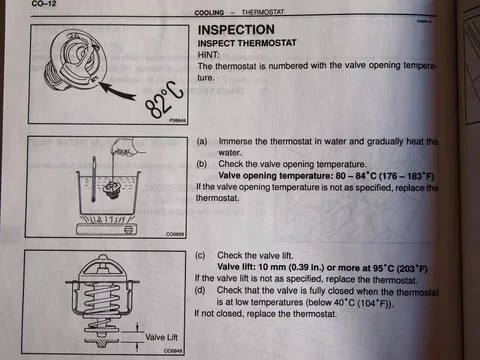
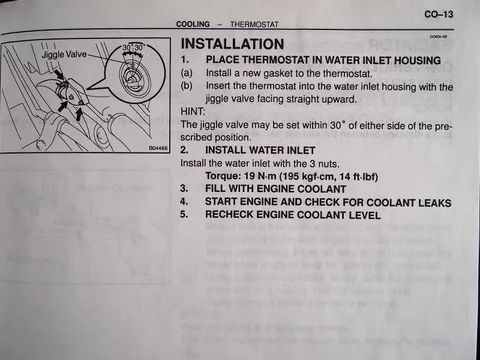
2001 FSM thermostat bench, plus cap & coolant system pressure test.

Was reservoir level low this morning?
Can you see any deposits/scaling inside radiator?

I don't have a temp gun any longer, so I can't check. I'd look for something approaching FSM specs:
Thermostat test.webp
Thermostat FSM 002.webp
You may find this helpful as well:
Coolant cap & system pressure test 001f.webp

Thermostat test.webp


Coolant cap & system pressure test 001f.webp


Thermostat FSM 002.webp
 
Last edited:
These drawings might do well in this thread...

2UZ-cooling layout.webp


2UZ-cooling schema.webp
 
Sure 2001LC,********

One question about the thermostat - why do you feel it would be a suspect? It isolates the radiator from the rest of the system. If it went bad closed then the car would have heat and the engine temp would rise. If it failed open then the car would take longer to warm up but once warm the heater would function as normal. - no??

Thanks again for your input and help - your explanation of the circuit is exactly what I was looking for.

~ Carl
The thermostat opening to soon or stuck open would not allow coolant to reach normal operating temp. Heaters would blow cool at best on cold day. You'd probable also notice a slight drop in MPG while running below engine designed temp.

If rear heater blowing very hot and front not, then thermostat probably ok.:bang:

What was reservoir level this morning when you checked?:confused:


******I haven't been great about using the Toyota coolant exclusively. *******
Carl

Can you give more detail, did you add coolant because low or was this non exclusive coolant used during a flush & refill job?
What type of coolant?
Did you put tap water in coolant system?
How long ago; miles & time?
 
Last edited:
Sorry to disappear,

Over the weekend I drained the system and ran a heavy duty flush treatment over a few long distance trips. Then I replaced the flush with coolant and also changed the thermostat. Last night I burped some air out of the core and it was blowing hot again. This morning it was warm but not as hot as last night. Rear heater cranking hot as always.

I plan to search for more trapped air.

After the flush there was coolant now moving to the core at idle, I believe this was a good part of my issue.

UHU, your second diagram shows a heater valve. Are you sure that's for the 100? I was lead to believe that we do not have a heater valve on these trucks and coolant is always flowing through the core(s)>

Thanks guys,
Carl
 
These drawings might do well in this thread...
Thanks again for the flow diagram, and I too am wondering about the heater valve?

Post in different mud thread stated; the coolant flows unrestricted all the time through heater core(s). Makes the heater valve in the diagram perplexing. The diagram looks like our 100 engine. Perhaps the other poster in mud was wrong or possibly we're not understanding the diagram.

I know older V-8's used a heater core valve, modern engines I don't know. Can someone help-out on this issue?:confused:

Sorry to disappear,

Over the weekend I drained the system and ran a heavy duty flush treatment over a few long distance trips. Then I replaced the flush with coolant and also changed the thermostat. Last night I burped some air out of the core and it was blowing hot again. This morning it was warm but not as hot as last night. Rear heater cranking hot as always.

I plan to search for more trapped air.

After the flush there was coolant now moving to the core at idle, I believe this was a good part of my issue.

UHU, your second diagram shows a heater valve. Are you sure that's for the 100? I was lead to believe that we do not have a heater valve on these trucks and coolant is always flowing through the core(s)>

Thanks guys,
Carl

Last time I flush I had too keep adding each morning to the coolant reservoir for 3 or 4 days before it held at high level. Now my heat is very hot.
 
Last edited:
I know older V-8's used a heater core valve, modern engines I don't know. Can someone help-out on this issue?:confused:

I'm with you on this one. I restore/hot rod vintage cars for fun, the new ones??!! - I just like to drive them. :D


Last time I flush I had too keep adding each morning to the coolant reservoir for 3 or 4 days before it held at high level. Now my heat is very hot.

That's what I was thinking. :bounce:


~ Carl
 
Last time I flush I had too keep adding each morning to the coolant reservoir for 3 or 4 days before it held at high level. Now my heat is very hot.
My '01 LX is also self-bleeding.

I add new coolant to about 2" from the top of the tank and check the level over 3-4 days of driving. Masking tape on the side with a marker until the level stops going down.

I guess you could install a flushing T or T's at the top of the system (existing heater hose T's), but that's 3 more clamps in an area that has barely enough room for the oem T's.

Steve
 
UHU, your second diagram shows a heater valve. Are you sure that's for the 100? I was lead to believe that we do not have a heater valve on these trucks and coolant is always flowing through the core(s)>
The diagram is an illustration for the cooling system for the engine, not a description of the hvac-system. Looking at the description and drawings of the front heater, there is no mention of any valve.
Therefore, I believe that the engine-drawing has the valve and heater core in there only as a representation of a typical heating system.

Btw: The front heater is designed to give nearly 5 KW of heat, and 6 KW of cooling (>5 Kcal).
The rear 2 KW heat and 3 KW of cooling.
 
The diagram is an illustration for the cooling system for the engine, not a description of the hvac-system. Looking at the description and drawings of the front heater, there is no mention of any valve.
Therefore, I believe that the engine-drawing has the valve and heater core in there only as a representation of a typical heating system.

Btw: The front heater is designed to give nearly 5 KW of heat, and 6 KW of cooling (>5 Kcal).
The rear 2 KW heat and 3 KW of cooling.


Makes sense, thank you for clarifying.

~ Carl
 
***
Therefore, I believe that the engine-drawing has the valve and heater core in there only as a representation of a typical heating system.

***
Thanks, that what I was thinking also.
 
I think I finally have everything sorted out and I once again have heat. I'm pretty sure my problem was a combination a partial blockage and air in the system. After a couple of good flushing sessions, including an extended period with a heavy duty cleaner, and constant monitoring and refiling my overflow chamber the heater is once again blasting away.

Thanks for all the help guys.

~ Carl
 
FWIW: I don't like using chemical flush unless absolutely necessary, same for tap water and mixing different coolants. Minerals in water react with the silicates in coolant and cause deposit (blockage) and shorten life of components in systems.

I'd triple flush out the chemical/cleaners with distilled water (deminerialized), they will reduce life of core's IMHO.
 
Back
Top Bottom