Charging problems on a 1979 BJ40?

This site may earn a commission from merchant affiliate
links, including eBay, Amazon, Skimlinks, and others.

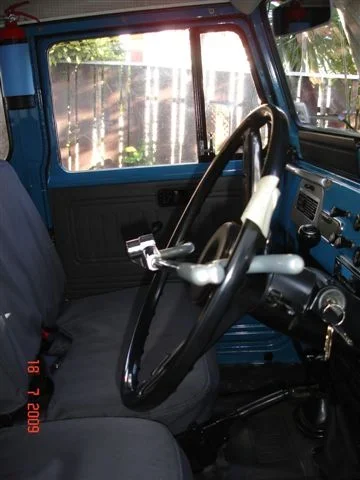
These days - I like to put something on the steering wheel to remind me that the engine shouldn't be started up (and it serves to remind me what exactly I'm working on too):

BracketAlz.webp


Well ....... I think I'm happy to call the charging system "done" now and move on to other things.

:beer:
BracketAlz.webp
 
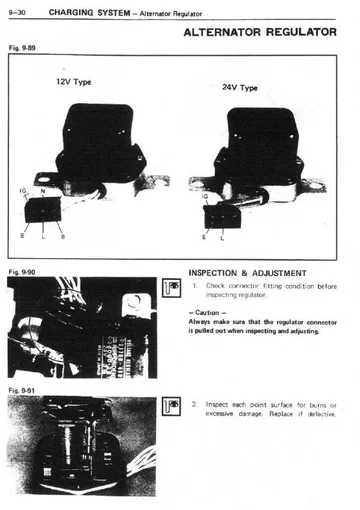
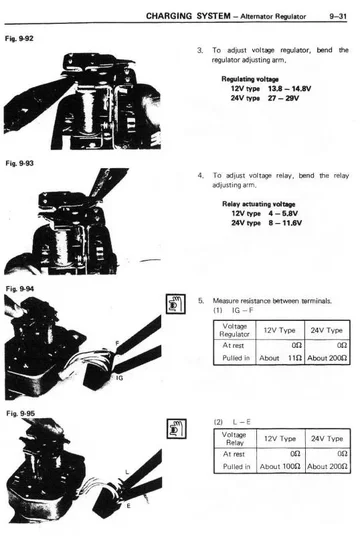
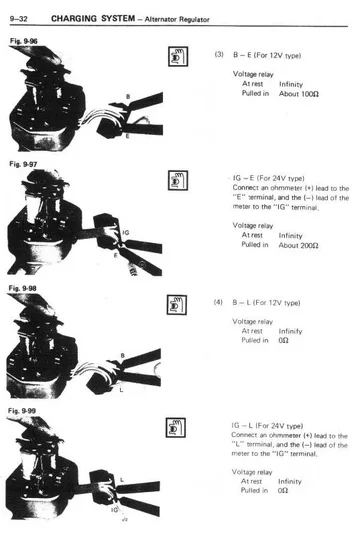
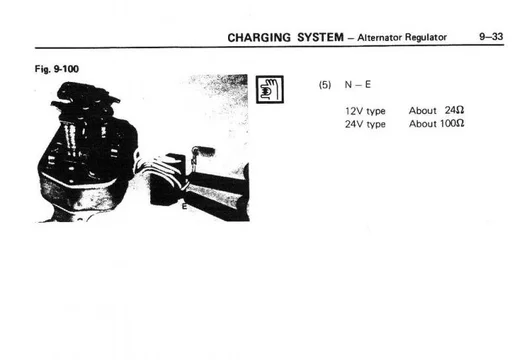
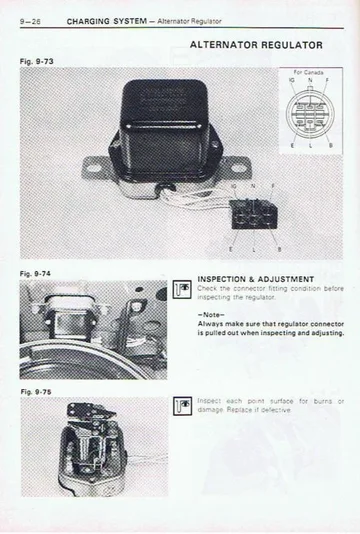
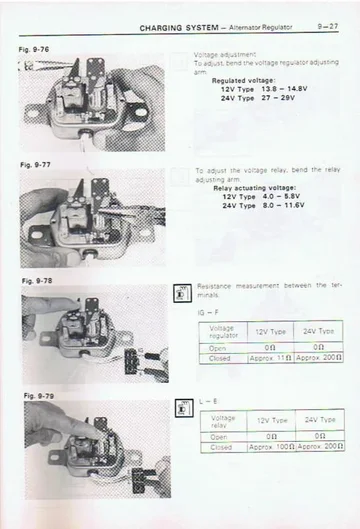
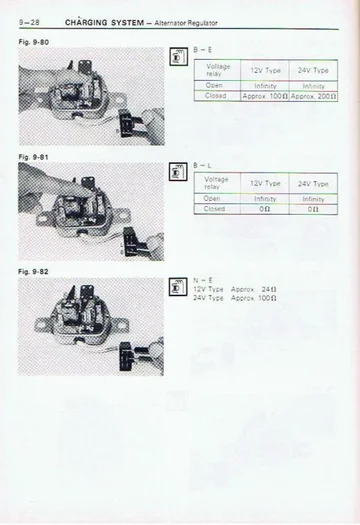
OK. I'm so dumb! I was looking at alternators on the Internet and I stumbled across images of how to adjust/calibrate the old-style regulators. And those images looked remarkably like the pages of the Engine FSM.
So I looked in my FSM and sure enough - there they were:

Reg1.webp

Reg2.webp

Reg3.webp
Reg1.webp
Reg2.webp
Reg3.webp
 
Reg4.webp

Hmmm - but these didn't turn out to be very clear. Perhaps the ones I found on the internet will be clearer. (They're from a different B-engine FSM too.)
Reg4.webp
 
Here are the images from off the Internet (and YES the images are clearer):
9-26AlternatorRegulator.webp

9-27AlternatorRegulator.webp

9-28AlternatorRegulator.webp
9-26AlternatorRegulator.webp
9-27AlternatorRegulator.webp
9-28AlternatorRegulator.webp
 
In general I think your voltage regulator is now behaving as it should. You SHOULD observe varying swings of the needle when operating at different load/current draw levels. With your very large battery I'd assume (just guessing here) that the reserve potential is much greater than those of us with 12 volt systems. This would nullify some of the wider swings I see when, oh, say...turning on the wipers or sitting at a traffic light with the turn indicators on. Your later alternator (81?) may have greater potential for output at low rpm which would reduce the amount of time your needle would swing away from the centered mark.

I must have referred to the FSM to determine that bending the arm was the way to adjust the regulator. I don't remember having as many ohmmeter checks but then I only have three wires to my VR. I can't find my FSM at the current time so I'll just have to keep driving along like usual.:rolleyes:

As to my battery - I always disconnected it when I parked the vehicle for the summer. Yes, summer. I drive a different vehicle in the warmer months as I need to haul more gear and a canoe. That probably accounts for the long life span of what some her consider a marginal battery i.e. - Optima Red Top. It'll probably croak it when I hook it back up in a month or two.
 
Y
While I feel the "lights on at idle situation" is understandable, why should glowing produce a significant negative/discharge needle swing? (After all - my glow current travels through a different fusible link that isn't even monitored by my ammeter!!!! )

The battery is still being drained and will indicate such via the ammeter I'd think.

This ammeter situation is no longer causing me any alarm - just "mildly-concerning" (on the basis that it has NEVER performed like this in the last 30 odd years).

So I guess I'll put it down to ----- the fault with the old electro-mechanical regulator gave my ammeter a "revv up" which made it start behaving properly for the first time in its life. (Plausable? I'm sceptical! :D)

I think that is the most likely explanation. I mean, you have replaced batteries in the past due to age, etc. correct? Didn't the ammeter give you advance warning of this previously? A very low battery charge would have pegged the needle at maximum system output indicating an attempt by your alternator to rectify the situation. If not the VR never worked correctly (or had a loose connection) and is now fixed! :clap:
 
The battery is still being drained and will indicate such via the ammeter I'd think.

Yeah. I've given this aspect some thought too Numby.

My glowplugs draw a relatively high current and the FSM data well-and-truly underestimates it. (My FSM says they draw 10.3 amps max whereas I believe they draw at least 40 amps.)

So I reckon this high current draw-off (through my unmonitored fusible link) may be lowering my battery voltage enough to cause my glow relay's operating-coil (whose current DOES pass through the ammeter-monitored fusible link) to increase its "current draw" significantly.

(A lower supply voltage needs a higher current to produce the same power.)

But then again....(the other side of the coin)....... 40 amps is still "nothing" in comparison to the current my starter motor draws and my engine still starts fine. -So how can 40A really be "stressing" my battery (and lowering its terminal voltage)?

:frown: (So the truth is that I'm still confused but just treating it all as a "quirk" of a classic old vehicle.)

.. Didn't the ammeter give you advance warning of this previously? ....

My ammeter has never given me any warning of when my battery needs replacement. The usual indication I get for that is simply "very slow cranking speeds when trying to start on a cold Winter's morning".

But like you I do have an underlying suspicion that this present battery could somehow be responsible for my ammeter's different behaviour. (But it maintains its charge and starts the vehicle well so I am not planning on changing it in the near future.)

Based on age, this battery isn't due for replacement till 3 year's time (2012) so I may have to wait till then to find out if changing it returns the ammeter to its "age-old behaviour pattern". :D

:cheers:
 
Last edited:
My heart leapt recently when I spotted this for sale from a 4x4 outfit in Oz:

View attachment 354501

I was enthusiastic because -

  • It was made in Japan and clearly of a similar quality to Nippondenso
  • It was "old-school electro-mechanical" rather than "modern solid-state" so there would be none of the associated shoddy assembly techniques
  • It was reasonably priced.
  • It would match the alternator on my 1979 BJ40 perfectly being a simple "plug-and-play" replacement. (Just bolt in place and connect up.)
So I placed my Internet order and paid my money almost immediately (despite a high shipping cost)!

But alas - After a few days they refunded me and said they couldn't supply it.

These are also shown on their website:

View attachment 354502

View attachment 354503

I wonder if they actually DO stock those things or whether it would be the same story with them? :frown:
 
Just an update here.

I'm about to trash those "Made in China" sealed beams I fitted. I'm now sick of people flicking their lights onto high beam at me (because I'm obviously now blinding them at night even on the "dip setting"). These units obviously don't have the proper filiament-shields to stop the light from blinding oncoming motorists. (I should really notify the Commerce Commission to get the retailer reprimanded/fined because they were sold to me for on-road use despite the warning on the packaging.)

:hhmm: I hope this "sealed beam episode" doesn't destroy my credibility because I've only just finished posting in another thread in support of asian-made products! :lol:

And the white fusible link was indeed the cause of my ammeter coming to life (giving big readings) for the first time in 30 years. I have now fixed that problem so my ammeter is once again "dead". (The fusible link was only hanging on by a few strands of copper.)

See this thread for the fix:
https://forum.ih8mud.com/40-55-series-tech/378105-ammeter-fusible-links-late-model-40-series.html


:cheers:

PS... Images are being deleted from old threads by the MUD administrators/system. Has anyone else noticed this? (Not that I'm really complaining ... because people like me often post too much cr@p!)

And I think I was correct to replace the voltage regulator .... in other words I believe I had two faults. (A faulty voltage regulator AND a faulty fusible link.)
 
Last edited:
Back
Top Bottom