3 port fuel selector valve troubleshooting questions for Aux fuel tank

This site may earn a commission from merchant affiliate
links, including eBay, Amazon, Skimlinks, and others.

sheepdawg

Champagne appetite. Beer income.
Joined
Jan 16, 2012
Threads
38
Messages
322
Location
Eastern Sierras, CA
Alright, so here goes. I have an auxiliary fuel tank on my 40 and it suddenly stopped working after I left the switch it on accidentally one evening. I crawled underneath it and discovered the previous owner installed a pollak 3 port fuel selector valve. This is a very reliable and common set up. I figured I burned it up by leaving it on all night, so I bought a new one and replaced it.

I simply replaced the three hoses I removed in the exact same ports and hooked up the hot wire. NOTHING, Nada. I check the connection to the hot wire. It is good when the switch is activated. But fuel is not being moved from the auxiliary tank to the main tank.

Any suggestions on where to start? Prior to hooking up the new selector valve, I hooked it up to the positive and negative terminal and the selector valve was working, just not continuously. It would just click intermittently.

Pollak Valve.webp
 
Is fuel able to leave the tank on it's own? In other words is there a blockage in the tank or maybe in the line itself?
 
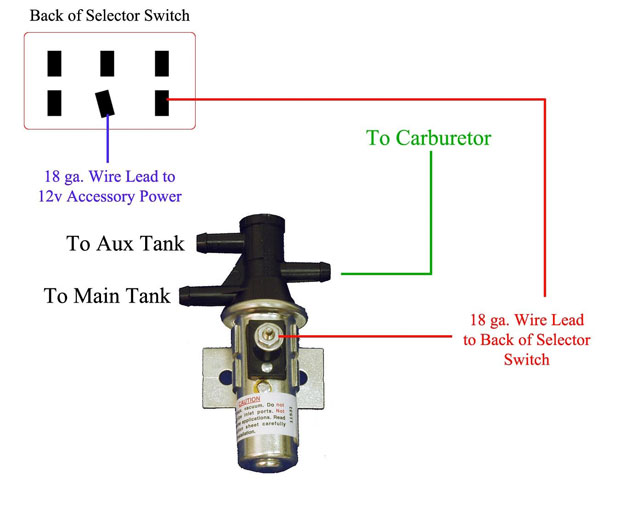
EDIT1: Since your picture doesn't look like a Pollak, I tried to find your switching valve. It looks like a BWD Switch Valve from CarQuest. But, my comments (below) should still apply. At least, I think my comments are still correct, even though you don't appear to have a Pollak valve.

EDIT2: It sounds like you think your fuel system is configured to move aux tank fuel to the main tank... A Pollak is an expensive way to do a simple transfer. Are you sure it's a transfer configuration. Do you have a gauge for both tanks? Does it really move fuel from the aux to the main?

EDIT3: This is a typical connection schematic for a BWD Switch Valve:

early-bronco-electric-selector-valve.jpg


I use a 6-port Pollak (I use fuel returns)... I believe the 3-port works the same (without fuel returns)... e.g. The Pollak only uses electricity, to switch the Pollak, when the toggle switch is switched between tanks.

So, leaving it switched 'all night' didn't burn out the Pollak

As the others said, it sounds like a possible fuel pump issue...

Are you running one fuel pump, between the Pollak and the carb? If so, is it the OEM mechanical pump? If you are running one fuel pump and you get fuel from the main tank and not the aux tank, it could be a dirty fuel filter, plugged aux tank fuel lines, aux tank pickup plugged or aux tank empty.

Or, are you running two fuel pumps, one between each tank and the Pollak? If so, are they both working?

Pollak warranty requires you place a fuel filter between the Pollak and the tanks - do you have two fuel filters installed, one between each tank and the Pollak?

With 3-ports, you have one fuel feed from each tank and a single 'output' line from the Pollack.

Without knowing how yours is configured (how many pumps, filters, etc.), it's hard to tell you how to troubleshoot.

But, here goes... Assuming your main tank is feeding fuel and your aux tank is not feeding fuel

...and you have two fuel pumps, BEFORE the Pollak

...disconnect the main tank feed from the Pollak

... Disconnect the aux feed from the Pollak and connect it to the port that had the main tank feed

... If you get fuel from the aux tank, thru the main tank side of the Pollak, your aux fuel pump is bad

... If you don't get fuel from the aux, thru the main tank side of the Pollak, you either have:

A plugged fuel filter,

a plugged fuel pickup

or an empty aux tank

If this doesn't help you, please post your configuration... e.g. How many pumps, how many filters and where they are located, in the scheme of things.
 
Last edited:
Agree with Pngunme. Your selector valve only opens/closes the valves that allow the fuel to move thru the valve/hose. Has nothing to do with actually pumping the fuel.

As I remember your set up (could be wrong tho) you only have an electric pump and not the factory mechanical pump. In the switch over you may have dislodged power to your electric pump. Or maybe you actually did leave the pump on, maybe it pumped air all night and burned it up ?? When you hit the elec pump switch can you hear it pumping ?

John
 
Without knowing how yours is configured (how many pumps, filters, etc.), it's hard to tell you how to troubleshoot.

But, here goes... Assuming your main tank is feeding fuel and your aux tank is not feeding fuel

...and you have two fuel pumps, BEFORE the Pollak

...disconnect the main tank feed from the Pollak

... Disconnect the aux feed from the Pollak and connect it to the port that had the main tank feed

... If you get fuel from the aux tank, thru the main tank side of the Pollak, your aux fuel pump is bad

... If you don't get fuel from the aux, thru the main tank side of the Pollak, you either have:

A plugged fuel filter,

a plugged fuel pickup

or an empty aux tank
I have a line from the Aux tank to the Pollak with a new fuel filter in between. The line from my Aux tank to the pollak is gravity fed. I then have a line that goes from the Pollak to the main tank. There is an additional line from the Pollak to a mechanical fuel pump. It also has a new fuel filter between them. Then there is a line from the main tank to the carb. It also has a new fuel filter.

I only have one mechanical pump and I only have a fuel gauge on my main tank. The auxillary tank was just boiled and completely cleaned out. And yes there is fuel in it. The aux tank does not have a pump to the pollak. I guess my mistake is I thought the pollak also acted as a pump. Like I said, I confirmed it is getting a hot lead when I flip the switch. But it is not pumping fuel to the main tank.

I did not confirm that fuel is free flowing from the aux tank to the pollak yet. I assumed this. I will confirm. As it stands now, I spilling fuel like mad because I do not have a way of plugging lines.

Thanks for your help.
 
The way I would expect your fuel delivery system to work (assuming main tank is A and aux tank is B) is as follows:
  • Main Tank Feed to Fuel Filter A (filter should be before the Pollak, to keep from voiding the Pollak warranty) to Pollak A
  • Aux Tank Feed to Fuel Filter B to Pollak B
  • Pollak C to Mechanical Fuel Pump to Carb
This is basically how mine is configured - the difference is simply that I have a 6-port, so I also have:
  • Return from carb to Pollak Return C
  • Pollak Return A to main tank
  • Pollak Return B to aux tank
Your mechanical fuel pump will pump fuel from whichever tank is 'active' (the currently switched tank), assuming the gravity feed is working...

Questions:
  1. Are you sure you really have "Then there is a line from the main tank to the carb. It also has a new fuel filter."? If this is true... where does this line connect to on the carb? If you have the stock Aisin carb, the fuel feed connection is on the front (sight glass side). The fuel return (if you have one) is on the valve cover side of the carb. To which carb port is this line attached?
  2. Your 'Pollak' doesn't appear to be an actual 3-port Pollak (there would be more than just the one wire used with Pollak). How do you select main or aux? Is it a SPDT (single throw, double pole) toggle or a DPDT (double pole, double throw) switch? Or does it always default to 'main', unless you select "aux"?
I would:
  • disconnect each segment of aux fuel line and blow them out.
  • Make sure the aux fuel filter is not clogged.
  • Then reconnect them together, but not to the pollak yet.
  • disconnect the 'feed' line on the fuel pump
  • connect the aux fuel line to the 'input' side of the fuel pump, bypassing the pollak for now
  • disconnect the hot wire from the pollak
  • try to start the engine and see if it runs off the aux tank.
    • If it runs ok,
      • disconnect from the fuel pump input
      • Reconnect the aux fuel line to the Pollak
      • Reconnect the hot wire to the Pollak
      • Try starting and running off the aux tank again
        • If it works, great!
        • If it doesn't work... we need to rethink this
    • If it doesn't run ok
      • disconnect the fuel pump 'feed' line from the sightglass (front) of the carb
      • put disconnected line in a container
      • have someone crank the engine for 15 seconds
      • If you don't have about 1/2 cup of fuel, in the container, after 15 seconds
        • we need to rethink this
      • If you don't have about 1/2 cup of fuel, in the container, after 15 seconds
        • fuel pump is not pumping enough volume OR
        • fuel filter is clogged OR
        • fuel line is clogged OR
        • fuel pickup on the aux tank is clogged OR
        • aux fuel tank is empty (I know it's not)
Work thru this and see where it takes us...

If you are running a return line from the carb to your main tank, but not to your aux tank, the returned fuel (regardless of whether you are running off the main tank or the aux tank) will always return to the main tank. Is your main tank full right now? If it is full and you run off your aux tank, the returned fuel will try to return to the main tank (assuming that is what the main-to-carb line is for) and would probably dump fuel into your carb - I don't know if I'm correct here... it would have to dump it somewhere.

You said, "As it stands now, I spilling fuel like mad because I do not have a way of plugging lines.", where is this fuel spilling from?

FYI If you are running the stock fuel gauge and an OEM fuel sender, you could add the same OEM fuel sender to your aux tank and share the stock gauge between tanks... you would need the proper OEM fuel sender for your year FJ40 - what is your FJ40 build date? But you would need a true Pollak-type switching valve... it has more wiring connection, to allow you to select a tank and cause the 'active' sender to change to that tank and the gauge to reflect the 'active' tank.

HTH


Last edited:
I got to work on everything earlier today and I think I can speak more educatedly.

If you are running a return line from the carb to your main tank, but not to your aux tank, the returned fuel (regardless of whether you are running off the main tank or the aux tank) will always return to the main tank. Is your main tank full right now? If it is full and you run off your aux tank, the returned fuel will try to return to the main tank (assuming that is what the main-to-carb line is for) and would probably dump fuel into your carb - I don't know if I'm correct here... it would have to dump it somewhere.

So my configuration is as follows:

Aux tank to Pollak has a new fuel filter. Lines are clear.
Pollak has a line to the main tank with no filter between.
Pollack to mechanical OEM fuel pump with a new fuel filter. Lines are clear.
Fuel pump to stock carb and carb has a return to the main tank. Return line to main tank has a new fuel filter.

Both tanks full.
When I activate switch fuel Aux tank has flow to pollak. I can see it flow with clear fuel filter. If I squeeze off fuel line from Aux to pollak, the carb will die from lack of fuel.
When switch not activated, fuel from main tank to pollak and I can see fuel from pollak to OEM fuel pump. Once again, I can see it through the fuel filter. Engine runs fine.

What I have noticed is there is a steady flow of fuel on the return line to the main tank. I can see it through the fuel filter. Is this correct?

Also with both fuel tanks full of gasoline and the engine running, when I activated the switch to draw from my aux tank, I was pumping fuel right out the gas cap to the main tank. The previous owner warned me about this. This suggests that fuel from the aux tank is going to the OEM mech fuel pump to the carb and excess is flowing down the return line, into the main tank. Since the main tank is full, it has no where to go but out the gas cap. Like I said, I can see fuel flowing through the return line via the fuel filter, into the main tank.

Does this sound right? My only fuel gauge is to the main tank and it does not function properly, but I know the tank is full because I just filled it up.
 
I only have one OEM fuel pump on the whole system and it is working.
 
I got to work on everything earlier today and I think I can speak more educatedly.


So my configuration is as follows:

Aux tank to Pollak has a new fuel filter. Lines are clear.
Pollak has a line to the main tank with no filter between.
Pollack to mechanical OEM fuel pump with a new fuel filter. Lines are clear.
Fuel pump to stock carb and carb has a return to the main tank. Return line to main tank has a new fuel filter.

Both tanks full.
When I activate switch fuel Aux tank has flow to pollak. I can see it flow with clear fuel filter. If I squeeze off fuel line from Aux to pollak, the carb will die from lack of fuel.
When switch not activated, fuel from main tank to pollak and I can see fuel from pollak to OEM fuel pump. Once again, I can see it through the fuel filter. Engine runs fine.

What I have noticed is there is a steady flow of fuel on the return line to the main tank. I can see it through the fuel filter. Is this correct?

Also with both fuel tanks full of gasoline and the engine running, when I activated the switch to draw from my aux tank, I was pumping fuel right out the gas cap to the main tank. The previous owner warned me about this. This suggests that fuel from the aux tank is going to the OEM mech fuel pump to the carb and excess is flowing down the return line, into the main tank. Since the main tank is full, it has no where to go but out the gas cap. Like I said, I can see fuel flowing through the return line via the fuel filter, into the main tank.

Does this sound right? My only fuel gauge is to the main tank and it does not function properly, but I know the tank is full because I just filled it up.

So, it sounds like your original problem, that it won't run off the aux tank, is moot, at this point... right?

First, I would move the filter from between the pollak and the fuel pump to the main-to-pollak line, before the pollak. No sense taking a chance on plugging the pollak.

Second, your carb has no idea where the fuel is coming from... the only return is to the main tank, so it will always return to the main tank. If both tanks are full, or just the main is full, and you run the aux first, you will always overfill the main. You can run this way, but you would need to always run the main tank first. That way, you are drawing down the main, before you start overfilling it from the aux.

Third, I have never watched the return line to see how much fuel is normally returned. Your's sounds like its returning a lot of fuel all the time. Are you having problems with flooding your carb?

Fourth, I don't know of a need for the fuel filter on the return line, but I doubt it's hurting anything.

Fifth, I would add a working fuel gauge. Rudi (@bj40green ) has a lot of good info in THIS link, to help you figure out if your fuel gauge is working... it could be that your main tank fuel sender is broken...

it could also be that your main tank fuel sender is simply disconnected. I would pull the passenger seat and the tank cover and figure out whether the main tank sender actually works. You could also replace the stock gauge or add an aftermarket gauge, if it's the gauge that's bad.

You can run like this, but, because of the main-only-return, you will have to run the main tank down first, then switch to the aux and run it down. You can switch to aux when the engine stutters, from lack of fuel, but you will never know exactly how much fuel you have in the aux... you'll have to keep a running calculation based on mileage after you switch to aux.

Have I addressed everything? Or, do you have other issues/questions?

If you want to do this right, you can change to a 6-port pollak and a working fuel gauge. You can share a single, working gauge, between two tanks, as long as both have identical senders and the senders resistances (ohms) match the gauge. I can explain this better, if you want to go that way.

It looks like, from your signature, that we are talking about your '69 FJ40... do you know if your fuel gauge and sender are stock oem for 1969?

Good luck!


So, it sounds like your original problem, that it won't run off the aux tank, is moot, at this point... right?

Correct. Fuel is flowing fine.

First, I would move the filter from between the pollak and the fuel pump to the main-to-pollak line, before the pollak. No sense taking a chance on plugging the pollak.

Good idea. This will not be a problem.

Second, your carb has no idea where the fuel is coming from... the only return is to the main tank, so it will always return to the main tank. If both tanks are full, or just the main is full, and you run the aux first, you will always overfill the main. You can run this way, but you would need to always run the main tank first. That way, you are drawing down the main, before you start overfilling it from the aux.

Correct. This is what the previous owner recommended to me.

Third, I have never watched the return line to see how much fuel is normally returned. Your's sounds like its returning a lot of fuel all the time. Are you having problems with flooding your carb?

Absolutely no flooding problems and I was surprised as well on the amount of fuel flowing from the return line to the main tank. It seems like a fairly steady trickle. I would never have thought that this was how the main tank get filled. It just does not seem to be the correct way. This is partially the reason I thought there was a pump from the aux to the main but after following the line, I realized it was the return line that was feeding the main tank. Which makes me question, what happens to the stock carbs that don't run a return line. Obviously they are not fed that much fuel.

Because of how this is set up, having a functioning fuel gauge to the main tank is essential. I will be reading more of Rudi's threads and yes you are correct, this is for my 69 fj40. Except I have a 77 2f stock engine in it and not the f engine. My instrument panel is stock with main tank having the stock sending unit under the passenger seat.

You have pretty much addressed all my issues. Thanks for the detail and time you put in on your responses.

Rick
 
Is the fuel return line stock? Don't believe I've ever seen a carb that needed one. If it's not stock and serves no useful purpose then remove it. If there's a reason for having it then add a 6 port switch. Or do what the PO told you to do, and then pass that along to the NO when you become the cruisers next PO.

Unless it's a hard line between pump and carb I'd add a filter there too.
 
You're very welcome, Rick!

Re: "...Which makes me question, what happens to the stock carbs that don't run a return line. Obviously they are not fed that much fuel..." - that's an excellent question - and I don't know the answer. Have you ever measured just how much fuel your mechanical pump puts out? Should be around 3 psi, IIRC. If you can't measure PSI, you can disconnect the feed line, from your carb and feed it into a container. Then crank the engine for 15 seconds... you should pump about 1/2 cup into the container in 15 seconds. I wonder if your pump isn't an over performer...

Re: "...Because of how this is set up, having a functioning fuel gauge to the main tank is essential...". It's not really essential because, if you always fill your main and run it first. You can keep track of mileage on your aux and guesstimate when you need to refuel. But, a gauge makes life much better.

Re: "...I will be reading more of Rudi's threads and yes you are correct, this is for my 69 fj40. Except I have a 77 2f stock engine in it and not the f engine. My instrument panel is stock with main tank having the stock sending unit under the passenger seat...". Jim (@Downey)'s post# 6 in THIS THREAD the two ranges of ohms, depending on your 40's build date.

HTH
 
@terrx

I don't believe he has a 3-port mechanical fuel pump.

From his description, I think his fuel pump has only an input and an output and his carb returns directly to the main tank.
 
For this work and most any other in which live fuel lines need to be disconnected and plugged to prevent fuel flowing out during the work get yourself a pair of these: http://www.lislecorp.com/divisions/products/?product=98 or similar device. They can be put on to squeeze the line closed BEFORE it's disconnection so that the only loss will be the small amounts between the clamp and the hose end, if any. They don't damage good hose unless too much pressure is put on the tightening - all that's needed is enough to close off the hose. It's the kind of simple little tool that can make a person say "Where have these BEEN all my life??"
 
Thinking of switch to a Pollock from BWD myself, after jogging over this post I have some quick questions...

questions
1. The fuel doesn’t actually seep into main from AUX does it? I thought these valves (BWD &/or Pollock), and the switch between the two tanks selects the fuel tank being fed to carb. - am I understanding that incorrectly?

2. wiring the Pollock - I have BWD currently ; what would the switch differ with regards to wire work? My BWD wires are in place. The wire set ups looks completely different looking at the valve advertisement pictures.

3. also in regards to wiring - I am installing an extra fuse box for my accessories. I’ll have a couple extra ports (this may be a dumb question), but should I run it through that and would that be advantageous because I’m doing the other accessories through that?
EDIT2: It sounds like you think your fuel system is configured to move aux tank fuel to the main tank... A Pollak is an expensive way to do a simple transfer. Are you sure it's a transfer configuration. Do you have a gauge for both tanks? Does it really move fuel from the aux to the main?

I use a 6-port Pollak (I use fuel returns)... I believe the 3-port works the same (without fuel returns)... e.g. The Pollak only uses electricity, to switch the Pollak, when the toggle switch is switched between tanks.
 
Back
Top Bottom