22RE - intermittent start with low voltage at solenoid

This site may earn a commission from merchant affiliate
links, including eBay, Amazon, Skimlinks, and others.

Joined
Jun 3, 2007
Threads
118
Messages
7,242
Location
SW MB CA
Hi all, hope you guys can help steer me in the right direction here.

I'm helping a friend get his 88 Runner back on the road, and it's got an intermittent start problem. I went through the test suggestions from the FAQ (Toyota/Chrysler/Mitsubishi - Nippon Denso Starter Solenoid Repair), the solenoid gets about 11 volts when the starter engages and the truck starts, and only 7 or 8 volts when the starter doesn't engage (but solenoid still clicks I believe). When it doesn't engage, the battery voltage drops like 0.3 volts, much less than the drop seen at the solenoid, and I'm assuming there is no draw on the direct lead to the starter.

So this leads me to believe the issue is with the wiring/switches to the solenoid, rather than anything internal in the starter. Does this sound right? If this is the case, is wiring a relay in for the solenoid going to be the easiest/best way to fix the problem? Is there particular spot in the wiring or component that typically goes, and would likely fix the problem rather than adding a relay? Have I got it ass backwards and it's still likely in the starter?

Thanks,
Curtis.
 
Solenoid voltage measured between the switching lead to the solenoid (using a jumper test lead as shown in the link) and the negative post of the battery, so it is showing the voltage applied to the solenoid through the ignition switch/clutch switch/associated wiring.
 
Last edited:
Yup, 0.6 ohms I believe it was. Cleaned the ends with some sandpaper, dielectric greased 'em and put it back together. I don't like the prospect of pulling the starter.... pretty tight in there.... any tips on how to get in at it? I have no FSM for a Runner to see how Mr. T intended for you to get at it.
 
Really appreciate this Ray. :cheers:

Just to be clear, we're done for the night, so there's no need to treat this as real-time-help.
 
K I needed a little refresher course myself :cool:

I would
jack up pass side put big jackstand under frame
pull off tire
pull off dust shield thingy in the fender there
disconnect everything
pull out starter
I think the bolts are 17mm heads

What was the voltage at the main battery to starter solenoid connection when the ignition (switched) lead was at 7 or 8 volts?

Did you test the in and out of solenoid with the same voltage drop test that did on the jumpered wires?

Just to be clear, we're done for the night, so there's no need to treat this as real-time-help.

lol...
 
I didn't think to test the voltage at the main-feed (stud) on the starter till after I had cleaned up (I think that's what you are asking about), but the voltage at the battery drops from about 12.5v to 12.2v on "failed" start attempts.

"Did you test the in and out of solenoid with the same voltage drop test that did on the jumpered wires?"
not sure what you are asking here..... maybe I should go back and take a second look at the FAQ link, I may have skimmed over a few things, although I see more tests in the FSM to do after pulling the starter.
 
Okay, I think the game plan for tomorrow night will be to check and clean the engine ground, then see if "jumping" the start signal terminal will activate the starter when the ignition switch won't. That should clear up for sure if the starter needs to come out.
 
The stud is what I was talking about...
and this one
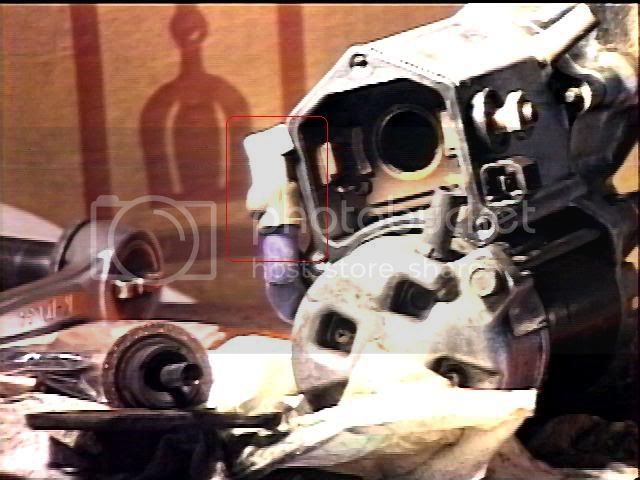
starter-before.jpg

Test the voltage at this one before taking the starter out.
Should be next to 0 volts here on the failed starts if the contacts are bad.
 
Okay, didn't even look for a terminal on the other side, I assumed the feed from the solenoid to the motor was internal. I'll see if I can get in to attach a lead to it.
 
replace the contacts. they are cheap. replace the plunger too, if its pitted.

after installing the contacts, put a light coat of colored grease on the ends. then put the plunger in and press it hard, dont turn it.

take it back out.

verify full contact on the contact, as they are adjustable, and can be slightly turned upon installation.

set so there is full contact.

use brake clean to remove all traces of grease, try not to get it all over the inside of the solenoid.

use small amount of grease to lube the plunger shaft.

make sure you do not have any grease on the contacts at all.

install and done
 
replace the contacts. they are cheap. replace the plunger too, if its pitted.

after installing the contacts, put a light coat of colored grease on the ends. then put the plunger in and press it hard, dont turn it.

take it back out.

verify full contact on the contact, as they are adjustable, and can be slightly turned upon installation.

set so there is full contact.

use brake clean to remove all traces of grease, try not to get it all over the inside of the solenoid.

use small amount of grease to lube the plunger shaft.

make sure you do not have any grease on the contacts at all.

install and done

Thanks for the tips. :cheers:

are both battery cables in good order, and is there the proper grounds hooked from the battery to body, and battery to engine mount?

I'll check to verify and clean the grounds tomorrow, guess it couldn't hurt to take a better look over the positive side too. We've verified the positive lead to the starter, but not the rest.
 
I would take a very close look at the ground leads, it can be deceiving. Just because the ends are clean and tight, the strands of wire under the insulation behind the connector can start to fray after 21 years, and that undersized #6 factory cable will be significantly reduced. I also don't like how the factory routes the ground, it goes from the battery (-) post to the inner fender, then from there down to the engine. Consider replacing both of those grounds with some new #4 cable and soldered & staked ends. Make one that goes straight from the battery to the engine, then do the same for the big red one that runs the starter. I did this a few years ago and the truck started noticibly easier and faster.
 
Yup, 0.6 ohms I believe it was. Cleaned the ends with some sandpaper, dielectric greased 'em and put it back together. I don't like the prospect of pulling the starter.... pretty tight in there.... any tips on how to get in at it? I have no FSM for a Runner to see how Mr. T intended for you to get at it.

.6ohms is high. It should be easily less than .06ohms. It's just a cable, and a fat one at that. I think the one on my 89 mini truck tested out at 0.002 ohms.

As for the starter. First, disconnect the battery... Extensions are your friend. You can actually run extensions from the top starter bolt all the way out the front of the truck. It helps to have somebody guide it to the nut, but it works and I've done it alone. You may want a swivel up by the socket, but the alignment is only a couple degrees off. If you don't have long extensions, a short one or two will do. You need to find a length that allows some swing room. You can also get a box end wrench on it, but the swing room is less than ideal.
 
Going to get back at it tonight. He had to get some work done last night, and I was kinda tired out anyway. I'll post up tonight after we've (hopefully) got it licked or at least know it's the contacts in the solenoid.
 
Back
Top Bottom