1HDT - Adjust timing after ACSD removal?

This site may earn a commission from merchant affiliate
links, including eBay, Amazon, Skimlinks, and others.

Joined
Nov 3, 2008
Threads
107
Messages
1,146
Location
Winnipeg, Manitoba, Canada
I removed the non-working and leaking ACSD on my 1HDT a few months ago and have since noticed an increase in black smoke. With a warmed up engine, I get smoke in 1st when accelerating from a stop, then in all other gears when accelerating after shifting. I usually shift between 2000 and 2500rpm. It smoked last summer but not nearly as much. I also notice that power in higher rpms is lower with a bit of a stumble. It just doesn't sound or feel that strong above 2500rpm.

I recently upped the boost from 10 to 14 psi. This has not really improved the smoke situation.

Since the ACSD adjusts timing, I'm wondering if I need to readjust my timing now that the ACSD is in the garbage. Or should I just turn down the fuel?

Black smoke - retard timing (tilt IP away from engine).

I always research the heck out of these things before I actually do anything. So I'd appreciate any real world advice before I get my hands dirty.
 
Well, I don't know for sure but I don't think that the ACSD has any thing to do with the timing. As far as I know it just upped the idle until the truck warmed up. I also just removed mine, so I am interested to see what other have to say.

Cheers
 
If it only adjusted idle, then it wouldn't make connection to the internals of the injection pump.
 
I removed my ACSD a couple of years ago in the middle of a bunch of other things and I noticed that I was making more smoke (particularly a lot of white smoke on cold starts) but I wasn't sure if that was the reason.

A few months ago when my truck was at ATEB getting a few things done they asked me if I had adjusted the pump timing after doing the ACSD job - of course I said no - so they did something and the smoke situation is much better plus I have a lot more power right off the bottom with no boost. Honestly, I don't know for sure if they advanced the timing or retarded it - I think it was advanced.
 
I had the ACSD extracted a year or so ago too. As far as I know, it does increase the rpm AND alter the timing for easier cold starts. So, after removal it make sense to get the timing checked. The question is: Where in Calgary you can find a reliable shop who know what the heck they are doing to adjust the IP timing? Do ATEB have plans to open a Calgary branch any time soon :D ??
 
I think it was advanced.

can you ask 'em about that .. ( not sure if they would give to your the info but .. ) coz I'm with you ... thought it's advanced the time ..
 
Well I guess I am lucky because my truck seems to be running better without the ACSD. I just finished the birf rebuild and just took it for a drive (after 2 months sitting it the garage) and I don't think I need to do anything. Before it smoked a bit but now there is nothing.

cheers
 
I turned down the fuel screw 1/8 of a turn. The smoke is all but gone and performance is the same as far as my butt dyno can tell.
 
Hmmm.. where is the fuel screw?? Any pics?
Cheers,
Refer to page FU-75 in the factory service manual. The fuel screw is also known as the "full load set screw". Turning counterclockwise will decrease the fuel, clockwise turns it up. Be careful as even a quarter turn can make a big difference.

I used a 12mm deep socket to loosen the locknut, then the set screw turned easily with my fingers. Don't forget to tighten the locknut, but not too much.
 
Refer to page FU-75 in the factory service manual. The fuel screw is also known as the "full load set screw". Turning counterclockwise will decrease the fuel, clockwise turns it up. Be careful as even a quarter turn can make a big difference.

I used a 12mm deep socket to loosen the locknut, then the set screw turned easily with my fingers. Don't forget to tighten the locknut, but not too much.

Thanks a bunch... found it..!
 
IIRC the timing is set when the ASCD is warm and not affecting anything i.e. timing/idle. Once the engine is cold the ASCD advances the timing and increases the cold idle. The timing advance helps the engine fire and the idle advance maintains the idle speed overcoming the drag on a cold engine for example the thicker oil ect. As the engine warms so does the ASCD via the water inlet/outlet and the ASCD backs the idle off and also allows the timing to return to normal running. That is how I understand it works, if it did not alter the timing then there would be no need to have a connection within the pump i.e. the part that breaks off inside and costs you lots of money.

Someone help me out with this because I spent my years as a petrol mechanic in the UK during the time when diesels were exclusive to lorries/trucks ect and were a completely separate discipline to us 'petrolheads' so my diesel tech is a little limited.

regards

Dave
 
IIRC the timing is set when the ASCD is warm and not affecting anything i.e. timing/idle. Once the engine is cold the ASCD advances the timing and increases the cold idle. The timing advance helps the engine fire and the idle advance maintains the idle speed overcoming the drag on a cold engine for example the thicker oil ect. As the engine warms so does the ASCD via the water inlet/outlet and the ASCD backs the idle off and also allows the timing to return to normal running. That is how I understand it works, if it did not alter the timing then there would be no need to have a connection within the pump i.e. the part that breaks off inside and costs you lots of money.

Someone help me out with this because I spent my years as a petrol mechanic in the UK during the time when diesels were exclusive to lorries/trucks ect and were a completely separate discipline to us 'petrolheads' so my diesel tech is a little limited.

regards

Dave
People here refer to the ACSD as a "mysterious device". Your reasoning seems sound as to the function of the ACSD.

Even though I turned back the fuel by only a tiny amount, I've noticed less power now that I've had the chance to drive it for a bit. The black smoke is all but gone, but the power is definitely reduced. I also notice a bit of hesitation when getting moving in first gear. I don't want to just turn the fuel back up and end up with smoke again, so I may attempt to adjust the boost compensator settings. I'm still not keen on mucking with the timing at this point. However, If all else fails, I may have to experiment with that too.

One thing I am doing is keeping an accurate record of any changes, so that I can reverse any of them if required.
 
People here refer to the ACSD as a "mysterious device". Your reasoning seems sound as to the function of the ACSD.

Even though I turned back the fuel by only a tiny amount, I've noticed less power now that I've had the chance to drive it for a bit. The black smoke is all but gone, but the power is definitely reduced. I also notice a bit of hesitation when getting moving in first gear. I don't want to just turn the fuel back up and end up with smoke again, so I may attempt to adjust the boost compensator settings. I'm still not keen on mucking with the timing at this point. However, If all else fails, I may have to experiment with that too.

One thing I am doing is keeping an accurate record of any changes, so that I can reverse any of them if required.

The fuel pump marks are ok as a 'base' setting but you will need a dial gauge to set it spot on IIRC, do you have one of these?

regards

Dave
 
Even though I turned back the fuel by only a tiny amount, I've noticed less power now that I've had the chance to drive it for a bit. The black smoke is all but gone, but the power is definitely reduced. I also notice a bit of hesitation when getting moving in first gear. I don't want to just turn the fuel back up and end up with smoke again, so I may attempt to adjust the boost compensator settings. I'm still not keen on mucking with the timing at this point. However, If all else fails, I may have to experiment with that too.

One thing I am doing is keeping an accurate record of any changes, so that I can reverse any of them if required.

As little as 1/8 turn of the main fuel screw can take your truck from peppy to a total dog. It sounds like you're in pretty much the same place I am. I either have a shot of smoke off the line and a somewhat quick truck or virtually no smoke and it starts off slow. If you want power off the line you will have smoke. It is, however, possible to tune it so that you only have smoke off-boost. Take the top off your boost compensator just so you can understand how the off-boost adjustment works - do not believe the inaccurate description contained in that article on LCOOL. It is full of s***. :)

The only other thing you can do to get a bit more power when you're off boost is to advance the injection timing slightly but this is more serious than just overfuelling a bit and you might not want to decide how much is acceptable without expert advice.

Good idea keeping a record of changes. I didn't do so well in that department so I had to go through the hassle of really learning how everything works. I'm finally there...
 
So Adam, what worked best for you? Leave the fuel set so you have no smoke, and make the 2 or 3 boost compensator adjustments?

I won't have time to "play" with this for a few days at least.
 
Yes, I've read that one. It's pretty good but it's still not exactly like our pumps. Specifically, the off-boost adjustment on top of the boost comp cap. Once you take the top off the boost compensator you will see why I don't like the LCOOL directions. When you back off the jamb nut and turn the set screw what's actually happening on the underside of the cap is a tapered piece is rotating. It neither moves up nor down. A full 360 degrees will return it to its exact same original position. The way the LCOOL directions go, they say to turn it in 1/2 turn increments. Great. So you could be going from max to min, or min to max, or 50% to 50% or anything in between. The next 1/2 turn you do will return you to your start position. It's possible that the 1HD-FT has a different cap than the 1HD-T but that's not helpful to me or you.

Here's a couple more that are well worth the read, particularly the first LONG thread....

Toyota 4WD Surf Owners :: View topic - 2LT Boost compensator

Bosch VW Type INjection Pump Governor Operation

Also keep in mind that when people erroneously refer to the main fuel screw as a "max" fuel screw, it's confusing. The main fuel screw moves the ENTIRE fuel curve up or down. That's why your idle changes when you play with it. That's also why it's a necessary part, but only part, of tuning the pump.

Assuming you're dealing with stock boost levels, my suggestion is to dial the main fuel screw to a point where your EGTs can't go over 1300 at max boost. Then turn your off-boost up or down to get a good compromise between off-boost response and smoke.

I wouldn't bother rotating the boost compensator rod at stock boost. It's an eccentric cone but the taper angle is the same all the way around. Rotating it will give you very similar results to playing with the main fuel screw.

Turning the star wheel inside will put more or less preload on the boost comp spring. At stock boost levels there's no need to tighten it but you may want to loosen it. This will allow fuel to get added more aggressively as you make boost. If you notice too much smoke in the 5-9psi range you've gone too loose. They say to only go about 3 clicks but that's not very much. Don't be afraid to go a lot more but I recommend keeping notes. BTW, it's much easier to keep track of if you do it from the top (with the boost comp cap off) instead of through the side hole where you can't see what you're doing and can't make reference marks.

The Surf Owners link I gave is really good. I think there was also a picture of what our boost comp rod actually looks like. The important feature not pictured elsewhere is that ours tapers in then has a straight section, then tapers back out. On mine anything above 12psi would result in fuel cut (a handy protection I guess?) Going to high boost and actually being able to tune a good fuel curve requires you understanding the whole setup well. You need to modify the rod, tighten up starwheel, get silly with the main screw, and allow the rod to ride higher off-boost so you're not smoking out the whole neighbourhood driving around town.

Have fun!

 
I had a chance to open up the boost compensator and familiarize myself with the insides. I read that long thread linked above and thought I had most things figured out as well as a plan of attack. Once I pulled the cover from the BC, I was a bit perturbed...

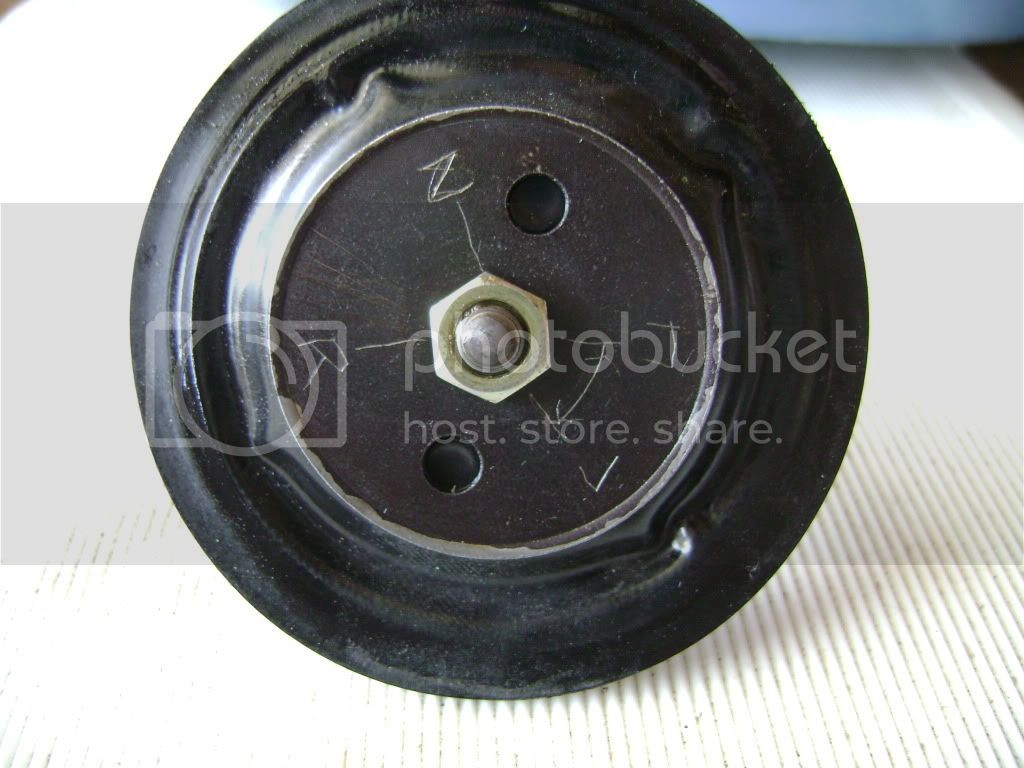
The previous owner must have done some tweaking as there were some marks and letters scribed into the top of the diaphram. Here's what it looked like:
DSC01637.jpg


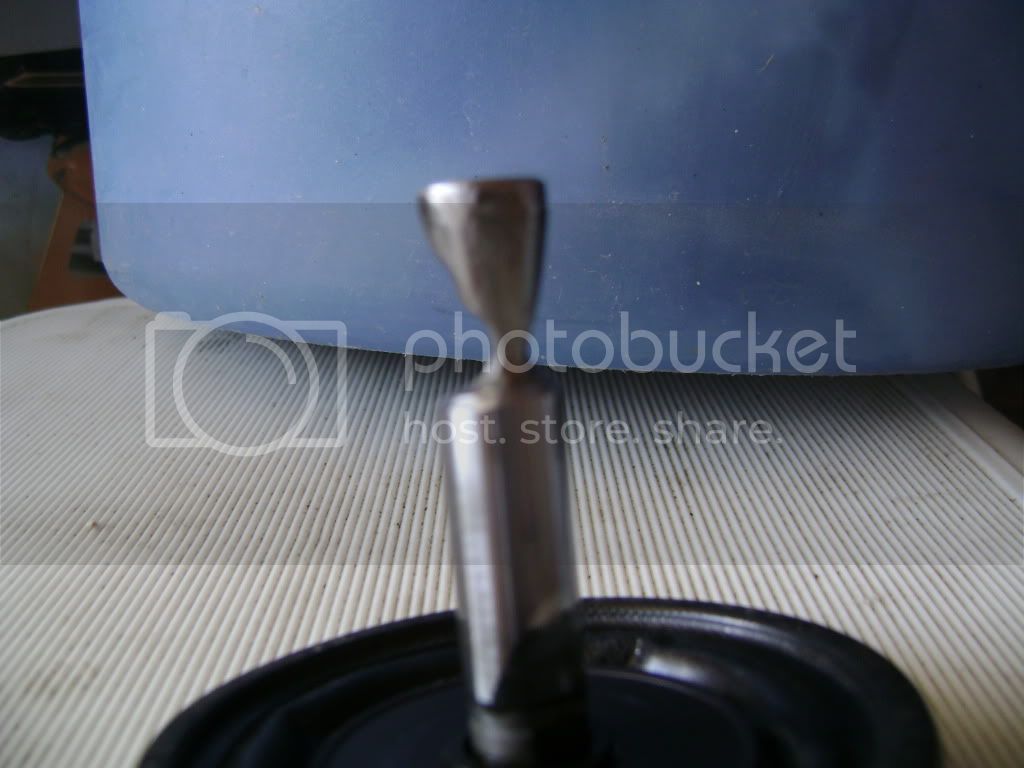
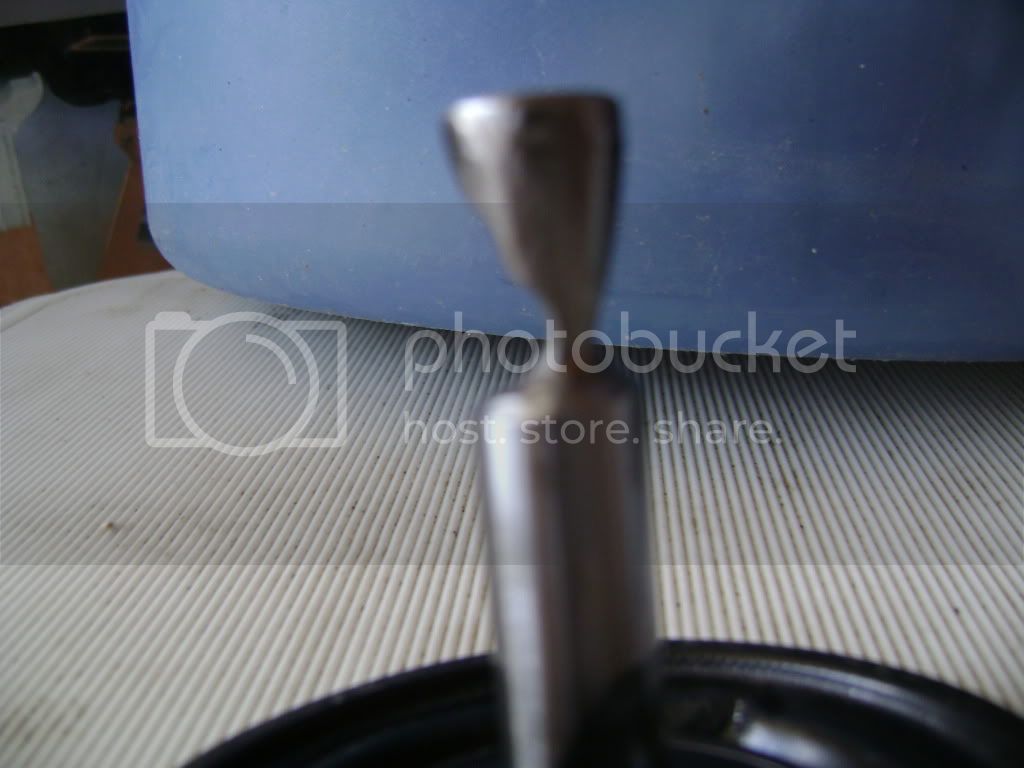
The "R" faced the front of the truck. When I pulled the rod, I found the "R" profile was obviously ground down considerably. It's hard to see in the photos but the rod was ground down with a two-tiered ramp that at the top is well past the centreline of the rod itself. I'm not sure what "R" means - rich? race? The rest of the rod looked like it hadn't been touched much at all.
DSC01636.jpg


DSC01635.jpg

So, I drilled out the nipple in the cover to the same diameter as the pipe. Then I lowered the guide bushing about 20 "clicks". After putting it all back together, I started the engine. At this point when pushing the throttle from idle, the rpms would rise very very very slowly. I took it apart and returned the guide bushing to where it was originally. It now revs up like normal. Looking at the pin marks on the rod it looks like lowering the guide bushing would have allowed more fuel, but instead it seemed to have much less. Unless I was turning the bushing the wrong way. I turned it clockwise to lower.

Anyway, the guide bushing is back to where it was, I'm still using the "R" profile on the rod, the cover "disc" is turned to the thinnest portion and the nipple is drilled out. I'll report back after driving it for a bit.

Because the rod has been ground down so much, I'm a bit stumped what to try next. I get great power in this truck if I don't mind black smoke off-boost. If I turn down the fuel the smoke is gone but the power is lower. I may try experimenting with the normal profile on the rod.
 
I took it for a drive, it is very very sluggish. Takes forever to build any power or boost. I will have to experiment with the guide bushing height to correct this.
 
Back
Top Bottom