

Navigation
Install the app
How to install the app on iOS
Follow along with the video below to see how to install our site as a web app on your home screen.
Note: This feature may not be available in some browsers.
More options
Style variation
You are using an out of date browser. It may not display this or other websites correctly.
You should upgrade or use an alternative browser.
You should upgrade or use an alternative browser.
1HD-FT. The Story of an Engine That Wasn't Allowed to Breathe
- Thread starter VADUS
- Start date
This site may earn a commission from merchant affiliate
links, including eBay, Amazon, Skimlinks, and others.


I doubt that. The best result is obtained with the pure twinscroll setup, especially for SUV and its lowest rpm range, where you do not have ANY boost pressure at all. That is because the pure twinscroll setup really protects valve overlap phase from previous exhaust impulses, therefore increasing amount of the air coming into the combustion chamber. It also works under the boost pressure modes. Divided manifold + single scroll turbo still has very strong back pressure impulses at valve overlap phase.
Regarding the housing size, even assuming, that the Celica's housing is a little bit bigger, than it should be - it is still working very good. Anyway, it is being resolved by fueling: twinscroll setup requires much more fuel at the start to generate a lot of exhaust for the both scrolls. And it is being easily adjusted on mechanical VE pump. Rough calculation tells me, that the Celica's housing is OK, since its gasoline motor has two more times smaller displacement and two times higher working/max RPM range. That little "more" (2*2<=4.2) compensates lower diesel exhaust gas temperature by increased gas flow and increased frequency of fire strokes (+0.2 litters and + 2 cylinders).
I had that turbo for almost 6 years (NON VGT configuration) and I can tell you for sure - it works much worse compared to the Celica's twinscroll. I never install VGT turbo on my engine, because I don't wont to get a stuck geometry blades somewhere 2000 km away from home at Caucasian mountains on 3500 meters altitude. If I really decide to get an immediate response from my turbo and very high torque at very low-end (what in its turn is not very good for the crankshaft since low oil pressure at low rpm), I will go with the BorgWarner solution, which is much more simple, reliable and effective. It also keeps the twinscroll setup at the normal boost mode and can be easily implemented on Celica's Twinscroll turbo by any good welder.
View attachment 4044350
View attachment 4044351
View attachment 4044352
View attachment 4044353
Your engine is not big enough to use a twin scroll successfully. That's why no-one puts a twin scroll turbine on a ~4 litre diesel from the factory. Step up to 6 litres and it's an option.
You are running what, 12psi boost? That's not a challenge. IMO if you can't get 20 by 1500rpm you're wasting your engines potential.
The CT20B being the best "toyota" branded turbo. That is all. It can deliver about 17psi by 2000rpm. Like all Toyota turbos it has a terrible turbine design. Possibly intentionally chosen so it would have enough exhaust drive pressure to run EGR flow at all operating points.
The smallest Borg Warner EFR turbo (6258) has a turbine CCF (corrected choke flow - phi ) of 0.022 which in imperial is 15.5 lb/min.
It is about 20% bigger than the CT20B turbine flow.
If you go through the EFR6258 match on a Toyota 15B you'll find it's got very little to offer over a TD04HL-19T and HE221 until you're at the rev limit.
Thanks to everyone for the input, learning a lot,
Ok where do find a td05h with a 17020 housing?? Or do I have to build one? Efficiency map??
I have been looking at the holset he250cw with a split manifold, these are used on the new 4.5 Cummins common rail motors, any opinions??
There is also the td04hl4s used on the yanmar marine engines, which should have a ct26 flange..haven’t looked into this much..
The asian aftermarket turbo makers (Mamba, Kinugawa etc) build them. Just be careful with the spec as many are optioned for high rpm power (big wheels and low turbine blade count) instead of torque and driveability.

- Thread starter
- #43
I am running at 18psi with current twincroll setup. It can easily give out 22 psi after 2000 rpm, but I don't need such a pressure, because: 1) the compressor wheel from 1HD-FTE feels not good with it. 2) turbo shaft 8.5mm is not suitable much for 22 psi. When I replace 1HD-FTE compressor wheel with Celica's 48/68 machined one, I'll probably increase the boost pressure up to 19psi and stop on that (might be 20). This is a limit for safe running my Celica's CT20B, counting, that I don't have a throttle valve.You are running what, 12psi boost? That's not a challenge. IMO if you can't get 20 by 1500rpm you're wasting your engines potential.
I am running at 18psi with current twincroll setup. It can easily give out 22 psi after 2000 rpm, but I don't need such a pressure, because: 1) the compressor wheel from 1HD-FTE feels not good with it. 2) turbo shaft 8.5mm is not suitable much for 22 psi. When I replace 1HD-FTE compressor wheel with Celica's 48/68 machined one, I'll probably increase the boost pressure up to 19psi and stop on that (might be 20). This is a limit for safe running my Celica's CT20B, counting, that I don't have a throttle valve.
With a better turbo you'll have 20+psi by 1500rpm and a strong powerband. It will also be better at altitude.
Get a TD05H based turbo with a CT26 housing if you want a close to bolt-on unit. GTurbo is the best solution but higher price. I wouldn't waste money customising a CT26/CT20B, the efficiency and response will never be there. I have the 1HD-FTE compressor as 65/46mm which is fine.
- Thread starter
- #45
In our conditions it is hard to be done. I've found a dead ceramic CT20B, rebuild it with custom restoring hot housing.... and it was a luck. For a reasonable budget you won't be able to get anything in here now.Get a TD05H based turbo
@RAYJON
Unfortunately, I'll not be able to help you with your question, my fiend. I was trying to find some Twinscroll modifications of td05/04 and others from Lancer, Impresa etc., but couldn't find it - pretty rare thing. Most of them in our region are single scroll. So, I am not familiar with this stuff closely and won't be able to give a good advice. But after I tried twinscroll, I'm not going back on single anyway.My engine is MORE than big enough for successful usage of a twinscroll. And a last 1.5 years of my experience proof this. It is just a matter of ability to correctly tune up the fuel pump. That is why Safari made a twinscroll turbo kit for 1HZ.Your engine is not big enough to use a twin scroll successfully. That's why no-one puts a twin scroll turbine on a ~4 litre diesel from the factory.
Last edited:
In our conditions it is hard to be done. I've found a dead ceramic CT20B, rebuild it with custom restoring hot housing.... and it was a luck. For a reasonable budget you won't be able to get anything in here now.
@RAYJON
Unfortunately, I'll not be able to help you with your question, my fiend. I was trying to find some Twinscroll modifications of td05/04 and others from Lancer, Impresa etc., but couldn't find it - pretty rare thing. Most of them in our region are single scroll. So, I am not familiar with this stuff closely and won't be able to give a good advice. But after I tried twinscroll, I'm not going back on single anyway.
My engine is MORE than big enough for successful usage of a twinscroll. And a last 1.5 years of my experience proof this. It is just a matter of ability to correctly tune up the fuel pump. That is why Safari made a twinscroll turbo kit for 1HZ.
The Safari 1HZ twinscroll only just matches the stock 1HD-T for torque. It's not a good example of a responsive turbo. If you need extra fuel to spool then your turbine is too big. It causes big problems at altitude with smoke and high EGT.
- Thread starter
- #47
1HZ with Safari is much stronger and faster, than stock 1HD-T & 1HD-FT, however, it doesn't live long with turbo kit and hi power output, even with factory 1HZ-T pistons...
My EGT is fine and safe enough: with the maximum load (weight around 6600 pounds = 3000kg) on highway at the speeds 80-100 Mph (130-165 km/h) with fully pressed accelerator at 2800-3500 RPMs, the EGT inside exhaust manifold (before turbocharger) does not exceed 1000F (550C). And I do not have a smoke problem while normal driving and at high altitude, and I don't have a high altitude compensation device on my fuel pump. Like I said before - it is just a matter of correct tuning of the fuel pump.
It doesn't have to be that way.... With the twinscroll config. any engine starts to consume more air (since the trick with valves overlap phase I was writing above). Because of that increased air consumption, and because of significantly reduced EGT due to the split manifold and two independent scrolls, turbo charger needs more exhaust to generate effective boost pressure faster. This is another important twinscroll advantage - you can burn more fuel while having less EGT. If you install twinscroll turbo on 1HD-FT and DO NOT make any changes with the fuel pump, you won't get even a 50% efficiency from that twincroll. It is just necessary to add a fuel. And while playing with VE pump, you definitely need to pay maximum attention to EGT. Then you'll get optimal result.If you need extra fuel to spool then your turbine is too big. It causes big problems at altitude with smoke and high EGT.
My EGT is fine and safe enough: with the maximum load (weight around 6600 pounds = 3000kg) on highway at the speeds 80-100 Mph (130-165 km/h) with fully pressed accelerator at 2800-3500 RPMs, the EGT inside exhaust manifold (before turbocharger) does not exceed 1000F (550C). And I do not have a smoke problem while normal driving and at high altitude, and I don't have a high altitude compensation device on my fuel pump. Like I said before - it is just a matter of correct tuning of the fuel pump.
Last edited:
1HZ with Safari is much stronger and faster, than stock 1HD-T & 1HD-FT, however, it doesn't live long with turbo kit and hi power output, even with factory 1HZ-T pistons...
It doesn't have to be that way.... With the twinscroll config. any engine starts to consume more air (since the trick with valves overlap phase I was writing above). Because of that increased air consumption, and because of significantly reduced EGT due to the split manifold and two independent scrolls, turbo charger needs more exhaust to generate effective boost pressure faster. This is another important twinscroll advantage - you can burn more fuel while having less EGT. If you install twinscroll turbo on 1HD-FT and DO NOT make any changes with the fuel pump, you won't get even a 50% efficiency from that twincroll. It is just necessary to add a fuel. And while playing with VE pump, you definitely need to pay maximum attention to EGT. Then you'll get optimal result.
My EGT is fine and safe enough: with the maximum load (weight around 6600 pounds = 3000kg) on highway at the speeds 80-100 Mph (130-165 km/h) with fully pressed accelerator at 2800-3500 RPMs, the EGT inside exhaust manifold (before turbocharger) does not exceed 1000F (550C). And I do not have a smoke problem while normal driving and at high altitude, and I don't have a high altitude compensation device on my fuel pump. Like I said before - it is just a matter of correct tuning of the fuel pump.
EGT at high rpm isn't the problem. The problem is high EGT and smoke while climbing and towing in the 1500-2000rpm band. This is what separates a good turbo match from a poor turbo match.
The breathing claims are overstated. Any good turbo will deliver drive pressure below boost in the best operating points. Which provides positive pressure across the cylinders during valve overlap. I have a 30 year old T25 turbo which will deliver more boost than drive pressure (20psi) as long as I keep EGT over 650C and rpm below 2000.
- Thread starter
- #49
This positive pressure is nothing compared to the exhaust pressure inside the common manifold, and especially compared to the fire-stroke pressure impulse from previous cylinder.Which provides positive pressure across the cylinders during valve overlap.
This positive pressure is nothing compared to the exhaust pressure inside the common manifold, and especially compared to the fire-stroke pressure impulse from previous cylinder.
Let me explain.
2000rpm
650C EGT
20psi boost (average intake manifold pressure).
18psi drive (average turbine inlet pressure).
Average net pressure across the engine to increase airflow. 2psi.
Exhaust pulses are in that 18psi average manifold pressure. They pulse both above and below. You need to average them out with gauge restriction to get a measurement or the gauge just pulses wildly.
Every manifold and turbo utilise exhaust pulses. The most important thing to maximise energy from pulses is minimising manifold and turbine volume. It is better to use a bigger turbine wheel and smaller housing than a smaller wheel and bigger housing.
- Thread starter
- #51
Exactly... And that is why you can't estimate the wave-impulses by a common gauge and average pressure.. There are low-pressure zone after the high pressure impulses from the exhaust valves. And they affect each over much (compensate) inside the common manifold, decreasing amplitude of resulting impulses on the turbine wheel. About the same thing happens with valves overlap phase - the high pressure exhaust impulse from previous cylinder hits the still opened valve of the filling cylinder. That bothers the fresh air to fill in the cylinder, even considering that the boost pressure is higher than average exhaust pressure - they also compensate each other. Moreover, exhaust impulse wave is always stronger, than a boost pressure. Therefore, the split manifold and scrolls resolve these problems.Exhaust pulses are in that 18psi average manifold pressure. They pulse both above and below. You need to average them out with gauge restriction to get a measurement or the gauge just pulses wildly.
This is a good video, that gives a simple explanation of these processes. Click
Exactly... And that is why you can't estimate the wave-impulses by a common gauge and average pressure.. There are low-pressure zone after the high pressure impulses from the exhaust valves. And they affect each over much (compensate) inside the common manifold, decreasing amplitude of resulting impulses on the turbine wheel. About the same thing happens with valves overlap phase - the high pressure exhaust impulse from previous cylinder hits the still opened valve of the filling cylinder. That bothers the fresh air to fill in the cylinder, even considering that the boost pressure is higher than average exhaust pressure - they also compensate each other. Moreover, exhaust impulse wave is always stronger, than a boost pressure. Therefore, the split manifold and scrolls resolve these problems.
This is a good video, that gives a simple explanation of these processes. Click
View attachment 4045775
Yes we know how exhaust pulses work, did you know pulse manifolds are still used with single entry turbines? The problem with twin-scroll is the size of them. You need a certain size turbine housing to fit them in and our engines aren't big enough. Which is why single entry turbines work better.
On smaller turbines the two scrolls are physically difficult to fit and result in more exposed wall, more drag loss and more heat-loss. Upsize to a 6 litre diesel and it all starts to work out.
Do you have any data on drive pressure, EGT and boost at 1500-2000rpm to backup your claims of superior performance?
- Thread starter
- #53
I am sure that you also know, that the size of turbo is always a compromise. Small or Big... each one has its own strong and weak spots. You need to find a compromise for your own goals. I was thinking about VGT, but finally refuse from that idea, since it is not reliable enough, especially with our fuel "quality"
Yes, just read more carefully my previous messages. By 2000 I have easily 18 psi. EGT never hits more, than 550C (1000F). At 1500 rpm it is not so good, but I am going to fix it a little bit (also described how). And actually, my claims are, that the Celica's CT20B Twinscroll turbo works drastically better, than stock single scrolls like original CT26 and CT20B from 1HD-FTE (non VGT). The fuel efficiency (MPG) is higher, low-end torque is higher, hi-end performance is higher, 0-100 acceleration is faster, and all of that together means, that engine's volumetric efficiency is higher. I am not talking about "superior" performance, however, you are talking about it every time. The most important aspects for me are: 1) reliability 2) simplicity 3) Low-end torque and high-end HP 4) High MPG.D.o you have any data on drive pressure, EGT and boost at 1500-2000rpm to backup your claims of superior performance?
You had to increase fuelling to hit 18psi by 2000rpm though. Those turbos you are comparing it to are old designs with inefficient turbines. They can be beaten by anything.I am sure that you also know, that the size of turbo is always a compromise. Small or Big... each one has its own strong and weak spots. You need to find a compromise for your own goals. I was thinking about VGT, but finally refuse from that idea, since it is not reliable enough, especially with our fuel "quality"
Yes, just read more carefully my previous messages. By 2000 I have easily 18 psi. EGT never hits more, than 550C (1000F). At 1500 rpm it is not so good, but I am going to fix it a little bit (also described how). And actually, my claims are, that the Celica's CT20B Twinscroll turbo works drastically better, than stock single scrolls like original CT26 and CT20B from 1HD-FTE (non VGT). The fuel efficiency (MPG) is higher, low-end torque is higher, hi-end performance is higher, 0-100 acceleration is faster, and all of that together means, that engine's volumetric efficiency is higher. I am not talking about "superior" performance, however, you are talking about it every time. The most important aspects for me are: 1) reliability 2) simplicity 3) Low-end torque and high-end HP 4) High MPG.
The stock 1HD-FTE had 430Nm from 1400rpm. Big difference between peak torque at 1400 and 2000rpm.
Your EGT measurement seems very cold. Is the probe in the manifold and does it reach the middle of the gas stream?
- Thread starter
- #55
Nobody is arguing with you about it. I just upgrade the stock engine and make a conclusions. All of it has OLD and inefficient design, but it is reliable.Those turbos you are comparing it to are old designs with inefficient turbines. They can be beaten by anything.
FTE has absolutely different and more precise fuel injection with higher pressure, plus VGT on restyle models. That is why my old NON VGT turbo from FTE was a restriction after 3000 rpm for max. HP output. Its turbine wheel 60/48 is too small for mechanical injection pump, due to very long injection time on hi-power mode and, as a result, obtaining a lot of extra exhaust, which can not go easily through 48 turbine exducer. However, the FTE pump has increased injection pressure and much more precise injection timing, that allows it to reduce extra exhaust at high rpm modes. Nevertheless, My TLC80 with "old inefficient twinscroll" is beating any non-VGT TLC100 FTE on 0-60mph acceleration with about 9 sec. at this moment. And I am sure, that it will be less than 8 sec. after I work on compressor wheel and separate waste gate gas flow.The stock 1HD-FTE had 430Nm from 1400rpm. Big difference between peak torque at 1400 and 2000rpm.
Nobody is arguing with you about it. I just upgrade the stock engine and make a conclusions. All of it has OLD and inefficient design, but it is reliable.
FTE has absolutely different and more precise fuel injection with higher pressure, plus VGT on restyle models. That is why my old NON VGT turbo from FTE was a restriction after 3000 rpm for max. HP output. Its turbine wheel 60/48 is too small for mechanical injection pump, due to very long injection time on hi-power mode and, as a result, obtaining a lot of extra exhaust, which can not go easily through 48 turbine exducer. However, the FTE pump has increased injection pressure and much more precise injection timing, that allows it to reduce extra exhaust at high rpm modes. Nevertheless, My TLC80 with "old inefficient twinscroll" is beating any non-VGT TLC100 FTE on 0-60mph acceleration with about 9 sec. at this moment. And I am sure, that it will be less than 8 sec. after I work on compressor wheel and separate waste gate gas flow.
The VP37 injection system on the FTE isn't high pressure and your turbines aren't too small. They're too inefficient.
There's ~15% difference in fuelling between max torque on a FT and FTE. Injection pressure and plunger size are not the difference.
There's 1100rpm difference in max torque though and that's 100% the FTE turbocharger working sooner:
A bigger turbine will get you more power and if you don't run out of rpm a faster vehicle 0-100km/h. But drivability will get worse.
A more efficient turbine will get you more power, earlier max torque, a faster vehicle and better driveability.
That's stock 1HD-FTe with the CT20B. Not the VNT.
Here's what Gturbo say about a 1HD-FT with a better turbo:
Gturbo said:1HD-FT (HDJ80)
Standard, the HDJ81 1HD-FT produces 295Nm of engine torque and 80-88rwkw. With a GTurbo HD-G333 Titan combined with a customised tune of the factory injection pump (while in car), you can expect 400-550 of wheel torque and 120rwkw to 135rwkw. Boost should reach a minimum of 20psi at 1600rpm. when tuned correctly. Installations with a large intercooler, 3” exhaust, custom injection pump and an upgraded air box and feed to turbo have yielded results as high as 160rwkw and torque 600+Nm at the wheels, and in these cases, 20psi may be reached at 1500rpm.
690Nm and 218kw (295hp) on the green line, at 1500rpm it's over 600Nm:
Check out the Gturbo G33# Titan turbine wheel vs my earlier guide:
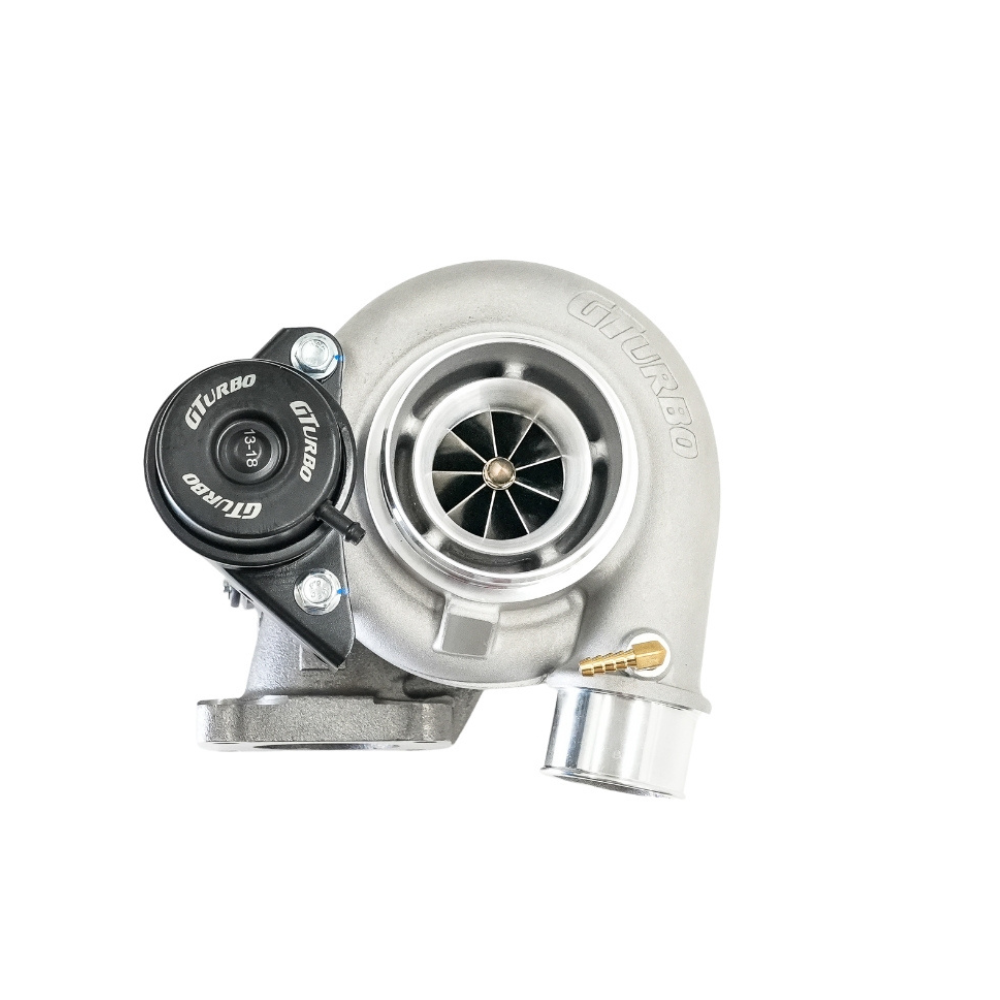
Toyota Landcruiser HD-G333 Titan - GTurbo
Introducing the GTurbo HD-G333 Titan, the latest evolution in turbocharger technology, replacing the renowned HD-G300 Green. Engineered with cutting-edge
 gturbo.com.au
Turbocharger Turbines.
Here is a short history of turbocharger turbines and their performance traits as interpreted by myself. All I can say about the accuracy of this data is it makes sense to me and I follow it with my own hard earned money. If anyone knows better, feel free to correct me. Turbocharger turbines...
That's generation 3. You're running a generation 1. Big gains waiting.
Last edited:
- Thread starter
- #57
This is great! Like I said before - I understand, that there are many other more efficient turbos. But they are for a future projects, since I am pretty much tied on budget and spare time at this moment. I have to be satisfied with my current setup, and I am. My clutch has about 275K km and badly needs to be replaced, so I am buying a complete clutch set from TLC100 1HD-FTE, including a fork. My injection nozzles are pretty old too - also need to be replaced. By the way, regarding nozzles:That's generation 3. You're running a generation 1. Big gains waiting.
If you check the nozzle opening pressure, you will see a difference about 1.5 times. Have you ever seen the plunger section of 1HD-FTE??? It CAN NOT be compared with single 1HD-FT plunger of VE pump, since it is a MULTY plungers head, which has much higher efficiency. Injection nozzles on FTE also have smaller spraying orifices in diameter. So injection pressure differs much. And it is not the matter of the fuel amount! It is a matter of the fuel amount, injected at the optimal time. Other words, FTE can inject the same amount of fuel much faster, than FT. And FTE has better quality of the fuel spraying.There's ~15% difference in fuelling between max torque on a FT and FTE. Injection pressure and plunger size are not the difference.

mine is working quite well and there are lots of OM606 with twin scroll setups at only 3.0L your defiantly right that the small twin-scroll turbine housing are rare and I'm sure more difficult to manufacture. I'm using the 2nd smallest one I could find. No doubt that the larger engines and turbos have larger benefits then the small ones but I do think there are some gains even at this size.Your engine is not big enough to use a twin scroll successfully.
- Thread starter
- #59
I would say, that gains are drastic, at least in my case. I've seen all these nice charts with comparison FTE vs FT long time ago. In reality, my car with twinscroll is faster, than stock FTE and has a better driveability.... I had dozens chances to compare, since a lot of my friends has TLC100 FTE (it is very popular in our region). In city mode, my rpm range 1000-2000 and it is much more comfortable, than with TLC100 1HD-FTE, which has EGR restriction for fueling at these RPMs.I do think there are some gains even at this size.
This is great! Like I said before - I understand, that there are many other more efficient turbos. But they are for a future projects, since I am pretty much tied on budget and spare time at this moment. I have to be satisfied with my current setup, and I am. My clutch has about 275K km and badly needs to be replaced, so I am buying a complete clutch set from TLC100 1HD-FTE, including a fork. My injection nozzles are pretty old too - also need to be replaced. By the way, regarding nozzles:
If you check the nozzle opening pressure, you will see a difference about 1.5 times. Have you ever seen the plunger section of 1HD-FTE??? It CAN NOT be compared with single 1HD-FT plunger of VE pump, since it is a MULTY plungers head, which has much higher efficiency. Injection nozzles on FTE also have smaller spraying orifices in diameter. So injection pressure differs much. And it is not the matter of the fuel amount! It is a matter of the fuel amount, injected at the optimal time. Other words, FTE can inject the same amount of fuel much faster, than FT. And FTE has better quality of the fuel spraying.
View attachment 4046156
For injection pressures and efficiency there's nothing in it. The good mechanical direct injection diesels are within 5% of the best automotive diesels ever. Fancier injection nozzles are to reduce combustion noise and higher injection pressures are to reduce particulate size (required for DPF). Injection pressures are simply set by the nozzle pop open pressure.
Your injection window (crank degrees to inject max fuel) is set by the plunger size in your injection pump.
This is why 30 year old direct injection diesels can get the same or better fuel economy as commonrail diesels. Best point BSFC on all of them is around 200g/kwh. On my Isuzu I went from old worn out nozzles to fully rebuilt nozzles with no difference in power or fuel economy. It did make idle cleaner.
Are you installing higher 5th gear? A mate with the 1HD-FT 80 series found the parts required but I don't know if he's done it yet.
Which model turbo are you using? The WRX IHI is the most common small one I've seen, flange is a complete orphan.mine is working quite well and there are lots of OM606 with twin scroll setups at only 3.0L your defiantly right that the small twin-scroll turbine housing are rare and I'm sure more difficult to manufacture. I'm using the 2nd smallest one I could find. No doubt that the larger engines and turbos have larger benefits then the small ones but I do think there are some gains even at this size.
Most of the OM's get turbos bigger than 1HD engines because it's about drifting instead of pulling. The OM's spin a lot higher.