Charging problems on a 1979 BJ40?

This site may earn a commission from merchant affiliate
links, including eBay, Amazon, Skimlinks, and others.

Joined
Sep 3, 2007
Threads
71
Messages
8,870
Location
New Zealand
I've done over 3000kms in my BJ40 over the last month and my ammeter has suddenly started behaving erratically.

In the last 29 years of ownership, it has never done anything other than "twitch" and it barely moved off the centreline for that!

But now it has begun showing significant charging currents as shown here:
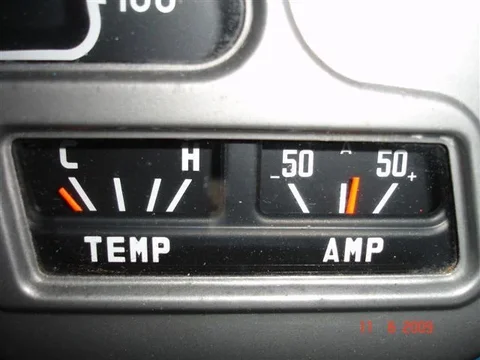
AmmeterCharge.webp

So I'm thinking........What's changed?

And knowing that I've NEVER had any battery-charging problems in my last 29 years of ownership - I have got to assume that this change is bad news (rather than "my ammeter suddenly repairing itself").

But driving along and seeing a positive/charging current doesn't make me overly alarmed. ....... Cos at least the battery must surely be charging - and perhaps better than ever before. Right?

However, that isn't the end of it. Sometimes now my ammeter shows "negative/discharge". Particularly when first started but much more alarmingly - sometimes when I'm cruising along at a good rate of knots!!:mad:. Here...... I photographed it in "discharge mode" too:
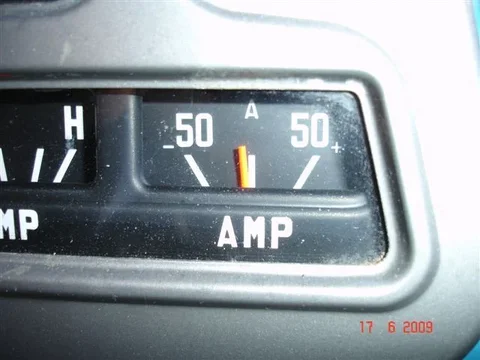
AmmeterDischarge.webp

Now the first time I saw the ammeter in the "discharge mode" was late at night, in a remote part of the country, where the outside air was sub-zero, and where, as well as having my lights on, I had the heater fan and wiper motor getting a work-out too. So you can imagine how my heart missed a beat or two!

There's nothing that destroys the enjoyment of "cruising 40-series-style" than feeling that a breakdown is imminent. - And I was suddenly thinking of being unable to restart my BJ40 next morning due to a flat battery!!!

But the old girl didn't let me down. It let me travel another 1000kms or so over quite a few days to get home without any battery problems. (The needle has always managed to mysteriously move off the "discharge zone"...either back to the "centreline" ....or back into the "charging zone".)

And the ammeter doesn't only show "discharge" when I've got electrical stuff on (such as lights). Sometimes it shows a discharge (same level as in the photo) when NOTHING electrical is turned on at all! :frown:

And now that I'm home I'm trying to find out what's wrong.

So I thought I'd share this "tracking down work". And I welcome any ideas/input anyone has. (Hopefully I will get to the bottom of it!)

:cheers:

PS. It can't be the alternator brushes because I replaced them in 2007 only about 4000kms ago. ($8 at Repco - Revolution Brand from Queensland - Part Number 22-73050 if anyone is interested)
AmmeterCharge.webp
AmmeterDischarge.webp
 
I would like to find out to as mine does the same thing only Im internally regulated,I,ve never had any battery probs in the time after the build that its done this all tests show 13.8 to 14.3 volts so I,ve lived with it.
 
I would like to find out to as mine does the same thing only Im internally regulated,I,ve never had any battery probs in the time after the build that its done this all tests show 13.8 to 14.3 volts so I,ve lived with it.

It certainly is confusing.

But at least you're getting better voltage figures than me.

Yesterday I got out my voltmeter too.

  • My battery voltage read 12.57V (after my vehicle had been sitting 2-3 days).
  • Then I read 13.5V across the terminals on start-up (as soon as I could get out of the cab and under the bonnet which just so happened to be "once the ammeter had come right".) But then this voltage was unable to rise over 14V and would sometime drop lower - to under 13V - particularly if I dropped the idling revvs.
At first (and before these voltage tests) I had suspicions about the "white" fusible link because my ammeter works off the voltage drop across this. And I figured..... If say it had lost a few strands of wire (from corrosion - say) then it may begin to produce a higher voltage drop for any given current flow within itself...................Thus explaining the greater ammeter needle movement (because the ammeter is driven by this voltage-drop).

But this wouldn't explain why my ammeter now occasionally records a "discharge" while I am driving along with nothing electrical turned on to draw any juice at all...

But then this line of thought made me realise that the alternator itself actually gets turned on automatically whenever my ignition key is in the "run" position.. .......So now I'm thinking ....Perhaps the alternator field coils are drawing juice but yet the alternator isn't producing any charging current (while the "discharge current event" is occurring).... ... And this could perhaps explain the appearance of higher "charge currents" too - Because if there are periods when my battery is being drained excessively - then when the charging system "comes right" the semi-flat battery will accept much higher charging currents than in the past (where my battery has always been kept close to "fully-charged").

So latest line-of-thought points me towards either an alternator problem or a regulator problem. (And since I have a new solid-state regulator on hand I'm trying that one first.)

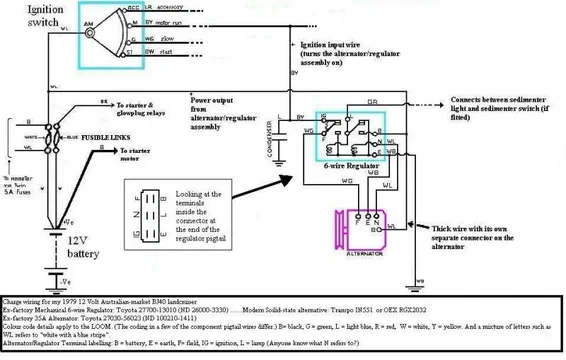
Anyway .... here's a schematic of my charging circuitry (Accurate to the best of my knowledge):

WiringCharging.webp

Oh.... And another symptom of this fault that I've neglected to mention is that the ammeter needle now likes to "twitch for no reason" when I'm driving, almost as though it is reacting to bumps in the road. I can't recall it ever doing this before either. (When it "twitched" before it always had a reason - Such as my hazard lights blinking!)

And another test I did yesterday was to unplug the connector to the alternator's B terminal and put an ammeter in series there. This confirmed that I am still getting charging current from the alternator although it appeared to be lower than I got in a similar test back in Dec 07 (when eveything was working fine). (I can't say exactly what the current is because the biggest scale on my ammeter is 12A and the current is still in excess of that. ... It just that the needle-swing is less rapid now when I briefly complete the circuit through the ammeter.)
WiringCharging.webp
 
Last edited:
Problem solved!!!! Yipeee!!!!

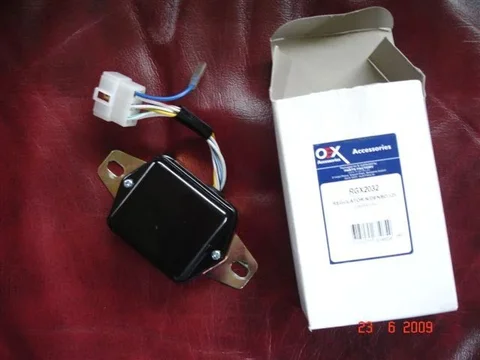
Today I fitted this solid-state regulator:

Alternator 001.webp

It is a simple "plug&play" replacement for the original Toyota 27700-13010 electro-mechanical regulator. I seem to remember it cost me something like $80 or $90 at Ripco.

Hey why doesn't Neil at Roodogs stock these? I'm sure he'd be able to get us a lot better price! After all, companies like OEX in Oz and Transpo in USA seem to be just sticking their own labels on Chinese products. I'll hazard a guess that this here is the chinese source too:

GOOD WAY Automobile Parts Co., Ltd.

Anyway, my battery has been on trickle-charge the last few days, and on removing the charge I measured 13.52V across the terminals.

So with the new regulator fitted and engine just started up I got 13.93V and rising (with no mysterious ammeter needle twitching :)).

Then 14.09 after 5 mins @ fast idle (dropping down to 13.9V at 650rpm - normal idle :)).

Then 14.10V after 15 minutes of idling and really no change on that there-after. (Even after a 1/2 hour test run except it drops to around 14.05 if I reduce the idling rpm to "normal".)

Choice!!!!!!

Now I'm back to having my ammeter needle resting on the "centreline" (zero amps) in almost EVERY situation - just as it has done for the last 29 years of ownership.

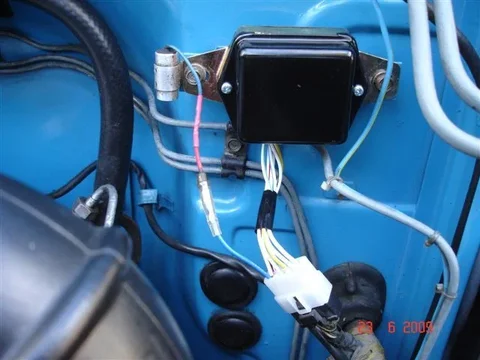
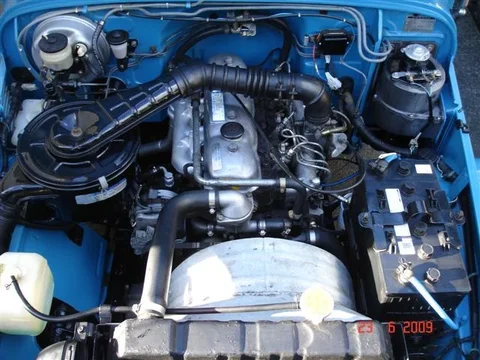
But I hate throwing out parts that have given years of loyal service. Then again, I guess the new solid-state regulator doesn't look toooooo out of place in my engine bay:

Alternator 003.webp

Alternator 002.webp

Hopefully this experience will be of use to others.

It shows you can't trust all you read! Cos I've read "experts" say that "excessive charging voltage" indicates a regulator fault whereas "low charging voltage" indicates an alternator fault. (And this sort of statement isn't helpful/useful here.)

:cheers:
Alternator 001.webp
Alternator 003.webp
Alternator 002.webp
 
I've done lots of Internet searching over the last couple of days. - Mainly trying to relocate a site I found a year or so ago that gave instructions on how to service my original Toyota electro-mechanical regulator. That has been unsuccessful so far :frown:

But I did find a lot of good stuff.

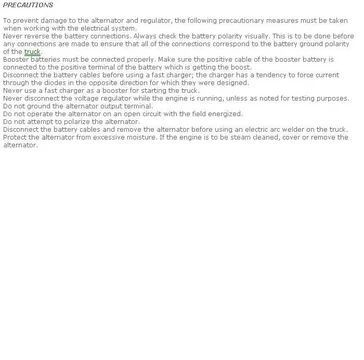
Here's something I found that I thought I should share:

Precautions.webp

:beer:
Precautions.webp
 
Cheers Falco

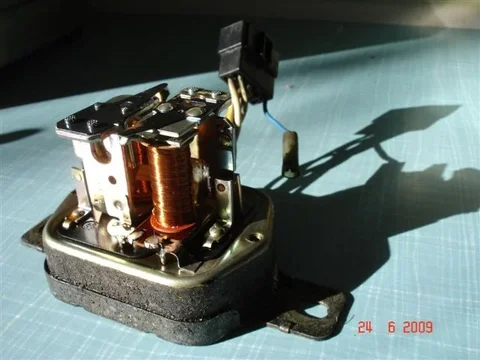
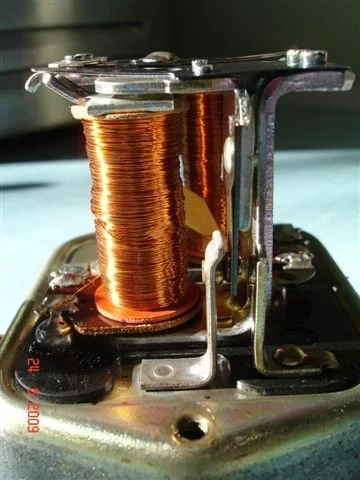
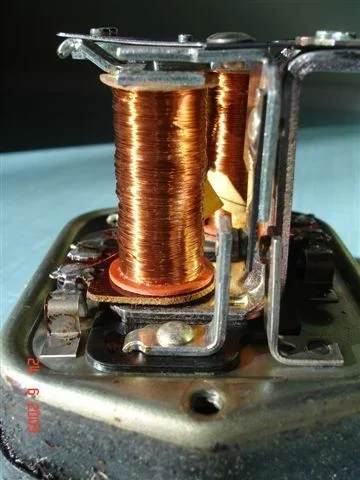
And in memory of the loyal service provided by my OEM regulator, here are a few photos of it:

Regulator1.webp

Regulator2.webp

Regulator3.webp

I think I'll follow Rockcrawler's advice (given in another thread) and carry a spare for the new solid-state regulator. (The workmanship is nowhere-near the standard of the old one and I agree that the new style of construction could lead to overheating issues within it.) ......Although my cruiser has very little in the way of after-market current-drawing accessories to increase the load. But then again - the montrous battery I carry does in itself provide extra load for the alternator (and I think it is responsible for my voltage measurements being lower - during charging - than some others may experience).

:cheers:
Regulator1.webp
Regulator2.webp
Regulator3.webp
 
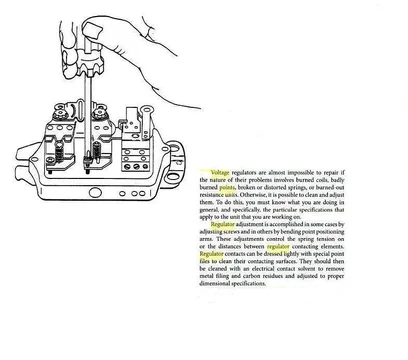
If the old one still works, why not clean the points on it and adjust it back to factory specs? Get another 30+ years out of it!

Well I might be able to get it working properly by doing that Coolerman. And I'm very tempted to try. But I need to find the specifications first.

Do you have the information I require?

I know I stumbled across the "regulator servicing specifications" on the Internet quite some time ago but I can't find that site again now. (I have a feeling it was a USA-based site that sold parts - And to attract people to their site they also supplied "servicing/repair information" there. And the site may have had a "marine" connection too but I'm not certain about that either. It certainly wasn't a Toyota site or a Landcruiser site)

:cheers:

PS. Here is some stuff I gathered in my hours (mainly fruitless hours! :D) of searching:

RegulatatorSettingSpecs1.webp

RegulatatorSettingSpecs2.webp
RegulatatorSettingSpecs1.webp
RegulatatorSettingSpecs2.webp
 
OK. .... So no-one who's viewed this thread so far has the info I need (specifications) for trying to "recondition" my old voltage regulator.

If anyone viewing this thread in the future has these specifications PLEASE DO post it. (Whenever you can.......It WILL be useful to others -besides myself - I'm sure.)

But I suspect the task of getting that old regulator reliable again is probably beyond my capabilities anyway. So for now I'll go with the new-fangled solid-state electronic sh@t and carry a spare (to cope with my mistrust).

But this regulator-replacement-work has got me thinking about that "noise suppression capacitor" too.

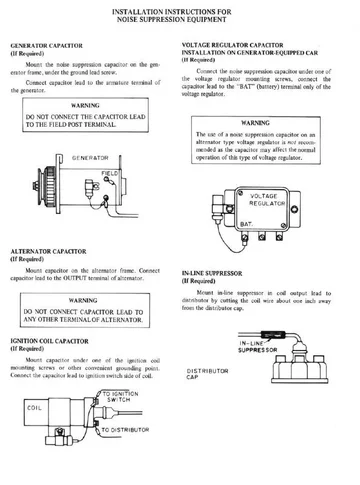
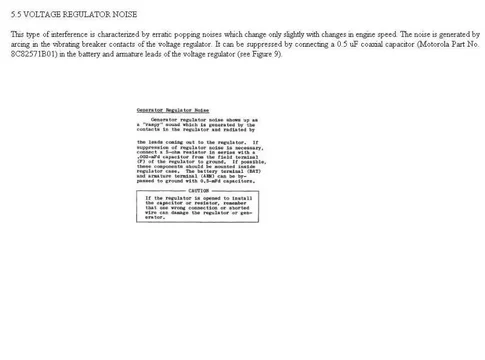
Surely it is there to stop radio interference from the old-style points? So why does the new solid-state regulator have the pigtail for it to connect to? Why don't they have instructions for me to discard this capacitor/condenser?

Searching gives me lots of conflicting (and in some cases mildly-alarming) information.

Here's a sample:

NSCap3.webp

NSCap1.webp


PS. I know that technically a "generator" produces DC current and an "alternator" produces AC current. And I know these names are often used in the wrong context. This just adds to the confusion/fun when searching.

Now I can't remember seeing a noise suppression capacitor/condenser on my alternator. (I'd have a look now but it is raining outside and I can't bear to get rain inside my lovely clean engine-bay Joe :D). So can anyone confirm whether that one on my regulator is OEM or aftermarket? (I can't find such a thing listed in the Toyota Electronic Parts Catalogue.)

And - I'll probably keep one there because one's been there for 30 years (if for no other reason). But I'd like to replace it (because I've replaced the regulator - which makes sense to me anyway even if it doesn't make sense to you :D). There's nothing stamped on it to give its microfarad rating so what size should I go for in a replacement?

Unfortunately I've gone into "rambling mode" again - so I've had to highlight the questions I'd like answered to make them stand-out from the background murmering :D
NSCap3.webp
NSCap1.webp
 
Dealing with Repco down-under

For your amusement, I thought I'd relate my recent dealings with REPCO. (For those of you who live in far-away lands - Repco is probably the down-under equivalent to NAPA - ..I mean "equivalent" as far as what their business aims are supposed to be .. because I bet NAPA achieves those aims far better than Repco does!)

Anyway - the story starts with me approaching my local REPCO store here in New Zealand's capital city - Wellington. I called in on my way to work and asked for "another OEX RGX2032 solid-state voltage regulator". And I was quoted $87 (significantly more than last time I bought one) and told that, because they didn't have one in stock, I must pay a further $10 in freight to transport it from another one of their stores. (This "internal freight charge" may shock you people overseas but I can assure you that it is standard practice for Repco - even though I don't know of any other company here that does it.)

So I left their premises on the understanding that I would return "same time tomorrow" to pick up the part. (We agreed that they would ring me should any problems arise and I gave them my cellphone number and home number for this purpose.)

Meanwhile ...... A search on the Internet revealed REPCO in Thomastown Victoria (Australia) advertising the same item for $40 Australian. (Equivalent to $NZ50 or thereabouts.) ... Damn. Still me-thinks ....."I'd better still buy the one I ordered" (because, after all, they are going to the trouble of getting it in for me).

So next day, since I didn't receive any phone call ..... I went out-of-my-way again to Visit Repco's Wellington store. But I was disappointed on arrival to find that the very same guy who took my order the day before didn't even seem to recognise me ..........And furthermore, when I told him what I was there for .... he simply wandered out the back and disappeared for at least 5 minutes. (I have limited time available on side-trips like this on my way to work - so I was looking at my watch regularly.) When he returned..... He told me (with no explanation or apology) that the part hadn't even left the other store ..... ...... So ...... after hesitating a while (to gain composure) ... I happily told him to "scrub the order" and that "I've found a cheaper source in Australia anyway".

Now it gets even more absurd.......

First some background... New Zealand has a trade agreement with Australia called CER (the letters standing for "Closer Economic Relations"). And our countries are in fact so closely tied, that from time to time we often discuss the possibility (here in NZ) of using Australian currency (and ditching our own NZ currency). And CER should mean that we are "one marketplace". So New Zealand should be treated just like "another Australian state" when it comes to phone orders....... Right?

So putting this to the test with Repco:

As I said ...... I had previously spotted advertising on the Internet from the "Thomastown Repco branch" in Victoria, Australia for an "OEX RGX2032 regulator" at $40.

And since the site didn't cater for Internet sales - I rang them...

I got a friendly-enough greeting and confirmation that the part is actually still in stock. (Yippee!) And I enjoyed hearing the Australian accents - which made me wanna go back there so bad!!! But unfortunately that is where my enjoyment ended.

I dropped the bombshell - "I'm ringing from New Zealand and is it OK if I pay by Mastercard from here and get you to send the item here?" This provoked the instantaneous response of "Awwwwww sorry mate....We caaan't do that! (with the tone of voice reserved for answering "silly questions").

And my response of course was "Why not?"

Well this at least got some hesitation. Then ...."Hang on a minute mate".

When he came back to the phone he had figured out the ideal response to "get rid of this troublesome caller for good".

He told me the regulator (that they advertised on the Internet mind-you) was actually faulty! (Yes faulty.) And that it was definitely "faulty returned-stock" because it showed clear signs of having been bolted in place on a vehicle!

But hey........ What's the point of arguing with someone who clearly "doesn't want your business no matter what"?

So I politely thanked him for his efforts and hung up.

And I've decided (for the time-being at least) to carry my original electro-mechanical regulator as a spare..


:lol: ---- It's just one more of life's funny experiences --- And I thought it was worth sharing...
:beer:
 
Moving on....

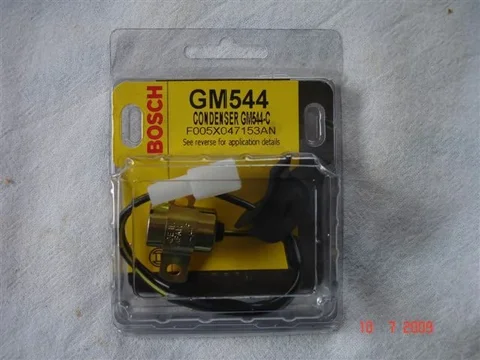
I bought a Bosch GM544 condenser off Trademe for a few bucks. (It's annoying that the automotive industry calls a "capacitor" a "condenser" but I'll stick with their jargon here anyway.)

BoschGM544.webp

I seem to remember the packaging said this condenser was made for a early-80s Ford Econovan (amongst other vehicles) - Probably for use on their "points ignition". ............But I chose it purely because I liked the look of it, it is made in Japan, and it looks like I can easily enlarge the mounting hole to fit one of my regulator mounting-bolts.


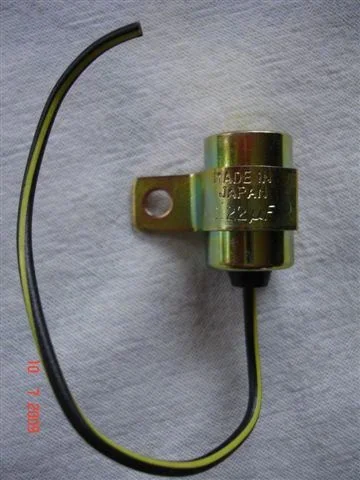
So my first job was cutting the cr#p off and enlarging the mounting hole:

Japan22MF.webp

It just so happens that this condenser is rated at 22 microfarads. (Heaven only knows what the microfarad-rating of the one I'm replacing is. ......But then this is all "witchcraft" anyway - so who cares? And besides - as previously stated - I'm sure I could simply omit having a condenser on this solid-state regulator anyway!)

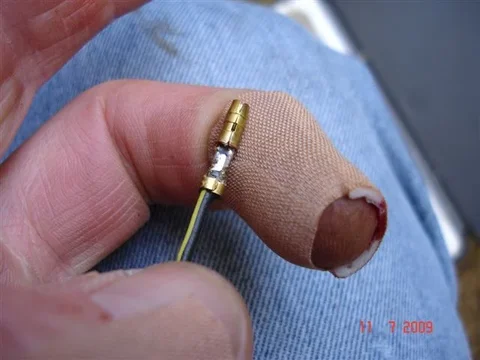
And I crimped-and-soldered the male bullet-connector as per my usual practice:

Selfmutil.webp

Notice that I engaged in a bit of "self-mutilation" that morning too. (Plasters on my digits). :D (It wasn't even cruiser-work either. - And despite the plasters - I still succeeded in getting blood all over my lovely clean engine bay :mad:)
BoschGM544.webp
Japan22MF.webp
Selfmutil.webp
 
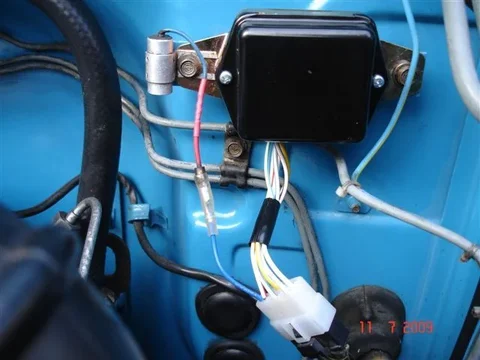
So here is the OEX regulator with the original (OEM?) condenser:

PreBosch.webp

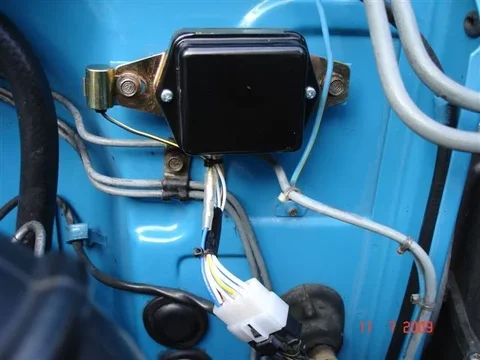
And here it is with the new Bosch condenser (and the wiring tidied a bit):

PostBosch.webp

Which bring me to another thing about my charging system that I need to work on....................

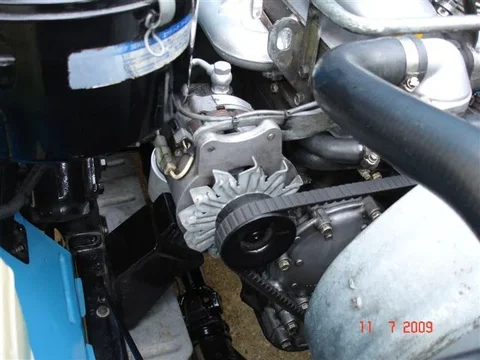
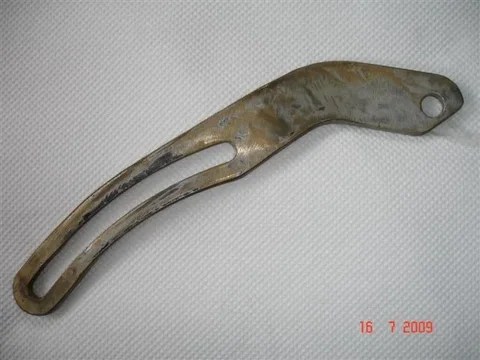
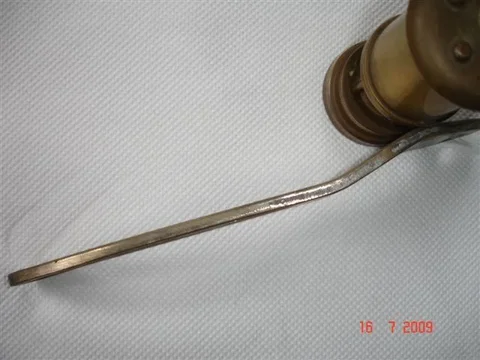
Ever since I bought this vehicle (back in 1981), the lack of proper fan-belt adjustment has been a source of annoyance. Here I'll show you what I mean:

LackOfAdjustment.webp


That belt is practically brand-new yet the alternator is already at adjustment limit! ..... and the vee belt is consequently "too loose".

:cheers:

PS. Fitting a shorter vee-belt is NOT a feasible solution because these belts are only available in certain sizes and the next size down is way-too-short. (Been there - Tried that.) So I'll have to modify the top-bracket to extend the adjustment slot. (Something I've always meant to do - but continued to postpone.)
PreBosch.webp
PostBosch.webp
LackOfAdjustment.webp
 
obsessive compulsive disorder

Yep...as you may have gathered .. these days when something happens to draw my attention to a particular part of my vehicle (like my charging system) ..... I keep on at it till I'm satisfied that I've got the area as good as new (or better) ... .........(but within the limits of my capabilities & finances of course).

And I spoke too soon (on 23 June) when I said my ammeter was "back to normal". .... I've travelled a further 2500kms since then and found that I still get greater ammeter-needle-movement that I've ever experienced in the past.

However the replacement of my old electro-mechanical regulator was still justified because now (with the new solid-state version)the needle never ventures into the "discharge" zone while I'm cruising along and the needle no longer "twitches for no reason" (as though being affected by bumps in the road) at this time either.

But I do get significant negative/discharge needle-swings when "glowing before starting" and when "idling at 650rpm with all my lights on". And I also notice that, while glowing, the needle likes to "waver a little bit" too.

While I feel the "lights on at idle situation" is understandable, why should glowing produce a significant negative/discharge needle swing? (After all - my glow current travels through a different fusible link that isn't even monitored by my ammeter!!!! )

And when I start my vehicle, my ammeter still swings well into the "charge zone" for a few minutes before settling down to "just-above the neutral/centreline mark". (Yeah - I know this is what MOST vehicles should do! But mine never has before!)

This ammeter situation is no longer causing me any alarm - just "mildly-concerning" (on the basis that it has NEVER performed like this in the last 30 odd years).

So I guess I'll put it down to ----- the fault with the old electro-mechanical regulator gave my ammeter a "revv up" which made it start behaving properly for the first time in its life. (Plausable? I'm sceptical! :D)

At least all this investigation/thinking tells me my alternator is performing well. After all, it is rated only at 35 amps and I've just realised its load is considerable when I drive at night.

Headlights = 100 watts (low beam)increasing to 250W if I put the low and high beams on simultaneously which I often do to light the road better.

Stop lights = 42W

Marker/side lights (4) = 20W

Interior/radio/blinkers .... say add another 50 watts

Total: 362W = current draw of 30+ amps compared to the alternator's rating of just 35A!

And since my ammeter never goes into "discharge" (even when I flick my headlights on both beams) it must therefore be putting out its rated 35 amps when the going gets tough. (Lucky I don't have a "boom box stereo" or "electric winch" eh?)

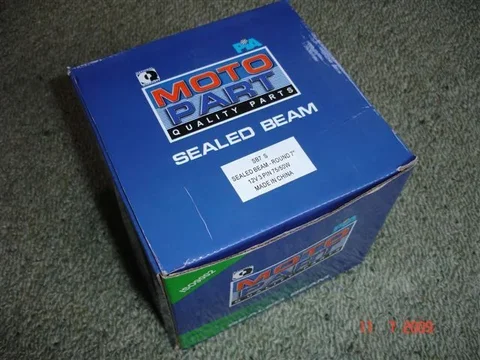
Talking of electrical stuff. Here are the new sealed-beams I just fitted:

MotoPartID.webp

Unlike some folk - I don't shy away from "all goods that come from China". (I couldn't afford to even if I wanted to. :D) Instead I believe that a "quality product" depends more on the "quality standards of the manufacturer" than the "country of origin".

But then again .......the wording on my headlight packaging doesn't exactly inspire my confidence:

MotoPartSwim.webp

WTF!
Off-road and swimming pools only!!!!!!

:cheers:

PS. As you can see - I've wasted most of today on the computer - My excuse = The weather in my workshop is LOUSY!
MotoPartID.webp
MotoPartSwim.webp
 
If anyone viewing this thread in the future has these specifications PLEASE DO post it. (Whenever you can.......It WILL be useful to others -besides myself - I'm sure.)

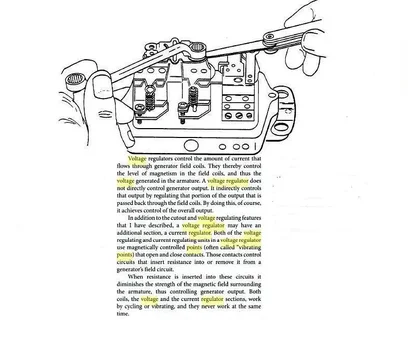
I just bent the arm until the ammeter needle stayed pretty much in the middle with a fully charged battery. Too close and it would read to high. To wide of a gap and it would read low. The ammeter tends to read a little low when all the accessories (lights, wipers, heater fan) are on but I've never come out to a dead battery. I'm running a '79 55amp OEM alternator. 20K miles later I've had no problems but I guess I could be frying my wiring.:eek: Battery is approx 8 years old at this time.
So can anyone confirm whether that one on my regulator is OEM or aftermarket? (I can't find such a thing listed in the Toyota Electronic Parts Catalogue.)

I had one bolted to the side of an ancient external voltage regulator at the firewall (1978). I assumed that, since the new voltage regulator came with a connection for the condenser, it was a stock component. My old school mechanic buddy said it was simply to reduce noise coming thru the AM radio. I've seen them attached to other Toyota vehicles of the same vintage.
 
...I just bent the arm until the ammeter needle stayed pretty much in the middle with a fully charged battery. Too close and it would read to high. To wide of a gap and it would read low.

Thanks numby - this will be useful if I decide to tweak my original regulator to get it to behave better.

...The ammeter tends to read a little low when all the accessories (lights, wipers, heater fan) are on but I've never come out to a dead battery. I'm running a '79 55amp OEM alternator. 20K miles later I've had no problems but I guess I could be frying my wiring.:eek: Battery is approx 8 years old at this time.
Well if you've never had a dead battery and your battery has lasted 8 years - I think your charging system must be pretty darn good. After all, it's keeping your battery charged and the charging current must be low-enough/gentle-enough to make your battery last well too.

... But having said that - I think you should replace your battery automatically (as part of "regular maintenance") well before it reaches the grand old age of 8 years! (I developed a policy of replacing mine before it reaches 6 years old after one collapsed internally while on the road at "7 years old" leaving me with a completely-dead vehicle.)

.....I had one bolted to the side of an ancient external voltage regulator at the firewall (1978). I assumed that, since the new voltage regulator came with a connection for the condenser, it was a stock component. My old school mechanic buddy said it was simply to reduce noise coming thru the AM radio. I've seen them attached to other Toyota vehicles of the same vintage.

Ta... That info is useful to me too.

:beer:
 
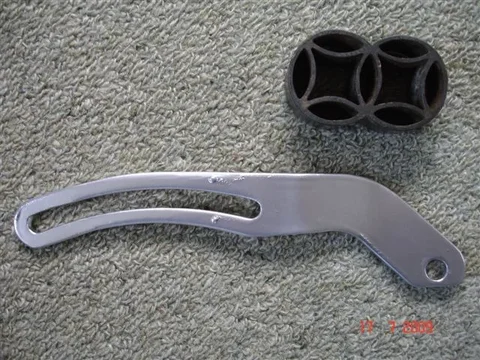
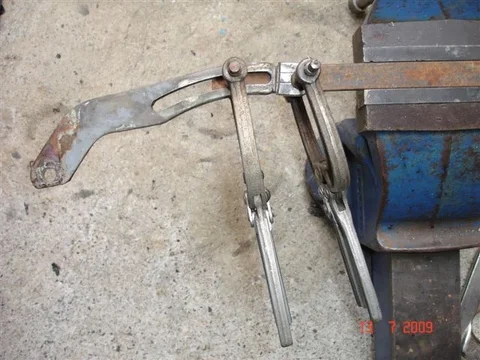
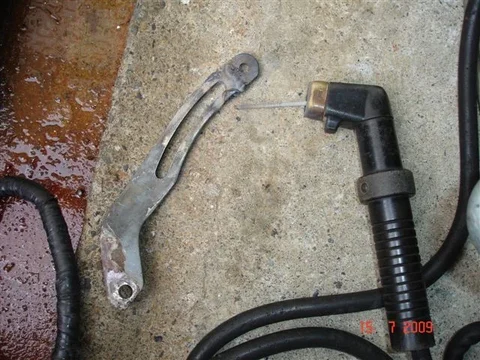
OK. ....This job's not exactly a "biggie" but since I like looking at what others are doing - I'm also assuming others will be interested in my tinkering too. ...........So here's the work done to achieve "proper fan-belt-adjustment capability" for the first time in my vehicle's history. (As mentioned before - the length of the factory-designed adjustment slot is pitifully inadequate.)

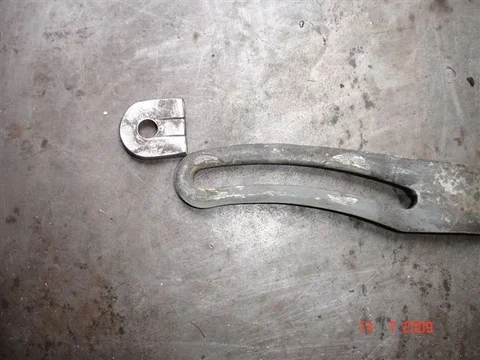
So here is the original bracket (with the adjustment slot) with the "new extension" alongside:

Bracket1.webp

And here they are lined up for welding:

Bracket2.webp

And here is the result:

Bracket3.webp

(While I was welding - I was trying to make sure there were absolutely no low-spots left (at the joint) to end up as "pitting" when I grind/file the excess metal away. So that's why the welding looks a bit heavy-handed)
Bracket1.webp
Bracket2.webp
Bracket3.webp
 
After grinding/filing, cleaning with "Marine Clean" and treating with "Metal Ready:

Bracket4.webp

Just to show it isn't warped:

Bracket5.webp

And after painting (compete with paint runs):

Bracket6.webp
Bracket4.webp
Bracket5.webp
Bracket6.webp
 
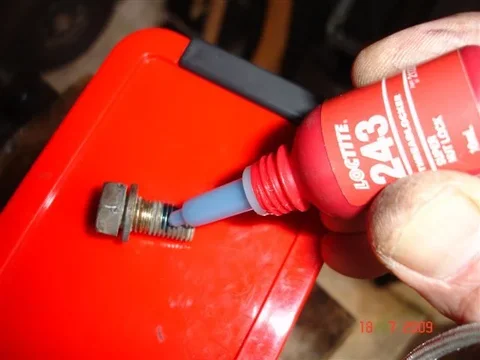
I used loctite on the bolt at the cylinder-head end:

BracketLocktite.webp

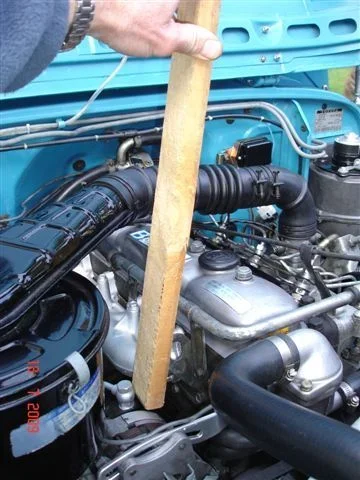
And here's me adjusting the belt to get it at the correct tension:

BracketBeltAdj.webp

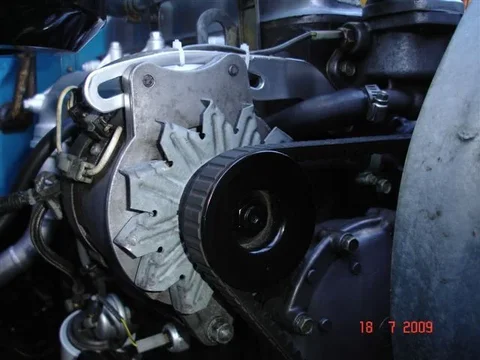
This is the first time I have EVER had the belt correctly tensioned too!!!!

BracketFin.webp

And as you can see, I've now got heaps of adjustment left too. (The slot has now been extended by 26mm.) ----
BracketLocktite.webp
BracketBeltAdj.webp
BracketFin.webp
 
Back
Top Bottom