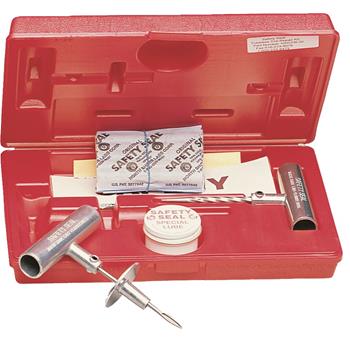
ARB style Tire Repair Kit
Getting a puncture in your tire immediately brings to mind using a jack, lug nuts and quite a bit of effort. But what about using a tire repair kit and saving time & effort and saving your spare in case of total tire destruction? We had just such a moment on the Continental Divide Expedition and thus an excellent chance to review an ARB style Tire Repair kit like you can get from our trusted gear guys Sierra Expeditions .
This is not meant to be a step by step guide but instead to be a review of how this $40 investment can be used by both the able bodied and disabled alike. Also regardless of your physical ability to use a piece of gear it is important to have the proper knowledge so that you can help others with trail repairs.

The first impression is that the carrying case is a bit large but when you see how well it keeps the parts arranged and the sharp bits away from the rest of your gear it isn't so bad after all. Not to mention it has little weight so little impact on your total payload.
Now it is time to play, and as you can see we need to get the cause of our puncture out of the tire, it started as a fishing weight we were thinking. This is the only thing we couldn't use the kit for, but my trusty Leatherman Wave did the trick right way. And Mike got a cool rear view mirror hanger out of his tire damage.

Next we need to move the steel cords inside the tire out of the way, the handle for this is easy to grip with one hand, large enough to get leverage on and a quality tool.

After that you need to place one of the plugs into a different tool and then putting some lube on it. Here is where working with 1 hand could be an issue, not impossible but would require some practice before leaving home.

Also it is important to note that while insertion of the plug can be done with one hand the final step of pulling the tool handle up while holding onto the part that keeps the plug in place is not a one handed job. But if you have a prosthetic that can keep pressure in place you might just be able to make it happen.

Now it should be noted that you can use more than 1 plug in a puncture but please use your common sense, if you can stick your arm through the hole or it is more of a tear then just go ahead and use your spare.

You will notice that I only referred to arm mobility issues, that is because this kit would be easy to use for someone with lower mobility issues or in a wheelchair. Actually it would be easier to use this kit that change a tire for someone with lower mobility issues. All in all I think it would be a shame to not have this kit in your rig and the $40 would be small change compared to the hassle of getting a puncture in your spare not long after you change to it and still ending up stranded.
Getting a puncture in your tire immediately brings to mind using a jack, lug nuts and quite a bit of effort. But what about using a tire repair kit and saving time & effort and saving your spare in case of total tire destruction? We had just such a moment on the Continental Divide Expedition and thus an excellent chance to review an ARB style Tire Repair kit like you can get from our trusted gear guys Sierra Expeditions .
This is not meant to be a step by step guide but instead to be a review of how this $40 investment can be used by both the able bodied and disabled alike. Also regardless of your physical ability to use a piece of gear it is important to have the proper knowledge so that you can help others with trail repairs.
The first impression is that the carrying case is a bit large but when you see how well it keeps the parts arranged and the sharp bits away from the rest of your gear it isn't so bad after all. Not to mention it has little weight so little impact on your total payload.
Now it is time to play, and as you can see we need to get the cause of our puncture out of the tire, it started as a fishing weight we were thinking. This is the only thing we couldn't use the kit for, but my trusty Leatherman Wave did the trick right way. And Mike got a cool rear view mirror hanger out of his tire damage.
Next we need to move the steel cords inside the tire out of the way, the handle for this is easy to grip with one hand, large enough to get leverage on and a quality tool.
After that you need to place one of the plugs into a different tool and then putting some lube on it. Here is where working with 1 hand could be an issue, not impossible but would require some practice before leaving home.
Also it is important to note that while insertion of the plug can be done with one hand the final step of pulling the tool handle up while holding onto the part that keeps the plug in place is not a one handed job. But if you have a prosthetic that can keep pressure in place you might just be able to make it happen.
Now it should be noted that you can use more than 1 plug in a puncture but please use your common sense, if you can stick your arm through the hole or it is more of a tear then just go ahead and use your spare.
You will notice that I only referred to arm mobility issues, that is because this kit would be easy to use for someone with lower mobility issues or in a wheelchair. Actually it would be easier to use this kit that change a tire for someone with lower mobility issues. All in all I think it would be a shame to not have this kit in your rig and the $40 would be small change compared to the hassle of getting a puncture in your spare not long after you change to it and still ending up stranded.