Surepower Batery Isolator Installation Question

This site may earn a commission from merchant affiliate
links, including eBay, Amazon, Skimlinks, and others.

Joined
Apr 14, 2008
Threads
367
Messages
5,754
Location
North of LA California
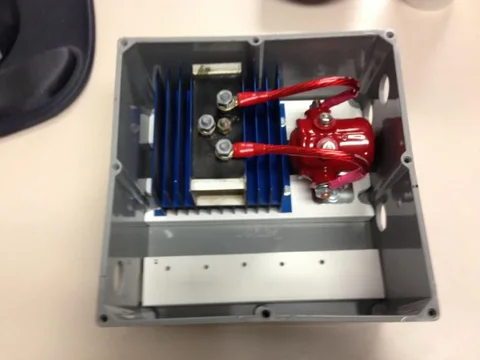
I picked up a Surepower 95A Battery Isolator in a Junk Yard last year. I am finally getting around to building the bracket to holding it in the engine bay so its time to get dual batteries wired up.

Here's the unit:
[URL="http://i82.photobucket.com/albums/j251/bambihunter/Untitled_zps8ce7edfd.jpg"][/URL]
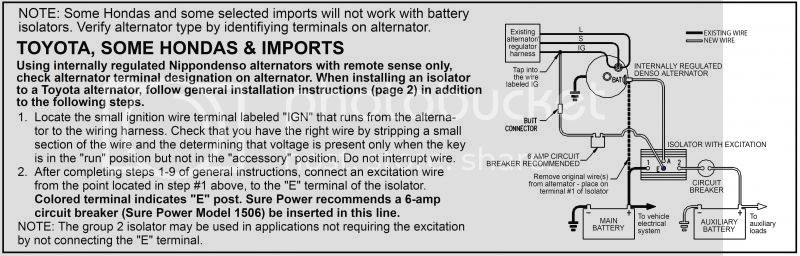
I understand you need to connect the alternator and two batteries to the isolator.

What is the fourth wire for? And where do I locate it on a 88 FJ62?

From what I gather the isolator is like a check valve; it allows the alternator to charge either battery without them seeing eachother. I took one mechatronics course 7 years ago and from that I gather the isolator is just two large diodes.

So back to my question: Why do I need this exciter fourth wire connected? Does it tell the isolator when to turn on? And which wire is it asking me to connect to on the cruiser?
 
If I remember right, and it's been a while, the Surepower is an active (MOSFET) device.
So it has a bit of 'intelligence' to its charging scheme. And it uses external power to do so.

From the directions, it looks like any 'hot in run' wire would work.

If the isolator used just diodes, it'd have a drop across it of something like half a volt. Doesn't SEEM
like much, but the difference between 12.6v and 12.1v is huge to a battery.

hth

t
 
That makes sense regarding the Diodes and voltage drop.

For the fourth hot wire. I assume it is best to run it to ignition so that the isolator only activates when the truck is on? Isn't that the whole point of the fourth wire?
 
Once I get this all installed I'm looking to add voltmeters for both batteries.

I've been looking at pillar gauge pods and was thinking I could install two voltmeter gauges and one ammeter gauge for the alternator output. This would allow me to know the condition of the two batteries and the condition of the alternator at a glance.

Has anyone done this?
 
The Sure Power isolators don't work with the stock Land Cruiser alternators. As mentioned, the diodes reduce the charge voltage to the batteries causing them to fail early. You'd be lucky to get 2 years out of a set. Our alternators use internal sense voltage and there is no way to trick it with the small 4th pole on the isolator.

Sell your Sure Power and get either a solid state switch (Hellroaring Technologies, Direct Power) or a constant duty solenoid (Painless).

Sorry to be the bearer of bad news.
 
I read up on the isolator and the model I pulled from the junk yard says specifically that it is for Toyota internally regulated alternators...

The Isolator has 4 studs; battery 1, battery 2, alternator, and exciter (E). The fourth exciter stud accounts for internally regulated alternators.

hmm.
 
This isnt directly related to this type of isolator, But i run a sidewinder isolator, it only requires the positive terminals of each battery connected to it, Which are connected in parallel unless the voltage of either batteries drops below 12.7 V, in which case the solenoid opens, so if i run the auxilary battery down overnight running a fridge, etc, the main battery wont be dragged down with it.
As soon as the isolator senses voltage above 13.2 V it closes so both batteries receive charge.
The thing i like about this isolator is that it has an optional voltage meter with an override switch that i mounted on the dash. The override switch comes in handy for cold cranking, and would be great for heavy winching.
Something to think about maybe? as having twice the amps available by having them connected in parallel, in my opinion is better than having them never "see each other"
I can post some photos later.
Cheers
 
Last edited:
Assuming that there are MOSFET's in it, what you've got is a solid state relay able to connect both batteries to the alternator when the key is on. With the key off they're both disconnected from each other and the alternator. Like any relay it just needs a signal to tell it to turn on. Any IGN hot wire can do this, just be careful that your choice isn't hot when in the "ACC" unless you want them to be combined then.
 
Thanks for the link Coyote. I was looking at their main website yesterday and couldn't find a price until you posted.

ntsqd,
I am not sure they ever get "connected together". I am assuming they only see the alternator charge. Here is a link to the Isolator:
http://www.waytekwire.com/item/80066/

Thanks for the confirmation regarding the Excitor wire. That should be easy to wire in. The last part is figuring out how to wire it to the alternator as the alternator diagram in the FSM was not helpful for me.

Seemus,
I like the idea of an override switch that would allow for cold cranking and winching.

I have a marine battery switch I got free from a friend. I am trying to integrate that as the override and I haven't figured out the wiring or if its even a good idea yet.
http://bluewatermarinesvc.com/html/bat_switch.html

Any Ideas on how to use the isolator and battery switch? Any diagrams or schematics on the iterwebs showing this?
 
If it has no diodes or diode-like function within then when it is "turned on" it essentially connects all three large terminals together.

Was it me I'd sell that off and go with a dual sensing version of a Voltage Sensing Relay / Automatic Charge Relay (VSR/ACR) and wire it in parallel with your battery switch. I'm sure if you noodle on it long enough that you can figure out a wiring schematic that will work, but a VSR/ACR will be a simple to wire proposition. One wire from it's two large studs to each of the switch's battery studs, and a wire to ground.

By using a dual sensing ACR/VSR it doesn't matter which is your primary and which is your secondary battery. If you also add solar to the aux battery at some later date then once it is charged the ACR/VSR will close and allow the solar to charge the starting battery too.

I realize that its bird in hand, but when that starts to compromise simplicity and robustness.....
 
From their website:
"Battery Isolators act as a check valve between the batteries and the alternator, allowing current to only flow in one direction, from the alternator to the batteries. "

http://www.waytekwire.com/products/1347/Battery-Isolators/

From this I can assume that the batteries never see each other and never come in contact with each other while charging. Since I have this isolator in hand I am going to give it a try. If I was starting from scratch I would probably go the VSR direction. We'll see.

So the only question remaining is what wire from the alternator do I connect to the Isolator?
 
the big one

Sometimes the simple answers are the best ones. Thanks for all the info. I'll get to this after thanksgiving and post my install.
 
That is waytech's site, not Surepower's site. Waytech is being generic and what they say is very specific to diode type isolators, but does not apply to every other type of battery separator. I'm not saying that what they say is incorrect, just that given the small terminal stud and it requiring a IGN-On source connected to it I'm doubting that you've got a purely diode type battery isolator as those are purely passive.

I don't think this is an affected model number, but Surepower did have a recall that should be looked into.
 
That is waytech's site, not Surepower's site. Waytech is being generic and what they say is very specific to diode type isolators, but does not apply to every other type of battery separator. I'm not saying that what they say is incorrect, just that given the small terminal stud and it requiring a IGN-On source connected to it I'm doubting that you've got a purely diode type battery isolator as those are purely passive.

I don't think this is an affected model number, but Surepower did have a recall that should be looked into.

Sure Power had a recall on a battery separator that ARB used. This isolator does not have a recall.

Maybe I'll email Sure Power and try to get an answer of the workings of the Isolator. I do not like that they don't explain the operation of the Isolator better.
 
Randy,

I tried to use the same Sure Power isolator: 95 Amp, Model: 9523A. The packaging says it's specially made for Toyota internally regulated alternators.

It won't work properly.

I spent a lot of time trying to do on a 60 what you are trying to do on a 62. (Looking at the wiring diagrams for both the 60 and 62's shows the external wiring is the same.) I spoke to Sure Power's tech reps. I even called several times to ensure I got a different tech to confirm. Same advice. The Land Cruiser's alternators are not the 'special type' that work with the isolator.

What happens is that the voltage regulator is measuring the alternator's output voltage to give a correct 13.7 v charge to the system. The sensing location is INSIDE the alternator. Sure Power uses diodes to isolate the batteries. The diodes cause a voltage drop before the 13.7 v makes it to the batteries. If you could move the sense voltage wire to measure voltage at the battery, it would work.

Undervolting batteries drastically shortens their lives. They'll never get a full charge. You'll get 2 years tops. Loosing money on the Sure Power will suck but its not nearly as expensive as buying 2 new batteries every other year.


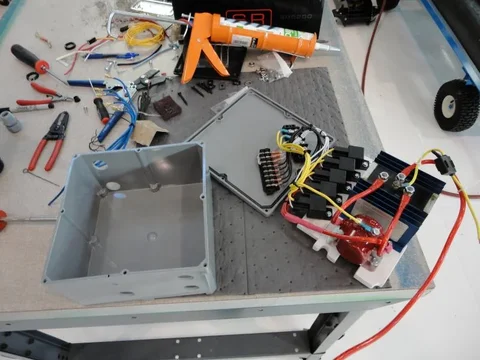
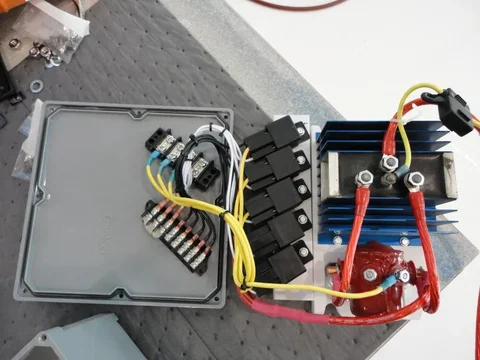
Here's the system I built and discarded because it doesn't work.

Mud 1001.webp

Mud 1002.webp

Mud 1003.webp

FWIW - If you decide to procede with your installation:

The A post goes to your alternator (make sure to fuse this if you add a whole new wire thereby bypassing the stock fuseable links).
The 1 post goes to your 1st battery.
The 2 post goes to your 2nd battery.
The E post requires +12V coming from the ignition 'On' switch. You have to add it to the system. It is necessary to 'excite' the alternator field so it can start charging. Without it the alternator won't charge. The +12 v is normally provided by the large white charge wire but, since the diodes deny backflow of current from the batteries you have to add a new source.

I added a solenoid between the 1 and 2 batteries with a switch in the dash. The solenoid is usually open allowing the isolator to isolate the batteries with internal diodes. Flipping the dash switch shorts the two batteries together and will 'self' jump start the vehicle. The solenoid provides a handy platform to wire in both the 2 ga main battery feeds and the 8 ga charge wires from the isolator.

It's a fairly simple installaion that almost works - EXCEPT IT WILL RUIN YOUR BATTERIES.

I replaced the Sure Power with a Hellroaring Technologies MOFSET solid state switch and love it. It doesn't require any splicing or mods to the stock wire loom either.

Mud 1001.webp


Mud 1002.webp


Mud 1003.webp
 
Last edited:
Juggernaught,
Thank you for sharing your attempt to use the Isolator. I'll put it aside and get a VSR then. My friend Manuchao has the VSR and it works great so I'll copy cat that setup.

ntsqd,
Looks like your advice was spot on.

Thanks for all the input.

/end thread
 
I am not familiar with this particular unit so take this with a grain of salt.... but. if they are truly diodes that separate the batteries form the alternator, the alternator has nothing to excite it to make current. Once it starts and is running, it will provide the voltage to excite itself. Before that happens it will spin with no output.

My guess is this provide the excitation for the alternator to get it generating any output.


And BTW perfect switch makes the lowest drop isolator I have found. 50 mV at 100 to 300 amp draw depending on model. I do not have any financial interest ins this company.
 
Back
Top Bottom