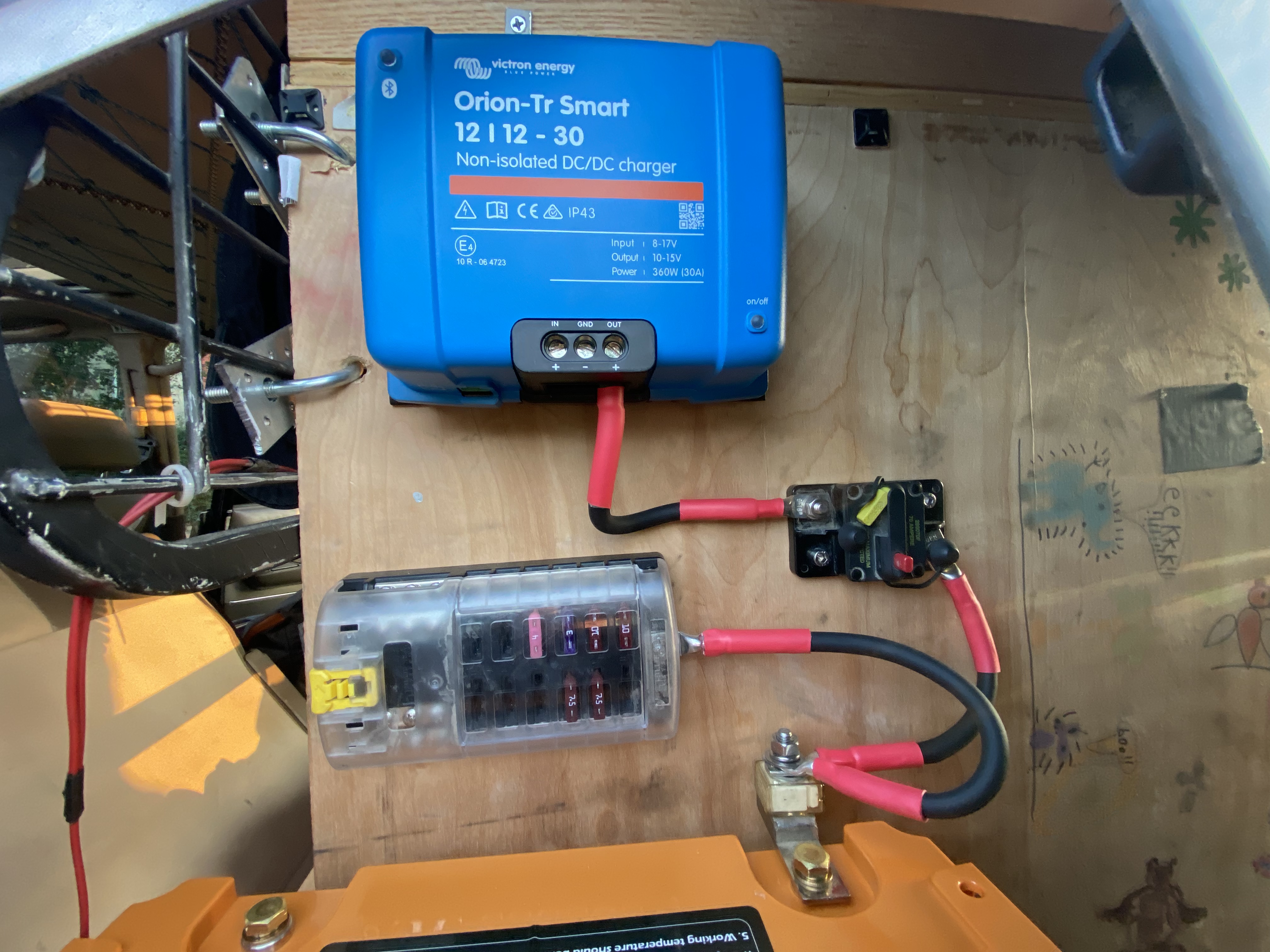
well, I ended up getting a Victron Orion for some battery tests I want to do. High quality build, as usual for Victron. Feels very solid.
One disappointment is that the V Connect app does not show the currents in or out. Maybe there is no current sensor in there. And no data logged either that I can see.
If anybody knows about those, is it OK to connect it to an ignition controlled input as in zero Volts when the ignition is off and full battery voltage when on? There is an input voltage lockout setting but that is probably intended for bad batteries and it's not clear what happens if the voltage goes below that. Or IOW, is the unit intended to be always connected to a hot battery on the input line, or will it not matter if the input goes to zero when ignition is off?
This is the exact scenario I have been doing for a couple of years now. I have a Victron Orion 12/24-15 to charge my Goal Zero Yeti 1500X right from the starter battery. I have not seen any problem connecting and disconnecting the Orion to the battery source which we often do when camping. I try and remember to turn the unit off before doing so, however.
We have our Orion set to Power Supply and leave it connected for the duration of our trip while driving letting the Orion stop and restart on its own as we stop and restart the engine. I might not be reading your post as you intended but it sounds like you’re also asking about how to set the lock-out and restart voltages.
These settings are for the safe use with your battery – they’re not necessary related to “bad” batteries. What you want is the Orion to turn on when the vehicle is running and to shut off immediately or within seconds after you turn the vehicle off. So I take a few measurements before we head out on a trip.
The charging and at-rest battery voltages are a bit interesting as they will vary by season (temperature), whether the engine is running and YOUR battery. I have the stock Toyota OEM battery as the starter and an AGM charged by a
Redarc BCDC as my 2nd battery. The voltages are very different between the 2 batteries. Speaking specifically about the starter battery, voltages will be higher initially from the alternator when you first start and more so when it’s cold and lower on the battery when the engine is off, again more so when it’s cold. The alternator is a temperature sensing unit.
So I do the following seasonally:
- Let the vehicle sit overnight and measure the battery voltage with the engine off. This is your floor voltage. It will be lower in colder weather. You never want to draw you battery down below this voltage.
- Connect the voltage leads to the battery and start the vehicle noting the highest voltage immediately after starting. The alternator is at its peak voltage as it tries to top off the battery. As I mentioned, it will be higher in colder temperatures but will drop off as the battery charges. This is your ceiling voltage. This is mainly for info only and gives you a value to never exceed in your Victron settings.
- Measure the battery voltage with the engine running after running 10-20 minutes. I try to run an errand and measure the voltage in the parking lot of wherever I’m at LOL. This voltage will certainly be in-between your floor and your ceiling. I call this the running voltage. It always has been for me.
There is a 4th voltage you can get if you’re over-analytical like me and that’s the battery voltage immediately after you turn off the engine. It will be above the floor voltage but not my much, in my experience.
By now you should have a nice warm fuzzy feeling as to how your electrical system is performing. So I set my Victron voltages at or just above the floor voltage (#1) and just below the running voltage (#3).
The actual voltages I have right now in my Orion with an OEM Toyota Lead Acid battery and alternator are as follows:
- Lock-out value: 12.3V
- Restart value: 13.2V.
The Orion turns off literally within seconds after I stop the engine. It’s what I want, it works really great.





 C converters for LED lighting applications and nailing down a realistic input voltage range and output voltage is the first step. Then agreeing to what the maximum output current will be and if it needs to be adjustable. You end up with combinations that can't be achieve without lots of expensive components (and size) for cases that may never be used. Then you need to worry about protecting the circuitry from situations that go beyond the power handling. i.e., the DC


