Gross Vehicle Weight

This site may earn a commission from merchant affiliate
links, including eBay, Amazon, Skimlinks, and others.

Joined
Apr 24, 2015
Threads
3
Messages
10
Location
Karachi
I have a 2005 VX Limited LC.
1. The Gross Vehicle weight mentioned is 2,940 kg (the Net Vehicle weight is 2,480 kg). It says the Payload is 350 kg. Does this mean that I can only load up upto 350 kg? If there are 5 persons in the car it comes to around 300kg in itself- not to mention fuel, water, baggage, etc. Can someone please advise me exactly how much I can actually load up for an overlanding journey?
2. How can I find out the true MAXIMUM Axle load? Is there something on the axle itself?
Many thanks. Dinshaw
 
The 350kg payload is indeed a strange term/rating because of the reasons you've mentioned. I would go with GVWR (or GVM: Gross Vehicle Mass) minus Curb weight to get load capacity (passengers and cargo). Curb weight already includes a full tank of fuel. If you add an aux tank, that tank and its contents are counted as cargo weight. I have not seen Toyota specify an actual axle capacity.

You can increase the the GVWR by simply upgrading the suspension. I don't know if you are looking for a an exact GVWR for your own design purposes or if you need pass/satisfy an inspection. In the US, nobody cares about an engineering certificate because nobody checks the weight of passenger cars. In Australia, they do... and some companies like ARB will provide documentation/certification of such... unfortunately, not for the 100 series. Maybe some of our Australian members can chime in.

http://www.oldmanemu.com.au/products/gvm-upgrades/
 
On UK vehicles the plate in the engine bay has 2 extra lines on it which give the max axle weights. It is also in the handbook (UK version at least). For my DIESEL truck (may be different to your GAS truck) my maximum axle weights add up to more than the GVW....but UK law says I can only go up to GVW and I am not allowed to overload any one axle either

100 Amazon
Front Axle 1630 (max axle weight)
Rear Axle 1950
Kerb 2320 (I don't trust this figure)
GVW 3260

The figures may be different for US models/Gas engined
 
Upgrading suspension is one key aspect BUT so may be the ability to stop the vehicle. MY handbook says I can go 100kg OVER GVW but due to compromises the max speed has to be reduced to 60 mph......this is the stopping distance/braking issue.

100 series payload is one of its weakest features....I'm stripping loads of weight off mine for that very reason
 
Wow. I would have thought the payload rating on a 100 series would be larger than the 80 series. I think the payload rating in NA for my 97 LX is 535 kgs (1155 bs).
 
Dear All, truly appreciate your feedback.

I assume Kerb weight is the same as Net Vehicle weight?
My plate has a line which says "axle weight" but there is nothing else- it's left blank.
It's very hard to communicate with Toyota on these technical points and my problem is that this is a Japanese model and the manual is all in japanese. (Trying to get someone to translate sections of it though= will check if there is a section on weight)
For now, if I were to deduct the GVW from the NVW, it gives me a total of 460 kg (not 350kg)- so at least that's something better.

Will try to get the axle loading weights somehow, as that will tell me how much the two axles can take - even with upgraded suspensions, etc.

If you'll do get any other information, would appreciate any further input. Many many thanks.
Dinshaw
 
Not sure where you are located, but as Hedgepig mentioned, speaking from a legal perspective, you cannot exceed the GVWR despite what the axle ratings might be. Changing your suspension will not increase the axle ratings or GVWR. Aside from potential legal repercussions, exceeding the axle ratings and/or GVWR will likely induce premature failure on all kinds of suspension, body, frame components over time depending on your speed and the road conditions on which you drive.
 
Dear All, truly appreciate your feedback.

I assume Kerb weight is the same as Net Vehicle weight?
My plate has a line which says "axle weight" but there is nothing else- it's left blank.
It's very hard to communicate with Toyota on these technical points and my problem is that this is a Japanese model and the manual is all in japanese. (Trying to get someone to translate sections of it though= will check if there is a section on weight)
For now, if I were to deduct the GVW from the NVW, it gives me a total of 460 kg (not 350kg)- so at least that's something better.

Will try to get the axle loading weights somehow, as that will tell me how much the two axles can take - even with upgraded suspensions, etc.

If you'll do get any other information, would appreciate any further input. Many many thanks.
Dinshaw

Just thinking about your Japanese dilemma.....probably UK RH drive is quite close for most things.....it may be easier to get a UK set of manuals??
 
...Changing your suspension will not increase the axle ratings or GVWR. Aside from potential legal repercussions, exceeding the axle ratings and/or GVWR will likely induce premature failure on all kinds of suspension, body, frame components over time depending on your speed and the road conditions on which you drive.
What you can safely carry vs what you can legally carry are different, obviously. Being compliant to local laws depends on the individual and the countries they are visiting. Staying under manufacturers GVWR is safest to do. /Thread

In Australia, with just a change in suspension by a certified installer (no brake, frame, drivetrain upgrades), you can increase GVWR by ~100-250kg, compliant to Australian Design Rules (ADR). Leaf sprung vehicles get upgraded up to 500kg over manufacturers GVWR. These are big name companies like ARB and IRONMAN too. In all cases, upgraded GVWR does not exceed axle ratings.

I agree, brakes are a factor in GVWR but the limiting factor of most modern trucks/SUVs is the suspension. There are lots of vehicles in Australia traveling countless km's over corrugated roads at or slightly over the standard GVWR and most vehicles are still sound after all these years. Certain parts will wear/fail sooner but it is not as catastrophic as you say.

In the US, if you look closely at the Ford F250 vs F350 and the GM 2500 vs 3500's, the difference in GVWR is often a difference in just suspension. Since nobody checks weight for non-commercial vehicles in the US, many folks will purchase the F250 or 2500 and then upgrade the suspension.... saves them on yearly registration fees.

Some companies offering the GVM upgrade and details about what the upgrade includes:

http://www.lovellsauto.com.au/product12d.php
http://www.westcoastsuspension.com.au/toyota-200-series-3800kg-gvm-upgrade/
http://www.arb.com.au/products/old-man-emu-4x4-suspension/gvm-upgrades/
http://www.powertune4x4.com.au/index.php?main_page=index&cPath=326_328

 
This is very interesting. The West Coast Solutions site indicates that for the LC200 series, the GVWR can be increased by 500 kgs. They also state that they are an authorized dealer and installer of kits approved by the Dept of Transport under design approval number M148WA, yet this kit may not be approved in other states. Do you know why that is? Assuming that the Dept of Transport is a federal body, I find that strange that different states have different rules. The ARB site states that any kit approved IAW the ADR are legal in all states.
The key is not exceeding the axle ratings. Even with with upgraded suspensions, the axle ratings are not exceeded. They are playing with the delta between the combined axle ratings, which usually exceed the GVWR, and the published GVWR. What do the OEMs have to say about this practice in Australia?
Structural part failures will be dependant on the cycling and loading they see. To really determine the effects, you either have to do real world testing or run complex modelling programs that only the OEMs can afford to do. I'm not disputing that many vehicles are running around in Australia without issue when they have exceeded the published GVWR, but failures are real. For example, they are many reports of cracks on the outer frame rail of 80 series LCs where the steering box is mounted. This is due to the larger tires people install on their vehicle. There are also plenty of birf failures as well. There are also reports of steering sector shafts failing, and cracks in the C pillar on vehicles who have large loads mounted to the roof.
 
My understanding, there are a few ways to get the GVM upgrade. The slam dunk method is to get an "all state approved" GVM upgrade (which is on the conservative side) and to have it fitted prior to first registration (brand new vehicle). You get a new GVM plate that pretty much replaces the factory one. The vehicle can be re-registered in any State in the future. Many States will accept a GVM upgrade on a used vehicle but the process is more involved.

I believe, companies like Lovell have offered these upgrades, long before ARB and only complied with local States. The problem is, the vehicle can only be sold and registered in the same State (or one that recognizes the certification).

As a former 80 owner, I have heard about the c-pillar cracks. Toyota must've made improvements since then. The LC100 has a rated roof capacity of 200kg total in Australia and I have not heard of any cracks. As for tires, many States in Australia restrict diameter increases to 15mm! Any larger requires an engineers certification... and generally, the maximum is 50mm over standard (33's).

As for warranty,

"Vehicle warranty is not affected when a GVM Upgrade is fitted. Testing and analysis procedures are stringent and undertaken by an accredited Automotive Engineering Consultant to ensure original equipment components are not compromised. Modifications and load limits are within theoretical service/safety factors to ensure the integrity and longevity of OE parts associated with increasing the vehicles load carrying capabilities. Therefore, should an original equipment component fail and be directly attributed/caused by the vehicle carrying loads to a maximum GVM or part failure associated with the GVM Upgrade modification, the manufacturer of the GVM will cover warranty of the component after written proof and testing by an independent body has been lodged. This clause relates to all components, barring the clutch assembly in manual transmission variants. Therefore, the clutch, pressure plate or associated clutch parts, will not be covered by warranty under this clause or Authority.

A vehicle that carries weight or loads in excess of the manufacturers GVM or a vehicle that has had an increase in its ride height will have “accelerated” wear and tear on its driveline components. The above warranty does not cover any components that have failed due to what is deemed “standard” wear and tear on a vehicle with increased ride height and weight carrying abilities. As a general rule the percentage increase in your GVM is equivalent to the percentage increase in accelerated wear and tear. For example a dual cab Toyota Hilux has an approx. 19% increase in GVM to 3300kg therefore you would expect to see a 19% increase in the wear and tear on your driveline components."
 
I'm in the process of increasing the GVM in my LC105 here in Western Australia. My engineer told me it would be possible to increase the GVM by maximum ~400kg. He also stated that whatever approval we get for increase in GVM - the same amount would have to come off the Gross Cumulative Mass (GVM + Towing Capacity).

My LC105 has a GVM of 3180kg so I'm looking to get to 3500+ as I think my kerb weight will be close to 3200kg when done (due to tanks and bar work etc). I'm sure I will have more information once I get to the weigh bridge and have had the modifications approved by the engineer.

 
Picked up some tiles a few days back. Very impressed with how the vehicle was able to handle the weight. While loading my tiles they also had a similar load put in the rear of a Tacoma pick-up and it must have dropped a good three inches. These tiles weigh 800lbs!
image.webp

image.webp
 
Last edited:
I'm pretty certain that increasing load carrying capacity by upgrading the spring/shock is NOT the same as increasing GVWR. That number is not regulatory-body (NHTSA in the USA) enforced, but rather the weight at which the manufacturer typically runs all durability tests. Sure, if you do, the results will likely not be catastrophic, but for a vehicle that is operated in extreme conditions in remote areas , I'd certainly refrain from exceeding GVW personally. I know that the US OEMs use 90% of GVWR to determine loading on the various components, and that is ultimately the loading at which they will have the longest life.

Bigger tire diameters and wider tires will also *dramatically* increase loading on all the driveline and chassis/suspension components. This obviously has a compounding effect when GVW is exceeded. Also add the fact that most vehicles in enthusiast hands are already well past the typical design intent life of 100k miles.

On the flip side, both 100 and 200 series look to have VERY beefy components in most of the problem areas, and the anecdotal evidence appears to support this as well. I would suggest a very cautious approach to load a vehicle more heavily than GVWR and also to drive conservatively when doing so. Me personally, I am trying hard to optimize what I bolt on to the truck, and the equipment that I carry. I would also be looking at de-contenting the base vehicle to increase payload capacity. You can drop 150lbs from a 100 series without trying too hard.

Also, to answer OP question, here are the numbers from a 2004 owners manual:

Vehicle capacity weight
(occupants + luggage)
kg (lb.) 545 (1200)

Towing capacity
(trailer weight + cargo weight)
kg (lb.) 2948 (6500)
 
I'm pretty certain that increasing load carrying capacity by upgrading the spring/shock is NOT the same as increasing GVWR. That number is not regulatory-body (NHTSA in the USA) enforced, but rather the weight at which the manufacturer typically runs all durability tests. Sure, if you do, the results will likely not be catastrophic, but for a vehicle that is operated in extreme conditions in remote areas , I'd certainly refrain from exceeding GVW personally. I know that the US OEMs use 90% of GVWR to determine loading on the various components, and that is ultimately the loading at which they will have the longest life.

Bigger tire diameters and wider tires will also *dramatically* increase loading on all the driveline and chassis/suspension components. This obviously has a compounding effect when GVW is exceeded. Also add the fact that most vehicles in enthusiast hands are already well past the typical design intent life of 100k miles.

On the flip side, both 100 and 200 series look to have VERY beefy components in most of the problem areas, and the anecdotal evidence appears to support this as well. I would suggest a very cautious approach to load a vehicle more heavily than GVWR and also to drive conservatively when doing so. Me personally, I am trying hard to optimize what I bolt on to the truck, and the equipment that I carry. I would also be looking at de-contenting the base vehicle to increase payload capacity. You can drop 150lbs from a 100 series without trying too hard.

Also, to answer OP question, here are the numbers from a 2004 owners manual:

Vehicle capacity weight
(occupants + luggage)
kg (lb.) 545 (1200)

Towing capacity
(trailer weight + cargo weight)
kg (lb.) 2948 (6500)


===========================================

Many thanks for your reply. Can I please ALSO ask what items can I 'drop' from my LC 100 to reduce the weight, as suggested by you? If you can give me (if possible) a small listing, then I can reconcile what I actually need and what I can remove. (Already it's a 5 seater, so there is no 3rd set of seats- so that weight is off already)
 
For what it is worth I routinely carry 25x80lb bags of concrete=2000lbs and have carried 2500lbs of stucco in my lx470 with hydraulic suspension.
The rear of the car is seriously weighed down, but it does fine. I'm adding a digital air bag system in addition to the hydraulics to help carry the heavy loads.

350kg is way under what these cars carry.
 
===========================================

Many thanks for your reply. Can I please ALSO ask what items can I 'drop' from my LC 100 to reduce the weight, as suggested by you? If you can give me (if possible) a small listing, then I can reconcile what I actually need and what I can remove. (Already it's a 5 seater, so there is no 3rd set of seats- so that weight is off already)

Well, the 3rd row is a big chunk of weight you can easily remove - they're together about 90lbs. Running boards are another 35lbs. If you have AHC, I'm estimating that deleting that system would really be another 100 lbs if not more. I don't carry more than 2 passengers in "expedition" mode so removing one half of the 2nd row seat is another 50lbs or so. There is no emissions inspection in many US states, so there is potentially another 30-40 lbs loss. Superfluous/obsolete electronics like Power antenna, DVD player , cd changer etc. is another potential area. It depends on how far you want to take it, I have a racing background so I see it fit to remove all items that are irrelevant to the purpose. Of course, with due consideration to the fact that you can't drive an expedition vehicle sitting on a milk crate in a car with no A/c, no carpeting or sound deadening.
 
I'm pretty certain that increasing load carrying capacity by upgrading the spring/shock is NOT the same as increasing GVWR. That number is not regulatory-body (NHTSA in the USA) enforced, but rather the weight at which the manufacturer typically runs all durability tests. Sure, if you do, the results will likely not be catastrophic, but for a vehicle that is operated in extreme conditions in remote areas , I'd certainly refrain from exceeding GVW personally. I know that the US OEMs use 90% of GVWR to determine loading on the various components, and that is ultimately the loading at which they will have the longest life.

Let me try to explain it a little better...

Yes, most people understand GVWR as what the manufacturer (Toyota in this case) has declared as maximum operating weight of this particular unmodified vehicle. To comply federal law, you should not exceed the weight on that data plate/placard.

There is what's called "intermediate or 2nd stage or Final manufacturer" and they take a vehicle, engineer, modify it and slap on a new data plate that has their revised GVWR/GVM.

The plate looks like (in Australia):

SecondStageManufactureCompliancePlate_zps6f6b9145.webp


All "WA SUSPENSIONS PTY LTD" did was change the suspension and the new GVWR/GVM becomes 3300kg. There is a demand for this in Australia and that is why many companies offer it. I bet you if our State Highway Patrols required weigh-ins for light trucks/SUV's, there would be big business for it in the US too.

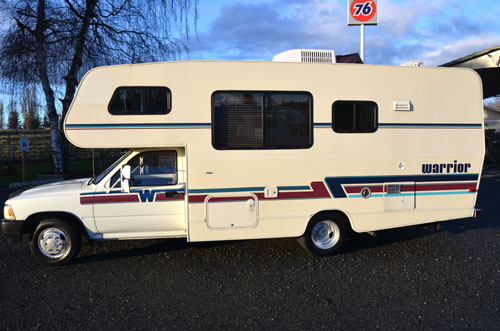
But there are many 2nd stage manufacturers in the US, most notably with RV's and commercial trucks, that will modify a vehicle and then issue it a new data plate with a revised GVWR. Have you ever seen a Toyota Motorhome? Yes, looks overloaded and probably is once you put 2 passengers in there.

big5.jpg


1992 Toyota "1-ton" GVWR 5600 lbs
1992 Toyota Winnebago, outfitted with different rear axle, hopefully brakes and what not. GVWR 6000 lbs

You may or may not trust the GVWR the 2nd stage manufacturer/Engineer's rating. But for FMVSS compliance and ADR compliance, the official GVWR can indeed be changed from the original manufacturer. If you don't need the compliance but you perform the same exact modifications, your GVW capacity will go up.

If you want more info, just search "FMVSS multi-stage manufacturer"

My work truck has one of these stickers on it.

gvwr.webp
 
@hoser - Thank you for the detailed explanation. I work closely with a motorhome chassis OEM and know for a fact that their design criteria is completely different than for a SUV you can buy off-the-shelf. SUVs and trucks up to half-ton have extremely stringent design criteria due to stiff market competition, and nowadays there is a huge push towards reducing mass to get better CAFE fuel economy. As a result they are built closer to the limits of durability for a given GVWR than a motorhome or other type of incomplete vehicle (this includes all HD trucks above half-ton, which is what your work truck is, I am guessing ). People are free to do as they choose with their vehicles, but I, having witnessed what a vehicle looks like at the end of an accelerated durability test, like being cautious in these matters.
 
I'm not trying to compare a light truck to an RV to a HD truck. My point in that post is the GVWR can be changed from the manufacturers rating.

Yes, there is no question, the vehicle will wear faster with more weight. You gotta pay to play. Hopefully, the memories will be worth it all. 1200 lbs is not a lot of capacity for an overlander.

2 people, 300 lbs
Fridge with food and water, 150+ lbs
Extra fuel tank with fuel 200-350
Drawer or platform, 100-250lbs
Bullbar with winch, 200 lbs.
2nd battery, 70 lbs
Load E tires, +10 lb x 5 tires = 50 lbs
Tools, Recovery gear, spares, 100+lbs

That's over 1200 lbs right there. There are many on this board carrying way more than that, and it is only possible because they've upgraded their suspension. It would be dangerous otherwise.
 
Last edited:
Back
Top Bottom