Doing panel welding the right way??

This site may earn a commission from merchant affiliate
links, including eBay, Amazon, Skimlinks, and others.

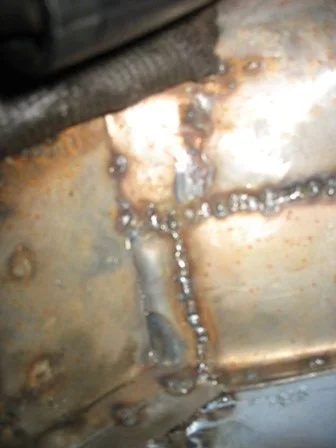
Fit is the best way to get good joints,there should be 1/16 in gap when you butt weld,Are you using stargon gas? or just co2,keep your mig gun at a slight angle. The arc should sound like frying bacon, not enough heat will give you snot balls,sometimes a little more heat and less wire feed and a short burst of 2-3 seconds max will give better results.I have done door bottoms with little or no filler needed.Take your time don't rush it.
 
1/16 a inch seems fine. Yes, the heat is enough but forgot that I had the speed up to high, turned it down. Now, I have a Lincoln mig 100hd. I had the settings at B with 3.5 for standard thickness 18 gauge steel. Should the setting be slightly different for butt welding?

If the gap is 1/16 inch..which would be ideal if the cut was 90 degrees on the patch. Do you push from one side to the other or just let it sit there pooling for 1/2 second then go to the next weld?

using 75/25 gas

Looking for good butt weld examples on youtube.
 
Having my compressor stolen about a year ago, I started, then put in the back burner my oba compressor system. I fabed up the brackets to mount the compressor but one thing that eludes me, how to center the holes in the 3/16 plate metal for drilling but how to get the drill holes centered if the plate if over the bolt holes. You cannot see the holes as the plate metal covers them so, how do you know where to drill exactly?

I just thought of something very novel. Build or buy some kind of jig that can hold a small laser pen. Then with a bolt in the hole, center the laser on the center of the bolt and tighten down the arm wing bolts to keep the laser steady. Remove the bolt, put cover over the holes centered, and the laser will point at exactly the same spot where the bolt was. Use a marking pen to mark the exact center of the hole.

I have tried plexiglass but that is a one time use. This is a much better idea. Now some one needs to build it.
 
I fabed up the brackets to mount the compressor but one thing that eludes me, how to center the holes in the 3/16 plate metal for drilling but how to get the drill holes centered if the plate if over the bolt holes. You cannot see the holes as the plate metal covers them so, how do you know where to drill exactly?

Do you have access to the back side of the bolt holes? If so, you can use transfer punches to give an accurate center mark.

If you don't have access to the back of the hole you may be stuck using some sort of transfer marker (lipstick works great for this) but it's never very accurate which means you have to go measure, re-measure and then measure again. The trick is to drill one hole at a time then test-fit the plate and make multiple measurements before marking the next hole for drilling.
 
Last edited:
belaw, just thought of something

I am going to finish up what I can on the fender today. I do not want to waste any more time on the 30 inch x 3 inch steel sheet metal arch by flanging it. I just do not want to put more time to get the compressor in. It is raining and water is splashing into the cab of the vehicle.

So, anyone who has worked with sheet metal tell me if I am correct on what I am about to do with the arch. Since the arch is pointing strait out, instead of down to the fender, I have to make a series of perpendicular cuts along the outside edge of the arch in order to push it down. This will close off the cut marks at the side of the arch that is near the center of the wheel well arch. It may even cause the cuts to overlap, in which, I may have to cut again. I will not use my pneumatic flange/hole punch tool since I do not have air. Instead, I will just lap well the arch on top of the fender....for now to prevent any more water from getting inside. I can always unzip it in the future to make it look more permanent and better looking.

As for centering a hole on sheet metal in which you cannot see the hold behind it on a engine block,
How about clay? Or silly putty? Stick it to the metal "hope it does stick" approximately where I think the center of the holes are and then press the place onto the engine block where the tapped holes are. pressing on the place will cause the slay,silly putty to push into the bolt holes, giving a near accuracy of where to drill. I do not think silly putty or bubble gum would stick. Clay would be hard to find. What else could be used? Silicone would need setup time to be usable.

Any other ideas? Other then that, laser idea would be quick and work.


 
Got alot of work done today. Should be finished tomarro

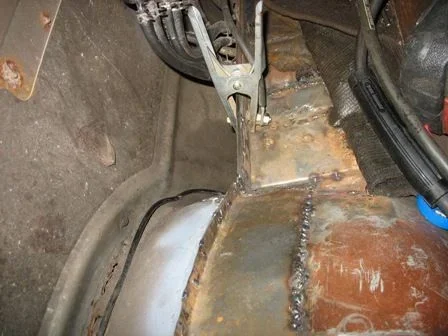
What a day. I started using the 30 inch curved sheet metal install. Started tack welding and using clincoes to tighten the patch against the wheel well. I was having difficulty closing the gap and remembered long ago, some one said to use small or tiny bolts and nuts to pinch sheet metal together. But I did not want to wait and proceeded. I also came up with a great idea to push the fender up to meet the patch lap joint. I used a small floor jack and placed it on the tire. With a ball of rage on the contact pad, I pumped the jack up until it started to push on the under side of the wheel well. A few more pumps, the fender went up. I also hammered the wheel well patch down to make contact. If a had a hand full of small bolts and nuts, I would have tightened the gap down to zero and tack welded it into place.

For some reason, the lap at the back end of the patch stopped being a lap weld and became a but weld at the very end. Going to tack weld the entire piece then blend the entire edge in with a grinding flap disk.


Last of the pictures and work completed..mostly

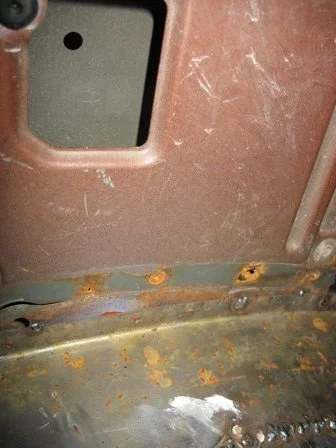
I finished up the wheel well repair for the inner wheel well yesterday with the exception of adding on a mud deflection panel at the rear 9 oclock position.

Here are some of the images I have.

IMG_1329.webp

IMG_1327.webp

This picture is the rear part of the wheel well.
IMG_1325.webp

This is my very first time doing body sheet metal work. If I had to have done this again, I would have stitched the wheel well and the patch differently. I would have instead used small bolts and nuts to pull the two pieced together since both were trying to stay apart.

I did not have special steel sealant, if there is such a brand, so used what I had which was red RTV and squeezed it into the gap and applied it outside the inner/outter wheel well joints. I need to buy some more to finish it, then apply my spray on undercoating. BTW, I do not care for this undercoating in a can. It dries to thin on the steel and would prefer a roll on brand that is thicker and can take the impact of gravel and rocks that will be kicked up by the tire treads. Anyone can name some brands?

What should I use to smooth out the lap joint of the wheel well patch after grinding the welds flush with both surfaces? Bondo or lead/solder? I would prefer lead as it is more robust to impact of tossing items into the back area. I have not used lead before but it may be the best thing to use as it would be easy to grind/sand smooth. I imagine I would have to use a carbon mask as to not breath in the lead fumes.

Your comments appreciated.

IMG_1329.webp
IMG_1327.webp
IMG_1325.webp
 
Last edited:
Hey, it looks as though you are trying to put on more weld than you need, because your temperature isn't hot enough

I'm fairly inexperienced, but when I did my truck I had the heat on setting from D, up to E, of E to weld my 14 gauge together, and when I welded on super thin factory metal I used C, up to D, of E.

I found lots of heat was great to make those little tack welds.
,
When you have the two pieces of sheet metal placed tightly together, it only takes a quick tack to melt them together. The key is that they are placed tightly together.

Good luck!
 
that was the problem..bringing the pieces together

It was a real problem trying to push down the long 30 inch patch that was mig welded to the outer wheel well. It was a curve that stuck out horizontally but was 1/2 above the cut edge of the inner well well. I used a combination of upper body weight and a sludge hammer to hammer the edge down to as close to the inner well well. I then used a car jack sitting on the tire to push up the inner wheel well to match the patch. I do admit that I could have done a better job doing this weld. If I have some more time set aside, I will unzip some parts that has a bit of a gap and the close it tighter.

I also should have had the body shop make the patch just 1/2 wider to use bolts and nuts to close the two pieces really tight.
 
Back
Top Bottom