



Mine was not holding pressure and set off the check engine light and emission code. The rubber seal gets old fix is $10 gas cap and free code read and erase at autozone. But if you freak out and take it to dealer that gas cap replacement might cost you a couple of hundred in dealer BS charges.
Navigation
Install the app
How to install the app on iOS
Follow along with the video below to see how to install our site as a web app on your home screen.
Note: This feature may not be available in some browsers.
More options
Style variation
You are using an out of date browser. It may not display this or other websites correctly.
You should upgrade or use an alternative browser.
You should upgrade or use an alternative browser.
Change your gas cap every 100k miles or 7 years
- Thread starter SWUtah
- Start date
This site may earn a commission from merchant affiliate
links, including eBay, Amazon, Skimlinks, and others.

Nah. My gas cap is 16 years old, works like a champ. If the gasket is cracked or dry looking, it could leak. Seems like the newer models are more sensitive to the evap code for loose gas cap. Dealer should only charge .5 labor maximum to diagnose a gas cap. So maybe $100 total w/new cap.

Eh, no issues with mine after 160k miles and 14 years. If it fails, I'll replace, but I don't think it's a regular maintenance item. It's not going to cause issues even if it does fail in the middle of nowhere, unlike a T hose, T belt, etc. I had a Jeep that the gas cap crapped out at 100k miles.

Mine gets tested annually for TN emissions, so I will replace it once they tell me or I notice a CEL.
Mine gets tested annually for TN emissions, so I will replace it once they tell me or I notice a CEL.
Same in Texas.

Just replaced the cap on my '05 at 150k. Yes, they go bad and throw a CEL that doesn't say "change the fuel filler cap." The cap went bad on my wife's 05 LS430 at 140k.
It's a $15 item.
It's a $15 item.
- Thread starter
- #9
I think it's funny we have people crawling around on their engine changing T's just incase and people don't want to spend $10 on their 100 series at 100k miles to prevent poor idle and a check engine And VSC light from coming on, by just buying a new gas cap. Whatever?

Nah. My gas cap is 16 years old, works like a champ. If the gasket is cracked or dry looking, it could leak. Seems like the newer models are more sensitive to the evap code for loose gas cap. Dealer should only charge .5 labor maximum to diagnose a gas cap. So maybe $100 total w/new cap.
Can't tell you how many times I have forgotten to put the cap back on. Light comes on, reminding me to do so. I put it on, light goes away, everything good.
That 100k advice is good. I'll have to get me a new one when the clock turns over again.
Actually you won't know if you have a bigger problem unless you carry a code reader in your 100. Mine also idled smoother after installing the new gas cap.
Doesn't make sense to me to worry about a part that's not going to leave you stranded (like the t valve). Might as well carry a few O2 sensors and maybe a cat.
Weren't you worried about going on a 1,000 mile trip in your LC with barely over 100k miles at one time? This thread may have topped that one.

- Thread starter
- #14
Thank you Sir for your input and opinion. Looks like you should not replace your gas cap. But others might want to. I've driven my 100 on several trips over 1000 miles but it was baselined before the first trip and everything is checked out before other trips. My previous post concerning reliability of driving a 100 with over 100k miles on a trip over 1000 miles was based on my past experience with vehicles over 100k miles on them, which at that point in my life was Zero. Guess I've been lucky in my life and have alway owned high-end, low mileage vehicles. But I've learned from this forum and through owning my 100 series that these beasts are in a class by themselves. My reason for posting this gas cap information was to help another member that has less technical expertise then you not panic and take their rig to a dealer and spend extra time and $$ needlessly. Sorry you disagree with the value of this information.
Thank you Sir for your input and opinion. Looks like you should not replace your gas cap. But others might want to. I've driven my 100 on several trips over 1000 miles but it was baselined before the first trip and everything is checked out before other trips. My previous post concerning reliability of driving a 100 with over 100k miles on a trip over 1000 miles was based on my past experience with vehicles over 100k miles on them, which at that point in my life was Zero. Guess I've been lucky in my life and have alway owned high-end, low mileage vehicles. But I've learned from this forum and through owning my 100 series that these beasts are in a class by themselves. My reason for posting this gas cap information was to help another member that has less technical expertise then you not panic and take their rig to a dealer and spend extra time and $$ needlessly. Sorry you disagree with the value of this information.
I don't have issues with the info given. But it was comments like this:
I think it's funny we have people crawling around on their engine changing T's just incase and people don't want to spend $10 on their 100 series at 100k miles to prevent poor idle and a check engine And VSC light from coming on, by just buying a new gas cap. Whatever?
that just don't make sense. I get preventative maintenance, but a gas cap is not a part of it. O2 sensors can go out at 100k as well. Should we change those out on a set interval? I don't. If they fail, you can get home, and change them out. You say that you're trying to help others out, but having them spend money when not needed isn't too helpful (no matter how small the amount). You could have simply said if you end up with a P0457 code, try changing the gas cap.
By the way, OEM gas caps are $15. I've had off-brand ones not work properly.
- Thread starter
- #16
Big cost difference in cost of a $10 gas cap that you screw on and O2 sensors that take installing. I've found through the years that just because something makes sense to me does not mean it makes sense to others.
Last edited:
No need to get snippy.
We all maintain our trucks the way we are comfortable with. I tend to do it more like SWUtah. Yes, I proactively replace parts like the gascap o-ring. Yes I proactively replace O2 sensors because they go bad about 100k or 125k and in fact they were at one time listed on the maintenance schedule on Land Cruisers. I proactively replace the T-fittings. I've been all through this at high mileages with my past trucks and cars and know the drill.
My approach is more akin to aircraft maintenance. We know the approximate useful life of parts, and I tend to replace them at my leasure at a certain intervals (100k etc.) before they fail or give me trouble. That's how I do it and my trucks very, very rarely give me any problems.
Agree to disagree. Let's move on.
We all maintain our trucks the way we are comfortable with. I tend to do it more like SWUtah. Yes, I proactively replace parts like the gascap o-ring. Yes I proactively replace O2 sensors because they go bad about 100k or 125k and in fact they were at one time listed on the maintenance schedule on Land Cruisers. I proactively replace the T-fittings. I've been all through this at high mileages with my past trucks and cars and know the drill.
My approach is more akin to aircraft maintenance. We know the approximate useful life of parts, and I tend to replace them at my leasure at a certain intervals (100k etc.) before they fail or give me trouble. That's how I do it and my trucks very, very rarely give me any problems.
Agree to disagree. Let's move on.
My approach is more akin to aircraft maintenance. We know the approximate useful life of parts, and I tend to replace them at my leasure at a certain intervals (100k etc.) before they fail or give me trouble. That's how I do it and my trucks very, very rarely give me any problems..
That's my plan as well. Do I care if the paint is scuffed in my old 206? No. Small float leak? No again. Fuel pumps, injectors, etc? I care a lot. I treat my cars the same way and they take car of me.

Getting tired of resetting the CEL and hearing about my EVAP...SMALL LEAK, so finally took a look at my gas cap. Pictured here on the left is the one from my 2003 100 and on the right, the gas cap from my 2001 LS430 which looks like the same part.
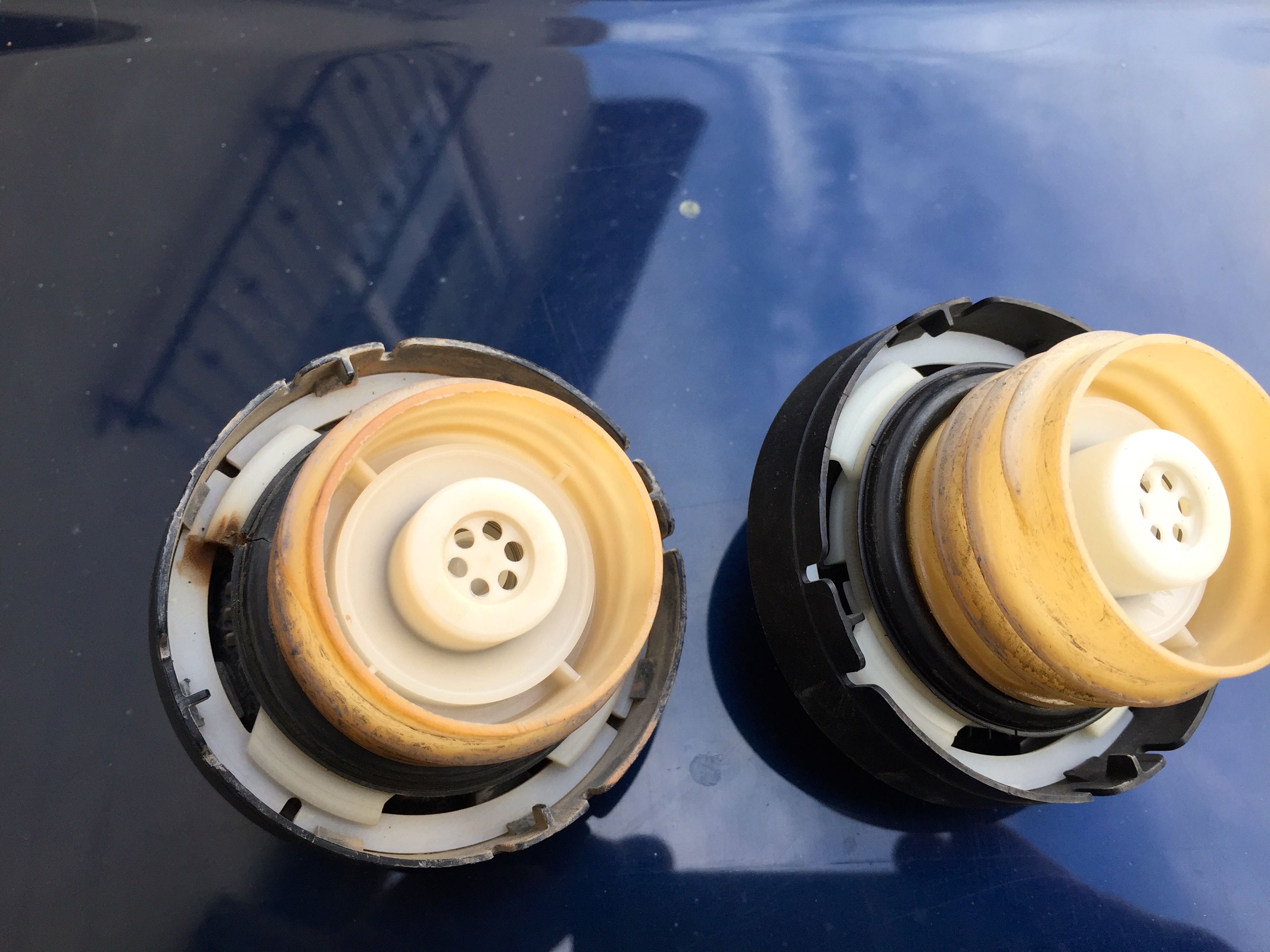
2 questions:
1. Can anyone confirm the crack in the gasket on the left would be enough to trigger the CEL? (PO442)? I just cleared the codes on the 100, swapped the caps and will see if the LS CEL comes on. I guess that will confirm this as well, but any insight would be appreciated.
2. Is there anything special about the gasket? Can I just use whatever I can find at the local hardware store or is there a better source? Obviously I could go get a new gas cap, but I'm heading out of town and can more easily get a gasket than a new cap, especially OEM.
2 questions:
1. Can anyone confirm the crack in the gasket on the left would be enough to trigger the CEL? (PO442)? I just cleared the codes on the 100, swapped the caps and will see if the LS CEL comes on. I guess that will confirm this as well, but any insight would be appreciated.
2. Is there anything special about the gasket? Can I just use whatever I can find at the local hardware store or is there a better source? Obviously I could go get a new gas cap, but I'm heading out of town and can more easily get a gasket than a new cap, especially OEM.