Aux Fuse Block wiring w/switch need suggestions

This site may earn a commission from merchant affiliate
links, including eBay, Amazon, Skimlinks, and others.

Joined
Mar 29, 2006
Threads
228
Messages
1,130
Location
AZ
MrZero had a similar thread but decided go a different route.

I need some help selecting the right gauge wire and fuse sizes.

I have some 4 gauge wire and was thinking of using that from the battery to the fuse block but with relay in between but I'm now sure how to go about getting a 4g terminal to connect with male terminals of the relay. Maybe the 4g is too much of an overkill?

Also, i guessing the fuse size needed will be dependent on the wire size chosen.

FuseWireDiagram.jpg


Found online, do you think this a good guide?
Wire Gauge Recommended
Maximum Fuse Size
00 awg400 amps
0 awg325 amps
1 awg250 amps
2 awg200 amps
4 awg125 amps
6 awg80 amps
8 awg50 amps
10 awg30 amps
12 awg20 amps
14 awg15 amps
16 awg7.5 amps
These are the recommended maximum fuse ratings for the corresponding wire size. Using a smaller fuse than what's recommended here will be perfectly safe.
 
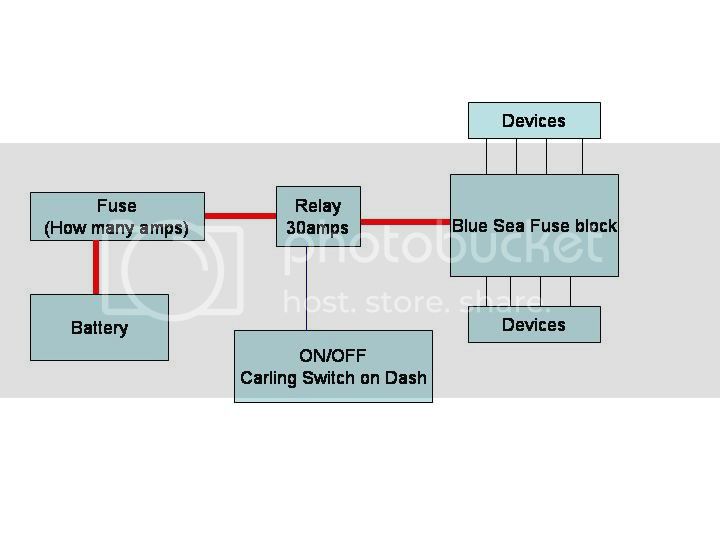
If your relay is rated for 30Amps then your fuse (as shown in your drawing) should be no larger then 30 amp. Without the relay the combine load (not fuse sizes) of your fuse block will dictate the size of fuse within the limitation of #4 wire.

What will you be powering off the fuse block.
How long of a run of #4 between your battery and fuse block.
 
I think the stock alternator for an '84 FJ60 is 40 amps. So that is going to be your limiting factor. If you draw more out of your battery than the alternator can replace, you will run your battery dead with the engine running. Forty Amps at 12.5 Volts is about 500 Watts total. So, your headlights, driving lights, fridge, etc should add up to less than 500 Watts.

Back to your original question, 10 ga or 8 ga wire should be plenty for the main wire to the fuse block. Your 30 amp relay might be a little small. I'd go up to 50 amps if you want to run everything from one fuse block. Size the fuse a little less than the relay.
 
If your relay is rated for 30Amps then your fuse (as shown in your drawing) should be no larger then 30 amp. Without the relay the combine load (not fuse sizes) of your fuse block will dictate the size of fuse within the limitation of #4 wire.

What will you be powering off the fuse block.
How long of a run of #4 between your battery and fuse block.

When you say combined load you mean the total number of amps that will be drawn from the devices? Don't know yet?

The Fuse block is connected to the aux battery, powering the stereo, soon to be purchased: off road lights, frig,

Aux battery is located on the driverside where the stock radiator overflow bottle is, so wiring distance is just from there to the driverside kick panel.
 
A maximum distance of 15.096 feet will limit the voltage drop to 2% or less with a #4 Copper conductor delivering 30.0 amps on a 13 volt system

Frig 4amp x 1.25% = 5 amps
4 - 100w driving lights = 30.76 amps
No workie

Frig 4amp x 1.25% = 5 amps
4 - 35w HID 10.76 x 200% = 21.52
Workie

A couple of examples
 
I think the stock alternator for an '84 FJ60 is 40 amps. So that is going to be your limiting factor. If you draw more out of your battery than the alternator can replace, you will run your battery dead with the engine running. Forty Amps at 12.5 Volts is about 500 Watts total. So, your headlights, driving lights, fridge, etc should add up to less than 500 Watts.

Back to your original question, 10 ga or 8 ga wire should be plenty for the main wire to the fuse block. Your 30 amp relay might be a little small. I'd go up to 50 amps if you want to run everything from one fuse block. Size the fuse a little less than the relay.

I should be able to monitor the draw on the national luna monitor i have installed, but if i'm pulling more than 500watts, how do you solve that? Mean green alternator, GM alternator?

So considering the yellow pushon terminals are #12-10 I'll go with #10 wire and look for a bigger relay and fuse that is about 10amps less then the relay.
 
A maximum distance of 15.096 feet will limit the voltage drop to 2% or less with a #4 Copper conductor delivering 30.0 amps on a 13 volt system

Frig 4amp x 1.25% = 5 amps
4 - 100w driving lights = 30.76 amps
No workie

Frig 4amp x 1.25% = 5 amps
4 - 35w HID 10.76 x 200% = 21.52
Workie

A couple of examples

What are these numbers representing: "10.76" and "200"% and "1.25" is estimating 125% usage of capacity?

Sorry if this is elementary.
 
What are these numbers representing: "10.76" and "200"% and "1.25" is estimating 125% usage of capacity?

Sorry if this is elementary.

Safety margins.
Some thing are better at accepting voltage loss then other. Lights dont care they just get dimmer but motor load like a frig or an air compressor like full rated voltage to keep them living a long time.

Any motor load and HID lights have a higher starting amperage then a running amperage. So you want to make sure you have enough to handle it.

locate your fuse panel closer to your battery will solve a lot potential problems and give you much more usable power. I dont see the need to use a relay. Mount your fuse block close to your battery fuse panel at 50A run a #12 circuit fused at 10amp to your frig outlet. Wire for your lights
 
I set up my aux fuse block so that I had half of the circuits switched to the ignition circuit and half unswitched. This way I can run some stuff while parked, (cooling fans, aux 12v outlets for phone/ computer, inverter) without the key on but certain items, like my big lights, will only work when the key is on. I run dual batteries with an isolator solenoid so that I don't get stuck if I drain one while camping. Then I set up a separate dedicated circuit for a winch. Next step will be an alternator upgrade. I used a 50amp relay but in reality, think about how many aux items you will be using at once when you size it. I figured it was unlikely that I'd have 8 lights, a fridge, GPS, computer, phone charger, wipers, heater, radio w/ amps, and the kid playing Wii all at the same time!
 
Safety margins.
Some thing are better at accepting voltage loss then other. Lights dont care they just get dimmer but motor load like a frig or an air compressor like full rated voltage to keep them living a long time.

Any motor load and HID lights have a higher starting amperage then a running amperage. So you want to make sure you have enough to handle it.

locate your fuse panel closer to your battery will solve a lot potential problems and give you much more usable power. I dont see the need to use a relay. Mount your fuse block close to your battery fuse panel at 50A run a #12 circuit fused at 10amp to your frig outlet. Wire for your lights

The aux fuse block is actually closer to the aux battery than the stock fuse block to the stock battery, considering both fuse box locations are on the interior driver side of cabin/kick panel area...right?

The reason I have a relay in there is to to be able to add the switch on the dash that will let turn the power on or off to aux fuse block.

Your suggestion is to run #12 wire to a 50amp relay to 10amp fuse on the aux fuse box for a wiring a frig for example? Sorry if i didn't get the translation right.

Thanks again guys!
 
Just looked at my relay, it says RATED 40A, 12VDC for motor devices, 60A, 12VDC for lighting, audio and security devices. So since it's powering any motored devices, It should stand a 60Amp relay right?

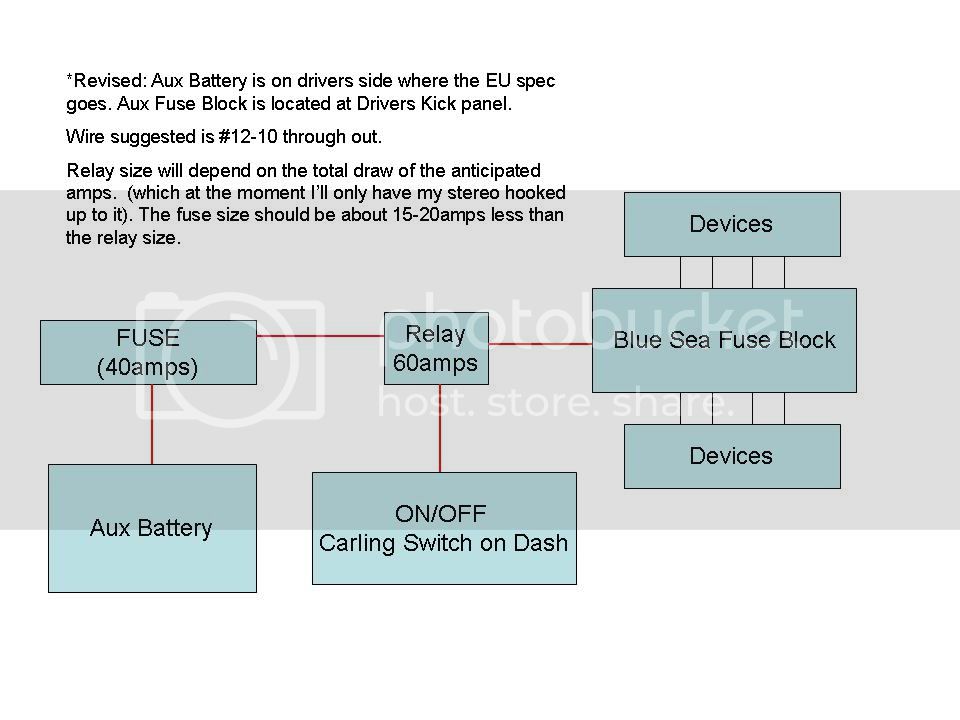
Ok here is a revised diagram: Aux Battery is on drivers side where the EU spec goes. Aux Fuse Block is located at Drivers Kick panel.

Wire suggested is #12-10 through out.

Relay size will depend on the total draw of the anticipated amps. (which at the moment I’ll only have my stereo hooked up to it). The fuse size should be about 15-20amps less than the relay size.
Presentation1.jpg


I'm I on the right track now?
 
I would add that the off road lights should be routed through their own relay, like LandCruiserPhil pointed out, incandescent lighting draws a lot of amperage. Maybe instead of a switch to trigger the relay, perhaps the ACC wire or IGN wire might be more convenient. Pretty much like Devortex suggested. I have three separated fuse blocks. One that is triggered by IGN, one triggered by ACC and one wired hot to the battery. As you start adding peripherals, you find that some items need to be triggered differently. With that I used 12g wire and 30a relays, anything that has a higher draw than 30a gets it's own relay, i.e. off road lights.
 
I would add that the off road lights should be routed through their own relay, like LandCruiserPhil pointed out, incandescent lighting draws a lot of amperage. Maybe instead of a switch to trigger the relay, perhaps the ACC wire or IGN wire might be more convenient. Pretty much like Devortex suggested. I have three separated fuse blocks. One that is triggered by IGN, one triggered by ACC and one wired hot to the battery. As you start adding peripherals, you find that some items need to be triggered differently. With that I used 12g wire and 30a relays, anything that has a higher draw than 30a gets it's own relay, i.e. off road lights.

That makes sense for the lights as most come with or need a harness that includes relays. I guess the diagram is not accounting for those specific devices (which I don't have just yet).

I just want to make sure that my wiring, fuse. relay and switch selection will function and not start a fire haha (I want that aux fuse box to be switched on or off as i choose.)

What size wire do you have going from your battery to your aux boxes? 12g? just confirming.

Thanks!
 
Yup, 12g, 30a relay, 25a fuse. I use this for the ACC & IGN blocks. The battery block doesn't have a relay, but does have a 30a fuse same 12g wire size. I might be a little light on the wire gauge, if your concerned go 10g. My total amp draw on each block averages around 10-15 amps. My Ham radio in on the battery block it draws about 9 amps max.
 
Last edited:
Yup, 12g, 30a relay, 25a fuse. I use this for the ACC & IGN blocks. The battery block doesn't have a relay, but does have a 30a fuse same 12g wire size. I might be a little light on the wire gauge, if your concerned go 10g. My total amp draw on each block averages around 10-15 amps. My Ham radio in on the battery block it draws about 9 amps max.

What about using a bussmann circuit breaker instead of the fuse between the battery and the relay?
 
Back
Top Bottom