Agm battery management

This site may earn a commission from merchant affiliate
links, including eBay, Amazon, Skimlinks, and others.

Joined
Jun 18, 2004
Threads
259
Messages
1,501
Location
Pacific Northwest
Has anybody tried a voltage regulator to manage your AGM batteries? This particular model will let you charge both an AGM, and a lead acid at the same time at different charge rates. AGM batteries can last 10 years if they are properly charged/ taken care of.

http://www.balmar.net/PDF/regulator info s/MC-614.pdf

I ran a similar system on my 80 series back in 2007. Figured you guys might have some new ideas since my last install.

https://forum.ih8mud.com/80-series-tech/130036-house-battery-vs-start-battery-location.html
 
I use this one

ForumRunner_20130503_073739.webp
 
I'm interested in AGM battery management in my '04 because this past winter I had a Diehard Platinum 31 die easy after just 7 months. Sears replaced it for free, but I'm tracking charging/discharging over time to see if the truck's system is treating it right.
 
When I joined IH8mud in 2004 the 80 series section was a great resource. Lots of technical solutions.

The 100 series section is a giant shopping forum.....

how big a lift can I put on my 100 series?
how big of tire can I get?
what bumper can I get?
look at my new plastidip?

I am dumbfounded as to why this got moved out of the 100 series section. You would think that maintaining and setting up a charging system would be valuable tech. As near as I can tell nobody offers a solution to charge the AGM batteries.... Slee offers a great tray kit...but the 100 series factory charger is designed for a lead acid battery.

I feel seriously let down by the priorities of the moderators in this forum.
:flipoff2::flipoff2::flipoff2::flipoff2::flipoff2::flipoff2::flipoff2::flipoff2: :ban:

I want to regulate the charging so I don't fry my AGM battery.
 
Yah I have a Odyssey 25 amp charger that I hook up to my truck once every 2-3 weeks to top off the Diehard AGM Group 65. They are nice enough to provide a list of recommend chargers other than their own. The main thing is if the charge protocol meets the required threshold of AGM chemistry (14.7V bulk charge, and 13.6-8V maintenance charge).

I think a lot of the failures in cases where there are 2 of the batteries in parallel in the stock position (like big dually diesel F250/350 type trucks). I think the factory charging system isn't able to properly top off the batteries and a lot of those folks are having premature dead batteries. I read seem that no one is using a maintainer in those cases. I often find that my batteries are at like 95-97% charged even if I do a lot of highway miles. I don't think the built in charging diodes let the voltage go high enough, I believe the Odyssey / Diehard Platinums need 14.7V absorption charge at the beginning to get fully top off.

A guy on the 80's forum actually did a semi permanent install with his Odyssey charger, he made some connectors (anderson power poles?) so he could rapidly connect / disconnect. There were some really nice dust caps and stuff he got through Mcmaster.com for it also. I'm currently just using a regular battery clamps that came with the system.

Sorry if this is not very coherent. End of finals week and didn't get much sleep.
 
Total fail, forgot to post the link to the Odyssey website:
http://www.odysseybattery.com/chargers.html

I have the 25B Charger, which is rated up to the Group 65 series. Folks with the PM1 / Group 31 need to get the larger and almost 2x more expensive 50 amp charger. I paid 150 ish + shipping for mine last year.

http://www.odysseybattery.com/documents/ODYSSEYapproved12VchargersJanuary2013.pdf

I also have one of these battery load testers. Pretty handy and carry it in the back with all my spare parts and mini tools.
http://www.amazon.com/BA7-100-1200-Electronic-Battery-System/dp/B0015PI7A4/?tag=ihco-20

Splurged recently and got one of these: http://www.amazon.com/Rampage-86619-Trail-Utility-Tool/dp/B004YNOT0Q/?tag=ihco-20
 
When I joined IH8mud in 2004 the 80 series section was a great resource. Lots of technical solutions.

The 100 series section is a giant shopping forum.....

how big a lift can I put on my 100 series?
how big of tire can I get?
what bumper can I get?
look at my new plastidip?

I am dumbfounded as to why this got moved out of the 100 series section. You would think that maintaining and setting up a charging system would be valuable tech. As near as I can tell nobody offers a solution to charge the AGM batteries.... Slee offers a great tray kit...but the 100 series factory charger is designed for a lead acid battery.

I feel seriously let down by the priorities of the moderators in this forum.
:flipoff2::flipoff2::flipoff2::flipoff2::flipoff2::flipoff2::flipoff2::flipoff2: :ban:

I want to regulate the charging so I don't fry my AGM battery.

Sr. Gringo, I have seen of some retrofit charging diodes for like RV / Campers, but it's really expensive when compared to the external chargers like the Odyssey one. I'll try and find the link of the 2 companies I found a while back that much a module one splice into the charging system that can handle AGM and Dry Cell in addition to reg. lead acids.

Interestingly, I've seen a lot of the selectable charging algorithms on solar panel charge controllers. The really nice ones let you program the charging curve. This a budget non MPPT charger that I'm looking to get to pair with my 100 watt panel I got for beach camping :)
 
Are 100s killing the AGM batteries? Does driving frequency/style matter? I feel as though Im missing something.

I put a Diehard Platinum Group 31 in my 100 about 18 months ago, and everything seems fine so far.

I dont understand why they would sell/market AGM batteries for use in cars that would kill it, and give it a 4 year replacement warranty. Seems dumb to me.
 
Are 100s killing the AGM batteries? Does driving frequency/style matter? I feel as though Im missing something.

I put a Diehard Platinum Group 31 in my 100 about 18 months ago, and everything seems fine so far.

I dont understand why they would sell/market AGM batteries for use in cars that would kill it, and give it a 4 year replacement warranty. Seems dumb to me.

AGM have a lot of benefits over traditional lead acids, one of the really nice things are the no maintenance aspect and lack of spilling! It's one battery type that can be flown with and checked.

I think the issue is that overtime the battery might go bad sooner as they aren't being recharged to 100% by the stock charging diode's. I believe it's better to have the battery charged up at 100% if the vehicle is left in storage for a while, as a lot of folks have had issues with the battery being dead after long periods of inactivity.

The regulating diodes are set from the factory for a regular lead acid, so the bulk /absorption phase charging voltage is lower than what the AGM types need closer to 14.7 volts. Folks that change to a higher output alternator probably don't see much gain in charging rate for their battery system.
 
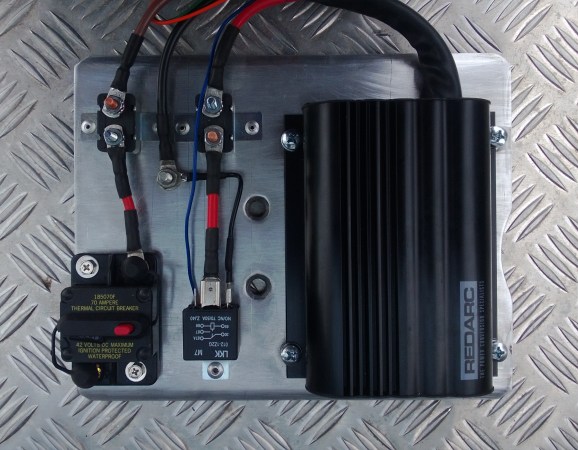
I was out working on the 80 today installing a Redarc BCDC1225 DC-DC battery charger. They are quite popular here in Australia, there is basically no better way to charge an auxiliary battery, especially one of a different type. They aren't cheap, I paid $330AUD for mine, but if it means the drinks are cold at the end of the day that's all that really matters :)

Prior to this I had a standard wet-cell calcium type battery with a simple solenoid based isolator. There was nothing wrong with that configuration, and it worked fine for many years, but when it came for replacement I decided to go for a deep cycle battery. It is more suited to the deeper discharges that happen when sitting for a day or three.

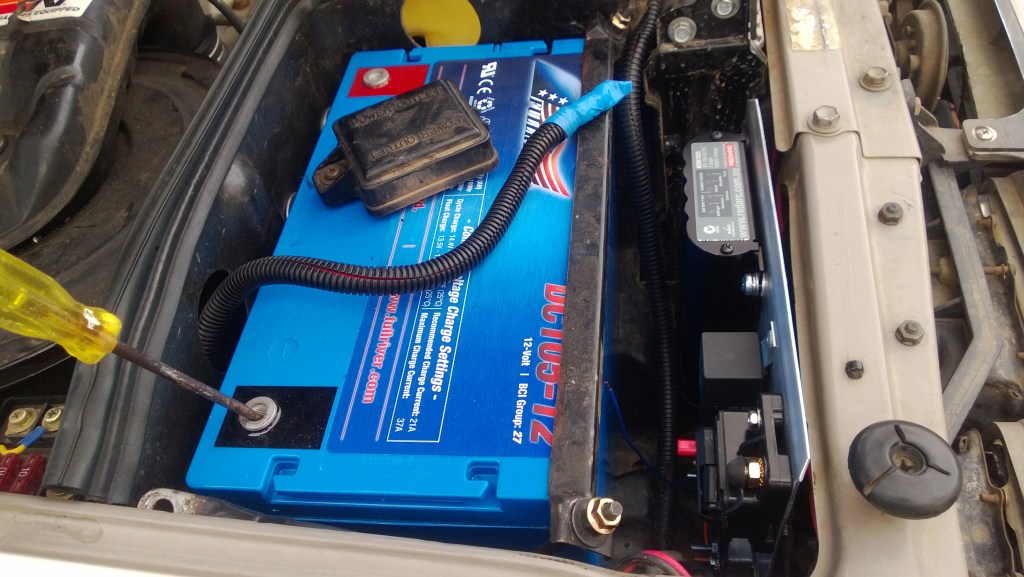
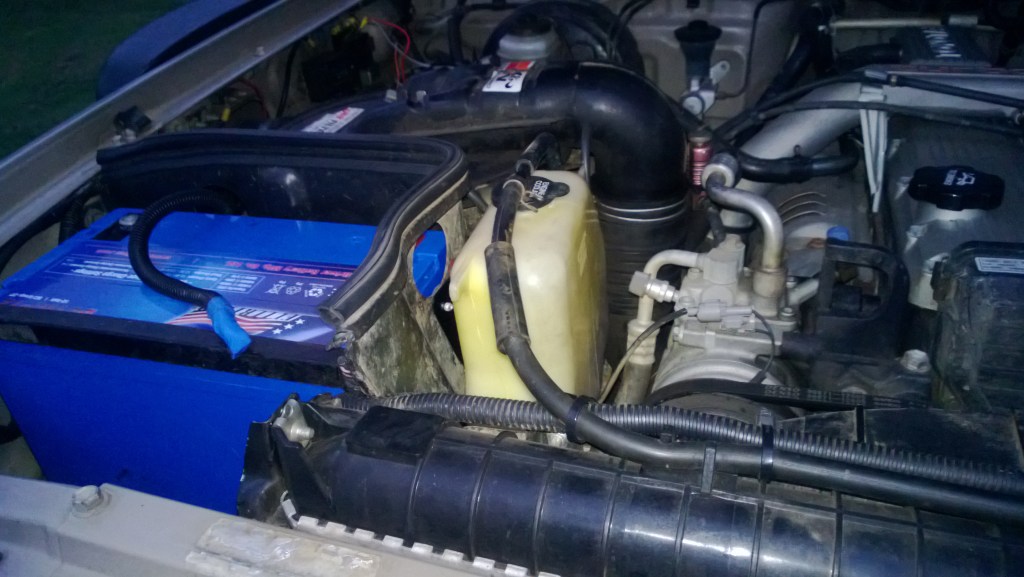
I had my mechanic create a plate to mount the charger, and relocate the overflow. I am happy with the end result, and it includes a convenient place to mount all the paraphernalia associated with the BCDC (changeover relay, breakers etc).

The wiring is still incomplete but unfortunately I ran out of time this weekend...

bcdc1225_mounted.jpg


bcdc1225_installed.jpg


overflow_relocated.jpg
 
I was out working on the 80 today installing a Redarc BCDC1225 DC-DC battery charger. They are quite popular here in Australia, there is basically no better way to charge an auxiliary battery, especially one of a different type. They aren't cheap, I paid $330AUD for mine, but if it means the drinks are cold at the end of the day that's all that really matters :)

Prior to this I had a standard wet-cell calcium type battery with a simple solenoid based isolator. There was nothing wrong with that configuration, and it worked fine for many years, but when it came for replacement I decided to go for a deep cycle battery. It is more suited to the deeper discharges that happen when sitting for a day or three.

I had my mechanic create a plate to mount the charger, and relocate the overflow. I am happy with the end result, and it includes a convenient place to mount all the paraphernalia associated with the BCDC (changeover relay, breakers etc).

The wiring is still incomplete but unfortunately I ran out of time this weekend...

Very cool! I went to the company's website and it says that also integrates a MPPT solar charge controller! That's exactly what I'm looking for. Right now I was thinking of using a Hellroaring Isolator but I'm not sure if I want their default set up with all my accessories being drawn from the main starter battery and the auxiliary battery used to assist in starting up the car. But rather the more traditional set up with the starter battery isolated and protected from deep discharge and the auxiliary battery used for all my accessory power. http://www.hellroaring.com/bicfaq.php

Then I was hoping to have a solar charge controller hooked up to my auxiliary battery to top it off after each night of use. I just have a single 100 W panel and don't think I will expand, so the benefit of a MPPT controller isn't as great. But I would like to have the ability for the charge controller to use the AGM algorithm to recharge my auxiliary battery if that makes sense.
 
So I went and found this, it will apply to anyone running a DieHard Platinum/ Platinum Marine battery or if you bought it as an Odyssey. Look at the last page under general provisions.
http://www.odysseybattery.com/documents/US-ODY-OM-011_0213.pdf

It says that if using one of their batteries with an alternator you must measure 14.0V-14.7V at the battery terminals.

My 2001 LX470, 154,4XX miles, original alternator puts out 14.2V, idling in park, warm. The battery on its own measured 12.75V, with 12.8V being 100% charged. This battery has been in my LX since December 2011.

Thats good enough for me.

Also from reading the PDF, the more often you drive, the less you have to worry about. However, I am now considering getting a charger and peaking the batteries every few weeks.
 
Last edited:
Very cool! I went to the company's website and it says that also integrates a MPPT solar charge controller! That's exactly what I'm looking for. Right now I was thinking of using a Hellroaring Isolator but I'm not sure if I want their default set up with all my accessories being drawn from the main starter battery and the auxiliary battery used to assist in starting up the car. But rather the more traditional set up with the starter battery isolated and protected from deep discharge and the auxiliary battery used for all my accessory power. http://www.hellroaring.com/bicfaq.php

Then I was hoping to have a solar charge controller hooked up to my auxiliary battery to top it off after each night of use. I just have a single 100 W panel and don't think I will expand, so the benefit of a MPPT controller isn't as great. But I would like to have the ability for the charge controller to use the AGM algorithm to recharge my auxiliary battery if that makes sense.

My understanding is that, if anything, an MPPT controller on an individual panel is more advantageous than on a group.

I've always kept the main battery for starting - I don't like the idea of drawing down on it. It's even saved me a few times when my main battery was on the way out and wouldn't start - I just jumped from the aux.
 
Any thoughts regarding the following battery chargers for the Sears AGM group 31? These chargers are not on Odyssey's recommended list but I think they should work. Hoping to find something that works that is not going to cost more than the battery. The place referenced below sells the Odyssey(pc2150) that is identical to the group 31 and recommends the following:

http://www.atbatt.com/product/6841.asp

http://www.atbatt.com/product/23685.asp

http://www.atbatt.com/product/23695.asp (this one is hard wired into your vehicle)

http://www.atbatt.com/product/23684.asp (referenced by Marius)

http://www.atbatt.com/sku_pdf/g7200-battery-charger-overview.pdf
 
I don't have any direct experiences with those that you listed, but from what I read during my research the Batteryminder and Batterytender ones are really well liked. I didn't happen to come over too many of the NOCO reviews. But i think this is for your main battery right? It should be fine as your stock alternator should be able to get it up to mid 90's% of charge and the ones you listed can top it off. It's also good if you are ever keeping your vehicle offline for a while, some folks periodically hook this charger up to keep the battery in tip top condition.

I think the higher current systems are more if you deplete your battery down quite a bit like a camper or marine application. I got mine mainly for the anticipated 2nd battery :).
 
My understanding is that, if anything, an MPPT controller on an individual panel is more advantageous than on a group.

I've always kept the main battery for starting - I don't like the idea of drawing down on it. It's even saved me a few times when my main battery was on the way out and wouldn't start - I just jumped from the aux.

Hmmm. good to know about MPPT. I agree with having the main battery isolated just for starting and using the auxiliary for all the accessories.

I need to read up a lot more on the solar charging subject for sure. I was able to snag a 100W panel through a sale at Costco. It's a Grape Solar one. Still deciding on what charge controller I want to get.

I found this fellow who has been blogging about solar systems in vehicles and found it pretty useful in planning out my set up: http://handybobsolar.wordpress.com/the-rv-battery-charging-puzzle-2/ who had a lot of info / experience in installing systems. He's an electrical engineer so it's been a really good read through on design of a dual battery system though more for RV / Camper settings. I think a lot of it would be applicable to expedition use a lot of mudders seem to do.
 
To me the alternator should do all of the job of charging the battery(ies). My discussion thread on the topic of alternator regulators that can do that job: https://forum.ih8mud.com/electronic-toys/705147-smart-alternator-regulators.html

I have two of those Costco solar panels. For our use the MPPT solar controllers don't make economic sense. A PWM controller does 'waste' some of the power generated by a solar panel, but the large difference in cost doesn't pencil out for the small difference in efficiency here in the South-West. Not for casual use anyway, for full timer RV use I think that an MPPT would be the only way to go. So I bought a Sunsaver Duo which gives me the option of having the solar also charge the truck's batteries when it is sitting between uses.
 
Back
Top Bottom