Engine Woes - Rod Bearings?

This site may earn a commission from merchant affiliate
links, including eBay, Amazon, Skimlinks, and others.

Joined
May 15, 2009
Threads
10
Messages
92
Location
SLC, UT
Engine Woes - Rod Bearings, now Motor Swap

So I was driving from Park City(a very high city) to Salt Lake City(a somewhat lower city) in my 95 with 230k on the engine and about 70k on the new HG. The Beast doesn't burn any oil, no leaks, and good oil pressure, no overheating. Near the peak of the road, I developed a serious knock. Developed, yeah...

So I was driving along and started hearing a slight metal clanking sound, like a heat shield vibration, but more right below the gas pedal. In about five seconds it went from clang clang scratch scratch, pop, and then a definite knock. I pulled over and verified that it was coming from the engine, but since I was 20 minutes from home, and I had the wife and kid in tow, I idled it down the canyon and coasted into my driveway.

During this time the knock would sometimes switch to spinning metal on metal sounds. I had good oil pressure the whole way, and the temperatures stayed normal. When I got home, oil level was still to the middle of the dipstick.

After a little research on Mud I'm thinking rod bearings. I dropped the first oil pan to discover an oz. of little brass colored pieces every where. No water in the oil. Currently I have all the bolts off the second oil pan, and am kind of stuck on getting that seal to break.

Am I in way over my head? From what I've read, its possible to do rod bearings from the bottom, but no one goes into detail. LX_treme has done it from the bottom, but he has some mad skills I may not have. Do I just find another 1fze? My top end is(was) in really good shape, so I'm praying I can do just the bottom end.

What should I do? Does anyone have a 1fze in Utah? Is there a shop around that is reputable and affordable? Part with me your wisdom!
 
Last edited:
I've never heard of a "second oil pan", but I've never been in the bottom of one of these beasts! However, with any stuck cover, I find that a rubber hammer works great. Keep in mind, you don't wanna beat the snot out of the pan, just "vibrate" it to knock it loose. Try hitting on one of the rounded corners, you are less likely to dent it.
As far as replacing rod bearings while the engine is in the truck, you "can" do it if you have the tools, and a little knowledge. But, I would think that it would be much better to pull the engine and do a complete rebuild at this point. You have already seen metal shavings in the oil pan, this means that they were most likely sucked up into the oil pump and promptly distributed throughout your entire engine!! So, quite possibly there is, or is going to be, even more damage. On the other hand, you might replace the rod bearings, put it all back together and get another 100K out of it.
(In my best Clint Eastwood voice) "I guess the question you gotta ask yourself is do you feel lucky punk...well do ya?"
 
By second oil pan, I really just mean the bottom of the engine. I'm not finding any good pry points to break the seal. I'll try the rubber hammer tonight.

I realize there is some risk in my attempt, but with my top end so tight, I am feeling lucky... If I can just get some more info on how to get the rod bearings out! Anyone want to shoot me a few pages of the FSM? I'm looking for pry points and my next few steps to get those rod bearings out.
 
I've never heard of a "second oil pan", but I've never been in the bottom of one of these beasts! However, with any stuck cover, I find that a rubber hammer works great. Keep in mind, you don't wanna beat the snot out of the pan, just "vibrate" it to knock it loose.

Uh...yeah...there are two pans...and beat the hell out of it to get it loose if you have to...but for sure use a dead-blow or rubber mallet...not the job for a ball-peen.

You have already seen metal shavings in the oil pan, this means that they were most likely sucked up into the oil pump and promptly distributed throughout your entire engine!!

Unless you don't run an oil filter I'm sure there is little worry about metal all over your motor. Hell, I live in Chicago boys and hear cars ALL THE TIME in my hood that are about to throw a rod...you're fine. However, you won't know the condition of the crank until the rods are off...but it's probably ok IMO.
 
Last edited:
Am I in way over my head?

That is a question only you can answer...however, having posed such a query...I'd say the answer is "definitely maybe."

But with enough time, patience, and assistance, you can really surprise yourself. Don't give up yet, you're just started. BUT and a big one, engine work takes time...unless you're a school teacher with the summer off. Especially if you have some trepidation about your lack of "mad skillz". Plan on this vehicle being out of service for at least a few weeks if not more.

You know we need a handiness scale here...something like this:

1. I know how to check my oil.
2. I can find the drain plug and oil filter on some cars and perform an oil change.
3. I sometimes have trouble changing a tire.
4. Two stroke? What's that? Who, Dr. Felix Wankel, who the hell is that?? A friend of the Diesel guy, and yeah not Vin Diesel, the other one...Otto right?
5. Oil change? s*** yeah I can do that on any thing, gas, diesel, boat, snowmobile, farm equipment, et cetera.
6. Yeah, I did my own breaks [sic] once, it was a little tricky.
7. Once I took my car's fan belts off and for the life of my I could not figure out how to put it back together...had to get it towed to a shop to be finished...I'll never EVER tell anyone this story.
8. I readily diagnose my own OBD-II issues.
9. I can run a cylinder leak-down test
10. Stem seals? Yes, I know them, I've replaced them.
11. And so on an so forth-

This knowledge would make the questions like the aforementioned easier to
answer. I should take this to Chat...I know.
 
Last edited:
Off Topic:

That's fair. Well I definitely don't want to overstate my abilities, because I know many of you make my wrenching look like a walk in the park. I have another DD, so it can sit for however long it needs to. I am taking a Moab trip later this month and am really going to hate driving down Main St. in my wife's Sienna...

I would consider myself capable around cars and engines. I've done a couple head gaskets on a 22r and 22re in an 87 pickup and 91 4runner. I've also done considerable work on a couple of 13b's in an 85 and 91 rx7. I've replaced most things including starters, fuel pumps/filters, alternators, and most recently an a/c compressor. And lastly I have a finely tuned 82 Yamaha xv750 that runs beautifully(read: sounds like a bucket of rocks when starting) and all that went into getting it that way.

The closest I've ever been to opening the bottom of an engine is in high school when we jumped a jetta in the sand dunes and it ripped the axle/tranny/engine bottom clean off and I'm pretty sure I saw a rod or two.

On Topic:

If I sound a little lost, its probably because I am. I guess my first real question is: Is this the right diagnosis? Then a follow up, once I'm looking at the bottom of my engine, how do I go about getting the rod bearings out? Later there will be a follow up about how to get them back in with proper torque and all that.
 
Towards "is this the right diagnosis?"

If you for sure had a knock, that was a rod, then yes. Sorry if this sounds sarcastic, it's actually not. You sound like you can tackle this. Engine rebuilding is a piece of cake. In-chassis engine rebuilding, not so much. Not saying it's not possible, but I would NEVER do a motor in-chassis. If this were me, and I pulled a conn-rod cap off and found a thrashed bearing, like now it looks like aluminum foil, I'd pull the motor and do a bench rebuild with rings, crank polishing, cylinder honing, etc.

The engine is kinda old, I'm sure you're leaking oil from other spots, and it would really suck to do this work, only to have a rear main start leaking or something of the like. From my perspective, if you can to a HG, you can build a motor. It just takes someone who can follow directions, is detail oriented, and has mechanical acumen (and another car!)...which it sounds like you have all of the above.

You can always do a good ole ROI analysis on "in chassis rod bearing replacement" versus pulling the motor. And, if you've had head work not too long ago, you can skip that altogether here and save some trouble in the job.

Towards "how to replace rod bearings"...in chassis would be just like if you had it on an engine stand in the garage. Pop some rubber tubing on the bolts, slide the piston up, get the old bearing out, thoroughly inspect the crank, clean it, plastigauge the new bearing (you should know what this is), if ok, lube it up, tighten conn-rod nuts to torque, move on to the next until...viola...you're done.

I'm sure others will give their opinions too, but I'd just not half-ass it. To me, bearings with the motor in the truck is a band-aid fix and pulling a motor is not that bad all told. And if you did a motor rebuild, you'd be set for years and years to come.

However, new rod bearings also could last a long LONG time too...tis a gamble.
 
Removed!

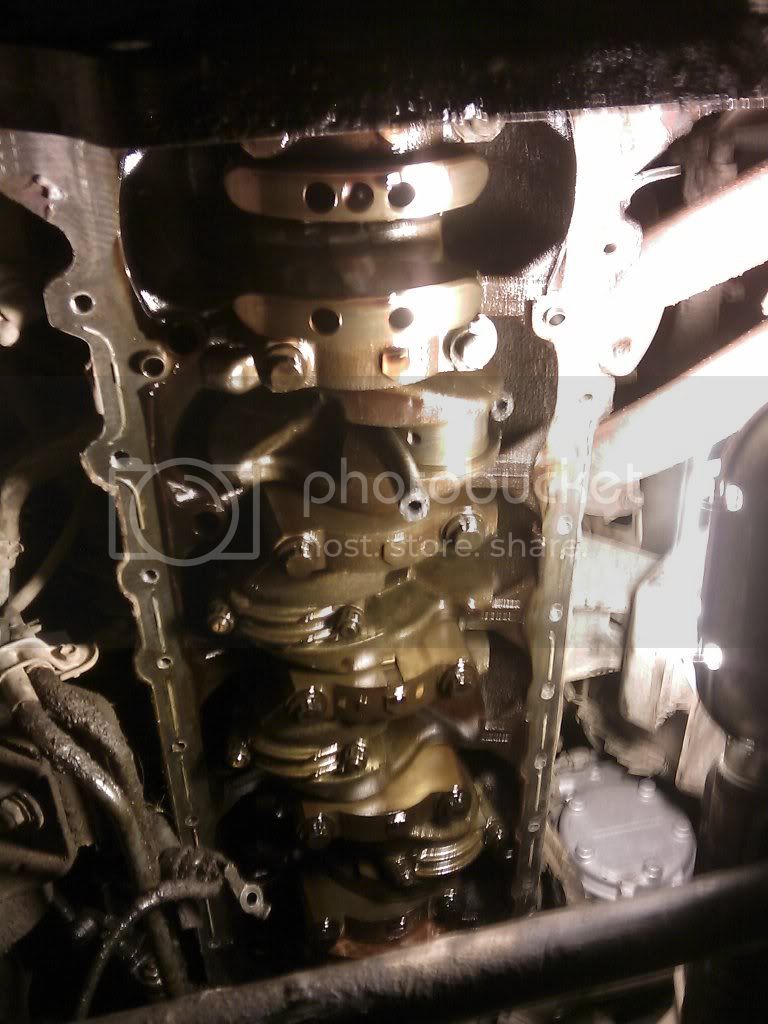
I got some time to look at this more tonight and I found another bolt I had forgotten to take out. The seal broke easily after that with a little prying. The tricky part is getting the big oil pan out. I had to loosen the engine mounts and jack the entire engine up an inch to get the clearance to slide the pan out.

IMAG0012.jpg


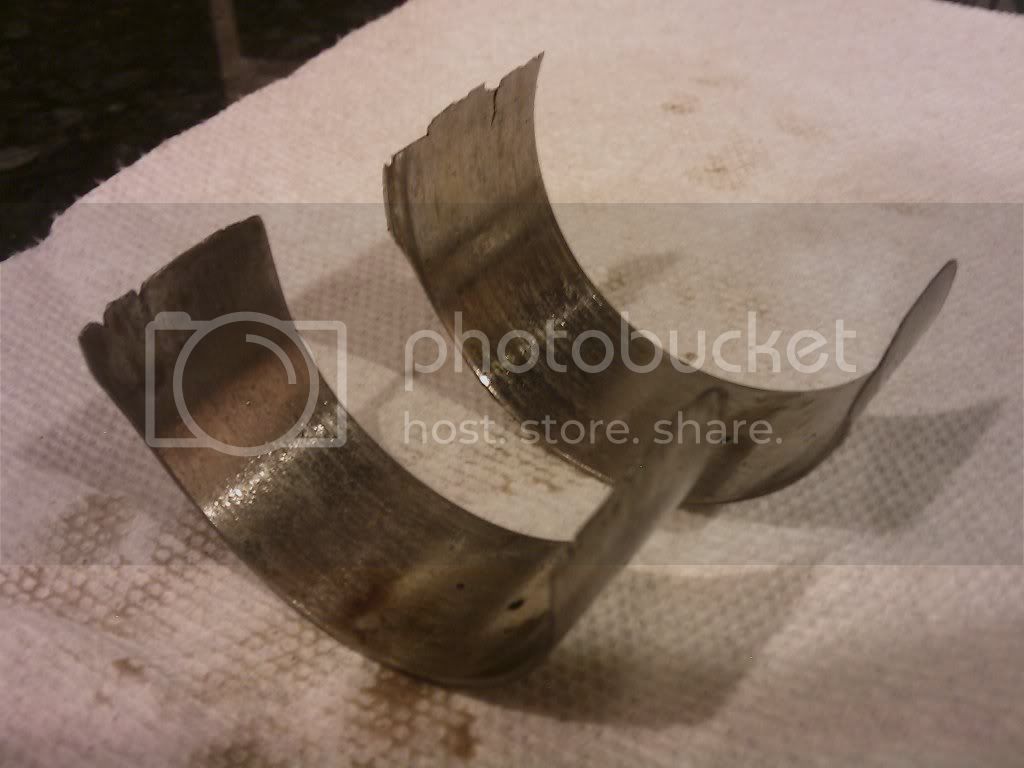
I tested the play in all the connecting rods and found #5 to be very loose. The other have no discernible play when pushed on with a large screwdriver. I removed the bolts and end caps for #5 and found these bearings.

IMAG0018.jpg


Yeah, I ain't no expert, but I'm pretty sure they're supposed to be thicker than that...
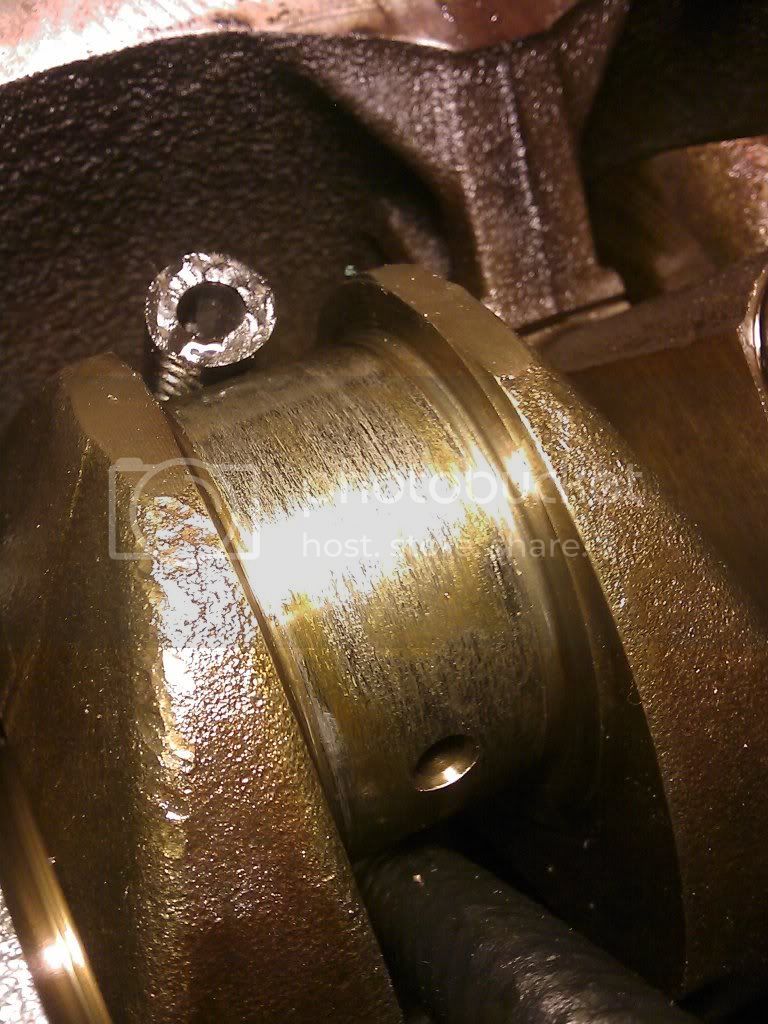
I was worried about the crank being damaged/burred/grooved, but to my joy, the crank seems very smooth and consistent.

IMAG0002.jpg


I haven't seen a 80 crank before, is it supposed to look like this? Or is this showing excessive burn? The connecting rod also felt very smooth and in good shape.
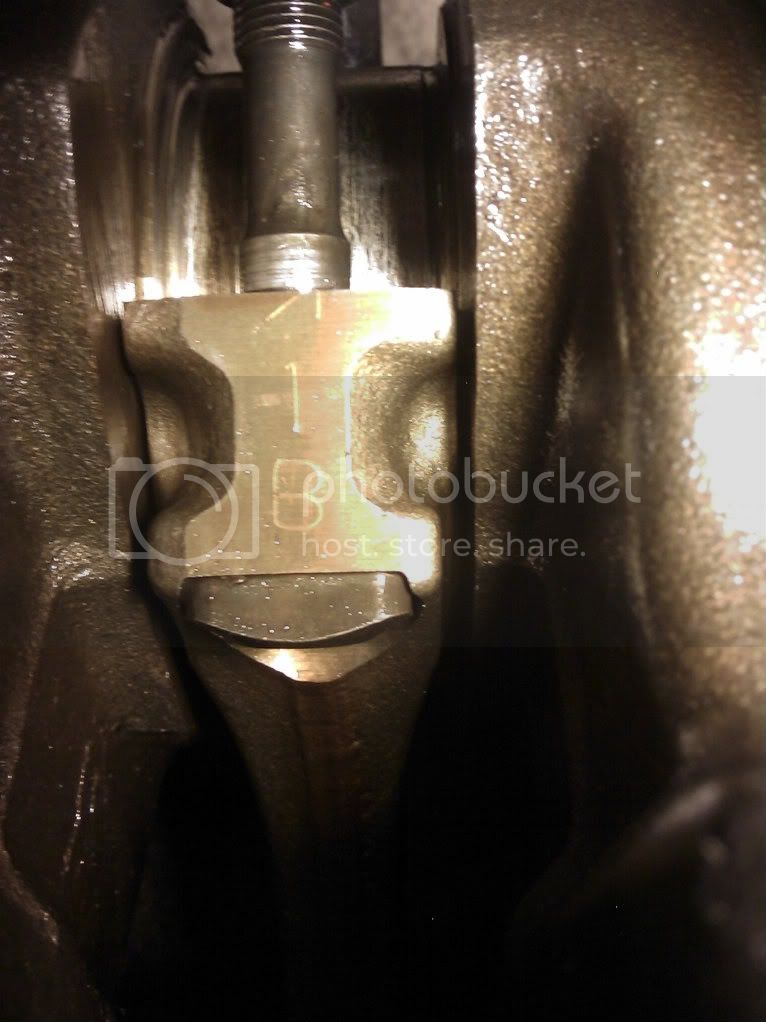
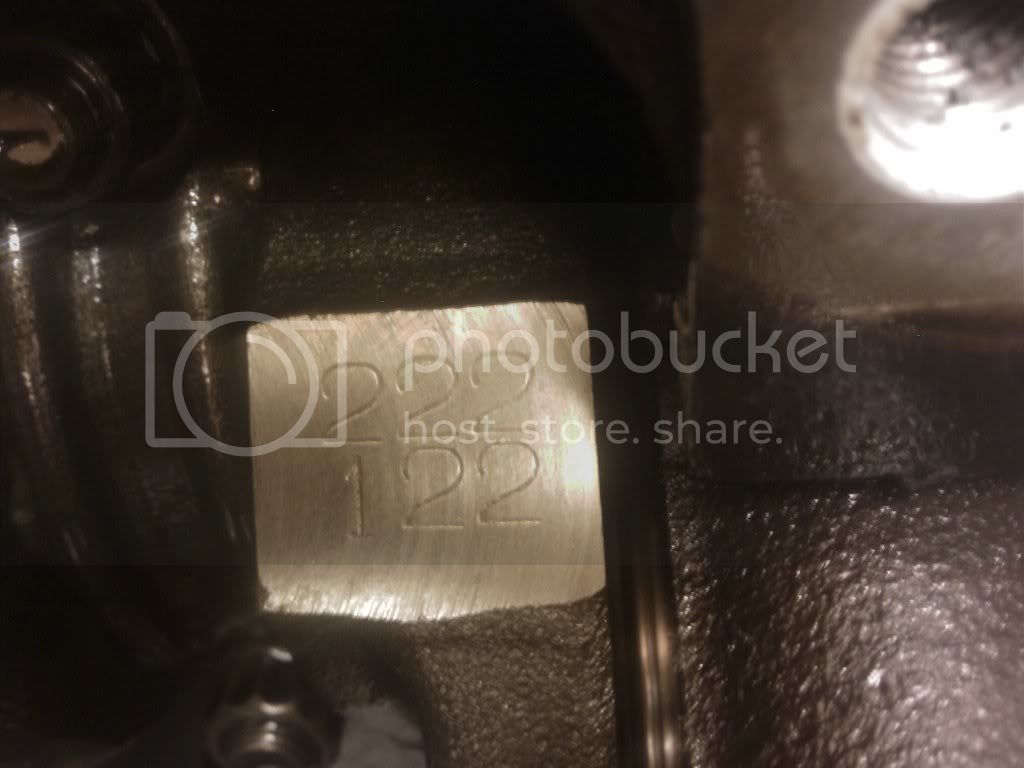
Next, I need to determine what size bearing to put back in. From what I read, I take the number off the connecting rod and add it to the corresponding number on the end of the crank to get the bearing size.

IMAG0014.jpg


IMAGE_025.jpg


I guess that means I'm looking for a rod bearing size 3. I'm going to see if I can find one in the valley tomorrow or maybe get an overnighter. The Beast may see Moab this weekend afterall.

When I go to put everything back together, what type of gasket material do I use? (I will plastigauge the bearing to make sure it's within spec.)
 
I'm no expert, but looks like the crank took a bit of a beating. You might be able to polish it out, but if you run it like that you will probably chew up the bearing pretty fast. You should remove another one & compare.

Godd Luck,
Paul
 
Coupla thoughts:

I'm a little worried about the look of that crank. Unless others have actually run a crank with new bearings on an old surface that looks like this, I'd say that slapping a new bearing on #5 is a very temporary solution. A new or freshly machined crank looks almost mirror like. The entire force from that piston (and it's a lot) pushes on a very thin film of oil contained between the crank surface and the bearing shell. If there are even small places for the oil to hide, you end up loading that force from the piston very unevenly across the bearing surface, squishing oil and increasing the probability of metal to metal contact. My guess is that you could get a few thousand miles out of it.

#2 Last time I did a motor, the bearings were sold in complete sets, so I don't know if you can find just this bearing.

#3 If I were in your shoes, I might consider finding a used motor (no accessories needed) and swapping it for yours. It could be a rebuilt one or one from a wreck. The nice thing about this solution is that you know all of your accessories and EFI, etc., and the only thing you would change would be the actual motor. To tell you the truth, I think this won't take much more money or time than what you are proposing.

#4 I will differ a bit from others about rebuilding the motor yourself. By the time you re-ring, hone cylinders, redo whatever you want to in the head (might as well while you are in there!), get the crank ground, buy new bearings and install, powerwash all of the oil galleries (brass shavings!), replace chain stuff, rent an engine hoist, etc. etc. etc., you will not make your trip to Moab. Although some people are comforted by driving around a motor that they have completely done down to the very last bolt, I have found it to be maddening. Every little pop you hear is potentially a piece of dirt you let fall onto the bearing surface, or it is a crank bolt you didn't tighten down properly, or two rings whose gaps line up, etc. etc. For me, I'd rather drive around a motor with 100,000 miles built by an anal retentive Japanese guy than a motor with 0 miles built by me. But that's just my own paranoia coming out.

In any case, good luck and keep us posted.
 
Try crocus cloth on that journal .. if you can get it looking polished (shiny) with crocus cloth ... then measure the diameter to see if there is any variance from side/center/side ... try to measure at different points "around" the circumference if you can ... I would check those measurements against a journal that looks good .
The pic you show illustrates a very bad journal -- if it doesn't clean up ... you will need to have the crankshaft machined. Remember that the oil pressure creates a film/cushion that the bearings (bushings) ride on ... any grooves/nicks will effect that cushion and you will have a repeat bearing failure
 
My crank ('94 190K mile 1FZFE) is currently on the bench as are my bearings. If you want pictures, drop me a line. My crank looked mirror smooth, as did my bearings. I also am coming to see the wisdom in Snowtire's point #4. I'm currently agonizing over 0.005" taken off my block...
 
Thanks for the responses, looks like I need to do some polishing. You can buy individual bearings for around $15 a piece. Finding and replacing the entire motor is a lot more work that what I am doing. I'm going this route because my top end is fairly tight. Newish HG and doesn't burn any oil. I do realize replacing the entire motor would have the lowest risk. What grit on the Crocus? I'd imagine about as fine as I can get, like 2400 or something...
 
that crank is toast. remove and replace. or get it welded and ground. but if you put in a new bearing on the journal it will run for approx 5-10 min and spin just like the original.
 
Uh...yeah...that crank is in need of being polished or maybe ground. However, if you feel like your time can be spent attempting to clean this one up, then drive it...then maybe get stuck on the side of the road on a road trip then do it.

But really, if you just bite the bullet and pull the motor, it's not a lot of work. But, if you don't think you can handle it, just buy a short block. I've built many many many motors for my trucks, cars, snowmobiles, motorcycles and it's not as hard as others have said. However, that is from my POV. But when you boil it down to brass tacks a motor is simple. And all this time you're spending pulling the pan, trying to clean up the crank, etc you could have LONG ago had this motor pulled, on a stand, crank out and to the machine shop, block cleaned, prepped, honed, and be ready for reassembly in a week or two.

If you keep going in the direction you're headed...I hate to predict failure...but if I were a betting man, I'd say you're asking for problems.
 
An alternative to rebuilding the bottom end yourself is to pick up a new short block from Toyota. You get the combination of a 0 mile motor and it was built by some anal retentive Japanese guy. Last I checked they were just under $3k. Of course you would have to add the cost of all new gaskets and any headwork to that figure, so it isn’t the cheapest route but it would save time. Additionally it would be a great chance to replace all the hoses , rubber bits, water pump and oil pump. Afterwards you would essentially have a brand new motor waiting for another 200,000+ miles.

Whenever my block starts leaking more oil than I can pour in it or does what yours did I plan to use a new short block and send out the head to be reworked. Maybe I'll even throw a supercharger on.

I don't know how accessible the oil pump is with the motor in the truck, but I would be tempted to replace the oil pump, with a new Toyota unit, if I had it open like you.
 
Coupla thoughts:

I'm a little worried about the look of that crank. Unless others have actually run a crank with new bearings on an old surface that looks like this, I'd say that slapping a new bearing on #5 is a very temporary solution. A new or freshly machined crank looks almost mirror like. The entire force from that piston (and it's a lot) pushes on a very thin film of oil contained between the crank surface and the bearing shell. If there are even small places for the oil to hide, you end up loading that force from the piston very unevenly across the bearing surface, squishing oil and increasing the probability of metal to metal contact. My guess is that you could get a few thousand miles out of it.

#2 Last time I did a motor, the bearings were sold in complete sets, so I don't know if you can find just this bearing.

#3 If I were in your shoes, I might consider finding a used motor (no accessories needed) and swapping it for yours. It could be a rebuilt one or one from a wreck. The nice thing about this solution is that you know all of your accessories and EFI, etc., and the only thing you would change would be the actual motor. To tell you the truth, I think this won't take much more money or time than what you are proposing.

#4 I will differ a bit from others about rebuilding the motor yourself. By the time you re-ring, hone cylinders, redo whatever you want to in the head (might as well while you are in there!), get the crank ground, buy new bearings and install, powerwash all of the oil galleries (brass shavings!), replace chain stuff, rent an engine hoist, etc. etc. etc., you will not make your trip to Moab. Although some people are comforted by driving around a motor that they have completely done down to the very last bolt, I have found it to be maddening. Every little pop you hear is potentially a piece of dirt you let fall onto the bearing surface, or it is a crank bolt you didn't tighten down properly, or two rings whose gaps line up, etc. etc. For me, I'd rather drive around a motor with 100,000 miles built by an anal retentive Japanese guy than a motor with 0 miles built by me. But that's just my own paranoia coming out.

In any case, good luck and keep us posted.

Same thing happened to my '95, I attempted to replace the bad bearings after honing with an emory cloth for almost a day. It lasted me 8 miles before it started making bad noises again.... I ended up replacing the engine (not cool) and still have some minor glitches to fix...but it's the journey not the destination, or so I am told...
 
Ouch 8 miles. Sounds like I'll be lucky if I get that many! I'm going to try polishing and putting it back together just for the heck of it. I'm only into about 6 hours, so might as well button it up before I swap engines. Any one have a bottom end they want me to take off their hands?

I will polish the rod and the crank to a mirror finish and also go over it carefully with my Starrett 721. Don't worry, I will for sure let you know how many miles or how much run time I get before it spins again. Then you can all say, I TOLD YOU SO!

Maybe we should start a wager on how long it will run before it happens again. I'm giving my polishing skills a confident 50 miles. Winner gets this crankshaft...

For putting back the oil pans, do you all just use high temp silicone gasket sealer? Does sensor safe matter?
 
Back
Top Bottom