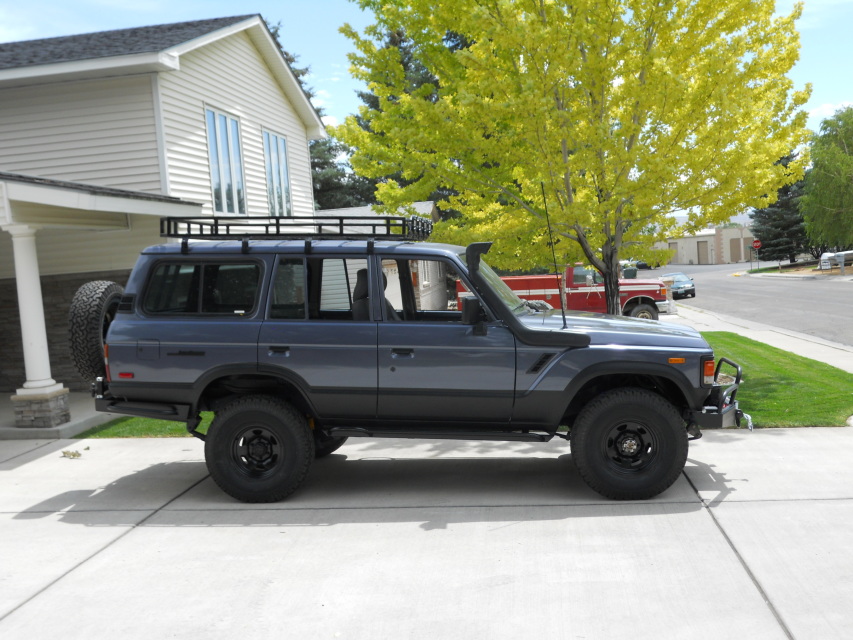
What Did You Do with Your 80 This Weekend?

This site may earn a commission from merchant affiliate
links, including eBay, Amazon, Skimlinks, and others.

In between kitchen duties I managed to finally finish the supercharger install this morning then filled the cooling system with distilled water for its first engine run in 6 months.
Came back an hour later to a puddle on the garage floor. 😕
Supercharger back off so i could get better access to the leak area.
View attachment 4038492
Started second guessing if i had fitted the 3 O-rings but on inspection they were present and not damaged. The gasket between the thermostat housing was also in place and good. Will investigate futher tomorrow when wine isn't part of the equation.
It's probably the gasket on the heater return pipe. Especially if you used a paper one instead of the OEM metal gasket.
 
H series Cerakote in satin silver.

IMG_0645.webp


IMG_0646.webp


IMG_0648.webp


IMG_0649.webp


IMG_0650.webp
 
Last edited:
It's probably the gasket on the heater return pipe. Especially if you used a paper one instead of the OEM metal gasket.
Proper OEM metal gasket was used. Gasket didn't look damaged. My hypothesis is that the plate between the timing cover and thermostat housing is cracked. I will know for sure in about 2 hours.
 
Hypothesis #1 is a fail so far as I can tell. No cracks or corrosion that I can see on the thermostat guide plate or any of the mating surfaces. The timing cover side also looks good.
20251128_094040.webp


I tried a new thermostat guide gasket (16119-66020) and a new heater bypass gasket (15785-66010) but it is still leaking :frown:. The only difference from this build to all the others I have done is the supercharger - specifically the heater bypass pipe. I have checked this pipe with an engineers flat bar (same thing I use to check the block surface) and it is OK.

The leak is with cold water so no thermal expansion in play. I am now out of new gaskets. I could try a thin coat of sealer on the gaskets but at the moment I am very reluctant to go down this path. I"m running out of ideas.
 
Hypothesis #1 is a fail so far as I can tell. No cracks or corrosion that I can see on the thermostat guide plate or any of the mating surfaces. The timing cover side also looks good.
View attachment 4038606

I tried a new thermostat guide gasket (16119-66020) and a new heater bypass gasket (15785-66010) but it is still leaking :frown:. The only difference from this build to all the others I have done is the supercharger - specifically the heater bypass pipe. I have checked this pipe with an engineers flat bar (same thing I use to check the block surface) and it is OK.

The leak is with cold water so no thermal expansion in play. I am now out of new gaskets. I could try a thin coat of sealer on the gaskets but at the moment I am very reluctant to go down this path. I"m running out of ideas.
The o-rings are in good shape? I have pinched the lower one before and had to pull apart and use some lube on the o-ring.
 
Hypothesis #1 is a fail so far as I can tell. No cracks or corrosion that I can see on the thermostat guide plate or any of the mating surfaces. The timing cover side also looks good.
View attachment 4038606

I tried a new thermostat guide gasket (16119-66020) and a new heater bypass gasket (15785-66010) but it is still leaking :frown:. The only difference from this build to all the others I have done is the supercharger - specifically the heater bypass pipe. I have checked this pipe with an engineers flat bar (same thing I use to check the block surface) and it is OK.

The leak is with cold water so no thermal expansion in play. I am now out of new gaskets. I could try a thin coat of sealer on the gaskets but at the moment I am very reluctant to go down this path. I"m running out of ideas.
To confirm, it is leaking without the engine having been run. Correct?
 
To confirm, it is leaking without the engine having been run. Correct?
Correct. Happened when filling the cooling system. Cold water, no pressure. Leak results in a 1 drop per second on the floor so not a small leak.
@Fj80oregon the 3 O-rings were my first guess so i swapped them yesterday. Original (new ones) looked perfect.
 
Classic 1FZ-FE monster torque setup:

5.3L
102mm bore cp flat pistons
108mm crankshaft

Head is milled around 0.5mm. Compression is quite high since I had to retard ignition advance significantly at lower RPMS or else it knocks, also had to introduce transient knock retard.

3.5 inch Cold air intake, 6-1 Long Tube Headers and straight through muffler, Emtron SL6 ECU, 3UR-FE Coils, Walbro 525 LPH Fuel Pump, AEM Fuel Pressure Regulator, All else stock.

Broad torque curve, runs out of steam above 4500RPM cause of the stock intake manifold (as in stock GEN 2 1FZ-FE intake manifold) and stock camshaft.

I am amazed that I am able to go up dunes on 2WD third gear at slow speeds wide open throttle keeps going forward never stalling. Even if it gets down to 1200-1500 RPM.

20251128_023545659_iOS.webp


20251128_023534807_iOS.webp


20251128_064326879_iOS.webp


In the first clip of this video especially, I was amazed at how it climbed the steep dune on third, stock would have bogged in third as soon as it touched the sand, I purposely did not gain speed before hitting the dune so minimal momentum. This setup makes it feel light. The 80 series is the best vehicle!


 
Last edited:
Classic 1FZ-FE monster torque setup:

5.3L
102mm bore cp flat pistons
108mm crankshaft

Head is milled around 0.5mm. Compression is quite high since I had to retard ignition advance significantly at lower RPMS or else it knocks, also had to introduce transient knock retard.

3.5 inch Cold air intake, 6-1 Long Tube Headers and straight through muffler, Emtron SL6 ECU, 3UR-FE Coils, Walbro 525 LPH Fuel Pump, AEM Fuel Pressure Regulator, All else stock.

Broad torque curve, runs out of steam above 4500RPM cause of the stock intake manifold (as in stock GEN 2 1FZ-FE intake manifold) and stock camshaft.

I am amazed that I am able to go up dunes on 2WD third gear at slow speeds wide open throttle keeps going forward never stalling. Even if it gets down to 1200-1500 RPM.

View attachment 4038688

View attachment 4038689

View attachment 4038691


In the first clip of this video especially, I was amazed at how it climbed the steep dune on third, stock would have bogged in third as soon as it touched the sand, I purposely did not gain speed before hitting the dune so minimal momentum. This setup makes it feel light. The 80 series is the best vehicle!


Your cold air intake needs a source of cold air.
 
I just started finding drips under my 94, apparently oil from the rear differential carrier behind where it meets the drive shaft.

I think the oil seal highlighted in yellow is my problem. I'm looking for a thread that shows successful R&R but can't find one.

Can anyone point me towards more info, and maybe give me a banana score? How does this compare to doing wheel bearings?


1764441522873.webp


Thanks,

T.
 
I just started finding drips under my 94, apparently oil from the rear differential carrier behind where it meets the drive shaft.

I think the oil seal highlighted in yellow is my problem. I'm looking for a thread that shows successful R&R but can't find one.

Can anyone point me towards more info, and maybe give me a banana score? How does this compare to doing wheel bearings?


View attachment 4039151

Thanks,

T.
Clean it up then unplug the breather on the top, see if it stops, if it does plugged breather, sometimes if plugged up pressure will push out the oil through that seal
 
The o-rings are in good shape? I have pinched the lower one before and had to pull apart and use some lube on the o-ring.
After my rebuild mine leaked at the o-rings as well. Installed new ones using sil-glide and no issue. I must have nicked one when installed. 45k since and not an issue.
 
Back
Top Bottom