Real Time Help-Almost melted wiring loom near EGR valve

This site may earn a commission from merchant affiliate
links, including eBay, Amazon, Skimlinks, and others.

Joined
Jun 9, 2006
Threads
89
Messages
2,632
Location
Utah
This morning I popped a P0401 code, so I have been reading up on how to either fix or bypass the system here on MUD and in the FSM.

As a temporary fix I went outside to see where the resistor should be placed to do the bypass and to my chagrin, the wiring harness heat wrap has been heat blasted to near disintegration!

Luckily, the wires underneath appear to have survived and to not appear to be melted. I will investigate further and re-wrap it when I have the chance to.

In the mean time I need to disable the EGR system to prevent the wiring harness from frying.

I am still learning about how the egr system works but from what I have read, the system will NOT pull hot exhaust gasses back through the intake runners IF the 2 vacuum hoses that are connected to the throttle body are capped as well as the 2 ports to the EGR Vacuum Modulator (the space ship on the PS side with 2 PS ports, 1 DS side port and a port on the bottom).

Is that correct? I'm worried that if I start capping and plugging those lines I will end up with an epic failure like what happened to Grench:

https://forum.ih8mud.com/80-series-te...-meltdown.html

I cannot see where the exhaust gas has been spewing from exactly, but my best guess would be somewhere near the EGR valve where it screws into the round pipe (not where it bolts onto the intake manifold).

I've been looking over the FSM and it looks like the exhaust could still spew from the EGR unless it is completely removed and capped.

Is that true or will capping the vacuum lines that go to the TB prevent exhaust gasses from being sucked up into the EGR?

I am at school right now and my tools are at home, so capping the vaccum lines in order to limp home without frying the loom would be great if it will work.


Thanks in advance!

Edit: I have been reading this post by RT that states that the system can be disabled, but I just want to be sure flaming hot exhaust gasses won't be able to spew from the system and fry the loom.

I have not nor do I plan to delete the EGR on my 80, there is just no good reason to do so, unlike the 3FE you cannot gain much working space by de-smoging a 1FZ,

But I do know the EGR system and hypothetically if I were to it would go something like this:

The temp sensor resistor is detailed in another thread, that tricks the ECU, that is the ECU's only window into EGR operation,

You could then unplug the two vacuum lines on top of the throttle body that go to the modulator, plug the ports on the TB and on the modulator. Depending on how discrete you are with you plugs and how good the inspector is it may or may not pass the visual portion of a smog inspection,

EGR is then disabled with the parts still in place, easily reinitiated

If you wanted to go further and remove the parts:

Unplug the VSV and cover and seal the plug to prevent corrosion of the pins or a short from water, possibly by packing the plug with dielectric grease then wrapping it in electrical tape and then heat shrink.

Remove the vsv and its bracket under the intake, plug the ambient line at the T with the purge valve, plug the bottom of the hard line that passes through the intake, cap the top of it also,

Remove the modulator and its bracket,

Remove the EGR valve and EGR pipe, source a cap for the EGR outlet on the head (good luck) use a new gasket as a template to fabricate a block off plate for the open port on the intake manifold, 5/16” 7075-T6 aluminum worked well for the 3FE, install both.
 
Last edited:
I actually have a roasted EGR modulator valve here on my desk.

I had a clogged catalytic converter that caused excessive exhaust back pressure, forced the bottom hose off of the EGR modulator valve. It resulted in spewing hot exhaust gases directly into the valve like a blow torch and drilled a hole right through it.

The vac input labeled R goes into the valve and actuates it.
The vac input labled P goes right on through to Q.

If I understand it right, the valve under the intake that connects back to Q acts as a defeat.

A link to a thread with pics and links to other threads that explain how it works better than I could ever do in one post.

https://forum.ih8mud.com/80-series-tech/245912-near-rth-vacuum-modulator-meltdown.html
 
I cannot see where the exhaust gas has been spewing from exactly, but my best guess would be somewhere near the EGR valve where it screws into the round pipe (not where it bolts onto the intake manifold).

I've been looking over the FSM and it looks like the exhaust could still spew from the EGR unless it is completely removed and capped.

Is that true or will capping the vacuum lines that go to the TB prevent exhaust gasses from being sucked up into the EGR?

From what I've lived through, the most likely culprit is going to be the stem off of the EGR valve (DS space ship) that points to a little L shaped hose on the bottom of the EGR modulator valve (PS space ship) and puts exhaust pressure under it.

This is the point where mine failed twice. On a SC engine with old stock exhaust and clogged catalytic converter, the back pressure was too much for that little L shaped hose to either stay on the modulator valve (my meltdown documented in the link) or even to split the L hose itself.

As a temporary fix to stop the blazing gases coming through, inspect the L shaped tube. I replaced mine temporarily (while waiting to get parts and change out the exhaust system) with a 3" piece of super heavy duty high temp 1/4" ID 1/2" OD hose. One end I clamped -tight- to the EGR stem. The other I put a 1" long 1/4" bolt in and clamped down as well.

Now, how your gases got back behind the EGR to the main wiring harness... don't know. Mine hit my SC wiring harness that we had strung back behind the EGR setup.

Keep us updated. A picture of where your harness melted would help out a bit in pinpointing the leak too.
 
As a temporary fix to stop the blazing gases coming through, inspect the L shaped tube. I replaced mine temporarily (while waiting to get parts and change out the exhaust system) with a 3" piece of super heavy duty high temp 1/4" ID 1/2" OD hose. One end I clamped -tight- to the EGR stem. The other I put a 1" long 1/4" bolt in and clamped down as well.

Now, how your gases got back behind the EGR to the main wiring harness... don't know. Mine hit my SC wiring harness that we had strung back behind the EGR setup.

Keep us updated. A picture of where your harness melted would help out a bit in pinpointing the leak too.

Thanks Grench. I'm having a family member pick me up from school so I can go home and get some tools. The big thick loom that is covered with heat sheilding is what is deteriorated. It's the one that is right next/behind the EGR pipe.

I'll hopefully have some pics later on tonight, but keep the suggestions coming in the mean time.

Thanks!
 
Thanks Grench. I'm having a family member pick me up from school so I can go home and get some tools. The big thick loom that is covered with heat sheilding is what is deteriorated. It's the one that is right next/behind the EGR pipe.

I'll hopefully have some pics later on tonight, but keep the suggestions coming in the mean time.

Thanks!

OK. So the primary loom behind the EGR. When we replaced the head gasket, I found my harness was toasty there too. That area is a whole lot easier to work in if the EGR valve is out of the way. However, getting it out of the way is a bit of a PITA.

If you need to remove the EGR valve, a quick tip. Loosen the nuts about 3/4 of the distance off the stud, then double nut them and remove the studs. The EGR valve won't come off without the studs removed. Seriously... and yes that's whacked.

Good luck and keep us posted!
 
OK. So the primary loom behind the EGR. When we replaced the head gasket, I found my harness was toasty there too. That area is a whole lot easier to work in if the EGR valve is out of the way. However, getting it out of the way is a bit of a PITA.

If you need to remove the EGR valve, a quick tip. Loosen the nuts about 3/4 of the distance off the stud, then double nut them and remove the studs. The EGR valve won't come off without the studs removed. Seriously... and yes that's whacked.

Good luck and keep us posted!

Thanks for the tip.:) Yes, its the primary loom. I changed all the firewall hoses last fall and IIRC the loom was covered with a silver-gray heat wrap and it seemed to be solid. Now it is brittle and I was able to poke my finger through it to expose the wires. It also has black-peppered look to it now and I assumed that it was exhaust. However, maybe that's just how it looks when it gets old.

After spending some time looking at it in the school parking lot, I couldn't see anything that appeared to be leaking. So I hooked everything up, crushed a diet coke can (that I scrounged out of a garbage can) and placed it over the loom just in case anything failed on the 4.3 mile trip home.:hillbilly:

The trip home was uneventful. She drove how she normally does and I didn't even see a drop in MPG with the P0401 code (I use 0.25-0.27 gallons depending on which route I take). Luckily I will be able to use a spare family vehicle tomorrow and hopefully I will have more time tomorrow night to start diagnosing the problem or disabling the system (whichever one I have time for).

I won't have another emissions testing for at least another 1-2 yrs, so I might just disable it. However, I read in the FSM that the EGR system was designed to 1)Lower emissions and 2)Lower combustion temperatures. The latter kind of has me worried if I were to disable it.
 
Today I capped off the two lines that run from the throttle body to the VSV modulator. I used a pretty slick tip from our own Beowulf. IIRC he was the one that mentioned to place a "BB" (as in BB gun) into the vacuum line as a sly way to pass visual inspection with a LT MAF. The fit perfectly in the lines.

I also placed a 3.9K ohm resistor (same one Gotmud used) in the EGR temp plug and cleared the codes via SGII.

So far, so good. No P0401's, it idles and drives like it should. Not enough data to tell if the was an MPG +/- yet.

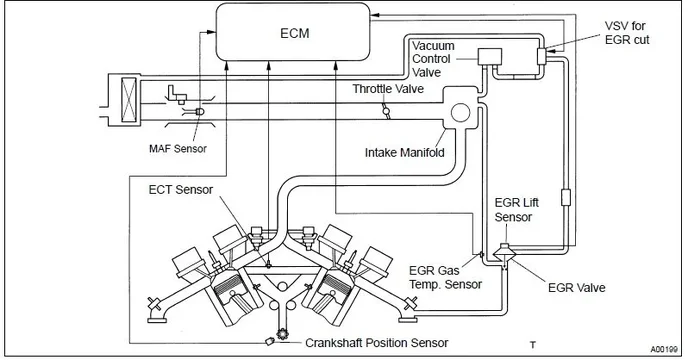
Does anyone know where the EGR pipe leads to? It seems to go down behind the motor somewhere and eventually pull exhaust up to the intake. I ask because it seems like even though the vac lines are disconnected/plugged, the hot exhaust should still be able to creep up through the EGR and get sucked into the intake.

Am I wrong? I know the lovely boyo and a few other people were wondering the same thing, but I didn't see anyone give them a clear answer.

I'm trying to read more about the EGR system but I only have the electronic FSM and I haven't deciphered the file labels yet so it's been slow going trying to find relevant pages.

Thanks!
 
The pipe leads to the back of the head where it recircs exhaust gases. That pipe itself can get up to 1000 degrees during operation.

Hell almighty, that is hot. I am 100% convinced that the US market HG woes at cylinder 6 are due to this POS system. It obviously was necessary for Mr. T to get the pig to pass gubment standards, but I'm going to keep it disabled as long as possible.

I found this in the FSM:

"The recirculated exhaust gas lowers
the combustion temperature and NOx production is reduced. Under some driving conditions, EGR gases
affect driveability. Under these driving conditions, the ECM commands the VSV for EGR–cut to block the
engine vacuum source to the EGR valve. Blocking the vacuum signal allows the EGR valve to close and
stop recirculation of the exhaust gas to the intake manifold."

egr.webp


So I guess by blocking the tubes that ran from the TB that I have effectively neutered my EGR system.

That is unless that upper line in the diagram that runs from the VSV to just before the MAF has any influence on the system.

In other words, have I stopped the EGR valve and pipe from exhibiting temperatures of ~1000 degrees?
egr.webp
 
Last edited:
1'' of garden hose fits nicely over the main harness for a temp fix and its alot easier than disabling the system :D

Same place i began to melt my main harness and where InfoJunky melted his stranding him ontop of a mountain in the middle of nowhere.

Sorry cant answer any of your questions on whether the system is completely and safely dissabled. Looks like youve already found the thread for dissabling and fooling the system w/ the resistor. I put a piece of industrial hose around the loom and its been fine for over a year now.
 
1'' of garden hose fits nicely over the main harness for a temp fix and its alot easier than disabling the system :D

Same place i began to melt my main harness and where InfoJunky melted his stranding him ontop of a mountain in the middle of nowhere.

Sorry cant answer any of your questions on whether the system is completely and safely dissabled. Looks like youve already found the thread for dissabling and fooling the system w/ the resistor. I put a piece of industrial hose around the loom and its been fine for over a year now.

Good idea. I'm tempted to pull the EGR valve, make a cap for the intake manifold, then find some sort of cap for the EGR valve tube. I'm not so sure how easy that would be since I'm sure it is a metric size.

That would be a pretty good way to make sure that no hot gas is coming up, but it would take <10min to out back together in the event that I have to pass emissions in the future.


If I could get my hands on a broken EGR valve I could cut the nipple portion off and weld a plate over it to seal it off.

Does anyone have an broken EGR valve laying around that they would be willing to part with?
 
Good idea. I'm tempted to pull the EGR valve, make a cap for the intake manifold, then find some sort of cap for the EGR valve tube. I'm not so sure how easy that would be since I'm sure it is a metric size.

That would be a pretty good way to make sure that no hot gas is coming up, but it would take <10min to out back together in the event that I have to pass emissions in the future.


If I could get my hands on a broken EGR valve I could cut the nipple portion off and weld a plate over it to seal it off.

Does anyone have an broken EGR valve laying around that they would be willing to part with?

I'm not endorsing this idea, just floating it as a problem solving exercise.

What about creating a sheet steel gasket without a center hole for the end of the EGR on the exhaust side? That should short end the heat at the source. Passing emissions sniff tests might not do so well though.

IMHO YMMV
 
I'm not endorsing this idea, just floating it as a problem solving exercise.

What about creating a sheet steel gasket without a center hole for the end of the EGR on the exhaust side? That should short end the heat at the source. Passing emissions sniff tests might not do so well though.

IMHO YMMV

Isn't that pretty hard to get to? I thought that was connected to the head and kind of inaccessible due to the intake manifold.

If I could guarantee that I would never have to do a sniff test then I would do that. I haven't had to do one for 3+ yrs but that may change in the future, so I'd like a semi-quick way to put it all back together to pas if need be.

Actually come to think of it, I don't think I have ever had to pass a sniff test. IIRC WA state only plugged an OBDII plug into my port and didn't even do a sniff test. I know they didn't have me pop the hood. I didn't even have to get out of the car. It was like a drive thru setup.

As long as my resistor keeps the CEL off, I'd imagine I'd pass unless they popped the hood. :doh:
 
Back
Top Bottom