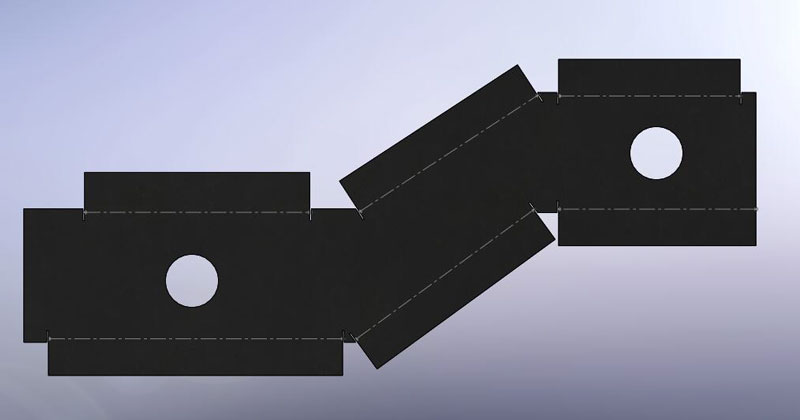
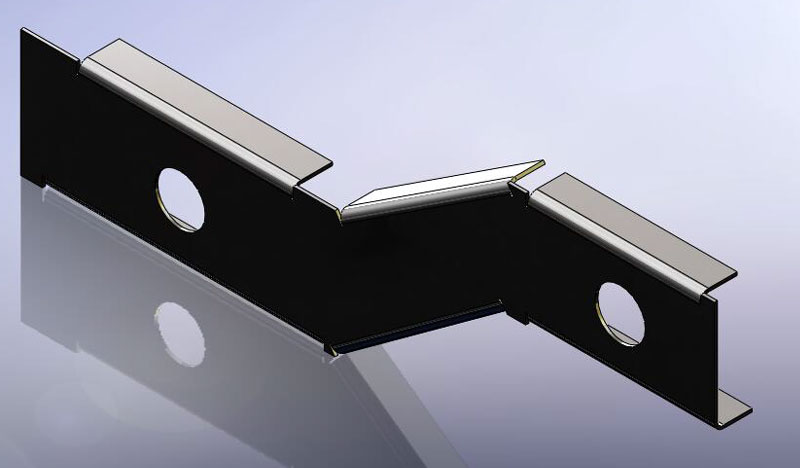
My HJ45 has a section of inner frame that's rusted through and brittle in spots. I can easily poke a screwdriver through in a couple of sections. Thankfully the outer frame is still in decent shape. I've been reading frame repair threads for a while and most people seem to just weld a patch panel directly to the outer frame. That's OK, I guess.
I've been trying to figure out a way to inexpensively fab a section of the inner frame and here's what I have come up with in SolidWorks. It's a proof of concept and not dimensionally accurate yet. I can cut it out of sheet using an X-Y plasma cutter and bend it up. The bender I have access to can't bend curved steel without very expensive custom tooling so I'm going to TIG in the bends between the tabs.
I'll grind/plasma the stock frame rivets out and bolt the new section in using grade 8 hardware in the same locations. The ends of the frame channel will be flanged so they can be rosette welded to the existing, solid inner frame rail
Any thoughts on the concept? I think it will work but before I get too far into it I figured I'd ask here first.
Nice looking part. I don't think you will gain much by welding in the sections between the tabs, but you will make fitting much more difficult.
One thing to consider is the rivets. They take a bit of removal, attached photo show the rivets that attached the rear cross member of my '75 FJ45 to the curved stiffeners that run to the spring hangers. I ground the rivet heads off and hit the rivets to drive the stiffener and cross member apart. Where there is a C section riveted in you might need to cut the C and take the two halves out seperately. I suppose this is a body off job? The rivets themselves seem quite ductile and might drill out as easily as the grind or burn out.
That plan will work fine, just be sure not to bend your C channel to wide so it fits in (obviously). As for welding in the curved flanges I would do it just to add more rigidity. As mentioned it will make fitting more challenging. Take a look at miker's thread here (post 217+), he made his inner channel over the rear axle with a flat web and welded the entire flange on with bent flat bar (very nice work BTW). And he bolted the rivet locations. By bending your straight sections you will reduce welding and therefore distortion from shrinkage.
I also have removed rivets from my frame. I ground the head off and drilled out most of the rivet to weaken it (not all the way through) leaving a thin wall of rivet with a solid bottom. Then punch it out with a small round punch and hammer. Even with the head off and drilled it took a few good smacks to send it accross the garage.
I also have removed rivets from my frame. I ground the head off and drilled out most of the rivet to weaken it (not all the way through) leaving a thin wall of rivet with a solid bottom. Then punch it out with a small round punch and hammer. Even with the head off and drilled it took a few good smacks to send it accross the garage.
Thanks for all of the feedback. I hadn't seen miker's thread. I thought about doing it the way he did and may end up having most of mine look like that. The curves in the frame are much more gradual than what's depicted in my mock up part. There may not be enough straight area to bend the tabs the way I was hoping. I'll know for sure soon when I make a template out of plywood.
I do plan to pull the body off of the frame for access to the rivets. It will also help me do a better job applying rust treatment on the whole thing.
I was just going to post something about the curves, I looked a my frame this morning and realized how smooth they are.
Looking at the bump stops also made me wonder why the frame goes so high, perhaps Toyota were think a head to all the multi-link suspensions the clever guys on here fabricate.
Mikers thread is a great read and has give me lots to aspire to.