Hydraulic parking brake

This site may earn a commission from merchant affiliate
links, including eBay, Amazon, Skimlinks, and others.

Joined
Nov 10, 2006
Threads
111
Messages
936
Location
Bonsall, CA
So I got really fed up with the definitely stupid design of parking brakes. I want to go hydraulic. A disc brake engaging on the driveshaft is not an option because I do not want to stress the diff and I do not want to be dependent on the play which is caused by the axles and diff. Sometimes a little play can make the vehicle move while it's on jack stands.

I have just designed a parking brake lever which bolts onto the existing holes and uses a typical brake master cylinder. Then there is elastic tubing which goes to the back and there.... and there is a slight problem.

What are the differences between the drum brake axles and disc brake axles. Maybe on the disc brake axles I could fit a brake cylinder inside. Are there any holes which would let me do it?

Are the parking brake shoes/pads any different from the drum brake ones?

I don't have any problem when it comes to welding and fabricating stuff but it's obviously better if I can just bolt on stuff.

Any comments? Photos? Info?
 
If you wanted a hydraulic parking brake, I would just skip the drum parking brake and use the existing disk setup.

Look up cutting brakes. They are designed to engage just one disk brake at a time, by tapping into the existing system.
 
Are you sure that I can use the existing disc system? My understanding is that it is impossible. Vehicles use an open hydraulic system, which means that while the brake pedal is not pressed there is an open circuit between the brake system and the brake reservoir. This is made to keep the brakes' performance constant in different temperatures. When braking fluid expands due to heat, it is circulated to the reservoir.

So if I create any pressure in the system by using another cylinder (in the parking brake lever) all the fluid will spill through the reservoir and the brakes won't even budge. The exact thing happens when you press the caliper cylinders to install new pads: all the fluid goes to the reservoir and not to the wheels.

Another factor is redundancy and simplicity. Two separate brake systems are better than one, and simplicity means that the best system is one with few connections. Adding another brake line, another cylinder and some connectors will unnecessarily complicate the system.

So anyway I can only create a separate system which uses the brake drums. This is why I wanted to know what are the differences between a disc and drum axle. The calipers have special mounts, but maybe the disc axle still has mounts for the drum cylinder? Any comparison pics would be great as there must be people who have completed a drum-to-disc conversion.
 
Just install a brake line lock kit. They are available in manual and electronic versions. Put your foot on the brake, engage the lock, and now all four wheels are locked. Google search "brake line lock", and you'll find your solution.
 
Just install a brake line lock kit. They are available in manual and electronic versions. Put your foot on the brake, engage the lock, and now all four wheels are locked. Google search "brake line lock", and you'll find your solution.

Blimey that takes me back when I use to drag race and we fitted what was known as a 'roll control' used an electronic valve to trpa the fluid in the brake line and locked the front brakes, lean on the throttle and 'stretch' the car into stage, press harder on the the throttle and release the switch and gooooooo!!!!

The only issue in the UK and perhaps Poland is the legal requirement to have a mechanical as well as a fluid brake to stop the vehicle.

This can be done quite easily, just check out the legality of it before spending money.

regards

Dave
 
So here goes my own idea. The orange cylinder is the brake cylinder which will activate the hand brake. The brown cylinder is a gas strut/spring.

My idea was to make a hand brake which will engage and disengage without the need to use buttons and which would apply constant pressure to the brake cylinder in order to keep the brakes clamped with a constant force.

In drawing 1 the lever is put down and the pivot on the blue lever (A) is lower than the pivot on the base (B). This difference makes the gas strut (brown) pull the lever downwards.

After pulling the blue lever up we approach a point when the pivot A is higher than B and from that time on, the gas strut pulls the lever upwards until it is stopped by the brake pads pressing on the rotors/drums. The gas strut will apply pressure all the time so there is not fear of the brakes losing grip and rolling the vehicle.

How about that for a start? Looks good to me.
hamulec-prototyp1.webp
hamulec-prototyp2.webp
 
I would prefer a mechanical ratcheting system similar to the stock ebrake setup to keep things simple. With the setup in your drawing, you are now relying of the pressure of the brown gas shock to maintain the force on the parking brake. If it loses pressure or otherwise fails, your ebrake no longer works.
 
There is always a neccessity to rely on something. Either it is ratchets or other stuff. I also thought about this and came to the conclusion that gas struts that see almost no use will last a few decades. My rear hatch struts are already 14 years old, are (and probably have been) stretched and compressed a few times a day during that period and still work. A hand brake will see usage a few times a month so I see an even longer mean time between failures. And with hydraulic brakes a ratchet would be risky because fluids cannot be compressed so if the brakes engage right before the next ratchet is about to click, you must lock the system one ratchet below and this might not be sufficient. A hydraulic brake must have some sort of constant pressure on the cylinder to keep the brakes from losing grip. Imagine that you park the car in the middle of a sunny day. In the middle of the night the temperature goes down by 10 degrees and the fluid contracts disengaging the brakes. Well, it might actually quit working once the truck cools down because after a long trip everything is warm from the engine heat. The center tunnel is warm, the rear axle is warm, as well as the brake area. After three hours all these components cool down, as well as the fluid within the system. This is why I do not want a ratchet system.
 
Got one of these on my bj42, was installed in 1983, still works.


MICO, Inc. : Products/Literature

or

Lever Lock - Mico® Brake Locks

MICO locks are a good product, but they're not intended to replace the mechanically actuated parking brake on a vehicle. They can, and will, bleed off over time. Usually about 2am in the morning, sending your rollback tow-truck careening down your street, and into the new car at the end of the block, totalling it. :doh: Been there, done that.

From MICO:
For these reasons, the MICO Lever Lock must not be
used for overnight or prolonged parking.

The MICO Lever Lock is a SUPPLEMENTAL safety device and
is NOT to be used in place of the original equipment parking
brake.

...MICO Lever Lock must not be
used for overnight or prolonged parking.
 
MICO locks are a good product, but they're not intended to replace the mechanically actuated parking brake on a vehicle. They can, and will, bleed off over time. Usually about 2am in the morning, sending your rollback tow-truck careening down your street, and into the new car at the end of the block, totalling it. :doh: Been there, done that.

From MICO:


I would say that about any hydraulic braking system. They are only a supplement to the mechanical system, which is essentially failsafe as long as they don't corrode. So if you've got a corrosion problem, keep everything lubed up, shouldn't be an issue.
 
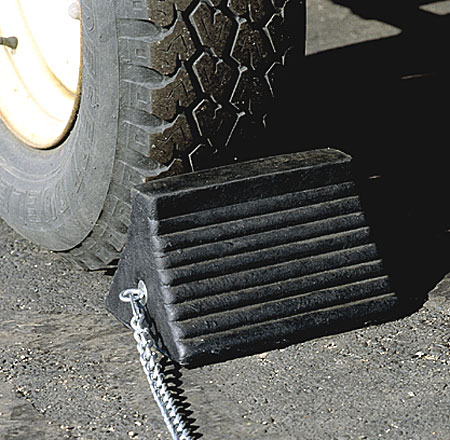
Cheap. Easy. Effective.

Economy-Wheel-Chock-BEN_i_lb16050.jpg


D

Disclaimer: I have no useful information to add. Just thought this was ammusing.
 
Cheap. Easy. Effective.

Economy-Wheel-Chock-BEN_i_lb16050.jpg


D

Disclaimer: I have no useful information to add. Just thought this was ammusing.

No I think this is a good contribution, just connect the chain to a lever in the car and pull the chock out of the way :D
 
MICO locks are a good product, but they're not intended to replace the mechanically actuated parking brake on a vehicle. They can, and will, bleed off over time. Usually about 2am in the morning, sending your rollback tow-truck careening down your street, and into the new car at the end of the block, totalling it. :doh: Been there, done that.

From MICO:

+1 They are fine for augmenting your parking brake but never replace the manual brake. I had a car roll down my driveway and into a fence.
 
4 wheel Disc's , shaft brake is the way as i see it , Disc ? or flanged drum with external pull band . BUT !! HYD is not the way for me.

Problem is the extension of output flange to be kept to a min to save shaft length to a max (less angle)..


I'm going to make a system.
I have made a bunch of c r a p so-far.
\
Post link::

http://www.tsmmfg.com/4066.htm
VT
 
Last edited:
When I had my rally car we used the line lock setup. It is easy to do, just plumb it in line with the rear brake lines. You may need to bend up some new lines, but it is very easy to do. I got mine at an American performance car speed shop.
 
Back
Top Bottom