help: fuel gauge shows full when tank is half full

This site may earn a commission from merchant affiliate
links, including eBay, Amazon, Skimlinks, and others.

Joined
Oct 19, 2010
Threads
64
Messages
688
Location
Le Grand Luce - France
Website
bj44.wordpress.com
hi mudders, I have an odd problem with my fuel gauge..

when the fuel sending unit is at its lowest point, it shows that the tank is half full, when in the highest position, the needle is far to the right of the F mark

I did searched for an answer, and thought it was the sending unit that caused the problem... after some testing with a multimeter, it show the correct (according to teh FSM) ohm values for full and empty (120 ohm for empty and 17 ohm for full )

so this makes me think its the gauge itself... what is the next step i have to look for?

the fuel gauge goes to the E mark when the key is switched off, then when switching on, the needle climbs again to the Half full mark, while the sending unit is at its lowest point...
:hhmm:
 
i've been reading some more threads with related problems and found out that this also happens when the temp gauge peaks at the same time... now I must admit that my temp goes up to HOT after a few minutes of idling, always though this was because I probably havent "burped" my cooling system the right way after filling it up with fluid.

now this makes me wonder if this is not also related to the fuel gauge reading..
from what I understand there could be a grounding problem in the instrument cluster causing this behavior...

anyone have some additional info on this and how to check/test?
 
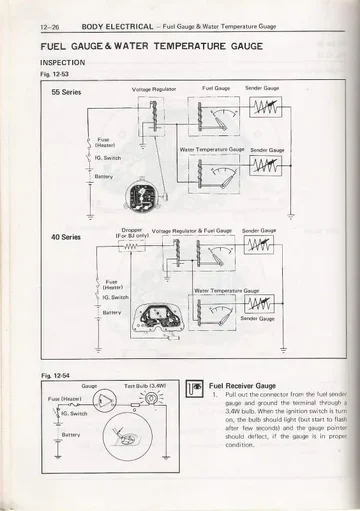
The fuel gauge has a regulator that drops the 12v down to 7 before it feeds it to the fuel gauge and temp gauge. If that regulator failed (or was miswired) and was passing 12v, you would see readings a little less than twice as high as they should be. This is in the Chassis/Body manual.
 
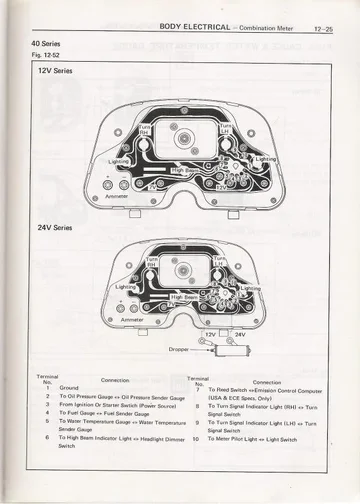
Page 12-25 shows a 12v and 24v system. Looks like the 24v has a dropper to bring the voltage down to 12v and then otherwise uses the same gauges, etc. Sorry, no personal experience with the 24v systems, I'm just telling you what I'm seeing. This would make sense so that the 24v vehicles wouldn't have to have all different parts. I would start by measuring the voltage at the fuel sender and/or the temp sender. If they are 12v, that would be where I would look.
 
Have you thought about replacing the sending unit?

Try pulling the sending unit out and ground it to itself, and see what the fuel gauge level does, it should peg all the way to the F mark, this would tell you the gauge is good, and more than likely the SU is bad.

I had this very problem, and decided it would be better to go aftermarket autometer sending unit & gauge.
 
The sending unit is a simple variable resistor. He checked the resistance at both ends of the range and it's in spec.

The gauge contains the voltage regulator. If the VR was bad and you changed the gauge then that would explain it.
 
I did the same thing, and the SU was still bad, but I didn't care to replace it at the point and elected to go aftermarket with all my gauges.

If his readings are correct for ohms, he should still ground the sending unit to itself, and see what the gauge does. If it doesn't peg to the F, then the gauge could very well be bad.
 
Shorting out the sending unit may peg the gauge to F or it may blow the fuse. The gauge is functioning-it is just reading twice the reading expected. Gauges don't fail like that. The VR could be bad or there could be a ground problem.

I'm on the side of checking that the voltage to the sending unit is correct and that the resistance varies per specifications.
 
Here we go. The 24 V cluster is basicly the same as the 12V cluster. The only difference between 24 and 12V are the oil gauge and sender. They work independent from the cluster on 12 or 24V. The Amp meter is not Volt dependent.
The dropping resistor makes 12V for the Fuel and Temp Gauge.
But.......... the Fuel gauge has a (very primitive) Voltage Regulator inside to provide 7V to the Temp meter. As you can see in the 2nd pic this is a network. Everyting works fine as long as all components are good. If something is wrong with the Temp gauge or sender this will influence the whole network and of course the readings.
Start with checking the 7V for the temp gauge. From there go back.
Image-25.webp
Image-26.webp

Good luck,

Rudi
Image-25.webp
Image-26.webp
 
Last edited:
Trouble shooting cluster problems

Here is a little explanation on troubleshooting a cluster.

First we have to understand how the 3 meters Oil, Fuel and Temp works.
Not the Amp meter, that’s a different story.
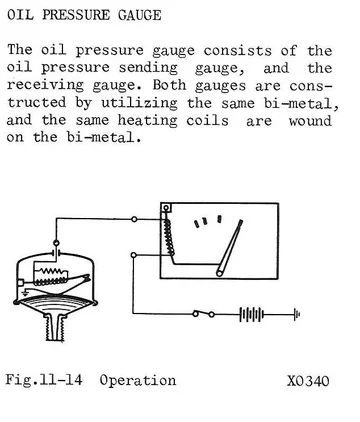
The core of the meter is a little heat resistor made of a tiny wire in a coil shape. This resistor heats up, bends a (temperature sensitive) metal strip which moves the needle.
The sender is variable resistor. Being a Temp sensor or Fuel sensor the principle is the same. The resistance changes and thus the current in the circuit and thus the position of the needle.
To work on this cluster you need a analog Volt and Ohm meter. Why…..?
If you are looking for a bad contact, ground, intermittent problem, the needle of a analog meter reflects what happens. A digital meter is flashing digits and you have no idea what’s happening.
If you run the test with the light bulb, the manual says that the bulb will flash after a few seconds. Why…..? The light bulb is like the gauge a heat producer. So when the light comes on the resistance is getting higher and the current is going down. At the same time the gauge is seeing a variation in current and is responding with a time delay because of the heating up. Now you have two items who are working opposite of each other. One is heating up while the other is cooling down. That makes the light bulb flash and the meter moving up and down.
Knowing this we can start working on the problem searching.
In the case of the Fuel and Temp gauges, the Fuel meter is the Voltage provider for the Temp meter. Together they are a little network. So if the Temp sender has a bad ground or a intermittent bad/good contact in the wiring not only the Temp reading is unstable but also reflects this on the Fuel meter. You will see the needle of your Volt meter move from 7V up to 12V. If the reading goes to 0V you have a short and the Fuel meter will read E(mpty).
In short; look for bad ground sensors, bad connectors / connections in the wiring, also the round plug on the back of the cluster and so on, using the analog meter(s) while moving and shaking the wiring.


Rudi

December 30 2014: EDIT: I wrote this a long time ago and the text above is not 100% correct.
For a better explanation go to this thread: https://forum.ih8mud.com/threads/clusters-gauges-speedo-odo-meters.544543/

 
Last edited:
Rudi,
ALL of the meters are ammeters. They measure current, not temperature. Simple-fixed voltage divided by resistance from the sensor equals current. Ammeter - Wikipedia, the free encyclopedia
Measuring temperature from heating a resistor would not be very accurate as it would vary with the ambient temperature. Almost all meters are ammeters at their core because this is the most fundamental, repeatable type of electrical meter.

When you substitute a low wattage light bulb for the sensor, the flashing comes because the resistance of the filament in the light bulb goes up as it heats up, which causes the current to decrease which causes the light to dim, which causes the current to go up, which heats the filament, and so on....
Incandescent light bulb - Wikipedia, the free encyclopedia

I'll agree that analog meters are much more useful debugging intermittent problems. I'm a big fan. Your analog multimeter is an ammeter at its core. When you switch from Amps to Volts to Resistance, it simply uses its built in battery and a bunch of resistors to use the Ammeter to measure voltage or resistance.

I've got a M.S. in Physics and another one in E.E. Occasionally they come in helpful wrenching on my FJ. :D
 
Rudi,
ALL of the meters are ammeters. They measure current, not temperature. Simple-fixed voltage divided by resistance from the sensor equals current. Ammeter - Wikipedia, the free encyclopedia
Measuring temperature from heating a resistor would not be very accurate as it would vary with the ambient temperature. Almost all meters are ammeters at their core because this is the most fundamental, repeatable type of electrical meter.

When you substitute a low wattage light bulb for the sensor, the flashing comes because the resistance of the filament in the light bulb goes up as it heats up, which causes the current to decrease which causes the light to dim, which causes the current to go up, which heats the filament, and so on....
Incandescent light bulb - Wikipedia, the free encyclopedia

I'll agree that analog meters are much more useful debugging intermittent problems. I'm a big fan. Your analog multimeter is an ammeter at its core. When you switch from Amps to Volts to Resistance, it simply uses its built in battery and a bunch of resistors to use the Ammeter to measure voltage or resistance.

I've got a M.S. in Physics and another one in E.E. Occasionally they come in helpful wrenching on my FJ. :D

Hi edwjmgrath,

I was explaining how this cluster works and why. For enlightning I ad this pic from the FSM.

In this case you are right. These 3 meters meassure amps. But the movement of the needle is caused by a heathing element, in this case the wire coil that heats up and the temperature sensitive strip that moves the needle.
From the same Wikipedia site: {QUOTE} In a hot-wire ammeter, a current passes through a wire which expands as it heats. Although these instruments have slow response time and low accuracy{END QUOTE}
To keep it simple for the boys and girls here on the forum I try to tell it in simple language. If you open up a cluster and look at the meters you'll see what I mean.
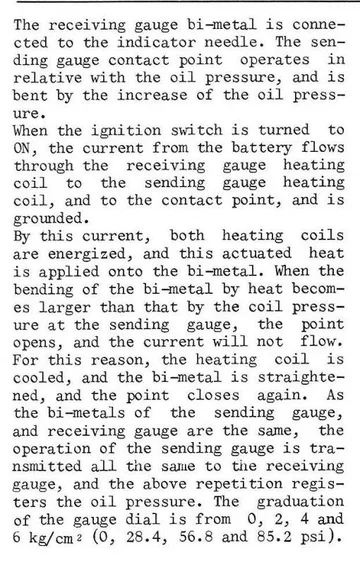
Here is the official Toyota description in the FSM.
Oops, the pics are a bit big.
meters expl 1.webp meters expl 2.webp


About Volt meters, Ampere meters, Resistance meters and other kind of meters like dB meters, KWH meters, VU meters and so on, we can start a new thread but I don't think this community is very interested. There are only a few with a good electrical knowledge here, most of them are very good mechanics.
No pun intended guys!

Rudi
meters expl 1.webp
meters expl 2.webp


Image-26- TEXT - crop.webp
 
Last edited:
The core of the meter is a little heat resistor made of a tiny wire in a coil shape. This resistor heats up, bends a (temperature sensitive) metal strip which moves the needle


Actually, it is magnetic. When the voltage is high, the magnetic field pulls the iron contact away from the switch contacts, breaking the flow to the coil until the field decreases to what the set point of the regulator is. If it was thermal, it would be more sensitive to changes in the ambient temperature.
 
hey guys you are a great help!!! thanks for all the feedback and very useful info..

today i just started as you suggested with testing with my multimeter..
it turned out that my 24 v > 12 v voltage dropper as shown in rudy's images was no longer working within spec... 28 v on one side and 22 v on the other, thats 10 volt too much..

i decided to hook the fuel gauge directly to my own 24 v > 12v inverter i bought recently... that looked much better... when i tested the voltage it was 15 v from the inverter... so still a bit too much, then i decided to hook up the inverter to the factory voltage dropper, with the little resistance it still has it gave me an exact 12 v output... how wonderfull, everything works great now...
when the fuel sender is in its lowest position i have the needle exactly on the E and in the up postion, the needle is exactly on the F...

hope the temp gauge will function better as well, cant test now because the fuel tank is off..

thanks again all!!!!:cheers:
 
hey guys you are a great help!!! thanks for all the feedback and very useful info..

....today i just started as you suggested with testing with my multimeter..
it turned out that my 24 v > 12 v voltage dropper as shown in rudy's images was no longer working within spec... 28 v on one side and 22 v on the other, thats 10 volt too much..

Hi Folkert,

If you have 22V on the downside it means that the Temp gauge / sender is not drawing (enough) current or it can be that the resistor is out of spec. The resistor should meassure +/- 30Ω.

Good luck,

Rudi
 
hi rudy, yes its the resistor, indeed was 30 ohm printed on it, but gave something like 120 ohm... when i hooked up the gauge directly ( bypassing the resistor) to 12v it works fine..

i'm happy i solved another thing on my to do list.

will install the reconditioned fuel tank in 2 weeks... hope this will go smoothly and not too much hassle with bleeding air etc. then its time to hit the road!!!:bounce:
 
Sorry about the high jack but i have an older style guage cluster (65 to be exact) where can I get one of these Voltage Regulators. I'm 90% sure that is my problem. Since that part is non existant on my rig. thank you for any and all help in advance.
Keith
 
Back
Top Bottom