Build A pig for Father's Day

This site may earn a commission from merchant affiliate
links, including eBay, Amazon, Skimlinks, and others.

I am also at a standstill on the front axle so I'm slowly working on stripping and painting leaf springs in between domestic chores. I regreased and installed the old trunnion bearings and old shims (in the same places) and torqued everything down. Unfortunately I get very little bearing preload, like maybe 1 lb - maybe. FSM says 4.4 to 5.5 lbs. I also can feel the bearings catching occasionally on the passenger side, especially if I haven't moved the steering knuckle overnight. The bearings looked new and ran smooth as silk in my hands so it could be something else. Regardless, after much consideration, I ordered new bearings, a 12" digital vernier caliper (only had a 6"), and some red machinist dye. I have the Toyota SST for centering the steering knuckle and it's never been used. No time like the present. I considered just adding equal size shims top and bottom until I get the preload but ultimately decided I should really make sure the knuckle is centered.

I also ordered some new OEM seals. I had already installed a set of Marlin Crawler eco seals but I'm pretty positive I will destroy them when I remove them. They have to come out to use the SST. There appears to be zero availability of those at the moment so OEM it is.
 
Last edited:
Yeah, don’t install new seals before using SST. I might know something about that. 🤦‍♂️

IMG_8553.webp
 
Finally took some time and put the rear brake shoes and drums on. I did verify via the FSM that the diagram I referenced earlier is correct for the spring orientation; springs towards front of vehicle go on the backside and the ones towards the back of the vehicle go on the frontside. If for no other reason, you can put the one spring on the backside, mount the top shoe, stretch the spring down with your hands and mount the bottom shoe, and the shoes will stay put without the retainer pins because the spring is on the backside. Still need to adjust them but they are at least reassembled.

Took me a little while to figure out this "grease here" diagram in the FSM. I just wasn't sure where to grease on the shoes and/or backing plate but finally figured out it's the 3 pads top and bottom that are built into the backing plate. I'm so slow sometimes.....

1758222625385.webp


1758222559539.webp


1758222729068.webp


1758222761028.webp


1758222784501.webp
 
Got one spring pack reassembled between ESPN Game Day and the afternoon games. I'm very pleased with the end result but these springs are quite the undertaking. I stripped them with those side grinder stripping wheels. That works much better than a wire cup. Started with the ones from HD but they are about $11 each and you need a few. Found these on Amazon and they work just as well. 10 for $34:

10PCS Strip Discs Stripping Wheel for Angle Grinder 4-1/2" x 7/8" Fit Angle Grinder Clean,Paint Stripping Disc,Abrasive Quick Abrasive Disc Cleanemove Paint Rust and Oxidation: Amazon.com: Tools & Home Improvement - https://www.amazon.com/dp/B08DD1L2MP?ref=ppx_yo2ov_dt_b_fed_asin_title

I put two coats of Mastercoat Chassis Silver and two coats of AG111. Also bought new greaseable slip pads (or whatever they are called). Clip liner material is still on backorder but that can go on with the clip hardware at anytime.

Not looking forward to tackling the other 3 spring packs but it's not overly difficult work, just time consuming.


1758394835166.webp


1758394875926.webp


1758394932164.webp


1758394961881.webp
 
Finally found some brake fittings that are very close to OEM. Had a couple of near misses before I found these. Slightly shorter unthreaded lead-in but otherwise dimensionally more or less the same. Not sure about the silver vs yellow plating. Some of my OEM lines appear to have been yellow but some, like the rear brake cylinder jumper below, were clearly silver.


1758651171905.webp


1758651144391.webp


One of the previous near misses were these from the company that @J Mack referenced. These are the same fittings that they are using on their premade Toyota brake lines (they sell premade lines as well as fittings and line). They are also more or less perfect except the nut is an 11mm wrench. Did not know that until I started comparing them to the originals.


1758651811692.webp


1758651780836.webp
 
Got one spring pack reassembled between ESPN Game Day and the afternoon games. I'm very pleased with the end result but these springs are quite the undertaking. I stripped them with those side grinder stripping wheels. That works much better than a wire cup. Started with the ones from HD but they are about $11 each and you need a few. Found these on Amazon and they work just as well. 10 for $34:

10PCS Strip Discs Stripping Wheel for Angle Grinder 4-1/2" x 7/8" Fit Angle Grinder Clean,Paint Stripping Disc,Abrasive Quick Abrasive Disc Cleanemove Paint Rust and Oxidation: Amazon.com: Tools & Home Improvement - https://www.amazon.com/dp/B08DD1L2MP?ref=ppx_yo2ov_dt_b_fed_asin_title

I put two coats of Mastercoat Chassis Silver and two coats of AG111. Also bought new greaseable slip pads (or whatever they are called). Clip liner material is still on backorder but that can go on with the clip hardware at anytime.

Not looking forward to tackling the other 3 spring packs but it's not overly difficult work, just time consuming.


View attachment 3995316

View attachment 3995317

View attachment 3995318

View attachment 3995320

do you like the 'stripping discs' better than general purpose flap discs?
 
do you like the 'stripping discs' better than general purpose flap discs?
I would be lying if I said I had a lot of experience with any of these products. I did shy away from the flap discs because I thought they might be too aggressive with the surface of the springs. I just wanted to remove the paint. I even tried aircraft stripper first but that was somewhat of a waste of time. I could be totally off base on the flap discs and they could be just the ticket. I do know that the strippers I am using take the paint off very quickly and do not appear to remove any metal.
 
Started working on the front axle rebuild while watching paint dry on the second set of rear springs. The SST is fairly easy to use but, like a lot of these procedures, it takes a few minutes to fully understand what they are asking you to do. After going through the procedure and getting all the measurements I threw all the shims into a pile (existing and the ones that came with the front axle rebuild kit) and started playing with combinations. That was the point where a degree in engineering coupled with a new Mitutoyo digital vernier caliper that measures to 0.01mm became a major hinderance to progress.

The original shims were the same side to side, a 1.0 and a 0.5 on top (1.5mm total) and a 1.0 on bottom for a total shim height of 2.50mm. As previously mentioned, I got almost no preload on the bearings with that shim combination when I reinstalled everything and torqued it down. When I ran through the procedure with the SST, the total shim heights were 2.06mm on the driver's and 2.08mm on the passenger side. No wonder there wasn't any preload with the original shims.

According to the measurements taken with the SST, I specifically needed the following shim thicknesses:

Driver's Top - 1.12mm
Driver's Bottom - 0.94mm
Passenger Top - 0.88mm
Passenger Bottom - 1.20mm

This is the best I was able to do with the shims to hand. Number one goal was to keep the overall shim thickness as close as possible.

Driver's Top - 1.09mm
Driver's Bottom - 0.97mm
Passenger Top - 0.99mm
Passenger Bottom - 1.10mm

I installed the steering knuckles and get between 5 and 6 lbs on the driver's side and 4.5 and 5.5 on the passenger side. That's with the nuts torqued to 50 ft-lbs. FSM spec is 43 to 54.3.

New oil seals are due in tomorrow and I can finish up the front axle.
 
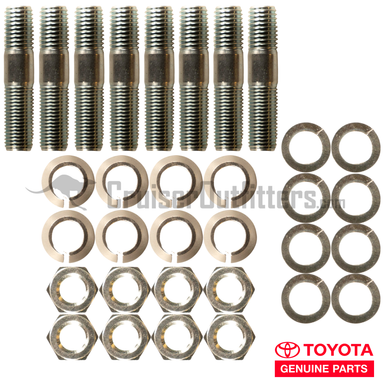
I started to post this tale yesterday but it's so bizarre I was certain that I was making it up; or at least had the facts wrong. Well I have quadruple checked everything today so here goes. When installing the steering knuckles yesterday I tried to use new OEM washers and nuts but they were a tad too large so I just assumed I had ordered something incorrectly and went with the old washers and nuts. One of the studs was apparently a little messed up on the end and I couldn't get the nut to start. So while trying to sort this stud I discovered that the nut was 7/16-20 and not metric anything. I pulled a stud and it's 7/16-20 on both ends. I don't see any evidence that the holes in the steering knuckle were welded up and rethreaded (since 7/16 is slightly smaller than M12) but maybe they were? Maybe I don't know what to look for? I have rechecked what I ordered and, assuming the nuts are correct, the studs should be M12. I did notice when making my measurements yesterday that the Steering knuckle heights were both exactly 165.15mm so either the factory was really good or maybe the surfaces were decked to match during this process? No idea really.

To add to the intrigue, the nuts are definitely M17 wrench size but, again, 7/16-20 threads. A normal M10 nut is a 17mm wrench size so it could have been easily tapped out to 7/16-20. FWIW, a JIS M12 is also a 17mm wrench size.

So now I need to find a 2" long, 7/16-20 double ended stud and I also need to make (or have made) another nut since I destroyed one trying to get the stud to work. Every one I have found so far online is 7/16-20 on one end and 7/16-14 on the other. I'm still looking though.

Or, I need to take these steering knuckles to a machine shop and have them rethreaded to M12.

I still keep thinking that there must be a simpler explanation because I cannot imagine why someone would go to this much trouble.

1758922746928.webp


1758923250202.webp


1758923384126.webp
 
11mm through December 1978. 12mm January 1979-up.
 
I started to post this tale yesterday but it's so bizarre I was certain that I was making it up; or at least had the facts wrong. Well I have quadruple checked everything today so here goes. When installing the steering knuckles yesterday I tried to use new OEM washers and nuts but they were a tad too large so I just assumed I had ordered something incorrectly and went with the old washers and nuts. One of the studs was apparently a little messed up on the end and I couldn't get the nut to start. So while trying to sort this stud I discovered that the nut was 7/16-20 and not metric anything. I pulled a stud and it's 7/16-20 on both ends. I don't see any evidence that the holes in the steering knuckle were welded up and rethreaded (since 7/16 is slightly smaller than M12) but maybe they were? Maybe I don't know what to look for? I have rechecked what I ordered and, assuming the nuts are correct, the studs should be M12. I did notice when making my measurements yesterday that the Steering knuckle heights were both exactly 165.15mm so either the factory was really good or maybe the surfaces were decked to match during this process? No idea really.

To add to the intrigue, the nuts are definitely M17 wrench size but, again, 7/16-20 threads. A normal M10 nut is a 17mm wrench size so it could have been easily tapped out to 7/16-20. FWIW, a JIS M12 is also a 17mm wrench size.

So now I need to find a 2" long, 7/16-20 double ended stud and I also need to make (or have made) another nut since I destroyed one trying to get the stud to work. Every one I have found so far online is 7/16-20 on one end and 7/16-14 on the other. I'm still looking though.

Or, I need to take these steering knuckles to a machine shop and have them rethreaded to M12.

I still keep thinking that there must be a simpler explanation because I cannot imagine why someone would go to this much trouble.

View attachment 3999322

View attachment 3999328

View attachment 3999329
There are a couple of SAE thread pitches that are really close to metric standards.

20–TPI works out to 1.27–mm pitch, theoretically. Since The JIS threads are measured over the external thread and the UNF measure at the midpoint of the root and external height, it's easy to mistake one for the other, especially using calipers and thread gauges to measure commercial rolled threads. Even using thread wires for the SAE threads, it's hard to distinguish between two commercial rolled fasteners, especially if they've been used.

My thread gauges fit both the 7/16-20 and M12x1.25, and I've mated one to the other just to make sure one of my pitch gauge leaves weren't screwy, and they fit each other, at least for the length of the leaves.
1758972784256.webp

I'd bet what you have is M12x1.25. Someone could have replaced the knuckles at some point?
 
Last edited:
You have 11mm studs..
Oh thank God it was just my stupidity. Thanks Jim. Very much appreciated as always! You have pulled me out of many rabbit holes. Please don't go anywhere until I get this pig back together.

First time I can recall having these parts diagrams confuse me so much. Here's the diagram for a '77 FJ55. I ordered the highlighted nut and corresponding washer but they are M12-125. I went back and checked a '73 model and it only shows the nut and washer in the box that I circled. The only stud in the diagram, 90116-11033, is the correct stud according to the '73 diagram. Normally the year splits in these diagrams are much clearer. They should have at least shown both studs if they were going to show both nuts and washers.

Steering Knuckle Diagram.webp


So to summarize:

Through Dec '78:
90170-11059 Nut
94512-01100 Washer (superseded to 90206-11001)
90116-11033 Stud

-79 and up
94115-71200 Nut
94531-01200 Washer
Diagrams for a 1980 FJ55 show two different studs. Assume that is just a supersession since the 90116-12007 is correct for my '83 FJ45.
1758973819872.webp
 
Last edited:
Back
Top Bottom