Engine Rebuilding options for S/C

This site may earn a commission from merchant affiliate
links, including eBay, Amazon, Skimlinks, and others.

Finally got to installing the new windshield washer JDM style.

Nice work, I've been thinking of doing that for a while but two things are stopping me.

1. I'm having trouble finding the part numbers for that washer bottle and bracket.
2. How do you change the bloody oil filter?
 
So update. I've managed to avoid MUD for awhile now but now find myself needing to make a decision.

My #6 and #5 fuel injectors just flat out died. #6 worse than #5. Since the entire intake manifold and rail needs to come off, I'm going to just go ahead and replace all of the injectors. This is kind of a bummer since I had all of the injectors done when I rebuilt the motor last year.

At the same time I've decided to just go ahead and throw on the S/C since we're going to be in there anyway. So the question:

• I am NOT going to try and add a 7th injector so do I try and get by with brand new OEM 280cc injectors or do I go ahead and upgrade to the 450cc injectors? Any other options?

I'm looking at these injectors which are brand new and $450/set: http://www.fiveomotorsport.com/denso-import-fuel-injectors-195500-4450
 
For your needs, I would stick with stock injectors. Least complicated. Proven reliability. The fact that your new injectors failed should throw up a yellow flag. But if you plan on higher performance goals then adjust accordingly. Gotta pay to play.
 
For your needs, I would stick with stock injectors. Least complicated. Proven reliability. The fact that your new injectors failed should throw up a yellow flag. But if you plan on higher performance goals then adjust accordingly. Gotta pay to play.

Er, well I don't have new injectors. I had mine rebuilt and blueprinted.

And um...how is a S/C not a "higher performance goal"?

"Gotta pay to play"? Are you kidding? Have you read this thread?
 
Sorry if its mentioned elsewhere in this thread but what engine management are you running?

The tuning capabilities of your engine management are important when sizing your injectors.
 
I am pretty sure the stock injectors are 305cc.

If you think at some point you might do an intercooler and smaller pulley, you could do the 440cc or 450cc injectors and also upsize the MAF housing the same ratio. It would give you some more fueling but it wouldn't address the reduced timing you might want if you go to crazy with the boost.

By upsizing the MAF housing you fool the computer into keeping the fueling right under normal conditions but at boost when you would max out the stock MAF signal you still have some resolution in the sensor.

I am not sure that it has been done but I would do it, if performance was something I was looking for. If just a little extra power is your goal with maximum reliability, stick with the stock injectors, stock pulley but still add an intercooler.

Ryan
 
Let me clarify. Imo, 10 psi boost is not high performance but on the same note it is just right for the type of performance most here look for including myself.

I have read and enjoyed your thread. My comment to "pay to play" was in regards to your engine performance goals. Bigger than needed injectors will hinder your performance. Blah, blah, blah. I think you know where I'm going with this.
A TRD Sc install does not = requiring larger injectors. So when you state that you are putting your sc in but are considering buying larger injectors also, I question what your end game is. It's not apparent to me.
 
Unless I missed it, I'm under the impression that he is currently running stock engine management.
 
I'm as confused as the rest of you as soon as he started to talk about larger injectors.
 
Like the others have said, no need for anything more than stock injectors unless you plan on 10+ psi of boost (IMHO). I'm running stockers with about 8 psi and an intercooler and have no fueling issues, for what it's worth.
 
Sorry if its mentioned elsewhere in this thread but what engine management are you running?

Currently none. I'm open to all options.

If you think at some point you might do an intercooler and smaller pulley, you could do the 440cc or 450cc injectors and also upsize the MAF housing the same ratio. It would give you some more fueling but it wouldn't address the reduced timing you might want if you go to crazy with the boost.

I have the smaller pulley and indeed intend to go with an InterCooler and/or Meth Injection.

By upsizing the MAF housing you fool the computer into keeping the fueling right under normal conditions but at boost when you would max out the stock MAF signal you still have some resolution in the sensor.

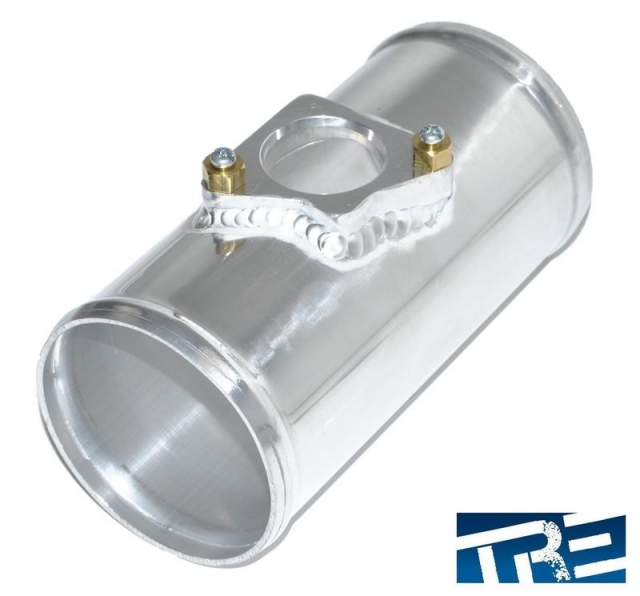
I was looking at LILEVO's links for a larger MAF pipe which can be found here: http://www.treadstoneperformance.co...er+Pipe,+Subaru,+Scion,+Mazda,+Toyota,+Lexus+
img-1296-csvul13463604757351-large.jpg


I am not sure that it has been done but I would do it, if performance was something I was looking for. If just a little extra power is your goal with maximum reliability, stick with the stock injectors, stock pulley but still add an intercooler.

This is has been my primary goal when I started this. The way I am looking at it now, this truck is about to become a spare vehicle. So if I just put a little bit of love into it I can get better performance out of it. BUT, is the performance gains enough to warrant just staying stock injectors, standard pulley and call it a day?

Like the others have said, no need for anything more than stock injectors unless you plan on 10+ psi of boost (IMHO). I'm running stockers with about 8 psi and an intercooler and have no fueling issues, for what it's worth.

Makes sense. I'm curious about seat of your pants difference between going this route or going further.
 
Run the stock size because you are not going to need anything larger for the S/C. However if you "want" larger, that is entirely a different thing. I went camping 2 months ago and drove up the grapevine pushing about 5-10psi consistently for about 30 mins. AFR's were perfect, no fuel cut or bogging and this is all with stock engine management.
 
I am on my phone so I don't have the data in front of me but in one of the turbo threads I posted the TRD blower's compressor map. The problem with the TRD unit is that it was sized by Toyota to give a slight raise in power without making any changes to fueling and timing. The way they did it was by choosing a small enough compressor. The downside is when you start trying to hot rod that compressor you are doing a few things: you're off the efficiency of its compressor map so it's pumping lots of hot air and you're spinning it faster than it's made for essentially wearing it out quicker.

You can compensate for the hot air by running an intercooler and meth injection but once you cool that hot air down it contracts and you don't actually get a big increase over the stock pulley. Maybe a few psi.

Spinning the supercharger faster you certainly can expect a lot more wear, bearings, screws, etc. it probably isn't exponential wear with the speed increase but it is substantial. You can make 500hp out of a 2 liter motor but it's a lot easier if you start with a 7 liter motor.

If the engine is all built for forced induction and you want big power, it would be my personal recommendation that you start with a properly sized compressor for your power goals. If you just want to give the old girl a little bump in power and have all the parts already, I would throw the supercharger on in stock form and get an intercooler and call it a day.

Don't forget some of the forced induction headaches will be made worse being forced to run CA's 91 octane premium.

 
Last edited:
Actually there is a good reason to move up to larger injectors. If you look at the dyno charts that have been posted on a stock system you will see that on the upper end of WOT the ECU runs incredibly rich.

Now that I've dialed in my MAF for a stock truck it's not that hard to extrapolate out the bore size for larger injectors.

I've come up with a housing that would graft onto the filter cover so it would swap right in and be tuned for 372cc drop in densos.

I'm hoping to start test runs early next year.
 
Rick not trying to be confrontational but your cause and effect make no sense. - in stock form its rich at WOT so bigger injectors?

The reality is it doesn't need bigger injectors, it needs more resolution on the MAF sensor when boost is increased. How do you do that? You increase the MAF housing size. What happens when you do that? Well the stock computer reads the voltage and assumes less air than it is actually getting and under fuels so what do you need to do? You need to add bigger injectors.

Saying its rich at WOT so it needs bigger injectors is like saying you're drowning and need a glass of water.

So if your point was that you were going to try and lean out the WOT richness by under sizing the MAF housing size in relation to the larger injectors I think that's a bad idea because you would be relying on STFT's to provide extra fueling while in closed loop. If you're going bigger injectors up size them the same ratio you increase the MAF housing.

Ryan.
 
Last edited:
Makes sense. I'm curious about seat of your pants difference between going this route or going further.

Huge seat of the pants difference over stock, and I feel like the 2.8" pulley plus intercooler is a good "stopping point" in terms of having a reliable, somewhat-close-to-factory specs setup vs. going into all-out "performance" territory. Not that it wouldn't be fun to do so!
 
Huge seat of the pants difference over stock, and I feel like the 2.8" pulley plus intercooler is a good "stopping point" in terms of having a reliable, somewhat-close-to-factory specs setup vs. going into all-out "performance" territory. Not that it wouldn't be fun to do so!

I meant difference between stock TRD SC install vs IC, water inj, sm pulley, lg inj and lg MAF bore. :P
 
Ryan you need to review the dyno charts. At higher RPMs and WOT there is a point where the MAF output causes the ECU to turn richer as the RPMs increase.

And as you said you need a larger MAF which requires larger injectors. All with the purpose to lower the output of the. MAF and avoid that point where the turn down is longer in the RPM range.

So addressing the question if larger injectors are a good idea I believe they are to solve a richening condition at WOT in the higher RPMs
 
Last edited:
Yes that point is called open loop. lol. It is when the truck is dumping fuel because the computer tells it at that load point to go wide open rich. I don't have to check the dyno charts because I can pinpoint that point on my 21x17 load cell table on the computer I am using.

But you can't go with a larger MAF and avoid that point in the load table/MAF value all together in a supercharged/turbo'd truck because it is the only way it sees enough fuel under boost! If you made the truck stay in closed loop all the time, it would always use the feedback from the O2 sensor to maintain 14.7. Which is fine cruising around town in vacuum and low boost levels but when boost increases you have to switch to open loop or you will burn the motor up running too lean!

A holistic approach would be to take the compressor map, find how much more air the supercharger can produce when you spin it faster and then increase the MAF housing and injectors by that value, but you could still run 14.7 in low load situations, might be a bad idea on 91 octane.

I think you could do this in a NA truck and it would help with gas mileage and to some extent power in open loop but not a good idea in a FI application. IMO.
 
Last edited:
Ryan, you are not understanding what I am saying. Here is a Dyno chart posted by Cyclosteve on his super charged engine.

You'll notice at around 4000 RPM there is a sharp richening effect where the AFR goes from 13.96 right down to under 10.75

This same thing happens on a stock truck only at 4500 RPM.

This all happens way after the truck enters open loop.

I can't say for sure what is triggering this but strongly feel that a tuned MAF with larger injectors will shift this drop higher in the RPM range.

CycloSteve_before_exhaust2.webp
 
Back
Top Bottom