Where does the red SOLENOID POWER wire connect to? Using EZ Harness

This site may earn a commission from merchant affiliate
links, including eBay, Amazon, Skimlinks, and others.

The constant power side of the fuse block, the ignition switch and the - side of the amp meter are all equivalent in terms of the circuit. Generally though, for high current, high power lines, it is best practice to keep the runs short and direct (fewer connections) so the - side of the amp meter would be best for an alternator on the passenger side.

Way back on the first page, I mentioned that the EZ harness isn't going to work well unless you get all new parts, like a GM steering column and you will need to either customize the harness or reuse the old wires or make new wires. This is one of those many situations. Forget about making the EZ harness work the way it is and your job will be easier. Think of it as a new fuse block.
 
Forget about making the EZ harness work the way it is and your job will be easier. Think of it as a new fuse block.

Ok that all makes sense.

So, what if I just used the old white/blue alternator power wire the way it is supposed to be and disconnected the EZ alternator wire? I think the old one is still good but I'll double check.

Also, thought you might like to hear that I purchased a body & chassis service manual and a 2F engine service manual from SOR. This should obviously help me learn some things for myself!

Thanks again for all of your help.
 
Check the harness for evidence of burned wires, melting or abrasion. If you are going to run new wires in the same harness, you may as well remove the tape, bundle them when done and retape the harness. Then you can visually inspect the entire wire.
 
Sweet!

I'll be doing that then.

I've been advised to replace my broken instrument cluster and get an aftermarket oil pressure gauge before I try to start the vehicle again so that's what I'll be doing in the mean time.

I'll keep you posted for sure.

Thanks!
 
WIRING UPDATE:

Got a used and working gauge cluster on the way, it was a steal of a deal. Should be in next week.

I've got most of the front end wired.

Currently working on the back end as well.

My FSM's from SOR came in this week.

Now, for some more work...;)

The EZ harness apparently does not, or at least in my case did not, include brake light wires. It only has the following for the rear section:

left and right backup light,
left and right park light,
left and right turn light,
third brake,
license plate,
fuel gauge,
& lastly, the trunk light wires.

None of these sound like brake light wires to me...which seems ridiculous

So, unless I'm wrong or just lost track of those wires somewhere in the vehicle, I'm going to need to buy some wires for the brakes.

Next up, oddly enough, my fusible link wire from my starter is a smaller gauge wire than my white amp meter wire was...

The question is, should I connect a wire, that is the same gauge as the old amp meter wire, to the fusible link wire, even if the fusible link wire is smaller than the original amp meter wire?

Does it matter?

Because I can definitely do that.

Currently, I have it all wired back to the amp meter with the same gauge wires as the fusible link/bypass wire, but I'm concerned it won't be a thick enough wire to carry that much current... I'm assuming it wall be carrying around 12v from the battery? or more precisely, where it connects at the starter.

The fusible link/bypass wire looks to be about an 8 gauge wire, wheras the old amp meter wire is a good bit thicker, I'm not sure what gauge exactly. Thoughts?

I'll post some pics later.
 
The fusible link is always 2 gauge sizes smaller than the main wire. That is why they call it fusible. The brake light wires on early to up to 74 do double duty as the turn signal wires. The turn signal switch handles this, so all you need to do is recreate the turn signal wiring.
 
The fusible link is always 2 gauge sizes smaller than the main wire. That is why they call it fusible. The brake light wires on early to up to 74 do double duty as the turn signal wires. The turn signal switch handles this, so all you need to do is recreate the turn signal wiring.

Makes sense as far as the fusible link is concerned. Thanks.

I don't really understand what you are saying about the brake light wires tho.

Are you saying, the early brake light wires on up to 1974, doubled as turn signal wires?

I'm confused about how I should "recreate the turn signal wiring" also.
 
Yes, the turn signal rear bulbs do double duty as the brake lights. The turn signal switch takes care of the logic for this by interrupting the signal on the side you are turning if the brakes are also on.

What I mean by recreating is to replace the wires exactly as they are in the OEM harness or use them as they are.
 
Ok sounds good.

Thanks for clarifying. I'll be looking into that.

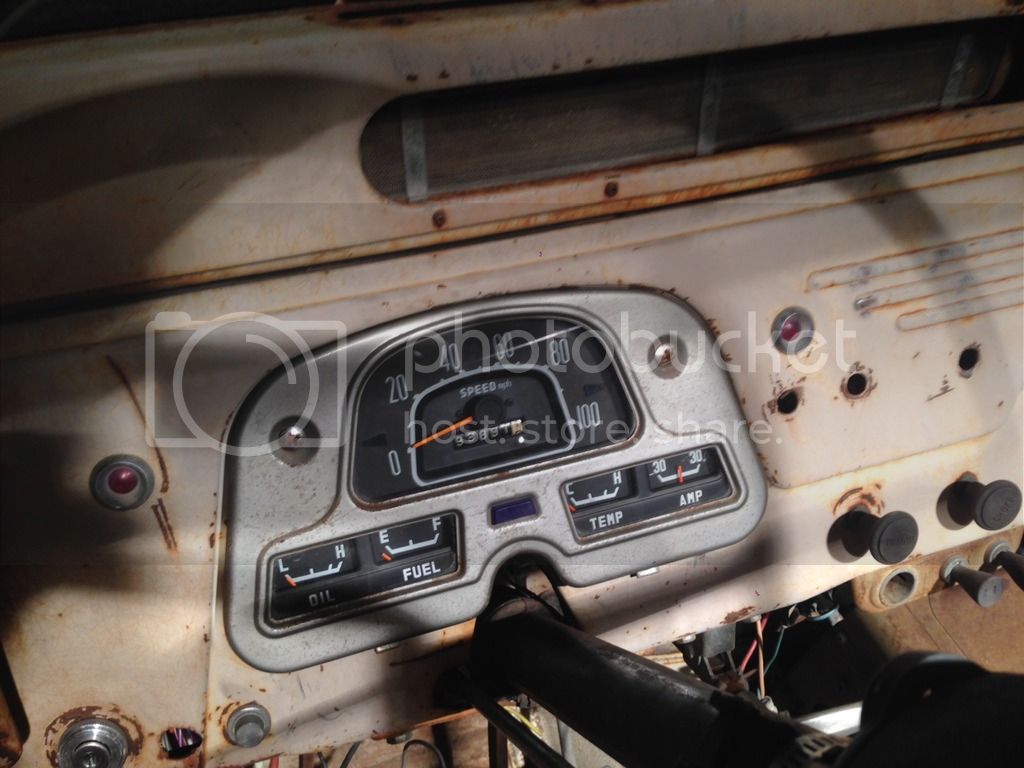
New, gauge cluster came in and is working good so far. (I just have it set in temporarily to make sure everything fits. I know the bottom's not in all the way rn)
IMG_5640_zpseuiuxc60.jpg


Also, do you know how to rename a thread?

I'd like to rename this thread as "EZ Wiring Harness For FJ40"
 
Ok good news, I hooked up the battery just a min ago and turned my key to acc. When I did this, my AMP meter gauge tilted to the left!

So I know I'm getting juice to the instrument panel.

The other ones didn't move because they are currently wired to the old harness and need to be integrated with the new one.

I would try to start the engine but I've been advised to "bench test" the engine first to make sure nothing in the engine is broken and whatnot. I forget how the guy said to do it exactly but it had something to do with taking a wrench and turning some kind of "axle" like bolt that runs through the center of the engine...I'll just look it up I guess. Thoughts?

Also, Coolerman on the instrument panel resto thread I started said something about installing an aftermarket oil pressure gauge before I try to start the engine, but I just bought a new to me gauge cluster with a perfectly good oil pressure gauge so I don't see why that would be necessary...Thoughts?

Here's the actual quote:

"If this engine hasn't been started in a while and/or you have removed and replaced the distributor, READ THIS!

The distributor is driven by the cam gear AND it drives the oil pump. Failure to get the distributor seated properly when re-installing means the oil pump WILL NOT BE PUMPING OIL! This is not good...

It's highly recommended you get an aftermarket oil pressure gauge installed BEFORE you try starting the engine. Without a oil pressure gauge you won't know if the engine has no oil pressure which leads to bad things happening to it."

 
As for the red solenoid power - as others have asked, it depends on where it goes into the harness.

Many GM vehicles (and it sounds like this system is made to be easier on GM systems) has a constant power that runs from battery to starter, from that same starter stud to the alternator, and then from either the starter or the alternator, into the battery.

There's a possibility that the red "solenoid power" wire is the main power feed wire for the EZ harness/fuse box (as in - the expect you to run power to the starter separately, but then to feed power to the EZ fuse panel from the same "solenoid" terminal). That would explain why it's a larger gage cable from the other wires. You can use the stock Ammeter if you want or you can bypass it (depends on how you end up wiring the entire truck). However if that's the main power feed for their fuse box, then it will need to be connected to a primary power source.

However without the harness nor instructions in front of me, I wouldn't know where that red solenoid wire goes to.


As far as starting the engine goes without an oil pressure gauge, there are a lot of factors to consider. It's most safe to have one connected so you can know what's going on with the engine but....
1) if you have no oil pressure, other than shutting it down, there probably isn't a lot you can do other than inspect the why (and usually the answers aren't fun)
2) if you only plan to start it up for a second or 2 to check the harness, then it kinda refers back to number 1, plus it may not build pressure right away (especially if the oil filter isn't full and/or it hasn't been run in a long time)
3) if you know the difference in sound between an engine that does & doesn't have oil pressure, you're fine.
4) Toyota tends to have pretty low tolerances for expected oil pressure at idle, so without getting ready to run/rev the engine (with a proper cooling system) it may give you incorrect bad results if you only read 8-10psi....
 
  • Like
Reactions: SMG
The amp meter deflecting when you have the key in ACC sounds wrong because there should be very little current flowing to the ACC fuse.

If the distributor has been out, you need to verify oil pressure. The easy way to do this is remove the oil pressure sender and manually crank the engine (by jumping across the spade lug and cable on the starter solenoid with a screw driver) after removing the coil high voltage wire. Oil will squirt out if it is pumping so be prepared to catch it with a rag.

GM did not use an amp meter, so their connections at the starter motor were fine. With an amp meter all chassis current in and out of the battery needs to pass through the amp meter. That is why the alternator connects to the - side of the amp meter in FJ40s.

The main power feed to the chassis also connects to the - side of the amp meter. This goes to the ignition switch and the constant power side of the fuse block. The IGN post powers the ignition coil and the switch on side of the fuse block.
 
It should also be said, but just because sometimes the simple things are overlooked....

If you have the neutral safety switch (if even applicable) bypassed and/or trying to jump start right off the starter (any means)..... make sure you're in neutral..... don't want to run yourself over and/or damage your house/shop (etc).

There IS enough power in the starter to move the vehicle forward.
 
It should also be said, but just because sometimes the simple things are overlooked....

If you have the neutral safety switch (if even applicable) bypassed and/or trying to jump start right off the starter (any means)..... make sure you're in neutral..... don't want to run yourself over and/or damage your house/shop (etc).

There IS enough power in the starter to move the vehicle forward.

In regard to everything you have said:

I appreciate your input! I will be pondering what you have said.

And yeah, I apprceciate that last bit about it being in neutral. Good reminder.

I am an automotive novice so any seemingly insignificant reminders can actually help me out a lot. Thanks.
 
The amp meter deflecting when you have the key in ACC sounds wrong because there should be very little current flowing to the ACC fuse.

If the distributor has been out, you need to verify oil pressure. The easy way to do this is remove the oil pressure sender and manually crank the engine (by jumping across the spade lug and cable on the starter solenoid with a screw driver) after removing the coil high voltage wire. Oil will squirt out if it is pumping so be prepared to catch it with a rag.

GM did not use an amp meter, so their connections at the starter motor were fine. With an amp meter all chassis current in and out of the battery needs to pass through the amp meter. That is why the alternator connects to the - side of the amp meter in FJ40s.

The main power feed to the chassis also connects to the - side of the amp meter. This goes to the ignition switch and the constant power side of the fuse block. The IGN post powers the ignition coil and the switch on side of the fuse block.


Well, that sucks! I was getting all excited for a second there haha :doh:

Seriously though, thanks for informing me. It is only tilting or "deflecting" by maybe a 1/16" to the left. I don't know what that is telling me but I do know that it means I am getting power to the instrument panel...just maybe not the way I want it to?

In regards to your comments on the GM wiring, I understand what you are saying. That makes sense. I have it wired the way you are describing it. I have the + of the batt to the starter, from the starter to the amp meter +, I have the alternator wire and the wire that runs to the IGN side of the ign sw on the - of the amp meter, and this runs back to the fuse block from my ign sw.

What do you think is wrong with the way I have my instrument panel wired?
 
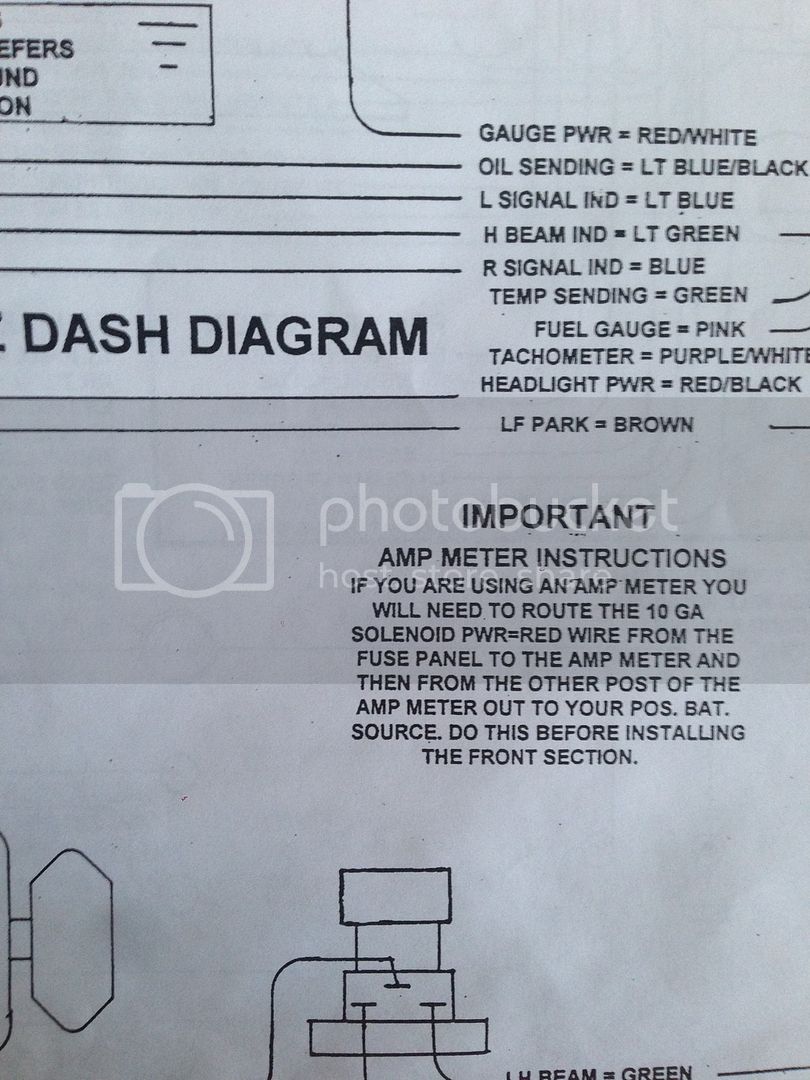
Here's what the EZ wiring book says:

IMPORTANT
AMP METER INSTRUCTIONS
"If you are using an amp meter you will need to route the 10 ga. SOLENOID PWR=RED wire from the fuse panel to the amp meter and then from the other post of the amp meter out to your pos. bat. source. Do this before installing your front section."

IMG_5687_zps3ts3ybiu.jpg


This is useful information in the event that I would be using the EZ method, but don't I already have power running to my fuse block because of the way that I it wired?

Should I just omit this solenoid power wire entirely? Or should I use it?
 
Hey great news.

I turned the key over today and it's definitely engaging the starter and wanting to turn all the way over. (it's making the sounds and everything) but it's not starting just yet.

A few friends recommended pouring some gas down the carb to get it to start. So far we've just been using starter fluid.

So now we are onto getting the engine to crank over all of the way.

Anything I should be paying special attention to?

Also, what is typically the method to use once it is engaging the starter but not starting all of the way?

I'm assuming it's really needing to warm up and I pulled the choke on the dash as if it were a cold start.

Should I just hold the key over and let it warm up and it will eventually start? Or will that drain the battery? My batt voltage is reading 12.2V currently.
 
So I've done a little diagnosing with reference to THIS VIDEO and so far my FJ is showing lack of both spark and fuel using the methods demonstrated in the video.

So now I'll be looking at whether or not my fuel pump needs to be replaced or if there is just something missing.

I also need to look into my spark plugs and distributor to make sure they are good. And I'll be looking at my ign coil wiring to make sure that is all set up correctly.

In the video he said something about the fuel pump fuse possibly being blown. I haven't wired my old fuel pump to my new fuse block but I'll be checking to see if I have one on the EZ fuse block and take care of that if need be...

Thoughts?

I'll keep y'all posted.

Thanks for helping me get this far already.
 
Back
Top Bottom