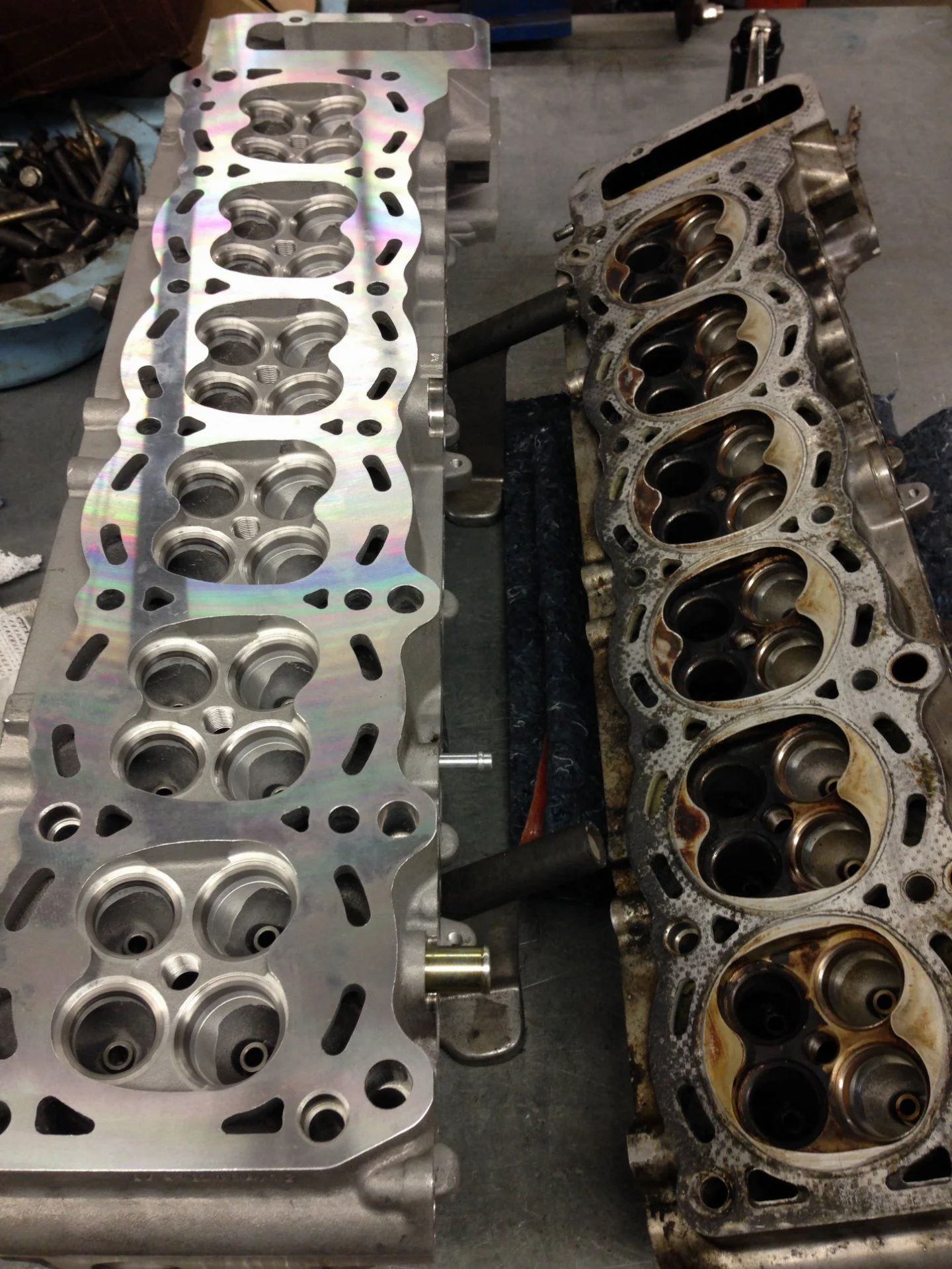
How to add EGR to a foreign market head.

This site may earn a commission from merchant affiliate
links, including eBay, Amazon, Skimlinks, and others.

Joined
Nov 26, 2015
Threads
8
Messages
234
Location
San Diego, California
The last thing you could possibly ever want to do I know, but here it is:

My FZJ80 is beater SUV with 360,000+ on original head, valves, etc., when the thermostat stuck closed and overheated it 2/3rds up the guage, and upon removal of the head, it was bent 40 thousandths (even the camshaft bearings). Shops wanted minimum $700 to straighten it (bolt it to a big metal plate and put it in the oven basically), and with no guarantee it would work for that much without cracking it (especially since it has been through so many heat cycles and has likely hardened/got brittle by quite a bit)

So... in comes the $400 china head.

Since it is a foreign market head, it has NO EGR- holes are drilled and tapped for bolting in the pipes for it, but it's just solid aluminum all the way through (everyone's dream I know). BUT, I live in CA where they put a sniffer in the pipe and so I figured better do it while it is out of the truck, than find out I have to take it off again later to pass smog.

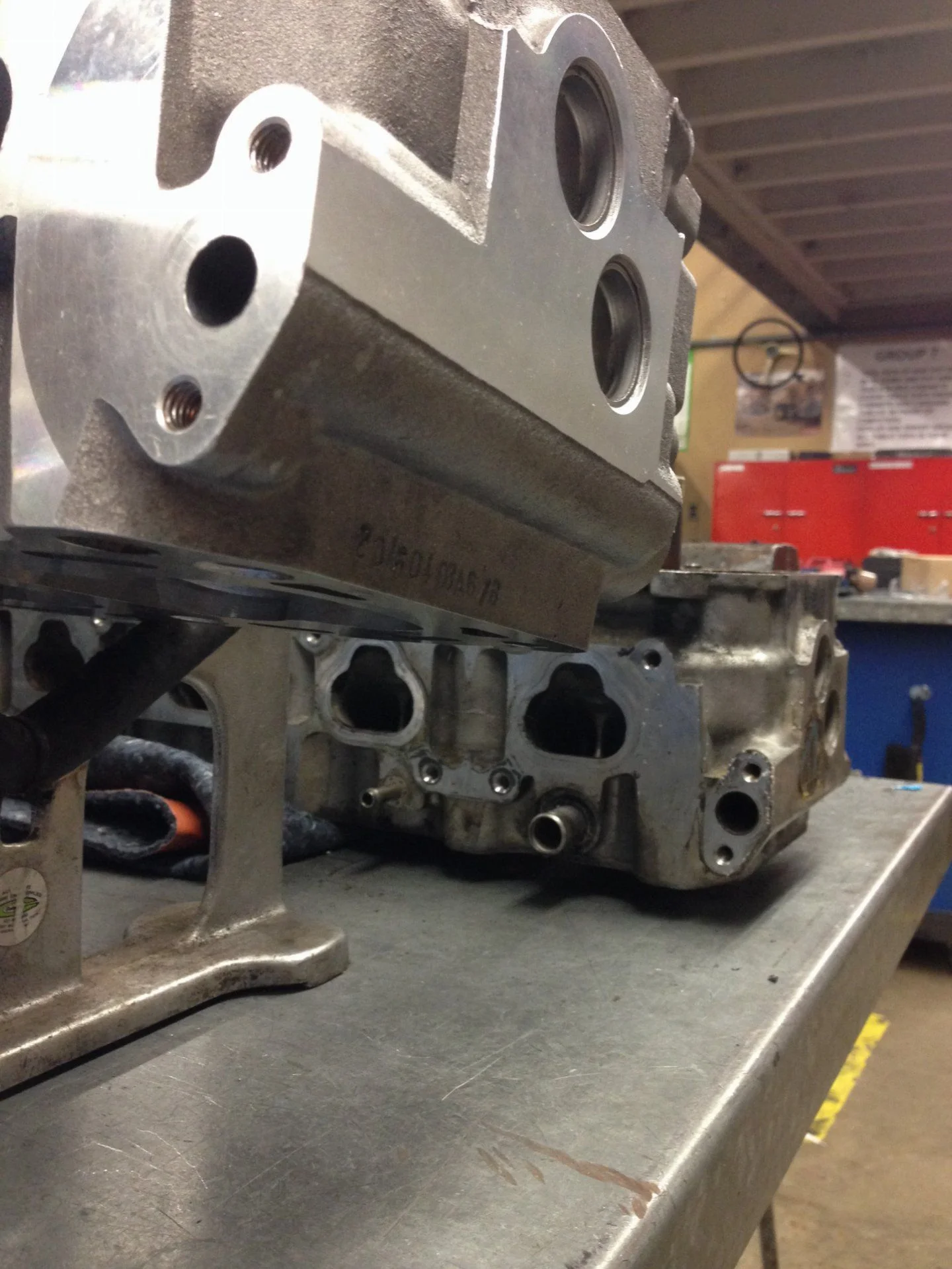
The vertical portion was quite easy- mount it on it's side in a drill press with a long drill bit (and tape for when to stop, measured by sticking it in the old head), and drill straight in.

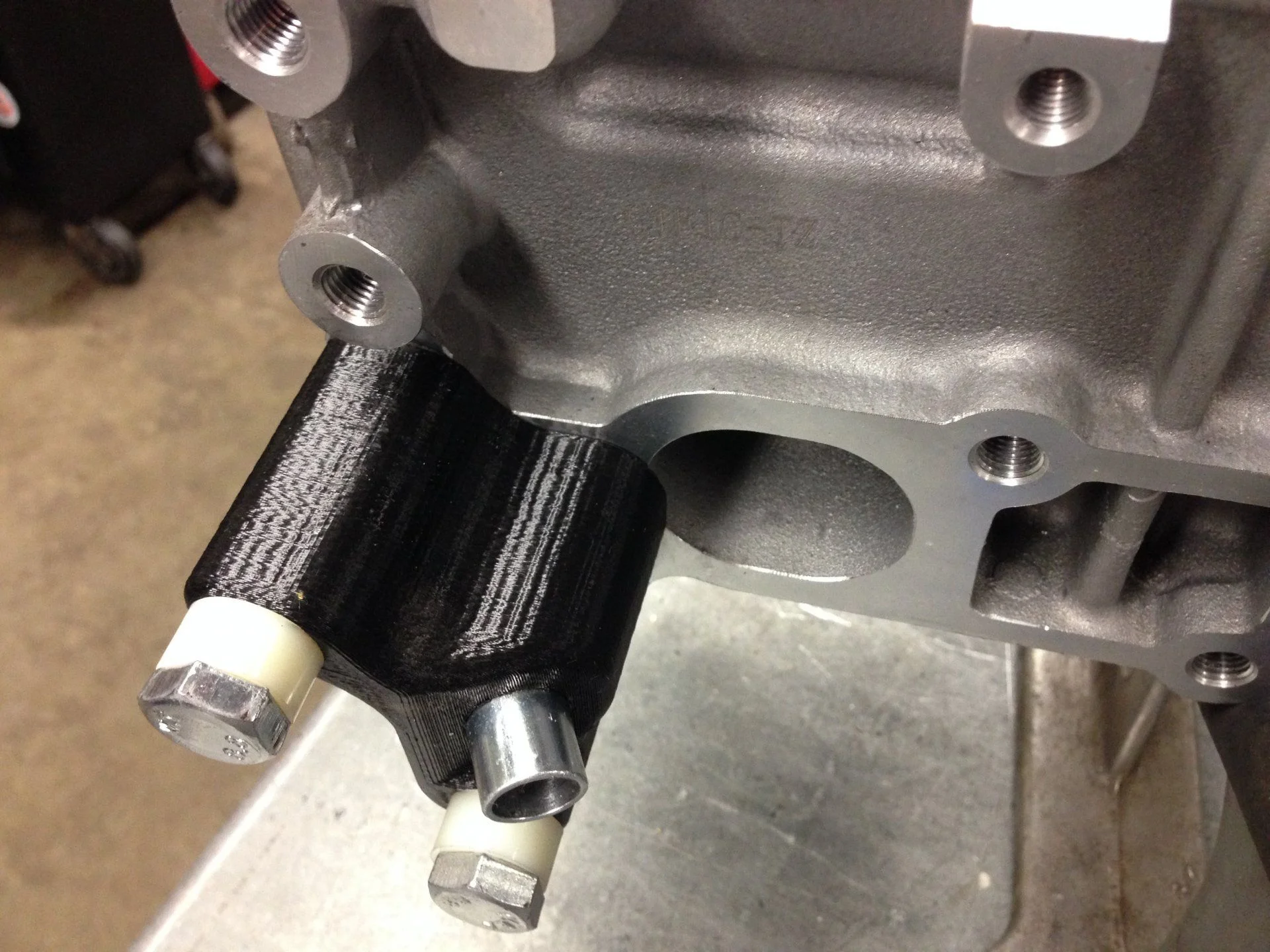
Then I had to drill the short section at an angle of 30* into the head, and while I don't have a milling machine, I do have a 3D printer, a hardware store, and a hand drill.

Onshape

1FZ-FE EGR 30* drill guide by Woofythewolf


You'll need someone with a 3D printer, 2x 2.5" M10x1.25 bolts (ACE only had 3" so I got some spacers), and a 1/2" ID x 5/8" OD x (as long as your drill bit will allow, 1.5" in my case) metal sleeve (I didn't bother with a real drill bushing because it's only getting used this once).

You may need to change the sizes of the holes depending on your slicing program and printer tolerances.

IMG_3754[1].webp
 
Wouldn't it be easier to move out of the people's republic of California
 
You California people need to revolt already.
 
CA isn't the only state that has smog visual as part of the inspection. It might not fail due to missing EGR but visual is DOA.

He's got the bosses, and frankly it would be awesome to see a de-smogged 80's tailpipe numbers to see if he could bolt up a phantom EGR, eerrrrrrrr - a used setup functioning like many things on a ~20 yrs old motor. ::cough cough::

If you pass on visual & pipe sniffer isn't that the litmus test?
 
He's got the bosses, and frankly it would be awesome to see a de-smogged 80's tailpipe numbers to see if he could bolt up a phantom EGR, eerrrrrrrr - a used setup functioning like many things on a ~20 yrs old motor. ::cough cough::

If you pass on visual & pipe sniffer isn't that the litmus test?

That would be it. Its not checked for function because the OBD2 is supposed to catch that. Its on the diagnostics to find it.
 
@scottryana I don't recall any differences from the old one, but I'll take a side-by-side pic tomorrow (it's at school).

@NLXTACY and @LINUS
Leaving it solid there would be nice (since that SEEMS to be a common failure point) a much thicker and stronger rear wall could help with that.
Besides that, it would bolt right up and look completely stock which is great for people who only get a visual inspection


If they didn't do the rolling sniffer test (In my county at least, they put it up on rollers and do it at 15 mph and 25 mph, and you're supposed to go in the lowest gear possible (that still stays under 3500 rpm or redline). Really funky IMO but that's how they do it.

It's during the constant rpm, low throttle situations that the EGR does it's thing (reducing the amount of combustible air/fuel mixture in the cylinder by displacing it with "inert" gas-no oxygen left to burn), and if it didn't pass I'd have to pull the head again to drill it out.

I did make the EGR (hole, tunnel, whatever it's called) smaller (1/2") to try and maintain the structural integrity of the head (hopefully the slightly reduced flow won't matter too much).

EDIT: I do plan on seeing if I can pass with a blocker plate, which I think I have a good chance of, but I just didn't want to risk having to pull it again.
 
Last edited:
I thought the EGR valve only opened at highway speed between 55-65mph. I'd check the FSM details to be sure but I would surmise that the EGR wouldn't open for the 25mph roller test.

In any case sounds like you have your bases covered, nice work.
 
@scottryana appears to have no major difference (the rounded part on the left side of the combustion chamber MIGHT stick into the chamber a tiny bit more but it's hard to tell)


Some really pitted exhaust seats- no wonder I had to floor it to maintain 65 up slight hills lol.

and new vs old EGR tunnel sizes- mine should keep the head a lot stronger.
 
@Output Shaft

I was kinda thinking of doing that, but this is going to my brother for 4-5 years (while he's in college) and he is not even remotely mechanically inclined.

Also if I (well my parents) were to sell the car or something like that I'd want it to be as set as possible, without any quirks like that. (If I was planning on keeping it to myself until it totally died then I'd probably go that route)
 
A warning to the few who are maybe thinking about going with a $400 cylinder head to stretch their reliable beater another 50-100k miles- not a lot of care is put into it by the people manufacturing it, even if they do use nice equipment.

Their machines are astonishingly accurate, not a single face or bearing was more than 1 thousandth out, and the valve seats were all done properly with the 3 angles and centered on the valve guides- I could not find a fault in it with the old prussian blue technique, but putting in a carbide guide (the shop I took it to has carbide guides in 4 ten-thousands increments to get one that fits perfectly) with a dial indicator showed some of them slightly off (by up to 1.5 thousandths, most were between 6-9 ten-thousandths off) so I had him correct those. In terms of machining, I don't have any complaints, especially for the price.

However- all they do is assemble it (sometimes incorrectly), machine it, put in the crappiest accesories (freeze plugs etc) in, and stick it in a box. that's it.

You will find the entire thing loaded with aluminum swarf- all the freeze plugs must be removed (even the 5 big screw in ones, which I replaced with the ones from my old head), the oil passages opened (thankfully they anticipate the customer wanting to clean it so they used threaded plugs instead of the OEM pressed in balls to block them), and the entire thing pressure washed inside and out, and then put in an ultrasonic cleaner.

Next, when you go to install your cams- after following the FSM to a T, your cams won't budge. Not even a little. Why? Some guy getting paid 5 cents an hour in china put them on backwards when he line bored them. I would recommend drawing an arrow over the ones stamped in the caps that show the direction they were facing when you got the head (which should be the direction they were in when they got line bored). Otherwise (like me) you have to try installing them one at a time to see which ones are binding,and reversing them to see which directions spins easily. (thankfully I decided to check fitment of the cams before installing the valves).
 
A warning to the few who are maybe thinking about going with a $400 cylinder head to stretch their reliable beater another 50-100k miles- not a lot of care is put into it by the people manufacturing it, even if they do use nice equipment.

Their machines are astonishingly accurate, not a single face or bearing was more than 1 thousandth out, and the valve seats were all done properly with the 3 angles and centered on the valve guides- I could not find a fault in it with the old prussian blue technique, but putting in a carbide guide (the shop I took it to has carbide guides in 4 ten-thousands increments to get one that fits perfectly) with a dial indicator showed some of them slightly off (by up to 1.5 thousandths, most were between 6-9 ten-thousandths off) so I had him correct those. In terms of machining, I don't have any complaints, especially for the price.

However- all they do is assemble it (sometimes incorrectly), machine it, put in the crappiest accesories (freeze plugs etc) in, and stick it in a box. that's it.

You will find the entire thing loaded with aluminum swarf- all the freeze plugs must be removed (even the 5 big screw in ones, which I replaced with the ones from my old head), the oil passages opened (thankfully they anticipate the customer wanting to clean it so they used threaded plugs instead of the OEM pressed in balls to block them), and the entire thing pressure washed inside and out, and then put in an ultrasonic cleaner.

Next, when you go to install your cams- after following the FSM to a T, your cams won't budge. Not even a little. Why? Some guy getting paid 5 cents an hour in china put them on backwards when he line bored them. I would recommend drawing an arrow over the ones stamped in the caps that show the direction they were facing when you got the head (which should be the direction they were in when they got line bored). Otherwise (like me) you have to try installing them one at a time to see which ones are binding,and reversing them to see which directions spins easily. (thankfully I decided to check fitment of the cams before installing the valves).


I am not trying to be an ass but that does not sound like something i would want installed on my truck. By the time i finished the cylinder head gasket install i had a major investment of time and other parts. I would rather not do it again because of a sub par part.
 
@rc51kid
No offense taken, and I would agree with you that for probably 95-99% of people, this is not the answer: however, there are some circumstances that led me to do this:

First, I am a highschooler- surplus of time, scarcity of money- probably the opposite of most mud people (maybe not a surplus of money, but enough to spend 2 grand on an OEM head).

Second, this car is basically on "old beater" duty. I'm not trying to make a super reliable rig that won't leave me stranded out in the middle of nowhere, it's a car for a college student (my brother) who lives on campus. He doesn't really need one (he's been taking the bus for errands since the start of the year), but it would be convenient and an 80 series is a whole lot nicer (and safer) than a $1000 90s Honda Civic off craigslist.

For the quality of the head:
The shop I went to for the machining has put over 20 of these china heads for various makes and models into service, and some of them have already been in use for 7+ years with no problems yet. I feel pretty comfortable with it being used as a non-critical daily driver, but if I was driving across Death Valley or other "long trip/expedition" service... I'd agree, go with an OEM head.

For other parts- I'm reusing almost everything after refurbishing them (not the valve springs sadly, I had to get new ones and went OEM to avoid wearing down my cam lobes with aftermarket harder springs), and I need to measure and order new shims for the valve lash adjustment. Consumables like head bolts are also new of course, although I dream of ARPs to say goodbye to any chance of headgasket failure, especially on a stock motor.

@scottryana
Is this a 105 series head?
Aliexpress 1FZ-FE

No quench zones and therefore what appears to be a much higher cc combustion chamber. I'm guessing the 105 pistons are high compression ones to make up for thi
 
Last edited:
Yep that's a 105 head, changes to combustion chamber and I guess the intake and exhaust ports.

@rc51kid
No offense taken, and I would agree with you that for probably 95-99% of people, this is not the answer: however, there are some circumstances that led me to do this:

First, I am a highschooler- surplus of time, scarcity of money- probably the opposite of most mud people (maybe not a surplus of money, but enough to spend 2 grand on an OEM head).

Second, this car is basically on "old beater" duty. I'm not trying to make a super reliable rig that won't leave me stranded out in the middle of nowhere, it's a car for a college student (my brother) who lives on campus. He doesn't really need one (he's been taking the bus for errands since the start of the year), but it would be convenient and an 80 series is a whole lot nicer (and safer) than a $1000 90s Honda Civic off craigslist.

For the quality of the head:
The shop I went to for the machining has put over 20 of these china heads for various makes and models into service, and some of them have already been in use for 7+ years with no problems yet. I feel pretty comfortable with it being used as a non-critical daily driver, but if I was driving across Death Valley or other "long trip/expedition" service... I'd agree, go with an OEM head.

For other parts- I'm reusing almost everything after refurbishing them (not the valve springs sadly, I had to get new ones and went OEM to avoid wearing down my cam lobes with aftermarket harder springs), and I need to measure and order new shims for the valve lash adjustment. Consumables like head bolts are also new of course, although I dream of ARPs to say goodbye to any chance of headgasket failure, especially on a stock motor.

@scottryana
Is this a 105 series head?
Aliexpress 1FZ-FE

No quench zones and therefore what appears to be a much higher cc combustion chamber. I'm guessing the 105 pistons are high compression ones to make up for thi
 
Hey guys I just had my first smog check with the drilled head and got excellent results.
Also, it's passed 10,000-ish miles I think (does a brakepad life cycle work as a unit of measurement?) with no problems.

CO2%
Idle: 14.8
2500RPM: 14.7

O2%
Idle: 0.0
2500RPM: 0.0

HC (PPM)
Idle: MAX(100) AVG(26) MEASURED(16)
2500RPM: MAX(180) AVG(11) MEASURED(16)

CO%
Idle: MAX(1.0) AVG(.00) MEASURED(.02)
2500RPM: MAX(1.1) AVG(.10) MEASURED(.00)

MAX = maximum allowed
AVG = average emissions for passing vehicles
MEAS = amount measured

This car used to barely scrape by with close to MAX scores even after getting it hot on the freeway. (it wouldn't pass if you didn't drive it hard right before putting the sniffer in).

My impression of the chinese heads is pretty good overall. You pay for good machining, what is hopefully good metal, and definitely not someone going through and cleaning up afterwards.
I do wonder what quality of metal the valve seats and guides are made of. The originals, although severely pitted, did survive 370k-ish miles with only 1 valve job at 150k I think (again, no paperwork since the car was stolen). Time will tell if these will recede faster and require more frequent shim changes. I wish I checked the play on the stock guides to see how much wear there was at such high mileage.

For durability results, this head is still around 10,000 miles and only a very long time will tell if it will crack at because of poor quality metal or something like that. I'm talking 100k miles at least. Then again, a used head with 200k may only have 100k miles of life left until it cracks due to thermal cycle hardening.
If I remember to, I'll update at 30k miles, 50k, etc etc, assuming I still have the car and the transmission lasts until then of course.

Update: I'm at about 40k miles and it's doing great. I've long decided it's going to be my forever offroad/ fun car, but the chinese head has certainly proven itself IMO.

I redline it on the regular, go full-throttle 3500+ rpm up the mountains for minutes at a time heading out to the desert, as well as twice a day for a shorter duration on my commute to maintain 70mph (about 1.5 miles, 7% grade on both sides). It gets terrible gas mileage with a commute like that, but it runs cool and doesn't use coolant or oil so its all good.
 
Last edited:
Back
Top Bottom