Engine swap in some little village in Sierra Leone!

This site may earn a commission from merchant affiliate
links, including eBay, Amazon, Skimlinks, and others.

Maybe its there to assist with downhill engine braking? Dunno.

Regardless its 100% drivable.

My 1KZ-TE had a throttle butterfly as well, I had read it was there to smooth engine shutdown. My 1HD-T has no throttle butterfly, and it really rocks the truck when it shuts down in comparison.
 
The next big problem is the power steering pump. It is contacting the steering box. I have not yet installed the power steering box so I'm wondering if I could space the box out a 1/4" or 1/2" to gain a little clearance. Anyone see any issues with that? I've probably got 1/4" left on the stock bolts as it is. I don't see it hit anything but of course the arm will be offset 1/4" or 1/2" from factory so will it still get the full range of steering? I don't want to wind a tie rod end out that much.

Swapping a 7M into my mini truck required me spacing the steering box 3/8" out from the frame. I can't even remember what contacted what because there was a lot of creative thinking involved. I might have put the power steering pump there (where the AC compressor on the 7M would have been) with a custom bracket to keep it on the same side as the steering box.

Initially I did it with thick home made washers to get the job done then I made up a nice plate a couple of months later. I had already done a high steer conversion and had swapped in an IFS steering box and wasn't using any captive nuts in the frame. I was able to just use longer 1/2-13 bolts + nuts (IIRC).

I think I just dialed out my drag link however many turns I needed to so that my steering wheel was centered again. :hillbilly: Could also pop the pitman arm off and move it a spline or two.
 
Spacing the steering box away from the frame did not affect my 60 series at all. No steering wheel off center and no adjustments needed.

I spaced mine with a 1/2: steel plate sandwiched between the box and frame.

I need the space to clear my AC comp for my Isuzu swap.

Over 25,000 miles with no issues.

Doug
 
Got the engine in. It was turning freely until the final cinching down of the bolts :( Now it will not turn so the clutch and the bellhousing must be contacting inside.

My choices as I see it are as folllows:

Grind the bellhousing to fit the larger clutch.
Downside: We don't KNOW it will be enough and in the right place without trial and error. Possible weakening of the bellhousing. If it fails when I am traveling that can be a big problem. Dyna clutch is likely not available if and when we return to Canada.
Upside: I can do it right here with the genset and grinder.

Redrill the old flywheel to fit the new crank bolt pattern (8 vs. 6 bolts)
Downside: possible warping of the flywheel or inaccurate drilling of the new holes. I need to have it done by someone else for accuracy/strength.
Upside: keeps the standard LandCruiser clutch, reuse the better of the two clutches (my clutch has almost no wear, even the grind marks on the clutch and pressure plate are clearly visible still, while the other is over 1/2 gone). We KNOW it will work once drilled. I should be able to get the local mine machine shop to do this for me.

Swap crankshafts
Downside: all bearings, seals and gears must interchange. Possible new bearings if they are not interchangable. I have a "Frankenengine" made up of a hodgepodge of parts. I'd want to replace seals along the way and there is no where to buy parts other than Freetown 6 hours away and they may not have the parts on hand either.
Upside: all standard Toyota parts although from different engines.


What would you do? If you have another idea let me know.

 
i would take a look at how deep the divits are in the bell housing from the teeth of the flywheel, if minimal then grind.
the redrilling of the flywheel makes me nervous.
replaceing the crank ... i wouldn't go down that road at all.
 
Agree with Crushers. Check the contact marks and if you can't get a good read on the contact points, possible try clay or epoxy on the bell housing where you think it is making contact. You can apply grease to the flywheel or other contact parts so they won't stick to the clay.

Doug
 
Pulled the engine again, pulled the bellhousing and then mounted it on the end of the engine. The pressure plate was the contact problem. If I would have ground the bellhousing I would have had a ring right around the bellhousing introducing a potential weak spot that might result in the bellhousing breaking. Not a pleasant thought at all!

We decided to take an eighth inch off the edge of the pressure plate where it contacts the bellhousing in the photo. We took care to take an even amount at all three locations and then I removed the flash as well. I'm hoping with the low revs on the 3B a little out of balance won't be an issue if we didn't grind exactly the same amount off all sides.

With the bellhousing mounted on the engine afterward it turned over fine with no rubbing.

Clutch is centered again by the touchy-feely method! Tomorrow the engine will go back in again, hopefully for the last time.

Another question. Is a brazed power steering pressure line going to be OK? I need to fab up lines for the new pump location using the ends of the pump and the ends from the PS lines from a '60. Brazing looks likely to be the easiest to make it all work.
SANY1229.webp
SANY1230.webp
 
I love seeing the problem solving and can-do attitude in a place where there isn't a auto parts store on every corner. Keep up the good work!

:cheers:
 
i highly doubt you will have issues with the modified PP as long as your handy man tried to take an even amount off.

steering lines is beyond me...
but
i doubt that brazed pressure line will stand up to the pressure.
 
Just curious, how would they do the ends on the power steering lines? The new pump has a "loop" connector, which I have, and I have the flex hose that threads into the steering box as well as the other end with the steel fitting and line. I assume they'd simply cut both steel lines, bell one out and then somehow connect them? Or do they take one of the ends and clean out the line and then reinstall like a new end? What is the correct term (using the Queen's english vernacular) to use when I ask them to do it?
 
the pressure line is crimped on.
these lines are good for 1000s of PSI, brazing isn't.

try it and let me know that works for you.
 
I'm not a brazing expert, but aren't the high pressure injection lines on our diesel engines brazed to the fittings, as our many high pressure fittings used in industry? These fittings and lines are exposed to a minimum 2000 psi and many are much higher.

Just a question for an expert.

Doug
 
Personally I would give the brazing a try.

On a 1/2" line at 1000psi there's only 200lbs of force trying to blow the fittings off the ends of the line.

This is a table of joint strength when soldering copper pipe. Even just with solder you can handle some extreme pressures:
Copper.org:

Defintely try it around town for a while before you head into the Sahara though!! :eek:
 
Brazing would probably work. But who is doing the work? If it is in the same shop where they have a hydraulic shop then get it done properly by the hydraulic guys. But if you are brazing it an important factor to think about is properly supporting it.

After it is installed the brazed joint should be supported properly, if it is just dangling or unsupported as in holding itself in position by the brazed joint then it may break prematurely.

I assume it is steel? If it is copper then work hardening by the bj vibrations will cause problems eventually.

Hth's
Daryl
 
Engine is in the truck and I'm connecting up all the lines and sorting out the issues with a late 3B swap.

The latest problem I've noticed is the later 3B appears to be wider. Is that possible? I had assumed the block was the same dimensionally. What leads me to this question is the engine mounts. Both of mine were bad so I need new ones anyways but the old ones look like they are way out. The engine side of the mount is about an inch farther out than the old 3B on both sides!! I looked at the Dyna mounting brackets but the slope is quite different from the Land Cruiser engine mounts on the frame.
I really want to use my old oil pan as the Dyna pan is quite wide and will likely be hit by the front drive shaft when going over a bigger bump if left as is, it's also leaking and my old one is solid. The newer 3B has a different bolt pattern for the oil pan so I'll need to redrill my oil pan to match.

I'm also going to need some ideas on the oil supply for the altenator. I have the turbo connected to the plug that was on the oil cooler using the fitting that came with the AXT kit so no problems with the turbo oil supply. If I have a similar fitting for the altenator is that enough oil to lube the vacuum pump and if so which plug is recommended to use? That side of this 3B is quite different from the old one. Drains will go to the oil pan as there is no drain provided like on the old 3B and the oil filter mount is not interchangeable.

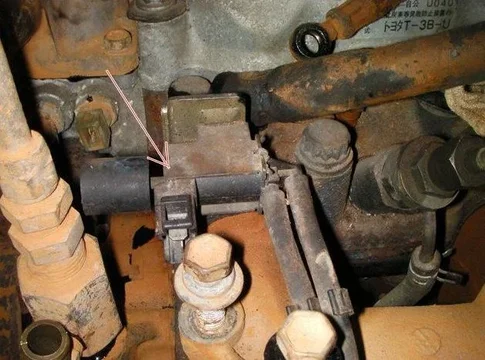
Ideas on what I think is an idle-up solenoid. I spoke about it earlier and it is connected to the injection pump and vacuum pump. It wouldn't be tough to connect as an idle-up if that is what it is meant for. Does this 3B slow when the A/C comes on at idle? I've never really had an issue with that on the old engine.

I've taken a closer look at the old power steering line and it appears to be a flare connection. I've soaked the connection with WD-40 and I'll give it a while to soak and then see if I can open it on Monday. If it is a flare the power steering hose is easy, other than pulling the old box and spacing the new one sufficiently. It looks like I'll need an inch thick spacer to get some clearance on everything.

The A/C compressor mount is slightly different and I'll need a different pulley on the A/C compressor to get the belts aligned again. I tried to see if the old A/C mount would work and if the bolt pattern of the timing gear cover were the same it would but alas it is not the same. Anyone know where to get just the pulley on-line?
SANY1233.webp
SANY1234.webp
 
Last edited:
I would not worry about an idle up for the a/c. My bj did not have an idle up and when a/c was engaged it would be lucky to drop 50 rpm. You would actually have to be concentrating on the rpm gauge to see the drop.

His is a great thread. It is wild how many differences there are between the 2 3B engines, it is turning out to be when ever you make a step forward there is something there to drive you back one.

Keep your chin up and you will get through it!
Daryl
 
Had a look into a couple of things for you CruiserGuy.

You wanted positive ID of this:
IdleUpReal.webp

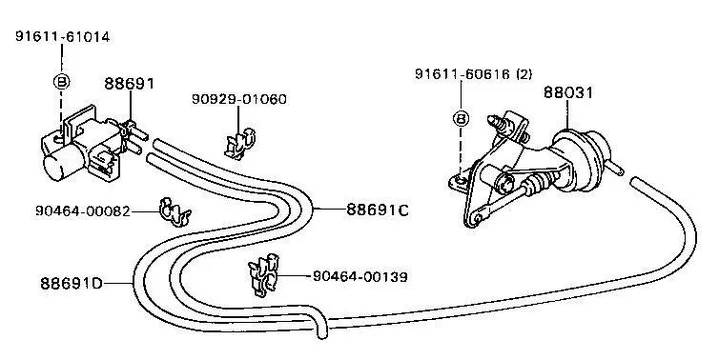
Well ... Yes. It is indeed part of the idle-up system for the airconditioning (and can be 12V or 24V):
IdleUp.webp

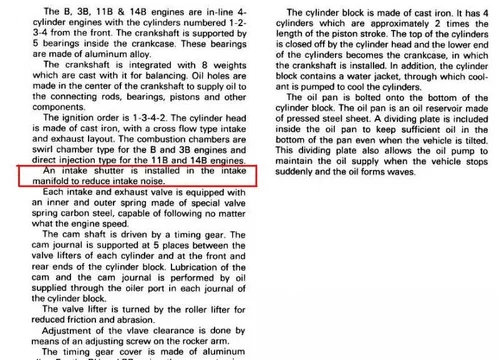
And that intake butterfly is apparently just for noise suppression:
IntakeShutter.webp

So do away with the lot I reckon .... Keep it simple.

:cheers:
IdleUpReal.webp
IdleUp.webp
IntakeShutter.webp
 
Had a look into a couple of things for you CruiserGuy.

You wanted positive ID of this:
View attachment 658919

Well ... Yes. It is indeed part of the idle-up system for the airconditioning (and can be 12V or 24V):
View attachment 658920

And that intake butterfly is apparently just for noise suppression:
View attachment 658921

So do away with the lot I reckon .... Keep it simple.

:cheers:

Thanks!

I'll pull the idle-up stuff then and plug that vacuum line. I'm sure it's 24v as the rest of the engine is supposed to be 24v though I have been unable to find any concrete evidence of that due to worn labels and unreadable info on the glow plugs.

Still working out how to hook up the throttle. The old engine had the cable across the valve cover. pulling towards the valve cover. The new engine has a much different geometry for that so it'll take a little more thinking but will be easier without the butterfly valve on the intake to contend with.

I expect my turbo will deaden any noise that the butterfly valve might have deadened anyways!
 
Last edited:
Back
Top Bottom