Koso slim water temp gauge install

This site may earn a commission from merchant affiliate
links, including eBay, Amazon, Skimlinks, and others.

Thanks, half k, for sharing the scoop on this mod. Perhaps if I take the hose off at the top clamp before cutting, I can catch more in the bucket. I'll use something more maneuverable and catchy than a bucket per se, too, like a costco nut jar or kid's sand pail, if those will be big enough.
 
I just put a wet dry vac in the top hose and ran it while I was cutting (system was drained). Got a little coolant sucked up and all of the metal.
 
Just did this mod. Super simple! I've got a trip to Yellowstone, Tetons, down into Colorado, and back across southern Utah in mid June, so having real-time temp info will be great. I went the inline sensor/hose split route, but will most likely tap the housing later.
 
I've ran mine for a few years now with the coolant hose T with no issues. I bought one for my 100series as well. I won't tap into the housing for mine
 
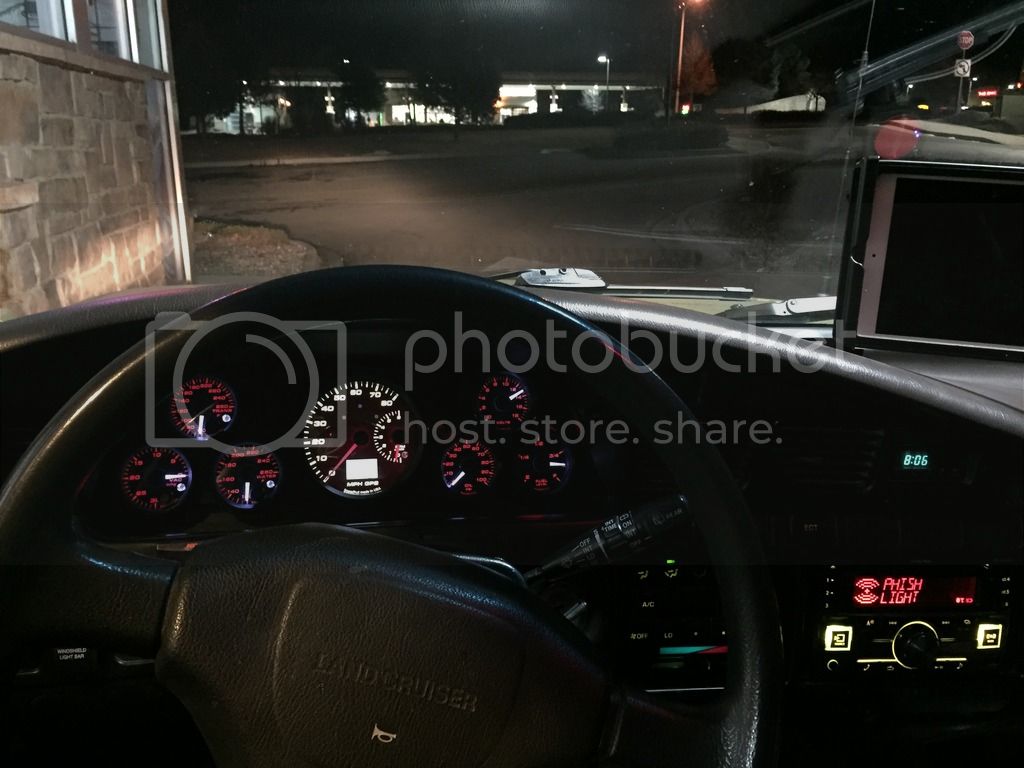
I even kept this gauge after I installed my custom gauge cluster.
IMG_0505_zpsyblp5jqw.jpg


the gauge cluster shows my coolant temp from the block drain location, and the koso shows the coolant out temp. I find its nice to have both as it adds to the piece of mind.
 
At $8, this might be more of a 100 series move but I used this stuff on my Koso gauge and the digital voltmeter for my house battery. It tones down the brightness so they aren't distracting at night. Dim It light dimming sheets - Alarm Clock Dim - Amazon.com

You must think we are made of money!!

I used a piece of window tint from a damaged box returned to Lowe's. I probably have enough for a handful more if anyone wants a piece. Just message me your address and I'll mail it out.
 
So, when I went to do this I discovered that the inline adapter and my sensor were threaded differently. It was last fall when I did my phh and most of the other cooling components and I haven't looked since then, but I seemed to be unable to find the sensor threaded correctly to fit my inline adapter. I returned two different adapters to Amazon, but kept the sensor figuring I'd just tap into the metal line with my next coolant flush and fill, but I'd prefer to go with the hose adapter route. Where did you guys who have done this recently source your hose adapter and sensor?
 
So, when I went to do this I discovered that the inline adapter and my sensor were threaded differently. It was last fall when I did my phh and most of the other cooling components and I haven't looked since then, but I seemed to be unable to find the sensor threaded correctly to fit my inline adapter. I returned two different adapters to Amazon, but kept the sensor figuring I'd just tap into the metal line with my next coolant flush and fill, but I'd prefer to go with the hose adapter route. Where did you guys who have done this recently source your hose adapter and sensor?
Amazon here, I will see if I can dig up the old records. Seems @DSRTRDR / @ChaseTruck had a similar ordeal. Maybe they remember better than I.
 
yes, we had that problem (starting at post #90 earlier in this thread) - called Koso and they sent another gauge that happened to fit - never got a satisfactory explanation - the final gauge has worked for the past 5 years

we still have one extra adapter, so if someone wants it . . . send me a PM
 
I want to do this but I'm a real cheapskate so I'm trying this for $7.99:

DIGITEN 12V Red Digital Fahrenheit degree Thermometer High Low Alarm -76-257F Temperature: Amazon.com: Industrial & Scientific

Even has an alarm so you can have it beep at you when it reaches 210*F (or whatever temp you want).

Should be here on thursday so I'll let you know how it works (accuracy test in boiling water). I'll probably have to put a dimmer strip on it.


One tricky thing is that the sensor is just a thermistor. On my isuzu I'll be drilling a hole all the way through the bleeder bolt on the thermostat housing, putting the sensor through and filling the hole with epoxy (this way it reads the temp immediately after the thermostats, and I can easily replace the sensor if I need to). I'm not worried about a stuck closed thermostat cause this truck has 2 in parallel :cheers:.

The 80 will be trickier since I don't want to drill/tap anything on the aluminum, and it doesn't have a handy bleeder screw. I'm thinking of doing something with the 1/4-3/8" coolant line that goes from right before the thermostat (think top of the waterpump area) to the metal hardline and eventually to the throttle body.
This line always flows coolant from right before the thermostat so I know I'm getting the hottest coolant and I'll know if the thermostat sticks closed and it starts overheating.
 
Last edited:
Has anyone ever had the feeling that their Koso water temp gauge was reading high, like 10-15 degrees high? Many times when I compare the Koso reading with my hand held infrared thermometer, the Koso is a good bit higher. And that's taking both readings at the Koso temp sensor location in the water outlet pipe.

I have a new HG, O2 sensors, no codes and a fully overhauled cooling system including a modded fan clutch and when it's 100 degrees outside with AC running, I can see 210-215 fairly easily on the Koso when running at highway speed. Shut down the AC or come up to a slow down in traffic flow and the water temp drops.

So I have been wondering which gauge I should believe, infrared or Koso?
 
take a glass of water with ice in it. make sure to stir it well. put the sensor in and see if it reads 32*F.

thanks to the properties of a phase change from ice to water, it will always stay at exactly 32*F until it is all thawed (assuming it's mixed thoroughly).

edit: for something closer to engine operating temperature, use boiling water. make sure to account for the change in boiling temp as elevation increases
 
take a glass of water with ice in it. make sure to stir it well. put the sensor in and see if it reads 32*F.

thanks to the properties of a phase change from ice to water, it will always stay at exactly 32*F until it is all thawed (assuming it's mixed thoroughly).

edit: for something closer to engine operating temperature, use boiling water. make sure to account for the change in boiling temp as elevation increases
Koso says the resistance reading across the connector terminals should be 10k ohms at "room temp". I could try both.

I'm interested to know if anyone else has had the same feeling about their gauge.
 
It is like Toyota left a flat spot for the Koso Temp Sensor! Nice and flat and facing upright.

Took longer to remove the distributor than to tap and drill hole for sensor

Hornd

I would advise you to change your temp sensor location to the other side of the engine:

this is a "reverse flow" system, it puts hot water into the bottom of the radiator and cool comes out the top. Why Toyota did this? not really sure, but maybe to reduce the chance of getting burned if you touch the upper rad tank.

The result: your temperature will be reading at the lowest temperature in your system (right after it's cooled down from the radiator) and is not very helpful in indicating an overheat condition since you don't know the actual temperature of the coolant coming out of your engine.
 
Koso says the resistance reading across the connector terminals should be 10k ohms at "room temp". I could try both.

I'm interested to know if anyone else has had the same feeling about their gauge.

Oh I meant to just take a glass of ice water out to your truck and see what the truck thinks the temp is (unscrew sensor, stick a plug in really fast, see what the temp reads for the icewater, then do the swap again. shouldn't lose much coolant I hope). if it's 32*F you're good.
 
Hornd

I would advise you to change your temp sensor location to the other side of the engine:

this is a "reverse flow" system, it puts hot water into the bottom of the radiator and cool comes out the top. Why Toyota did this? not really sure, but maybe to reduce the chance of getting burned if you touch the upper rad tank.

The result: your temperature will be reading at the lowest temperature in your system (right after it's cooled down from the radiator) and is not very helpful in indicating an overheat condition since you don't know the actual temperature of the coolant coming out of your engine.

Where did they put the overflow and pressure cap on this radiator?
 
Where did they put the overflow and pressure cap on this radiator?

On the top. Seeing as how there shouldn't be a detectable pressure variance between the input and output of the rad I'm not sure how this is relevant?

(Although having cooler fluid/fluid below its boiling point exit the rad cap to the overflow would be nice so it wouldn't boil itself in the overflow tank, perhaps that's why Toyota did this)
 
Back
Top Bottom