Navigation
Install the app
How to install the app on iOS
Follow along with the video below to see how to install our site as a web app on your home screen.
Note: This feature may not be available in some browsers.
More options
Style variation
You are using an out of date browser. It may not display this or other websites correctly.
You should upgrade or use an alternative browser.
You should upgrade or use an alternative browser.
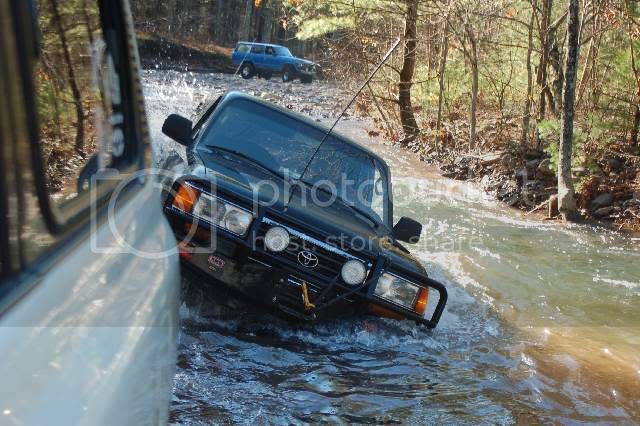
deep water pics
- Thread starter landcruisers4ever
- Start date
This site may earn a commission from merchant affiliate
links, including eBay, Amazon, Skimlinks, and others.


and how does one "seal" the dizzy?
I've heard of people using Silicone or equivalent and as extreme as using there ARB compressor to push air in the distributer so that water can't get in. I don't know how to do this but someone in here might. I read it in Off-Road Adventures' magazine, I can't seem to find the article right now, but it was there trek to Angel Falls. I'm sure you could find it online though. It was a fantastic read for me.

my 60 series has a distributor rubber boot, and a breather line that runs into the cowel area. As I understand it it is fairly waterproof. Just not sure what the 80 guys use in these cases. It's fun to drive through deep water, but not unless the truck is prepped for it. IMO, 80 series have way too many electronics to not prep them right.

IMO, 80 series have way too many electronics to not prep them right.
Very true.
I use dielectric aroung where the dizzy cap mates with the dizzy housing and it provides a very solid seal.
Luckily, all of the 80 series electrical connectors are waterproof.


and how does one "seal" the dizzy?
...Wrap it with saran-wrap...no, really.

- Joined
- Jun 5, 2003
- Threads
- 110
- Messages
- 1,847
- Location
- Sacramento, California
- Website
- www.instagram.com
what I've seen people do is to make the distributor air tight, except for two holes. A small 1/8" hose attaches on each hole. One hose goes to the cabin. The other attaches via another hole to the engine's air intake hose.
This will force air to be drawn from the cabin to the engine bay, passing through the distributor. Keeping it dry. If you got water in the cabin as high as the air intake, you have bigger problems than a wet distributor.
Regards
Alvaro
This will force air to be drawn from the cabin to the engine bay, passing through the distributor. Keeping it dry. If you got water in the cabin as high as the air intake, you have bigger problems than a wet distributor.
Regards
Alvaro

The standard 80 leads are very good factory with the inner boots to keep them dry, but it is worth using a sealant that stays soft like permatex on the face of the lead where it has the big round section that goes down inside the head. Water in here can be hard to clear, and it wont evaporate for up to half an hour driving with a miss.
We have also found the 12mm [1/2'] magneto type full shielded leads for drag cars work well for water protection, but cost $ and upset the radio also.
And not such a problem for the 4.5 cruiser, but exposed porcelain on the spark plugs can also create misfires, not so much in clean water, but if its dirty muddy water.
The dizzy has a breather hole in the bottom of the alloy housing, we normally drill and tap them and fit a hose to the air cleaner, in a low vacuum area, because with the cap sealing, if you dont have the air changing in the cap, it will condensate with the change in temp as it gets wet, causing the same problem as the water getting in.
I run a plastic shopping bag over the dizzy as a back up, and duct tape it around the housing shaft, and wrap it around the leads and tape it as well, cheap, easy to maintain, and lasts plenty of time to stay on there, you can also use a rubber glove, cable tie the shaft end and run the leads out through the fingers.
We have found a little air compressor off air horns works best, if wanting to go to that much trouble, blowing air in when turned on, to pressurize the dizzy, if you have it sealed well.
Also, if you have waterproofed the air intake, as an extra safety, I run 2 laps of duct tape around the air cleaner lid, then put the clamps back on, this way, with vacuum in the air cleaner space, there is no chance of water being sucked in there either.
The door seals will work well when moving, but stop, and water will start pouring in, also, if the water is deep, and/or running fast, letting more air out, helps the car stay on the bottom, and if you really unsure, open the doors to the first click, and let the water in, to help the car stay on the bottom.
We normally only have to do that if the water is over the windscreen wipers in depth, to stop the car floating.
Also make sure you run headlights that are sealed, and if you have a winch, make sure you spool it out, and back in within afew hours of the deep water, to generate some heat, and dry the internals of the winch and motor.
We have also found the 12mm [1/2'] magneto type full shielded leads for drag cars work well for water protection, but cost $ and upset the radio also.
And not such a problem for the 4.5 cruiser, but exposed porcelain on the spark plugs can also create misfires, not so much in clean water, but if its dirty muddy water.
The dizzy has a breather hole in the bottom of the alloy housing, we normally drill and tap them and fit a hose to the air cleaner, in a low vacuum area, because with the cap sealing, if you dont have the air changing in the cap, it will condensate with the change in temp as it gets wet, causing the same problem as the water getting in.
I run a plastic shopping bag over the dizzy as a back up, and duct tape it around the housing shaft, and wrap it around the leads and tape it as well, cheap, easy to maintain, and lasts plenty of time to stay on there, you can also use a rubber glove, cable tie the shaft end and run the leads out through the fingers.
We have found a little air compressor off air horns works best, if wanting to go to that much trouble, blowing air in when turned on, to pressurize the dizzy, if you have it sealed well.
Also, if you have waterproofed the air intake, as an extra safety, I run 2 laps of duct tape around the air cleaner lid, then put the clamps back on, this way, with vacuum in the air cleaner space, there is no chance of water being sucked in there either.
The door seals will work well when moving, but stop, and water will start pouring in, also, if the water is deep, and/or running fast, letting more air out, helps the car stay on the bottom, and if you really unsure, open the doors to the first click, and let the water in, to help the car stay on the bottom.
We normally only have to do that if the water is over the windscreen wipers in depth, to stop the car floating.
Also make sure you run headlights that are sealed, and if you have a winch, make sure you spool it out, and back in within afew hours of the deep water, to generate some heat, and dry the internals of the winch and motor.
- Joined
- Sep 1, 2007
- Threads
- 34
- Messages
- 588
I use "pro-seal" we use it on UH-60s to seal many things. Some places may consist of two high grade aluminum components with steel sleeves and a titanium bolt thru them etc... Lots of places we want water tight. Use a plexiglasss scraper to remove bulk of the old then clean it with a touch of MEK or acetone to get the film off. Anyway JP8 wont even dissolve it. Mix two parts 50-50 and spread with an acid brush.. Then make it pretty the same way you smooth out caulking.. Will outlast your cap and rotor for sure. I will likely clean, inspect and dielectric grease all connectors then as a teeny bit of proseal only where needed for a seal.. Shooot we use it on parts that are submerged in jet fuel as it is designed for that..
Ther eis no real issue with toyota plugs and connections.
good info from folks who know what it takes to drive an 80 through the deep stuff safely. Good read.

Here is the deepest I have been in but before I go any deeper I need to get that plug that goes around the steering column at the fire wall!
Video Link

Video Link

That would make for a great sticker.

Here is the deepest I have been in but before I go any deeper I need to get that plug that goes around the steering column at the fire wall!
QUOTE]
What plug? I was doing some wiring on my 80 and noticed a nice gap around the steering shaft where it passes through the firewall. Would like to plug that up, but wasn't sure how.
Jack
Apparently there is a gasket but since the steering wheel column is off center in the hole they never last. At-least that's what I have read.
Apparently there is a gasket but since the steering wheel column is off center in the hole they never last. At-least that's what I have read.
Cool, I didn't remember that gap on my LX. Will have to check into getting one.
Jack
- Joined
- Jun 5, 2003
- Threads
- 110
- Messages
- 1,847
- Location
- Sacramento, California
- Website
- www.instagram.com
When we did the Rubicon backwards in June of 05 there were some pretty deep water crossings.
Here's a picture of CruiserDrew's 40 that I took going through one of the deep water crossings. His 40 is on 35" tires.

Snook who was filming me, got video of the bottom of my spare tire under water.
Alvaro
Here's a picture of CruiserDrew's 40 that I took going through one of the deep water crossings. His 40 is on 35" tires.
Snook who was filming me, got video of the bottom of my spare tire under water.
Alvaro

Awesome picture Alvarorb!

Is this too deep?