80 series Slinky/ICON Long Travel Suspension officially coming to the U.S.A.

This site may earn a commission from merchant affiliate
links, including eBay, Amazon, Skimlinks, and others.

@Bogan @mryanangel Aren't the sway bars on the 1990 HDJ8X a fair amount less beefy then later years?

mranangle just beat me to it, but see if you can locate a stronger\stiffer swaybar.
 
Nice. Thanks, gents. We've gotta drive to El Paso for family stuff this week, so it'll be loaded down and we'll see how it feels on the road. I know @GW Nugget cut his coils to get an even lift height. I'm thinking it's the way I'll go. Swaybars too!
 
Cut one wrap of the coil down and it dropped the truck to a more desireable stance. Handles MUCH better now too. Ordered a HD Swaybar from @cruiseroutfit today and will hopefully put it on before we drive to Tejas. It's such a noticeable difference in handling with the EHD coils.
 
Cut one wrap of the coil down and it dropped the truck to a more desireable stance. Handles MUCH better now too. Ordered a HD Swaybar from @cruiseroutfit today and will hopefully put it on before we drive to Tejas. It's such a noticeable difference in handling with the EHD coils.
What is the part number of these EHD coils?
Aren't the EHD coils liner or single rate?
If so... you cut out live turns?
Do you have pics?
 
Part number from 4XO is SC70805RSLT. It says "dual rate coil" on the order email. Earlier in the thread people said the EHD coils are single rate so I'm not sure.

I cut a whole turn. No pics. I'll try to take some when I get a level place to park it. You have no idea how hard it is to find level parking in this city. The whole town is on a drainage slant. hah. It was a pain to do but already looks and drives better.
 
Last edited:
What is the part number of these EHD coils?
Aren't the EHD coils liner or single rate?
If so... you cut out live turns?
Do you have pics?
They are liniar rate coils. The rate is 20lb heavier than the HD coils heavy rate. In heavy loaded trucks, you don't need the softer rate rate coil as it will be a dead coil anyway.

EHD Coil Part number is AC7313
 
Last edited:
They are liniar rate coils. The rate is 20lb heavier than the HD coils heavy rate. In heavy loaded trucks, you don't need the softer rate rate coil as it will be a dead coil anyway.

EHD Coil Part number is AC7313
OK Awesome, so Ill repeat, you have a AC7313 rear EHD that has a 350# single rate.
I went back to the Compiled thread & see an AC7511E extra HD 330# linear coil.
I want to confirm this info before I enter it into the compiled thread.
@AutoCraft Aus
 
John have you thrown a @Delta VS panhard lift bracket on Ziggy?

check your last post number... ha

Nah, because the steering on a RHD is parallel with the panhard, so it doesn't jump around when you hit a bump.

lol sick
 
Nah, because the steering on a RHD is parallel with the panhard, so it doesn't jump around when you hit a bump.

Steering link on LHD is also parallel with the (front) panhard. That's not the difference. It's which way they slope.

Assuming there's some lift above stock:

LHD: Front steering link / panhard slopes down left to right and thrusts the front to the left on bump.
Rear panhard slopes down right to left and thrusts the rear to the right on bump.
Left-Right. Aggravates what just happened. Double the jiggly fun!

RHD: Front steering link / panhard slopes down right to left and thrusts the front to the right on bump.
Rear panhard slopes down right to left (same as LHD) and thrusts the rear to the right on bump.
Right-Right. Something of a "correction" to what just happened?
 
Darren told me could go as far 1.75” before starting to get any interference with steering/panhard. Pretty sure Darren tries to avoid offset (caster) bushings. I do as well and prefer sticking with OEM rubber bushings.
1.25” has worked out really well. Plenty of cloture clearance at the firewall. Straightened out the coil and centered the bumpstop in the coil again. With 35’s it would be perfect. With my 37’s I trimmed a little off the bumper wings and the front of the inner fender well to keep full stuff of the suspension.

Yes - about offset caster bushings, but Darren has mentioned numerous times using offset bushing at the frame mount, just to move the axle position forward, sometimes in addition to moving the frame bolt hole forward. But, he also uses the simple, inexpensive "washer mod" for caster correction, so no forward axle shift in his case (at the axle mount). But some caster correction plates do shift the axle forward (some don't). Trying to account for all the axle shifts that might be in play for that front tire rub.
 
Yes - about offset caster bushings, but Darren has mentioned numerous times using offset bushing at the frame mount, just to move the axle position forward, sometimes in addition to moving the frame bolt hole forward. But, he also uses the simple, inexpensive "washer mod" for caster correction, so no forward axle shift in his case (at the axle mount). But some caster correction plates do shift the axle forward (some don't). Trying to account for all the axle shifts that might be in play for that front tire rub.
Maybe he'll speak up himself but from my many conversations with him on the topic I don't think this is the preferred approach any longer. Don't think the "washer mod" has been used for a while. Regular practice lately has been Slee caster plates with the Slinky kits. Offset bushings have been abandoned as well from what I've seen. OEM rubber bushings have proven to work best and are what he uses and recommends in the Blackhawk control arms as well as new custom radius he has started selling in Australia (not yet in the US). So with standard radius arms, the relocation plates in the frame bracket are used, or longer aftermarket arms to put the axle forward. From what I understand, his custom radius arms have about 1/2" of adjustability to them so axle location can be fine tuned. (I'm still working on getting a set, but haven't seen them first hand yet to confirm).
I wonder if you're thinking of offset caster bearings? Darren does mention those regularly and likes to use those as a way to tweak front end camber. He likes to make the front end more "pointy" with the offset bearings used for camber. It's pretty effective too. I drove his US based 80 Snowy that is set up that way and fast corner turn-in is improved and understeer reduced with the offset bearings.
 
In regards to Darren using offset bushings on front radius arm frame mount:

...I don't think this is the preferred approach any longer....
...new custom radius he has started selling in Australia (not yet in the US)...
Could be, could be. You would know better than I would since you've had conversations.
Makes sense, too, with having newly developed custom forged radius arms available - kills 2 birds (or more) with one stone, so no sense in doing all those individual compensations.

I'm just recalling years worth of his postings. He's done so many things, and suppose his solution has evolved.

I wonder if you're thinking of offset caster bearings? Darren does mention those regularly and likes to use those as a way to tweak front end camber. He likes to make the front end more "pointy" with the offset bearings used for camber. It's pretty effective too. I drove his US based 80 Snowy that is set up that way and fast corner turn-in is improved and understeer reduced with the offset bearings.

Well, yes, I am thinking of that, sounds good to me, plan to do it, but it's a separate consideration from front axle position, so not in this context.
BTW - My calculation: 1* king pin bearing, rotated 30* to give -0.5* camber, adds 0.87* additional caster as well.
So - that too should be factored into the caster adjustment scheme, or you end up with more than you bargained for.

Anyway, I'm just trying to make sure I understand all that you've done in regards to front axle positioning, with your 1.25" forward adjustment. Anything else to add or subtract?

 
In regards to Darren using offset bushings on front radius arm frame mount:


Could be, could be. You would know better than I would since you've had conversations.
Makes sense, too, with having newly developed custom forged radius arms available - kills 2 birds (or more) with one stone, so no sense in doing all those individual compensations.

I'm just recalling years worth of his postings. He's done so many things, and suppose his solution has evolved.


Well, yes, I am thinking of that, sounds good to me, plan to do it, but it's a separate consideration from front axle position, so not in this context.
BTW - My calculation: 1* king pin bearing, rotated 30* to give -0.5* camber, adds 0.87* additional caster as well.
So - that too should be factored into the caster adjustment scheme, or you end up with more than you bargained for.

Anyway, I'm just trying to make sure I understand all that you've done in regards to front axle positioning, with your 1.25" forward adjustment. Anything else to add or subtract?

I have not done any offset bearings to add additional caster or to change camber. I'm using standard Koyo bearings in the knuckles. Still using OEM radius arms with rubber bushings. No caster change from the axle moving forward. The vertical position of the frame side end of the radius is unchanged, it's just moved forward 1.25".
Axle relocation by Adam Tolman, on Flickr

Axle relocation by Adam Tolman, on Flickr
 
Wow! I got the heavy duty sway bar on and new bushings on the rear upper control arms. what a pain but man, a huge improvement in how the Cruiser drives. I hit a whoop on Hwy 2 that used to cause the rear bumpstops to hit and with the new EHD springs and sway bar, the truck barely bucked. I imagine it'll limit flex on the trail a bit but overall, the truck is wayyyy less tippy / boaty and on my off-camber turn in my hood, I didn't feel like I was going to tip taking it a little bit faster. Thanks for the help y'all. We've gotta drive to Texas next week and I can already tell it'll be a much better driving experience.
 
Wow! I got the heavy duty sway bar on and new bushings on the rear upper control arms. what a pain but man, a huge improvement in how the Cruiser drives. I hit a whoop on Hwy 2 that used to cause the rear bumpstops to hit and with the new EHD springs and sway bar, the truck barely bucked. I imagine it'll limit flex on the trail a bit but overall, the truck is wayyyy less tippy / boaty and on my off-camber turn in my hood, I didn't feel like I was going to tip taking it a little bit faster. Thanks for the help y'all. We've gotta drive to Texas next week and I can already tell it'll be a much better driving experience.
Nice. I had a similar experience after installing the Blackhawk swaybar. Control and stability was dramtically improved. From my experience, the Blackhawk swaybar has had very little (if any) negative affect on flex. I was pleased with that. I look forward to hearing some additional review from you after some more road/trail time.
 
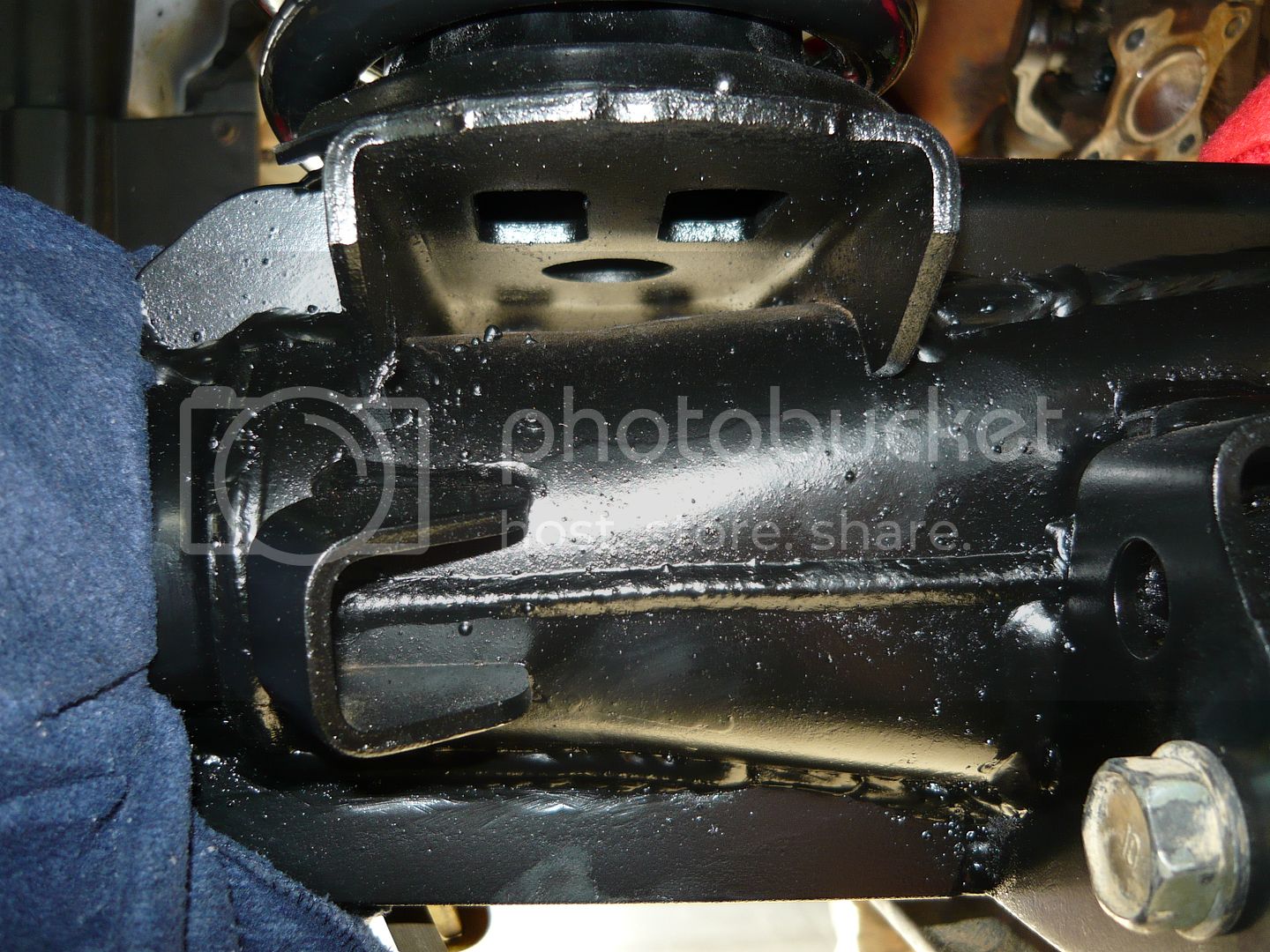
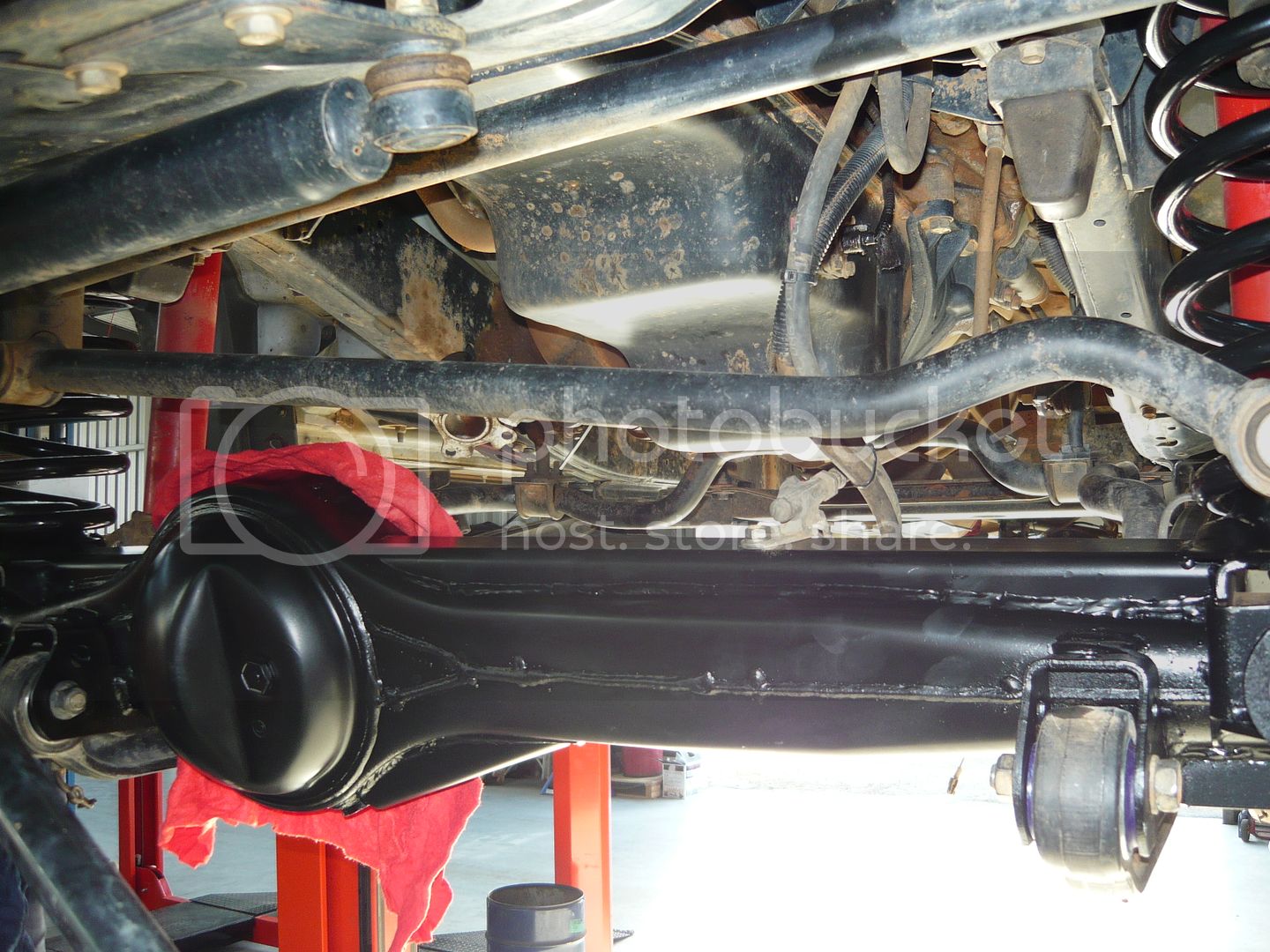
Gusseting the housing to stop the axle tubes flexing is the best way over the top can take space, we do the swivel ball top and bottom as well. Cutting the swivels and rheeming the housing, and pressing thick wall tube up the inside, and plug welding the ends with 6mm plates bent with axle holes welded into the centre pumkin is the neatest way.

P1000464_zps6d3ee136.jpg


P1000466_zpsefba797e.jpg


12642453_1751118215119382_8920910696503654071_n.jpg
Any pics of the tube inside? How often do you see bent swivel balls?
 
Finally got around to shooting a photo of the Cruiser with the Slinky extra heavy coils ( that I cut one turn off with a cut off tool) and with it loaded for a weekend of camping (minus bikes or bike rack). This is with 35 gallons of fuel, 10g of water, and other camping stuff. Looks pretty good. 3" Slinky coils, Delta Radius 4º arms, King 3-6" shocks, HD rear sway, no spacers, no body lift.

When I put the bike rack and two bikes on the back, that'll be about 120 lbs. It'll sit bit lower then...

BentonXmas-50.jpg
 
Back
Top Bottom