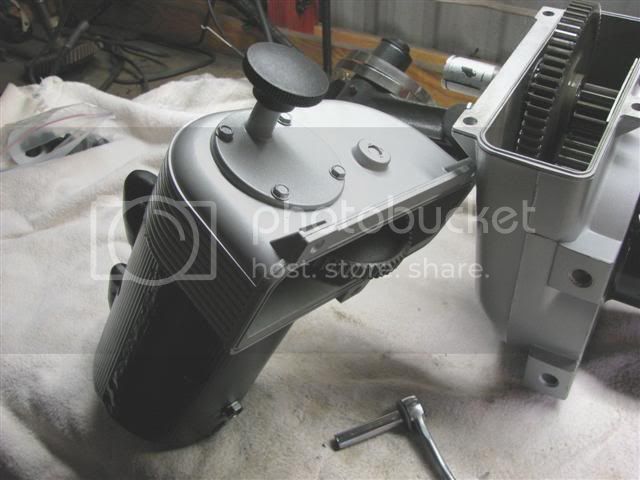
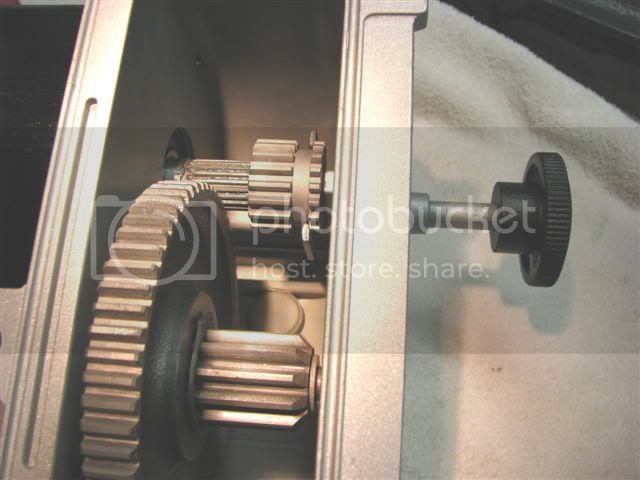
Just another 8274 rebuild - lots of pics

This site may earn a commission from merchant affiliate
links, including eBay, Amazon, Skimlinks, and others.

#1 Used a dead blow hammer and socket to drive in the new motor bearings.

#2 This one keeps the prestolite motor.

#3 And this one gets a new Warn. The color matches close enough for me :)
HPIM1375.webp
HPIM1376.webp
HPIM1378.webp
 
I'd better call it a night - pick it up again tomorrow :cheers:
 
I used my photos of the brake pawls before I disassembled them as a reference to put them back together.
HPIM1380.webp
HPIM1381.webp
 
Also, I used a bit of RTV silicone to seal up the clutch.
HPIM1382.webp
 
Paint or replace is the plan. I just stuck em on so I could push the shaft in and out. :hillbilly:
 
G'day Awl TEQ,

The black knobs look as though they are made from bakelite. If they are most commonly available metal polishing pastes such as Brasso will probably bring them up pretty well.

Just a thought.

Cheers,

Ben

P.S. I'm really enjoying this thread. You are doing a great job.
 
Really nice work !!

Glad to see some one who still does the rebuild the old instead of replace with new...

It is the way I grew up my Dad rebuilt almost everything as we could never afford to by new or replace the old..

I learned alot from that.


gr
 
Really nice work !!

Glad to see some one who still does the rebuild the old instead of replace with new...

It is the way I grew up my Dad rebuilt almost everything as we could never afford to by new or replace the old..

I learned alot from that.


gr

"they don't build them like the used to" comes to mind, though in this case they do - for a price. I would love a new M8274-50 or a 60th anniversary limited edition M8274-60 for I think $3000 USD! But I can buy a lot of suspension and brake components for that.

I am definitely one who appreciates well built, vintage and rare things. I have many new tools but use my father-in-law's hand me down tools the most and a 30 year old lawn mower that starts every time. My daughter is learning to play piano on a 102 year old hand carved Canadian built Bell.

Thanks guys for the kind words :cheers:
 
G'day Awl TEQ,

The black knobs look as though they are made from bakelite. If they are most commonly available metal polishing pastes such as Brasso will probably bring them up pretty well.

Just a thought.

Cheers,

Ben

P.S. I'm really enjoying this thread. You are doing a great job.


A quick application of “Plasti-Coat” (spray can) will make it look new again. It seems to wear very well too.

clutchinstalled.jpg


disengaged.jpg
 
Thank you for the tip Flint. No rush on the knob though - it can easily be the last component.

I finally got around to assembling one of the winches today so here we go with photos.:clap:

#1 here is the M8680 replacement lower housing bushings and seal.

#2 0.190 depth setting as per Flintknapper's thread (which I used directly as my re-assembly bible for the following - it's been to long since tear down and the details get fuzzy although my pics help as well).

#3 the bushing protrudes just slightly and the needle bearing for the brake shaft is installed (with an arbor press at work - not a hammer).
HPIM1408.webp
HPIM1409.webp
HPIM1410.webp
 
And now for the "Flintknapper method" of lubricating the free end of the drum ;).

Step 1
Basically drill and tap the stock cover retaining screw holes.

More in-depth tips:

-Use a 0.203 or 13/64 drill bit. (or to suit your required thread)
-Drill slowly and carefully - this is cast aluminum and very soft.
-Secure your work - your bit will "bite" and spin it.
-Do not drill through (Duh!). You will feel the bottom of the hole when you hit it.
-Tap with 1/4-28 or to suit your zerk fitting.
-Tapping cast aluminum can be a challenge, it may crumble rather than bite in - take your time. (I actually put the tap in my cordless drill and went very slowly on the trigger. That may sound reckless but it can work better than turning a tap handle and not keeping the tap perpendicular to the hole - this causes the tap to crumble the aluminum rather than cut threads.)
-Don't let the hole fill up with chips and bog down the tap - go half way and back out to dump the chips out.
-Drill the plastic cover even more carefully (I went to 17/64")
-Sit back and admire your work.
_
HPIM1411.webp
HPIM1413.webp
HPIM1414.webp
 
Step 2
Basically drill in to the above tapped hole from the bushing making a path for the grease to get to the friction area.

More info

-I used a 3/32" bit.
-Seat the bushing fully in place.
-Mark the center of the bushing (width) directly adjacent to the just tapped holes.
-Drill the mark with the bushing in place to assure matching holes. If you drill through the center of the bushing width you should hit the very bottom of the tapped hole.
-Starting the bit in the plastic bushing is a little tough at the angle required by the lack of access but once started the angle will help hit the bottom of the tapped hole.
-Don't move the bushing between holes.
-Blow out all chips - you don't want them in the grease and on the bushing.
HPIM1416.webp
HPIM1415.webp
 
Now for the drum.

#1 Here it is in all it's glory.

#2 The flat side of the plastic thrust washer goes against the drum. The seal is symmetrical and can go either way. Make sure there are no burrs on the gears to scratch the case bushing during install.

#3 A little lube always helps
HPIM1417.webp
HPIM1418.webp
HPIM1419.webp
 
#1 Here are the required components. The locking plate is in it's eventual location.

#2 This is the correct orientation of the main gear.

#3 I stood the drum on end and slid the case with gear onto the drum. The locking plate then went into place - bumps against the inside case wall.
HPIM1422.webp
HPIM1423.webp
HPIM1426.webp
 
I call this the brake shaft because the cam is the source of the braking power and the brake mounts to the end of the shaft. I don't know what warn calls it (too lazy to look and don't care - it's my thread :D)

This is the new shaft from Warn BTW.

#1 New o-ring and lube.

#2 Cam gear in place.

#3 Brake shaft and spur gear installed. I greased the needle bearing liberally and then forgot to install the locking plate - had to pull it out again.:doh:
HPIM1427.webp
HPIM1428.webp
HPIM1429.webp
 
#1 Bronze bushing and seal time.

#2 The bushing went in easy. To start the seal I lifted the locking plate a bit and slid the shaft out a little to get some surface to roll the seal onto.

#3 Then drove the seal in. I couldn't find anything to use as a seal driver lying around so I used a punch and hammer and took my time tapping around trying to keep the seal as straight as possible. During that process I slid the shaft back and locked it in place.
HPIM1432.webp
HPIM1433.webp
HPIM1435.webp
 
Brake assembly

#1 The parts. New friction material, snap ring and ball bearings (21) - the rest is freshly plated.

#2 Start with this plate down first.

#3 Add one friction material ring.
HPIM1436.webp
HPIM1437.webp
HPIM1438.webp
 
#1 Note the direction of the teeth on this ring.

#2 MAGNETS! These are rare earth and very strong. They will pinch you HARD if your not careful. I was going to spread three evenly around the toothed ring but I couldn't get two of them apart. They hold the chrome plated balls pretty good - still have to be careful or chase them around the floor. Also the spring is in now.

#3 Moved the assembly to the winch. The winch is standing on its side on the drum's free end. The fat washer and keys are set in place (I cleaned up the keys) as well as the friction material.
HPIM1439.webp
HPIM1446.webp
HPIM1448.webp
 
Back
Top Bottom