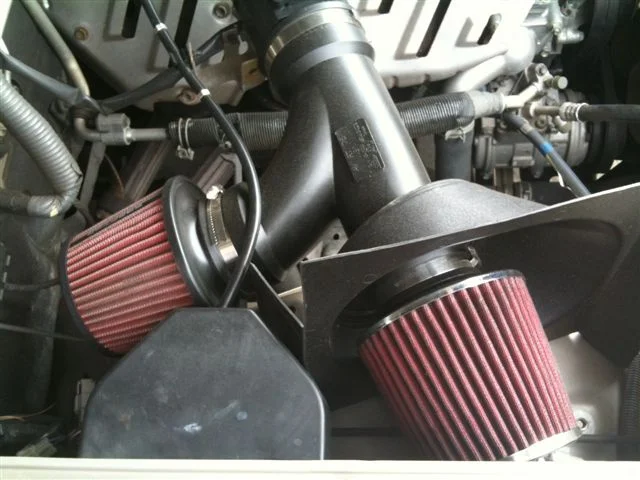
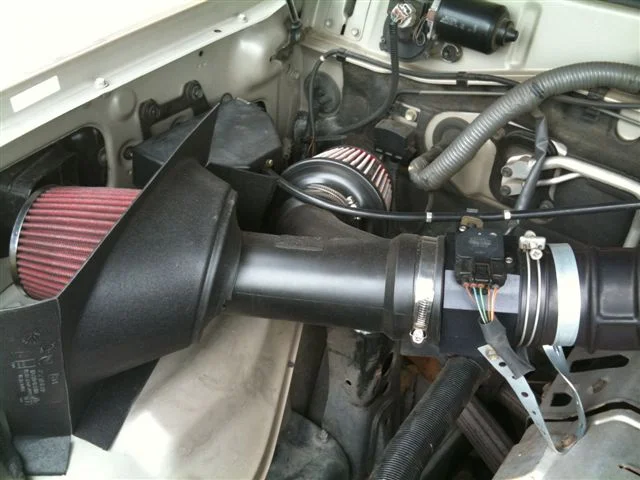
Haha, yeah you may be right there. However the main filter is directly inline with the cold air intake coming up through the fender and the shield directs that air to the rear filter. Can't get any closer than that unless you use a completely enclosed heat shield. It ain't perfect but it is what it is.
You probably don't want to be hearing this....but....

I can guarantee you that you are going to be absorbing tons of heat. Unless that second filter is for show, that's positioned directly above the exhaust downpipes, so you're going to be getting tons of heat from that.
The OEM setup pulls air directly from the fender well in a completely closed setup, what you've done is open up that sealed box and replace it with some flashing that is no longer completely sealed. You may suck in most of the cold air from the intake, but you'll suck in tons of hot air from the engine bay as well.
Additionally, there's a filtration issue there. The OEM filter setup will filter
far
more than those K&N's.
Don't believe me?
Filtration Testing for Amsoil, K&N, Napa, Jackson Racing, Baldwin, and Mazda air filters on a Miata
The OEM filter is a foam filter similar to the two best ones in that test.
"But wait!" you say, "the K&N will
flow better!"
Um, that may be true, but lets think about a couple of things here.
A filters job, first and foremost is to remove particles. A good filter would remove 100% of particles, but a good filter would also not let any air flow. No filter will flow the best, but will not remove anything.
And even
if the K&N air filters did actually flow better (which is not
necessarily the case), you've replaced a very large volume air filter with two smaller ones, which likely negates any gain you may have had.
Are you going to actually notice that extra 1 HP (at the engine, reduced further when you measure it at the wheels)? Probably not.
Are you going to notice the extra wear and tear on the engine from more particles getting into the engine? If you keep it long enough, yup.
Are you going to notice your wallet getting lighter by several hundred bones when you have to replace the MAF/VAF because oil contaminated it and ruined it? Probably.
Oh, that's right. Oil (the same oil that K&N and other companies tell you to use) is not only messy, but can ruin your intake sensor. :whoops:
An interesting comment from that test I linked to above:
In the e-mail I received from K&N, I actually got contradictory information on this point. They claimed that the deposit on my test filter was oil (it isn't), and then they said oil does not leave the filter and damage mass air sensors. Honestly, you can't have it both ways. Either oil leaves the filter or it doesn't. Oil will damage a mass air sensor if it gets on the sensor wiring. This is highly documented by TSBs easily available online.
I get what you're trying to do, and I applaud the idea and motivation behind it. But, and I hate to say it, you just spent $37 doing something that is
worse for the engine. Your air temps will be higher. You will let in more particles. The oil from the filters may damage sensors behind it. You will flow the same or even worse. There is absolutely no benefit to the mod....and every reason not to.
The air intake on an 80 is
incredibly well designed. The filters are also top notch, far better than just about anything aftermarket.
For one, the 80's air filter is huge, far bigger than the engine needs (and far larger than what most competitors would use). For another, the OEM filter is designed to be reused, not thrown away (it has cleaning instructions printed right on it, no oil needed). Finally, the OEM design has a pre-filtration catch can integrated into it, which you've removed. So a lot of the crap that would have been caught there is now going straight to your filters...which--as the K&N doesn't filter as well--in turn is going straight into your engine.
Here's my unsolicited advice. Undo what you've done, return it to stock, and buy a new OEM filter from Mr. Cdan as a way of apologizing to your truck.







 (and I've been selling them for 15+ years....even have the stupid ping pong ball demonstrator in my shop lol)


