Build '97 40th Build

This site may earn a commission from merchant affiliate
links, including eBay, Amazon, Skimlinks, and others.

Figured it out. I replaced the relay, and still no check engine light. I was going through the schematic and checking voltages and determined the ignition circuit had no power. The fuse is good, fusible links are good. IGN fuse under the dash had no power on either side.

Then I noticed an unplugged connector right at the battery by the fusible links. I plugged it in and then suddenly every thing works fine.

The truck was sitting in the viewing area of an auction for a few days and people could look at it/start it, etc... unattended. I think an adversarial bidder who knew a thing or two about Landcruisers pulled that plug to try to ward off other buyers while it was in the viewing area. The thing not starting added a big challenge to the shipper and caused a couple of really angry phone calls from a certain truck driver to me, giving me an earful for telling him it runs and drives when it doesn't run or drive. I knew it runs and drives because I had someone look at it for me and start it up. Oh well, now that it's running and driving, it all checks out. The A/C even works pretty well, so I'll probably leave it alone for now. It shifts and drives just fine. Low range engages OK.

Does the '97 have a center diff lock light that lights up in low range? I did not see it. I can't drive it much really with no coolant in it, but I'll probably try to do some tight turns in low range in the yard and see if it is locking or not before I pull the transaxle.
 
Nice find! I just picked up one too. Looking forward to watching your build and learning more about it.

Is the EFI relay a universal part or Toyota only?
 
I bought a 'quick fix' replacement relay at autozone. It's some cheap chinese brand that will now live in my toolbox for emergencies since nothing was wrong with the one I had already. They had to cross reference it off the denso number printed on the toyota relay. If I ever do end up using the emergency relay, I'll buy a new OEM replacement and put the chinese one back into toolbox mode.

I had really though someone might have added a relay to the security system so that it was cutting ignition instead of starter, and I was about to go down that path and start searching for modded wires and non oem relays in the drivers footwell when I saw the unplugged connector. That's the thing about systems that have the ability to disable the car, they can (and do) go wrong. There was a system in one of my other cars that decided to not allow start while way off the beaten path and out of cel range. Managed to bypass it with a paperclip and a AA battery, but I removed it the moment I got back to my full toolset. What a pain! If someone wants to steal your rig and they know what they are doing, no factory system is going to stop them. Perhaps I could just disable the no start 'feature' of the OEM unit, but I'd like something with remote start, remote window control, and will probably look into a remote tailgate hatch solenoid install. Not everyone's cup of tea, but I like my gadgetry.
 
OK, I guess I'm officially obsessed with these rigs. These two videos are now my favorites on youtube.

Austrailian Toyota 4WD training videos:

https://www.youtube.com/watch?v=Xz0hN05GyLQ


I know they've been posted before, but I can't stop watching them over and over...
 
Looks like some awesome plans and good times ahead.

Just a heads up, I did the Depo headlights and looked at doing LED bulbs. From what I read on here, the LEDs don't fit correctly in the Depos; however, I just used some cheap eBay bulbs, and the light output is seriously amazing compared to stock (I had the Slee wiring upgrade and John Deere HIRs before). My high beams rival my LightForce 240s. I also painted the surrounds black.
image.webp


35s should fit fine with a 2" lift. I have the 2" Ironman foam cell lift, but ended up getting 2.5" when it was all done. Then I redid the body mounts and got another 0.5" of lift.

image.webp
 
I really like that stance and tire size. Your Sig line says regeared, what did you end up going with and are you happy with it?

Thanks!
I went with 4.88s. They are perfect for the less powerful 3FE. I debated going with 5.29s, but I would have been way over geared on the highway.
 
In the interest of giving back or paying it forward, I wanted to contribute to the collective knowledge here and maybe help someone out. I have read a lot of threads, and there is a ton of really technical info and great advice. I'm going to attempt to share some of what I have learned over the years and give some basic info for people who don't know what goes into doing something like an engine pull, rebuild and reinstall. I'm not intending to provide step by step instructions, rather to help those who are new to wrenching. I see plenty of posts where the reply is from someone who says they have zero or very little mechanical ability or experience. If someone can benefit from anything I write or show, I will carry on with those things. I'm not intending to insult the experts here, only provide information for those that might not know a combination wrench from a socket wrench. I am not a professional mechanic so some of my methods may not be 100% correct, but I do what I know as a self taught mechanic.

So, in that light, I'll start. I find that anyone new to wrenching doesn't know the names of the tools.

P1040010-M.jpg


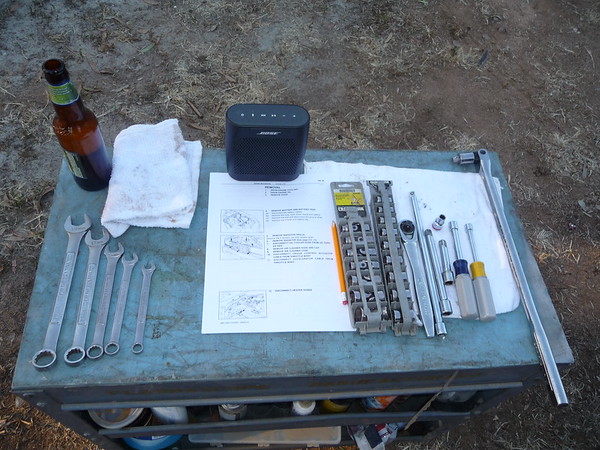
This is pretty much the bulk of the hand tools I expect to need for the engine removal process. I'm missing screwdrivers and various types of pliers and cutters in this photo. From the left we have, Combination wrenches, metric flex head sockets (wobblies), metric standard sockets, a 3/8" rachet, three sizes of 3/8" extensions, 8 and 10 mm nut drivers and a 1/2" breaker bar with a 3/8" adapter (my favorite tool). I will add tools to the cart as I go and I'll take a photo of every tool I end up using to remove the engine when I get done.

I also have a printout of the engine removal section from the FSM and a pencil I use to cross completed items off the list of work from the FSM. I make notes about what parts I want to replace as I go so I don't forget and any questions I have for later research. The beer is for when something isn't working out like it should.

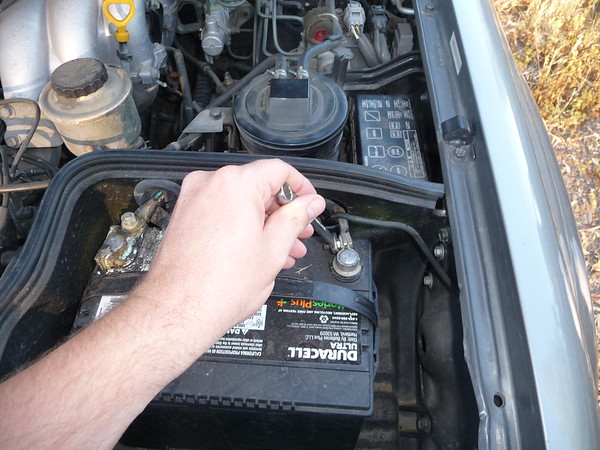
The first steps is to remove the battery (I skipped hood removal for now). When working on a battery, you always remove the negative cable first. The reason you do that is that if you put your wrench of the positive cable, and then turn it, and accidentally touch something metal, you will create a huge spark and possibly hurt yourself. I did that in my early days of wrenching a time or two. You an literally take a chunk of metal out of your wrench by doing that.

P1040012-M.jpg


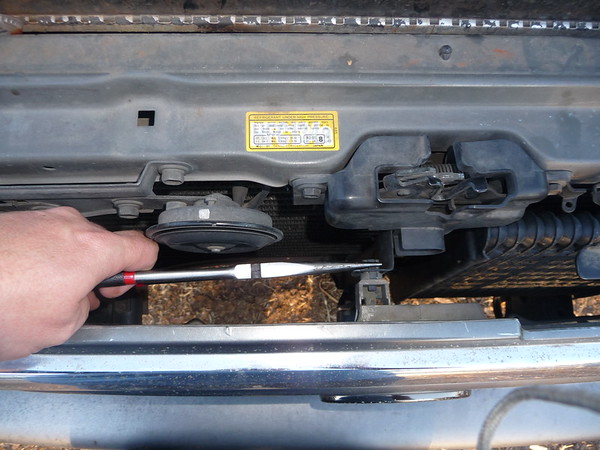
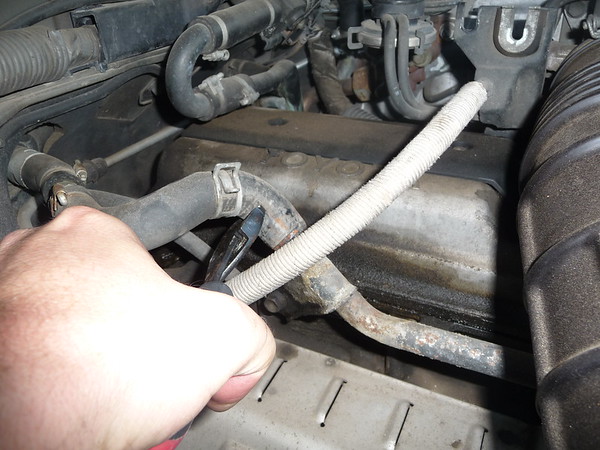
A light squeeze with some pliers frees the plastic clip holding the grill on

P1040014-M.jpg


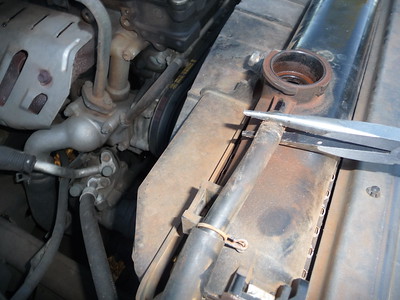
While removing hoses, I usually try to twist them first with my hands or with pliers. If you use pliers, don't squeeze very hard, with plastic or metal connections it is usually thin and you can crush the connection under the hose. Most beginners I see try to just pull the hose straight off. By twisting it first, you can break its 'set' and then it pulls off much more easily.

P1040015-S.jpg
 
Last edited:
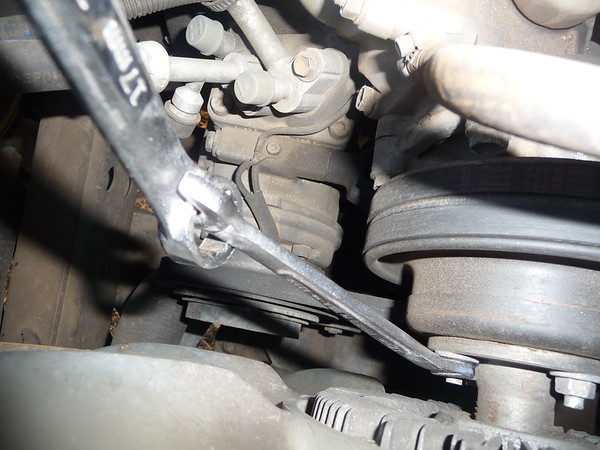
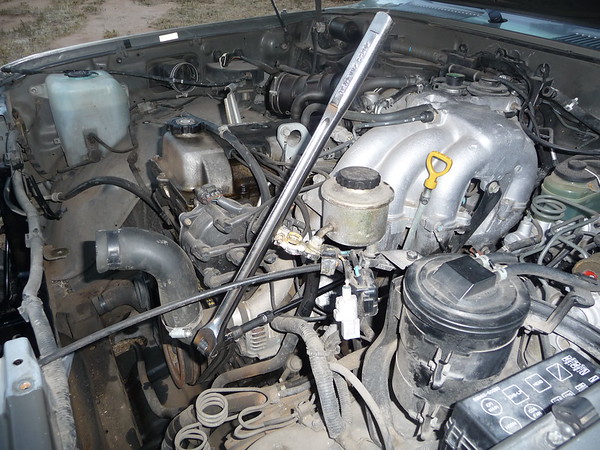
A trick that an old school mechanic taught me uses combination wrenches to make a longer handle for nuts that need more leverage to loosen. The first use of that I found is on the fan clutch. The nuts are 12mm and they are quite tight. A nice breaker bar with a long handle would easily loosen them, but you can't fit it on there because there isn't enough room. You have to use a combination wrench. A standard 12mm combination wrench isn't very long and you'll need to apply a lot of force with such a small lever, and you'll end up busting your knuckles. This trick allows you to make your combination wrench into a breaker bar. Maybe everybody knows this trick already.

P1040017-M.jpg


You put the small wrench box end on the nut/bolt and then hook a larger wrench, I used a 17mm into the open end and now you have a nice long handle, good leverage and you can loosen it without busting your knuckles.

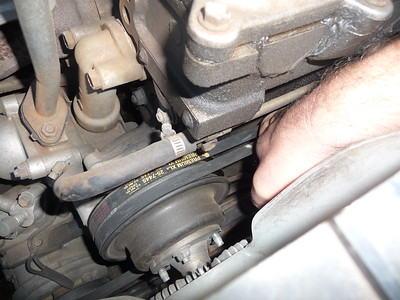
The next problem with the fan bolts are the fan turning while you try to loosen it. The FSM says to loosen the fan belts first. Don't do that. I think there is some fancy tool that can hold the fan while you loosen the nuts, but I've never seen one. The easiest way I have found is to push down on the belt(s) to add friction and use the belts to keep it from moving. I just pushed down on the belts like this. I'm sure there are other techniques, but this is the one I usually use.

P1040018-S.jpg


Worked about an hour tonight, and was pretty much ready to remove the radiator, but it was getting dark, so another evening.

If this is too basic and not of interest to anyone, just say so.
 
Very nice write up and good pictures. Keep it coming!
 
I like seeing the simple steps. The pieces "everybody knows". For instance when I replaced my head light bulbs, I didn't know I only had to loosen the screws holding the bulb in place. I removed my screws. Not a big deal, but it took me an extra half hour to get the cover lined up, and the screws back in. All I needed to do was loosen the screws, then twist and pull the bulb.

I don't recall seeing the tip about extending a combination wrench. Faster than duct taping a pipe to the wrench.
 
I took the radiator over to the radiator shop this morning. I wanted to see if I needed to replace it or what. $25 for pressure and flow testing, power wash and flush. It's not an OEM radiator, but the guy told me it's a good aftermarket brand that should provide good service, it looks like it's been replaced fairly recently. I should be OK to continue using it with it's fresh service.
 
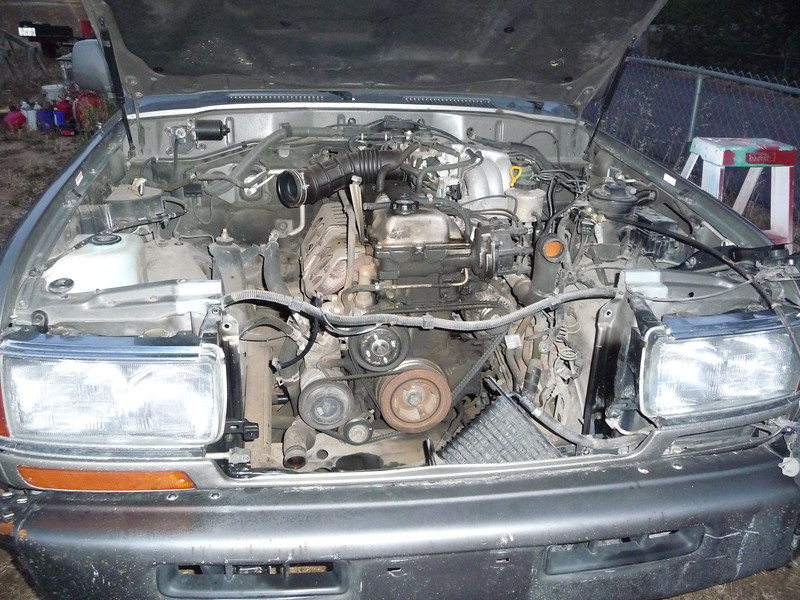
After about three hours total since starting, working at a fairly leisurely pace engine bay looks like this:

P1040030-L.jpg


Radiator is checked out, condenser will be evaluated tomorrow. I decided to remove the core support even though the FSM doesn't tell you to. I"m hoping that the wire harness that goes across there can be unplugged and fished over to give plenty of clearance for removing the engine through the gap, it will make it a lot easier to get it out with the lift.

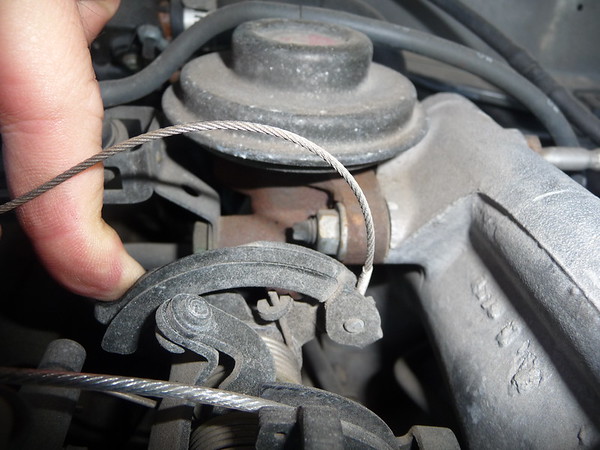
So far nothing very difficult. if you have never removed a throttle cable, here is how you do it:

P1040024-M.jpg


Press down on the cruise control and/or throttle control, and arch the cable up. It will rotate up towards a slot where you can slide it right out the side. Cruise control and throttle cables work the same. When undoing the nuts on the cables, only loosen the nut closest to the throttle and be sure to leave the other side alone, it's adjustable and by leaving it you won't have to worry about adjusting it when you put it back.

If you have hoses you are going to replace anyways, this is the easy way to get them off.

P1040026-M.jpg


Self explanatory.

The only really tight bolt was the high pressure fuel line bolt. I used my breaker bar, some extensions and a 17mm wobbly to get it loose. Worked great.

P1040028-M.jpg


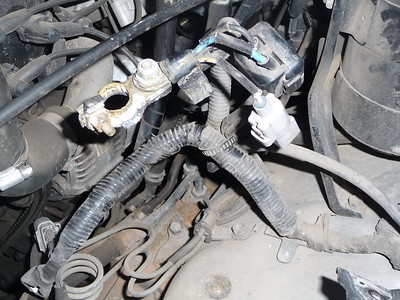
One place where the FSM steers you wrong is that you should disconnect the battery terminal wire connections while the battery is still in the truck. It's really tight and there's nothing to grab once you have it loose and then need to disconnect the wires with it's 12mm nut.

P1040029-S.jpg


The nut on the battery terminal needs to come off. I tried a couple of ways and started bending it. It was dark, so save it for tomorrow.
 
I'm starting to see signs that someone was in here before me. The hood has been removed, connectors that should be on factory mounting locations are not, etc... Not sure what that means yet. Possibly it has had a head gasket replaced somewhere in it's past in-place. Will have to be sure to check the head to see if it is in spec for milling. The FSM says that if the head is warped, replace the head. They do not give a spec for maximum amount that it can be milled. If it has been done before, is there any way to know?
 
This engine has 220K miles on it. I am wondering if I should replace the timing chain while I am doing a minor overhaul? I plan to put rings and bearings, and all new seals on the bottom end, and do bore and pistons if the wear warrants it. Should I replace the timing chain at this point as well, or are they good for a lot more miles? How about the oil pump, plan to replace or clean/inspect?
 
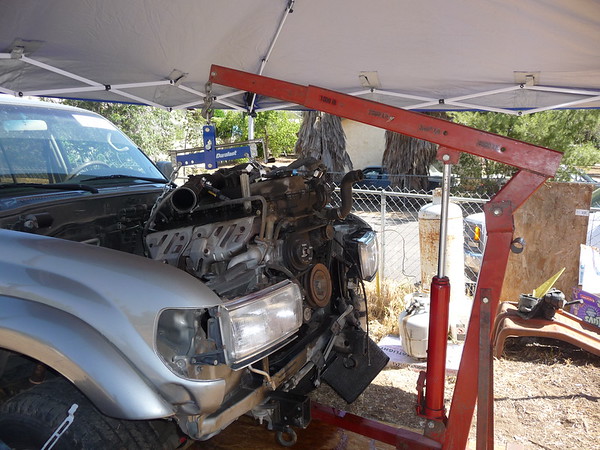
It's out.

P1040034-M.jpg


P1040043-M.jpg


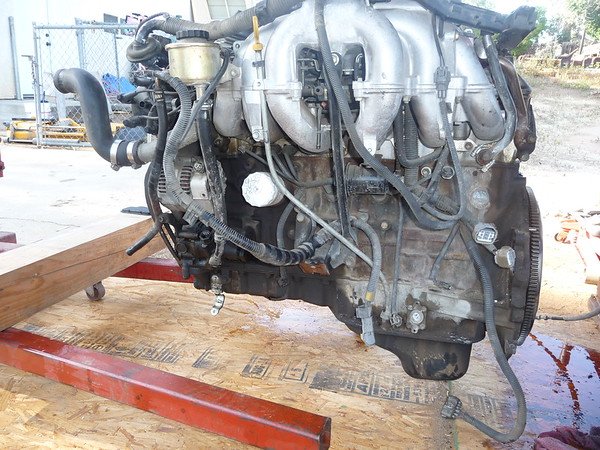
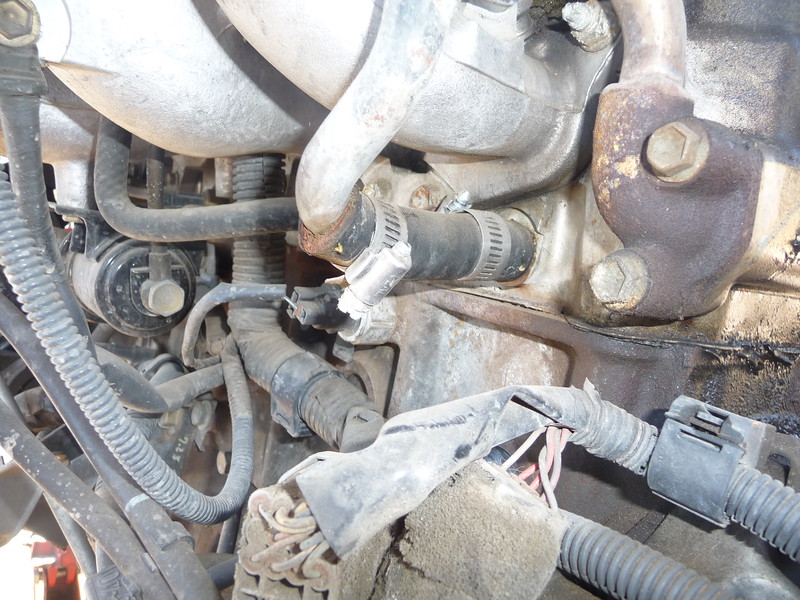
That thing is heavy. Pulled it with the trans and transfer case attached. The come along on the tranny lift hook is pretty much a necessity to get the tranny off the jack under the truck. Stood in the engine bay on the axle and helped lift the thing clear of the frame to get the tranny and transfer case lifted high enough to get it over. Used three guys, one in the engine bay lifting (me), one pulling on the cherry picker, and one lifting/twisting/pulling as necessary. With the bumper and core support removed, don't have to lift it too high. Went pretty smooth, broke a socket on the exhaust nuts. For a novice at a leisurely pace, it's about 10-12 hours total to get it pulled. basic handtools and a cherry picker get the job done. Had trouble with the trans cooler lines on the drivers side, they jut out just aft of the engine mount and make for a hassle. Will have to remember to jockey those back into place at just the right time on re-install. (note to self). Fuel filter does't look fun to change in the truck, will do it now. The rearmost coolant hose coming out of the head on the drivers side has been replaced at some point and was seeping/leaking, looks like it would be a nightmare to get to with the engine in. Destroyed sensor just above the oil pan on the drivers side, will have to look up what it is for.
 
<snip>The rearmost coolant hose coming out of the head on the drivers side has been replaced at some point and was seeping/leaking, looks like it would be a nightmare to get to with the engine in. Destroyed sensor just above the oil pan on the drivers side, will have to look up what it is for.

Just search "pesky heater hose" or "PHH" and you'll find a little info.;)

The sensor just above the oil pan is your oil level sensor - notoriously inaccurate even when it does work. I had the plug for that sensor destroyed on one of my 80s, so I just clipped the wires and taped them up. No lights, no problems - I still have the dipstick to tell me when the oil is low.:D
 
Thanks. I'd heard of the term pesky heater hose, but hadn't looked it up yet. I figured it would be pretty obvious when I saw it, and indeed it was. Possibly this leak is why the truck blew it's head gasket and is the reason it became mine. It's the first sign I've seen of a coolant leak. It has been replaced before, I found a cutoff of the previous hose, very very blown. A regular, cheap heater hose and twist clamps were installed, and were obviously leaking. Looks like the PO had been putting water based on rust found in cooling system, must have been leaking for a while. Fancy silicone hose and clamps ordered. Never want to see that again!

P1040041-L.jpg
 
That's great! Looks like you had the same idea as I did today. Interesting how there's a number of threads right now on blown head gaskets.
 
Back
Top Bottom