Build 1st FJ40, '76 - SMOKEY - Puttin’ her Back Together

This site may earn a commission from merchant affiliate
links, including eBay, Amazon, Skimlinks, and others.

Ok, so what year is my truck, officially? It has the front disks of a 76, but it is Oct 75.

View attachment 743905

Traditionally new model years start in August or September of the previous year. Front disc brakes started in 9/75 and are one of the defining characteristics of a '76 and later model.

Similar to yours, my Oct. 76 build is a 77 model year FJ40.
 
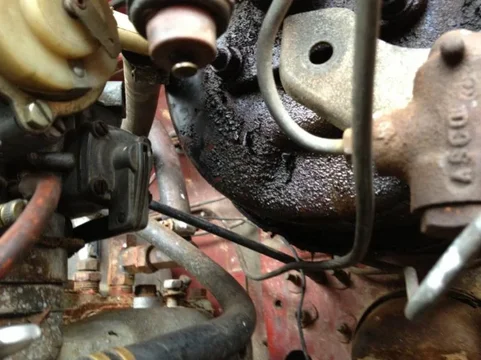
Next topic. Fluid leaks. Troubling or not, see each picture:

Brake Booster
image-2973533314.webp


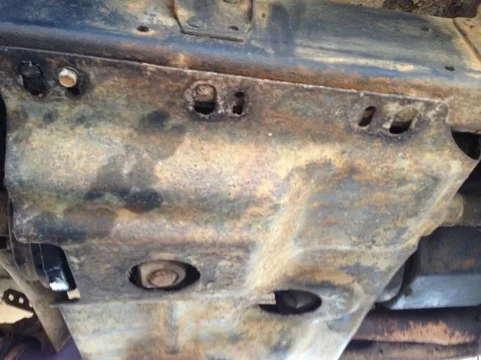
Drivetrain (note drip at left lower side of picture) just beyond skid plate. What is this component/area called?
image-1268252087.webp


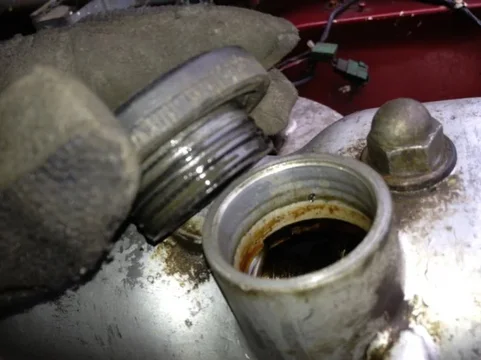
No threads on oil cap/valve cover?
image-1559855103.webp
image-2973533314.webp
image-1268252087.webp
image-1559855103.webp
 
Vae Victus said:
Next topic. Fluid leaks. Troubling or not, see each picture:

Brake Booster

Drivetrain (note drip at left lower side of picture) just beyond skid plate. What is this component/area called?

No threads on oil cap/valve cover?

Drive train: that's your handbrake. The seal from your transfer case is leaking and your brake shoes will be soaked. Not urgent, just don't trust your hand brake and keep an eye on your fluid level.

Oil cap: normal for '76. You can fit a valve cover from a newer 2f ('81 if I remember correctly) if you prefer a threaded cap.

Booster: likely your master. Replace it.
 
Next topic. Fluid leaks. Troubling or not, see each picture:

Brake Booster

Drivetrain (note drip at left lower side of picture) just beyond skid plate. What is this component/area called?

No threads on oil cap/valve cover?

Brake booster - worrisome because this indicates your brake master cylinder is leaking, possibly into you booster. This is bad for your booster (could eat the diaphragm and kill it) and also bad for your ability to stop the truck. Brakes are the most important part of the truck. I'd get a new MC(OEM or Japanese) and inspect the booster form damage.

Not sure about the drip from the drivetrain - my truck has no skid plates so its tough for me to identify what I'm looking at...

I'm also not sure about the oil caps on the stock engines, but the cap on my 350 is unthreaded and just pressure fit, so this could me normal.
 
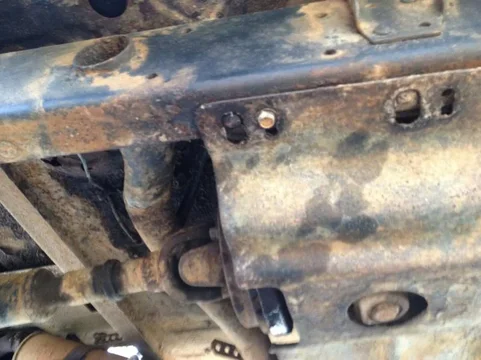
Another drive train photo:


image-994824050.webp


If I remember correctly, it is about mid-ship, just in front of that big structural tube going across the frame. Just behind the front floor tub where the gas tank hump ends. In this photo you can just see the muffler. This was taken while lying under the passenger side, front of truck to my right, rear passenger wheel to my left.

End of the main transmission where it attaches to the drive shaft?
image-994824050.webp
 
As chamba said, that is your transfercase. It connects to your rear drive shaft through your emergency brake. They are notorious for leaking from the rear seal, into that drum brake. As chamba said, this means your parking brake is an oil slick and won't stop anything. Relatively easy fix in the grand scheme of things. There's even a couple articles in the tech section on how to fix it.
 
Another drive train photo:


View attachment 744035


If I remember correctly, it is about mid-ship, just in front of that big structural tube going across the frame. Just behind the front floor tub where the gas tank hump ends. In this photo you can just see the muffler. This was taken while lying under the passenger side, front of truck to my right, rear passenger wheel to my left.

End of the main transmission where it attaches to the drive shaft?

Pull that skid plate off and have a look underneath and take some good pictures. The skid plate is not structural and won't hurt anything by not being on there for the foreseeable future. Take some pictures and post them up here. You'll want to inspect your transfer case and transmission for leaks, as they could be dripping and running down the skid plate in addition to your parking brake leak.

I would also pull the fill plug for the transfer case while you're down there, and check that the transfer case fluid level is good. If it's low, you may have additional issues. It would also be a good time to drain the transfer case, and refill with new fluid, which is a good rule of thumb when you're baselining your rig.
 
Pull that skid plate off and have a look underneath and take some good pictures. The skid plate is not structural and won't hurt anything by not being on there for the foreseeable future. Take some pictures and post them up here. You'll want to inspect your transfer case and transmission for leaks, as they could be dripping and running down the skid plate in addition to your parking brake leak.

I would also pull the fill plug for the transfer case while you're down there, and check that the transfer case fluid level is good. If it's low, you may have additional issues. It would also be a good time to drain the transfer case, and refill with new fluid, which is a good rule of thumb when you're baselining your rig.

Yep, have the new fluids in the garage already, got a hand pump ytd at Advanced Auto.

Was wondering where the eBrake was located. Strange spot.

Will get some photos up. Raining here now so not today.
 
I"d also consider dropping your rear drive shaft. Make sure you have wheel chocks on all 4 wheels first, so your rig doesn't go rolling away. That drive shaft looks like it's seen better days, and you'll want to inspect the inner mating surface between the female and male DS and make sure it's greased and not rusted up.
 
Vae Victus said:
Yep, have the new fluids in the garage already, got a hand pump ytd at Advanced Auto.

Was wondering where the eBrake was located. Strange spot.

Will get some photos up. Raining here now so not today.

Handbrake was moved to the rear axle in 1981. Far superior in my opinion.
 
Let me also add emphasis to a previous comment - ALWAYS PULL THE FILL PLUGS FIRST! If those guys are seized up and stripped and you've drained the case/trans you are SOL!
 
Handbrake was moved to the rear axle in 1981. Far superior in my opinion.

I must disagree. The driveshaft brake is geared 4:1, so one brake has the holding power of four wheel drum brakes. It also holds all four wheels when you're in 4 wheel drive. The axle brakes do not.
 
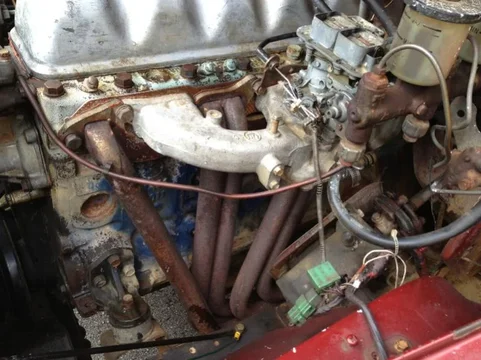
For rkymtnflyfisher and huminajumina (and anyone else): is this stock intake manifold and exhaust header or no? I think it was fast Eddie that commented in the beginning of this thread (yep just checked) that the header has a thick flange, and that he "prefers a cast iron manifold".


image-783215334.webp
 
Last edited:
I have heard good things about SORs weatherstripping kit. Search for it and see what kind of reviews pop up. I need to upgrade all my rubber too.

I'm about to do this as Cruiser Dan seems AWOL. Vacation perhaps. Sent him a couple of PMs with no response.

What about for brake and clutch cylinders, should I use Dan there too, or just search for he cheapest Aisin or OEM compatible I can find? Trying to support members here.
 
That looks like the stock intake manifold for a '76, it is made out of cast aluminum.

FJ40s never came from the factory with headers, they had cast iron exhaust manifolds. The header you have pictured is the common "6 into 1" aftermarket header. It is made out of steel tubes and a steel flange. The problem with the aftermarket header is that there is not steel plate material readily available in the same thickness as the original exhaust manifold, where the bolts seat. So vendors have historically chosen a standard plate thickness to make the header, which in turn causes uneven bolt contact where the bolts straddle both the intake and exhaust, and leaks can occur. There are several fixes to this including double gaskets, cutting washers in half to take up the thickness, etc.

Another thing to know is that the factory manifold had an intake preheating function to help with cold starts. With the header that apparatus (basically a spring-loaded flapper) is now gone. There are kits available in the aftermarket for a "fluid heat riser", which will take coolant and route it up under the intake manifold to help the engine warm up.
 
Last edited:
Pay close attention to what Subzali posted ^^^ , that part is very important . Those cheap 6~1 headers are just that -cheap . It's about rusted out from the pic so keep in mind it's gonna need replacing soon . I went with a much better tri-y design that uses a much thicker flange and still had to machine the intake bolt surface areas down to match so the gasket works correctly due to the shared bolts/studs in the head . There are a ton of tech writeups about doing this the right way - do some searching .

Pull that master cylinder right away - that leak is going to be expensive replacing the booster . The t-case leak issue isn't that hard to tackle although you'll have to replace the oil-soaked parking brake shoes and a lot of cleaning as well . A lot of writeups around for this fix as well .

That Weber will eventually be a problem unless you got lucky with a good casting , research replacing it and the gas pedal linkage with either a de-smogged stock carb or Trollhole's aftermarket like I have . If you want to offroad it at all this is the best route .

Don't be overwhelmed , this stuff is common for something 37 yrs old and these rigs are built to survive .
Sarge
 
Back
Top Bottom