Build 1st FJ40, '76 - SMOKEY - Puttin’ her Back Together

This site may earn a commission from merchant affiliate
links, including eBay, Amazon, Skimlinks, and others.

Turning anything round near the center of it's diameter will have much greater resistance than turning the same round piece at it's outermost line away from center - there's a math rule for this somewhere , don't remember it right at the moment as Smithwick's was involved heavily in mowing tonight after work .
That make any sense at all ?
Sarge
 
Let me help you scientists out. It's torque. Foot pounds.

If it takes one pound of force to turn it at a radius of 1', it will take two pounds of force to pull it at 6".

There is no acceleration in this measurement, so f=ma is not relevant.

Vae Victus said:
I think that when you measure with the string wrapped around the drum the force required to rotate the drum will be around 5-6 lbs

Sounds about right.
 
You're right eddy, it's not Newtons 2nd law. But i think do believe in practice i'm right. If not in the theory trying to explain it:doh:

Just got home after a nightshift, so my head is not really working the it is supposed to, but this is a nice chance to put theory to practice.
Maybe scott can measure again using the "string" :otechnique
 
Dang... , now i can't sleep :eek:

Let's toss sir Isaac Newton out the window and try again with Archimedes..

KAAAAAElFTkSuQmCC


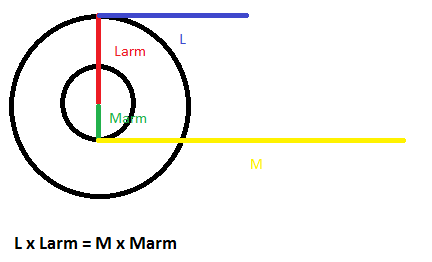
I put 2 methodes of measuring the force required accross from each other so I can explain using the cantilever theory of archimedes..
In the picture the formula is visualized. Lets say the "L x Larm" part is using the string method and the "M x Marm" part is using the rod end method.

Larm = 3 inch (guestimate)
Marm = 1.5 inch (guestimate)
M = 11 pounds (seen on fishscale)

L x Larm = M x Marm

L x 3 = 1.5 x 11

L x 3 = 16.5

L = 16.5/3

L = 5.5 pounds

To eddy: Yes basically we're talking about torque (in lbs/inch) but because mister toyota sets the length of the arm by using the string method, only the force part is the variable in the equasion.

Pffw, now I hope I can sleep. When I wake up, I'll read this again and hope it's not bullsh*t. So tired almost forgot how to :steer: home this morning
 
VV i'll PM you the drawing I made.Cant get it in to my post. Would you pls be so kind???? :cheers:
 
VV i'll PM you the drawing I made.Cant get it in to my post. Would you pls be so kind???? :cheers:

I just got a bunch of gobbelty gook when you sent the image. I PMd with instructions. Maybe the file is too big. Has to be smaller than 156KB if jpg. Can be 2Gb if PDF. You can email it yo me though. S m Portis at gmail dot com.

Looking at the time that you posted this, I don't expect to hear from you until late in the day.
 
I just got a bunch of gobbelty gook when you sent the image. I PMd with instructions. Maybe the file is too big. Has to be smaller than 156KB if jpg. Can be 2Gb if PDF. You can email it yo me though. S m Portis at gmail dot com.

Looking at the time that you posted this, I don't expect to hear from you until late in the day.

oe6q.png


ha. I know it isn't much of a drawing but this is it.

Couldn't have done it without you VV
 
Turning anything round near the center of it's diameter will have much greater resistance than turning the same round piece at it's outermost line away from center - there's a math rule for this somewhere , don't remember it right at the moment as Smithwick's was involved heavily in mowing tonight after work .
That make any sense at all ?
Sarge

Yes, makes sense.
 
Let me help you scientists out. It's torque. Foot pounds.

If it takes one pound of force to turn it at a radius of 1', it will take two pounds of force to pull it at 6".

There is no acceleration in this measurement, so f=ma is not relevant.
.
I was trying to figure out the acceleration last night. It is zero until it moves, then it has a value. Couldn't figure out if it was relevant or not.

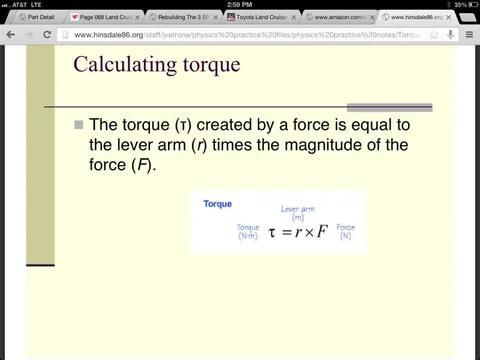
So, yea, the basic torque formula is

image-3954239666.webp
Torque

I would say it is all coming back to me, but it ain't.

I wish the professors would have rolled in some real life examples like this and said "you are rebuilding a transmission. Choosing the wrong preload on this bearing set will wreck all your time and cost you thousands of dollars. Calculate the correct preload using our torque formula." Man, that real life example would have stuck so much better.
image-3954239666.webp
 
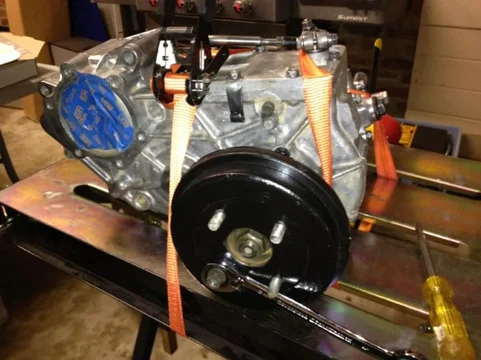
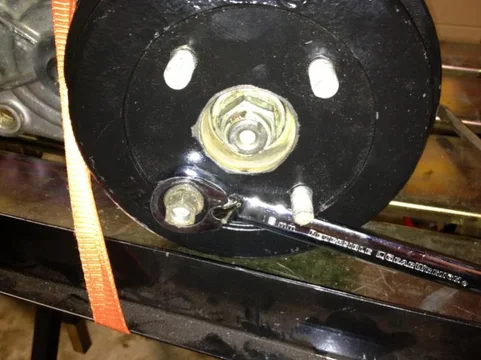
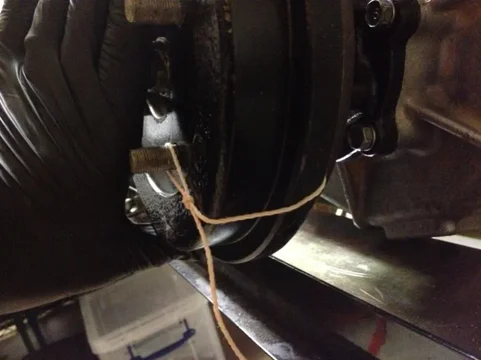
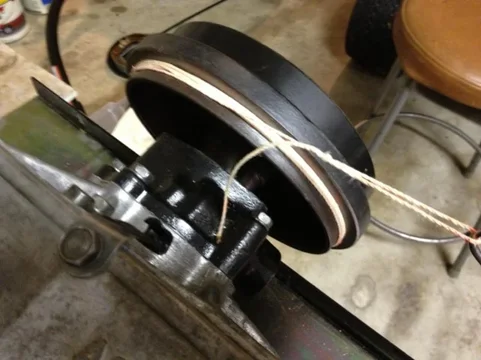
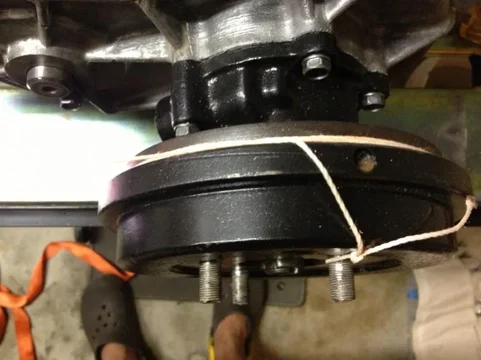
In the FSM, the force on the string is acting on the outside of the drum. It is only tied to the stud to lock it in place so it doesn't slip. If you are measuring using the fish scale directly on the stud then the force needs to be increased. You are trying to achieve an equivalent torque value.

Sent from my iPhone using IH8MUD at 85mph in an FJ40
 
Yea, well, DUH!

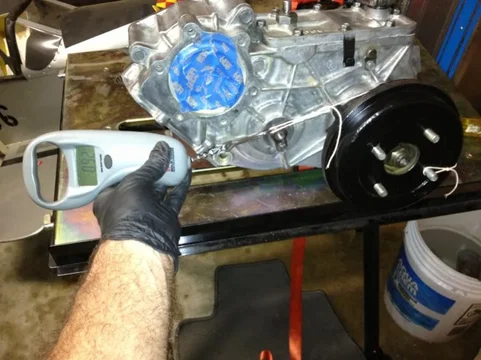
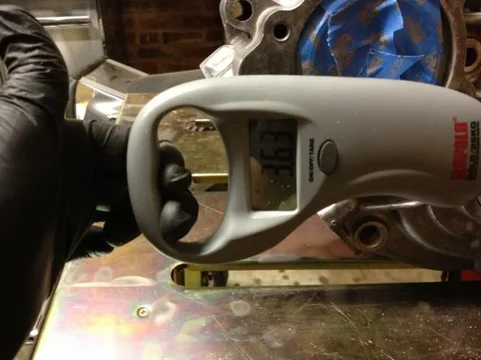
You guys are absolutely right. I measured under 4 lbs tonight using the string method.


image-2807430527.webp


image-1281592300.webp


image-1112891985.webp


image-1491936432.webp


image-287505074.webp


image-3419045256.webp


image-3682809217.webp


image-2026816599.webp

So now I get to buy new shims, wait on them, and re measure.

Part No...........Thickness
90564-64017, 0.10 mm (0.0039")
90564-64023, 0.015 mm (0.0059")
90564-64024, 0.20 mm (0.0079")
90564-64025, 0.25 mm (0.0098")
image-2807430527.webp
image-1281592300.webp
image-1112891985.webp
image-1491936432.webp
image-287505074.webp
image-3419045256.webp
image-2026816599.webp
image-3682809217.webp
 
Double Duh. I made two mistakes above.


1. Turned the drum the wrong way.

2. Didn't read the FSM, instead went by Coolerman's stated measurements for preload for his year (and possibly he corrected for the different measurement point).

So to correct #1, I redid it in the other direction and pulled almost 5#.
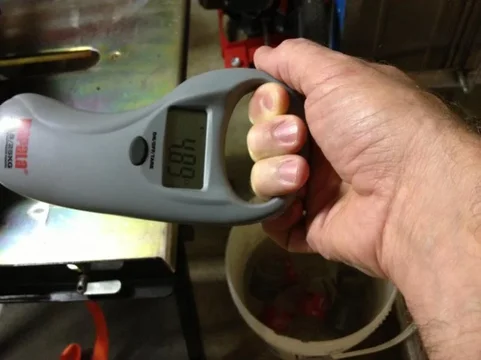
image-1687800808.webp
4.89#

I then checked MY FSM for my 1976 year and saw 2-9# as in range for preload. So, I am in spec! Yes!!!

For grins, I wanted to show, based on input from my better educated gear heads, how to calculate the preload specs from the bolt instead of the edge if you couldn't find a string ("My kingdom for a string!")

I measured the distance from the center of the drum to the center of the bolt (1.86") and from the center to the edge (3.34"). To convert the specs, all we have to do is get the ratio of the lengths and apply that ratio to the max and min values above.

So 3.34/1.86 = 1.79. Applying that ratio to the limits at the bolt would be 4.65 lbs min and 16.11 lbs max for new bearing, 1.86 or more for old bearings. If you want to measure from the bolt, do do at your own risk, but use this method to calculate your min and max limits.
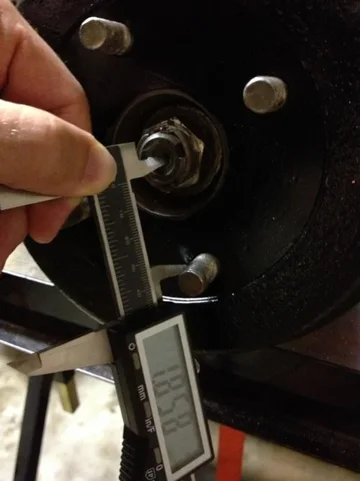
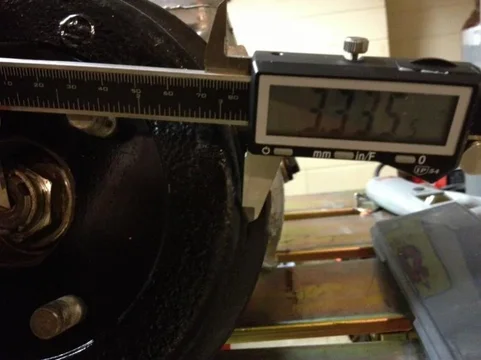
image-1662869594.webp
image-435688976.webp
image-1687800808.webp
image-1662869594.webp
image-435688976.webp
 
nice job VV. Maybe when you're done, you can make a carreerswitch and become a university math teacher :hhmm:
 
Ah , examples of why I went into the military instead of college . At the time I wanted that experience but money and drive wasn't there . I need real-world examples in math to grasp and retain , never really found in the classroom and better learned in the shop .
All I know for sure is this - Japanese original equipment service manuals need to be followed to the letter - their engineers spent far much more time getting things right than what most of us are used to dealing with here in the US . Many heated arguments with machinists and others over specs - if specs and methods are followed things last and work as they should - if not , well , we know the result . No real need to hash it out on the almighty net - just follow the book .

Sarge
 
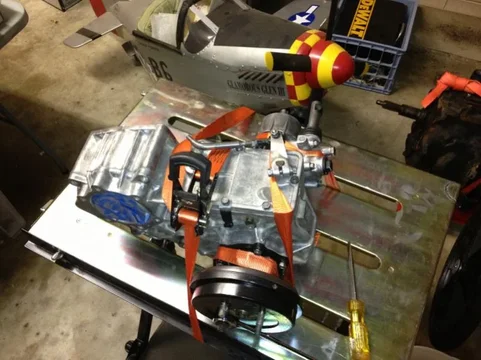
Your transfer case is looking pretty sweet VV. I'm going to refer back here when I check my preload on the E-brake. Nice work.

That pedicar is pretty damn cool too.:cool:

:cheers:

Ah, yes, the old P51. My father built that from scratch about 8 years ago. He did a great job. Seen some wear, but mostly bumps from storage with all the kids bikes. Is the Chuck Yeager version. Glamorous Glennis. I'll include a photo or two later.
 
Ah , examples of why I went into the military instead of college . At the time I wanted that experience but money and drive wasn't there . I need real-world examples in math to grasp and retain , never really found in the classroom and better learned in the shop .
All I know for sure is this - Japanese original equipment service manuals need to be followed to the letter - their engineers spent far much more time getting things right than what most of us are used to dealing with here in the US . Many heated arguments with machinists and others over specs - if specs and methods are followed things last and work as they should - if not , well , we know the result . No real need to hash it out on the almighty net - just follow the book .

Sarge

Yes, but at times they are too succinct and I (we) don't have a garage full of experts to ask for clarification. Not have we been trained ('scuse me, "have I been trained") in basic shop mechanic procedures, so stupid mistakes ensue. Hence the joy I get in finding folks like you Sarge, and OrangeFJ45, Poser (or is he just a poser?), and others who do this all the time (or did) and who have better training.

I'm in the app, so can't insert the little graphics, but I'll say :beer: :beer: :beer: to all of you who help the rest of us out.
 
Update: current frustration is finding a drive shaft u joint maintenance/replacement thread. About to check the FSM but I know I saw that somewhere. I asked in the forum, so maybe someone will, find it.

Also, just asked Sam at Lowe to get me the proper speedo drive and driven gears to allow my 33" wheels to turn the speedo at the proper ratio so it is accurate. Hope I really put 33's on it!

(CoolerMan's transfer case rebuild thread gave me the part numbers)

Trying to buy a used Carolina ShopHand 4000 engine hoist here in town at an auction. Also need an engine stand. Going to pull the engine and clean/paint it too.

This is turning into a frame off I'm afraid.... Ug. Not fully committed yet but it is getting close.
 
Found the thread(s) on replacing the u-joints, thanks to Mudders.

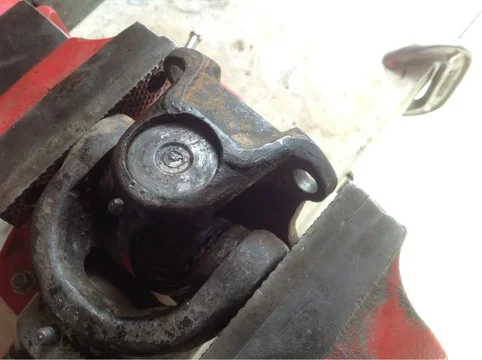
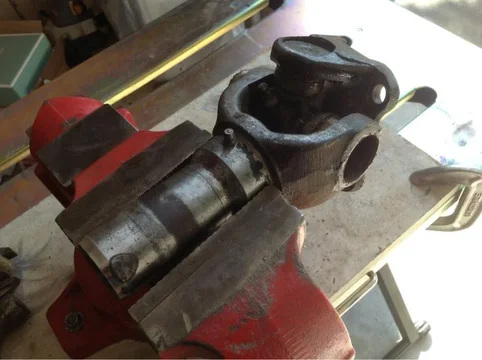
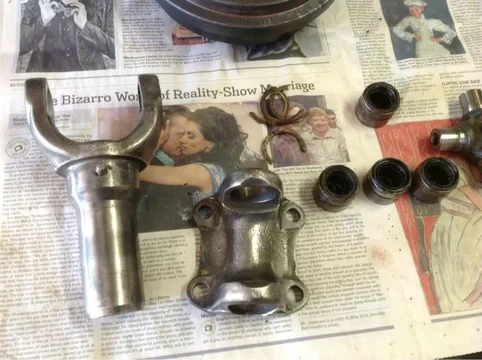
Removed one universal joint and cleaned up the shaft. This was the short piece of the rear shaft.

After figuring out where the clips were (buried under the grit that I'd already fought hard to remove), tapping them out with a screwdriver was easy.

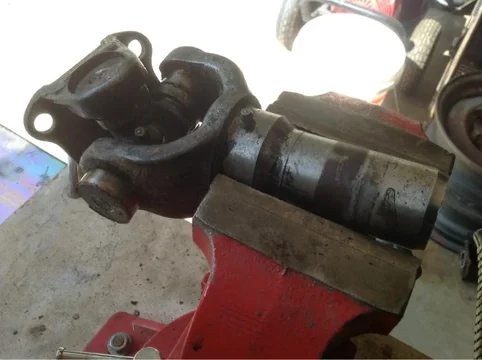
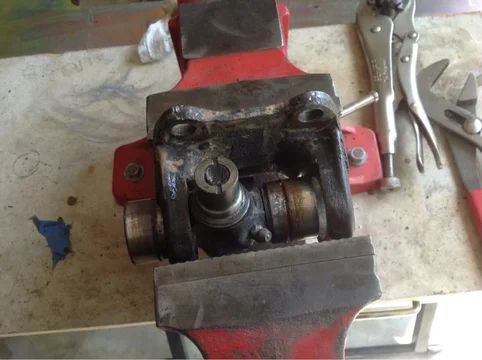
Started removing first ujoint by putting it in the vice the wrong way such that I was just hitting the uJoint but not driving it against anything. Once I looked at the example picture of the guy beating it on his front bumper (he was in "the field"), I figured it out. Looks simple but you have to pay attention or you will beat on it all day and it won't move.

image-1381045935.webp
Wrong way


image-2781584863.webp
Right way
image-36044482.webp
Right way
image-862142188.webp
Right way

image-1009654333.webp
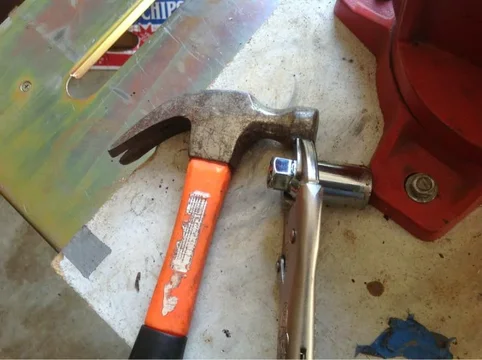
Used a spark plug socket on vice grips so I'd stop smashing my hand.

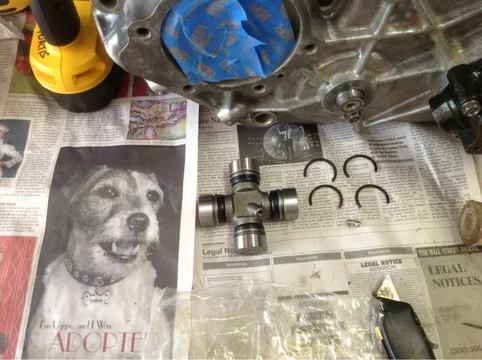
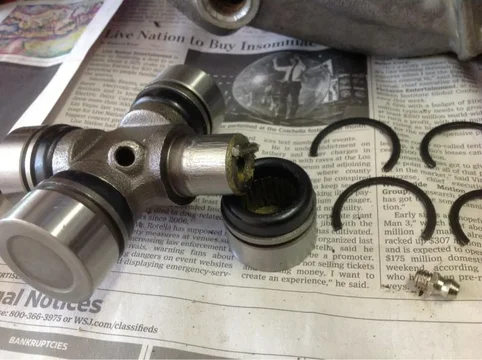
Here's what comes in a replacement kit:
image-1410257293.webp
image-630691466.webp
One of the bearings out of place - don't drop one of these (ask me how I know).

Old ones were in good shape, but replacing them now anyway.

After cleaning up the shaft (wire wheel):
image-1755782344.webp

These ujoints are in good shape. I'll hang onto them and clean them up if anyone wants a used set. I bought two new ones. I guess I'll get two more and do them all.
image-1381045935.webp
image-2781584863.webp
image-36044482.webp
image-1009654333.webp
image-1410257293.webp
image-630691466.webp
image-862142188.webp
image-1755782344.webp
 
Last edited:
Back
Top Bottom