The OFFICIAL clunk/thunk driveshaft thread

This site may earn a commission from merchant affiliate
links, including eBay, Amazon, Skimlinks, and others.

Remember, the slip yoke will use different grease than the u-joints. The slip yoke needs Moly grease as it's application is in an environment where cycles of compression occur. Non-moly won't be compressible and can cause hydro lock of the slip yoke.

I used Valvoline Red NGLI 2 for my u-joints and Sta-Lube Moly-Graph extreme pressure lithium grease on my slip yoke.
 
Also of note is that when doing the slip yoke vs. u-joints, the method is different. Meaning that for the u-joints you are pumping in enough grease to see it start pushing the old out of the seals. This is desired.

For the slip yoke, you want to only push in enough that you see the yoke start to move. DO NOT have it push out for the reasons stated above.
 
I use moly fortified #1 grease in slide yoke, only in problem cases. Once slide yoke is working well, I just use Mobil 1 chassis #2 grease.

Moly helps with stiction, which we don't have much of and issue with normally. But is certain fine to use in slide yoke anytime.
 
I use moly fortified #1 grease in slide yoke, only in problem cases. Once slide yoke is working well, I just use Mobil 1 chassis #2 grease.

Moly helps with stiction, which we don't have much of and issue with normally. But is certain fine to use in slide yoke anytime.
This is the red stuff that we see you using all the time correct?
 
Yes, Mobil One synthetic is red. Good stuff. Many good full synthetics on the market. I use all Mobil one lubes, where I can. Keeps it simple in the shop.
 
I use moly fortified #1 grease in slide yoke, only in problem cases. Once slide yoke is working well, I just use Mobil 1 chassis #2 grease.

Moly helps with stiction, which we don't have much of and issue with normally. But is certain fine to use in slide yoke anytime.

Excellent points. What are your thoughts on the slipe yoke greasing method whereby you pump in the grease, remove the Zerk, drive a few blocks to "pump" out the excess and then reinstall the Zerk? I've been following that method for the past 2 years.
 
It depends on how neglect the propeller shafts are.

If regular lubed, I just pump grease in until I first see extension of yoke begin. I do this with vehicle in a neutral position. That is, not raised in anyway from it's normal driving level, be it lifted or stock.

If I happen to grease while raised on jack-stand or AHC in H. Then I remove grease zerk to lower. Once back in a neutral stance, I torque zerks back in.

If very dry and under maintained, I'll try to get grease to pass the seals. This builds a lot of pressure. So then I remove grease zerks and lower.

If I've time with the vehicle, and it's very dry and clunky. I'll grease until extension with #1 moly. Drive for a tank of gas or two, and than re-grease. I'll repeating until clunk gone. Then switch to normal PM every 5K miles.
 
Last edited:
If I've time with the vehicle, and it's very dry and clunky. I'll grease until extension with #1 moly. Drive for a tank of gas or two, and than re-grease. I'll repeating until clunk gone. Then switch to normal PM every 5K miles.

I'll have to drive mine a couple of tanks to determine if it goes away at all. Otherwise it looks like I"ll need a new driveshaft I'm guessing.
 
It's super easy to pull the driveshafts out. Once you do that it's easy to remove old grease and apply the new stuff. You just need to make sure to put them back together exactly as they came apart. I did that rather than try to monkey around with all this stuff.

Note: pull parking brake or chock wheels. Vehicle will roll if placed in Park and driveshafts removed.

Buy this, thank me later: https://www.amazon.com/ACDelco-Cordless-Ratchet-Compact-100ft-lbs/dp/B07NBR63QY/?tag=ihco-20
 
Eh I guess I would consider it easier to slide under the truck and grease everything with the lincoln needle vs. removing the driveshafts. That seems like a lot of work with a decent risk factor if you don't remember correctly which side goes where or how things go back together. Then you are left figuring things out. Plus, seems like things would be much quicker doing the greasing on the driveshafts vs. taking things apart.
 
8 bolts and nuts per driveshaft, 10 seconds each. Only goes back in one way. Yeah sure, any monkey can pump a load of grease into a zerk, but the reason this thread is over 400 posts is because it's about the quantity of grease and where it's located that matters. Hence the fill, remove zerk, raise, lower, raise, etc.
 
8 bolts and nuts per driveshaft, 10 seconds each. Only goes back in one way. Yeah sure, any monkey can pump a load of grease into a zerk, but the reason this thread is over 400 posts is because it's about the quantity of grease and where it's located that matters. Hence the fill, remove zerk, raise, lower, raise, etc.
But that only applies to those with AHC (the whole, raise - lower - raise thing). And we are both assuming that the people doing this have the understanding of what they are doing and also that the drivelines are not rusty/crusty with seized bolts.

@2001LC For those completely removing the driveshaft(s), would there be any benefit to replacing the bolts/nuts?
 
Here is a link that may be useful for future DIY Zerk Lubers:

 
Just wanted to chime in, i had a light "thunk" when coasting at speed then giving it some throttle. I greased the drive shafts and all connected parts, didn't help. Finally this past weekend, i replaced my front axle snap rings and regreased the spindle and greased the output splines where it meets the hub flange. I used Mobil 1 NLGI #1, and holy mother of jesus, that thud i described before is now gone. I tried so hard to replicate over miles and miles of driving, even giving it extra throttle, more than i usually drive with. Gone.

Might not be the case for everyone, but it fixed my thunk, my snap ring was loose as hell and had so much play in it, and there wasn't much grease left. Dealer had packed it 20K miles ago per maintenance record found on the website.
 
Just wanted to chime in, i had a light "thunk" when coasting at speed then giving it some throttle. I greased the drive shafts and all connected parts, didn't help. Finally this past weekend, i replaced my front axle snap rings and regreased the spindle and greased the output splines where it meets the hub flange. I used Mobil 1 NLGI #1, and holy mother of jesus, that thud i described before is now gone. I tried so hard to replicate over miles and miles of driving, even giving it extra throttle, more than i usually drive with. Gone.

Might not be the case for everyone, but it fixed my thunk, my snap ring was loose as hell and had so much play in it, and there wasn't much grease left. Dealer had packed it 20K miles ago per maintenance record found on the website.

Can you post a picture of this "front axle snap rings"? I need help picturing the parts yall experienced DIYers talk about.
 
Can you post a picture of this "front axle snap rings"? I need help picturing the parts yall experienced DIYers talk about.

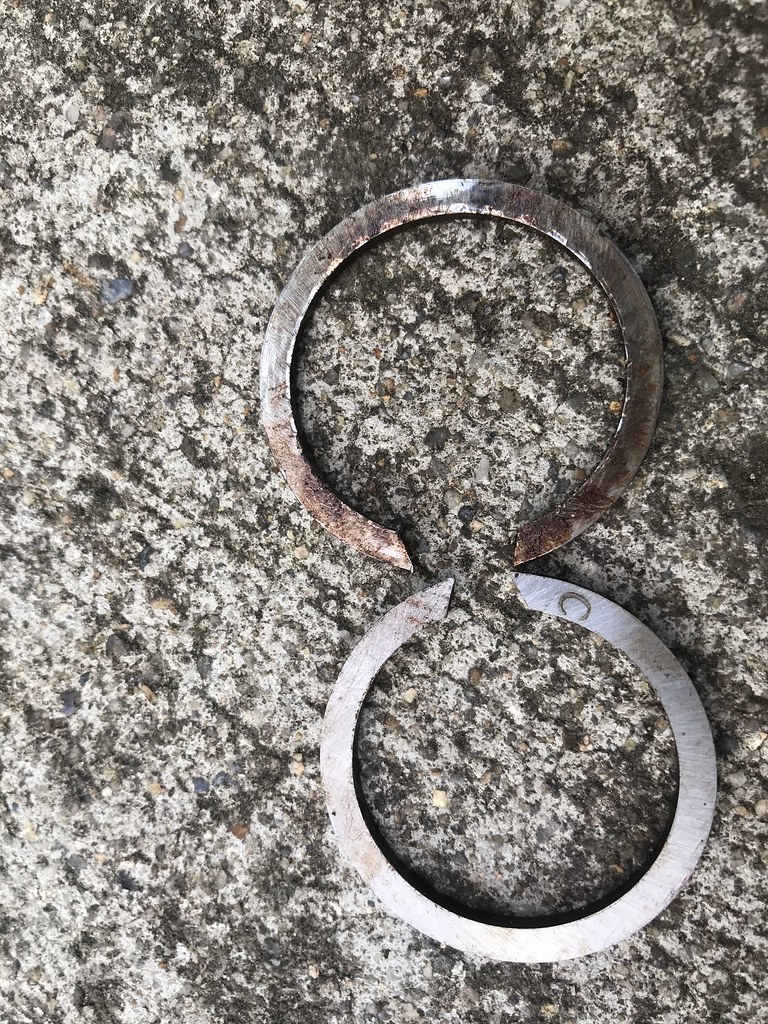
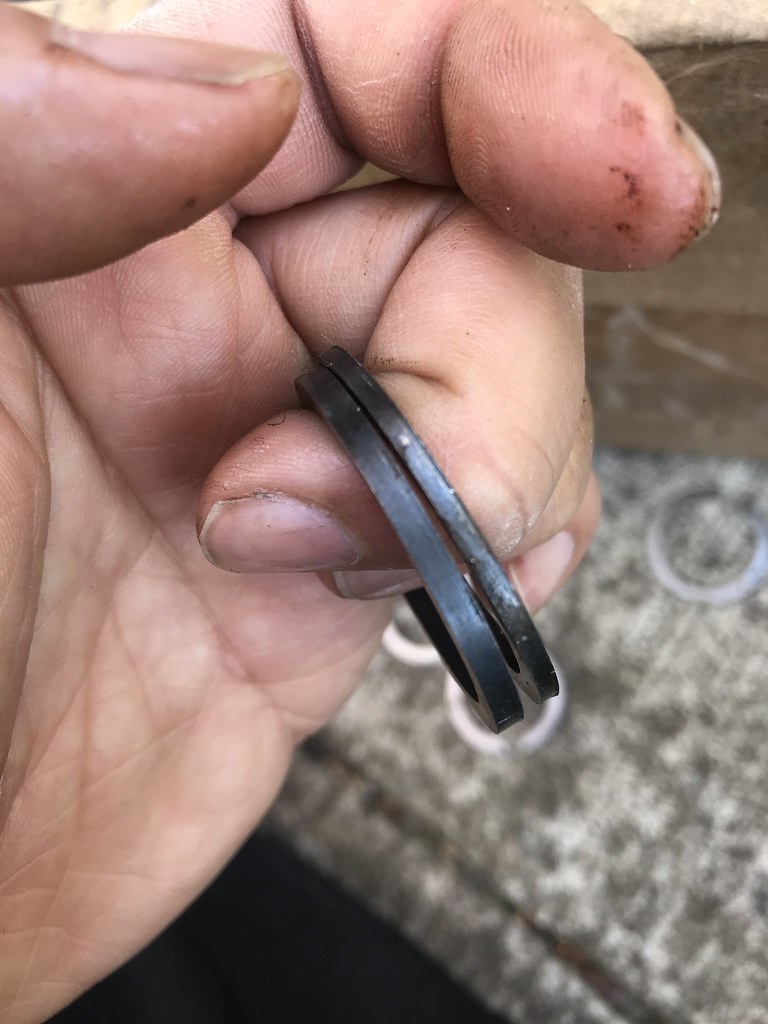
Mine was very loose, and of the wrong thickness. The snap ring likely didn't stop the thunk, it's the grease i packed in there afterwards. The snap ring if not properly seated, fit, it will pop out and you're going to be stuck with RWD.


It's been stretched beyond it's normal retaining size

49728717171_76c8edbe90_b.jpg


This new ring sits snug against the hub, notice it's almost twice as thick as the one i removed

49728747411_e4bea1e48d_b.jpg
 
Mine was very loose, and of the wrong thickness. The snap ring likely didn't stop the thunk, it's the grease i packed in there afterwards. The snap ring if not properly seated, fit, it will pop out and you're going to be stuck with RWD.


It's been stretched beyond it's normal retaining size

49728717171_76c8edbe90_b.jpg


This new ring sits snug against the hub, notice it's almost twice as thick as the one i removed

49728747411_e4bea1e48d_b.jpg


You got a part number?
 
You got a part number?

I don't, just email
kurt@cruiseroutfitters.com

tell him you want the snap rings pack for the 100 series. You get 6 of it, 2 of each thickness, all of the 100 axles have different thickness per side. It's good to have on hand, many have had issues of it popping off over time. It's like $14 for the set
 
Back
Top Bottom