

My first front axle service in progress; got some questions

This site may earn a commission from merchant affiliate
links, including eBay, Amazon, Skimlinks, and others.

Spike: do you know what should the thickness of the rotors be side to side, min and max??

Page BR-15 from the 96LC FSM (or BR-24 from the 96LX FSM):
Standard thickness: 32.0mm (1.260 in.)
Minimum thickness: 30.0mm (1.181 in)
 
Last edited:
Spike: do you know what should the thickness of the rotors be side to side, min and max?? Can't find it in the FSM. I'll see if I can get that shim locally, what problems could I have by reusing it?

Wondering also, when we put the trunnion caps back on, should we put some grease on the machined surfaces where they mate up with the knuckle housing? The FSM does not mention it but seems like something should go there to help prevent corrosion??

1993 FSM:

32mm STD.
30MM LIMIT

Disc Runout: .15mm LIMIT


Edit: I see I was a bit slow to the draw.

Edit 2: I checked the 1997 FSM; same numbers.
 
Last edited:
Also, I don't know about OEM rotors, but many have the minimum spec embossed on them somewhere.
 
corsair23; guess I'll have to bite the bullet and pull the birfs off the axle shafts; tell me again how you got the clip back on/in the birf?

Here is a handy thread showing you pretty much all you need to know about separating and reassembling the birfs:

Separating and Reassembling Birfs/Axles

I was a little concerned about doing this at first but after doing it I can honestly say it was not that hard at all...Messy like everything else associated with a front axle service but not hard. On the pipe I grabbed the thickest wall stuff I could find at my local ACE hardware that had the correct ID. I used the white pipe FWIW.

My main reason for separating the birfs was to swap them from side to side. At 120K miles I figured it was time to try and even out the wear and get more life out of them. I wasn't having any clicking and hopefully this will insure I won't for a long time to come.

When it comes time to reinstalling the axle shafts into the birfs (after you've filled them with moly grease making seeing what you are doing difficult) you can either follow the method in the thread above or try the method explained on page SA17 of the FSM. This was the method that worked for me in minutes vs. trying to dink with getting a zip tie to stay around the c-clip long enough to seat the axle shaft. Might have worked better with a wider zip tie than I was trying. The FSM method is basically to just go around the edges of the c-clip with a small flat head screwdriver, tucking the clip into the slot on the shaft while pressing down on the axle shaft into the cage. The short side is easier than the long side which can get unwieldy. Tipping the axle shaft a tad helps as you go around. Once the clip is all tucked in, push or gently tap the end of the axle shaft down until you hear the c-clip "click" into place.

HTH

Also glad to see someone else as anal about cleaning stuff as I was...I spent more time cleaning than actually wrenching...Probably 3-4x as much time actually. The wife asked why I was cleaning everything so well when it was just going to get dirty again anyway :hillbilly:

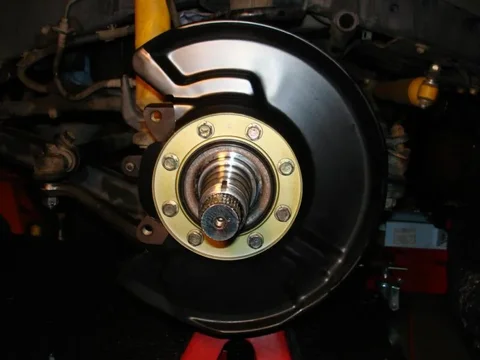
Case in point, here is a shot of my spindle and dust shield post cleaning:

Spindle 2 (Large).webp
 
Thanks all for the suggestions. Measured the rotor; just a hair under 31mm, so a little life left.

Anyone have a thought on putting a smear of grease on the mating surfaces of the trunnion caps before putting them in the knuckle? Any reason not to? Any seconds on replacing or reusing the shim? I know the shim has to do with preload on the knuckle, but what does that effect, the tracking down the road or the heaviness of steering?? My steering is perfect, no wandering, just straight down the road with one hand on the wheel. It's gotten a tad stiffer recently but I'm now thinking that might be due to the bad trunnion bearings? And after seeing the broken, chewed up and off kilter bearings I'm amazed at how smoothly it did steer.

Dan: I forgot to buy zip ties, so I'm stuck with a screwdriver or the hose clamp trick.
 
Anyone have a thought on putting a smear of grease on the mating surfaces of the trunnion caps before putting them in the knuckle?

Forgot to address that- on the last service I did for a friend, I put a little marine grease on those surfaces, the thought being that it would resist water and keep the trunnion bearings from getting wet. The truck hasn't killed any nuns yet, after 20K miles or so. There's probably a better product made for this, but I didn't have any at the time.
 
Spike; OK, grease it is. Thought crossed my mind for a second to use something like FIPG but then I figured I'd never be able to get it apart again, but it would be waterproof :hillbilly:. With the small amount of surface corrosion I saw on the mating surfaces for the trunnion caps, the shim, and where the ABS sensor mates to the knuckle it seems that a bit of water does get in between them. You'd think Toyota would spec something to be put there, but then that might affect preload?? I also noticed that the surfaces are left with a rough grind, maybe that helps seal them when they're torqued down??
 
Last edited:
You'd think Toyota would spec something to be put there, but then that might affect preload?? I also noticed that the surfaces are left with a rough grind, maybe that helps seal them when they're torqued down??


It is because Toyota doesn't think it is important. Now quit obsessing about polishing and shining everything and get the job done. I would reuse the shim after cleaning it and filing off any burrs. This isn't a nuclear reactor; it is a knuckle job.
 
If that shim is dimpled- as it looks in the pic- I wouldn't use it because it probably won't compress fully when the bolts are tightened. I'd be worried about it compressing further down the line and the tension coming off the bolts. But that's just me. I have to agree with the polishing though- who are you trying to impress? :D
 
I cleaned up the spindle before I realized it really doesn't matter that much. I now know (I think) that the scuffing of the spindle occurs because the bearing pack either rotates, slips, or wiggles when not torqued correctly and the whole pack is not supposed to move, correct?? The inside of the trunnion caps that fit down into the knuckle were covered in a combination of crud, corrosion, varnish (shoulda taken before photos) and were very difficult to get out, I'm guessing because the crud tightened up the tolerances. It's probably the first time any of these parts have been cleaned in 14 years of neglect, next time I'll just have to wipe them off. Sorry it's taking so long, I'm working on this in between juggling a dozen other things.

Got a new shim on order locally. Appreciate all the help.
 
Last edited:
It is because Toyota doesn't think it is important. Now quit obsessing about polishing and shining everything and get the job done. I would reuse the shim after cleaning it and filing off any burrs. This isn't a nuclear reactor; it is a knuckle job.

lol. Just what I was thinking.

If that shim is dimpled- as it looks in the pic- I wouldn't use it because it probably won't compress fully when the bolts are tightened. I'd be worried about it compressing further down the line and the tension coming off the bolts. But that's just me. I have to agree with the polishing though- who are you trying to impress? :D

Just check the bolts every so often...no big deal. I check mine before I go wheeling.
 
Trouble separating birfs from axle shaft

Got a couple of hours to work on the front end; now having trouble getting the birf off the axle shaft, how hard/high do you drop it from with the axle shaft inside the piece of PVC pipe, or any other ways to pull them apart?
 
Last edited:
Got a couple of hours to work on the front end; now having trouble getting the birf off the axle shaft, how hard/high do you drop it from, or any other ways to pull them apart? I've got a 3 foot length of 2 1/2 inch PVC, stuffed a rag in the end and set it on a piece of wood but it just bounces.

Kernal,

My long side axle and birf separated on the first drop from maybe a foot or so...Not surprising given the weight of the long axle.

The short side, that one took probably 3 or 4 drops, each one substantially harder and from a higher position. That short axle just doesn't weigh much. Using the PVC pipe, you aren't going to hurt the birf, just make sure you have a nice tight hold on it :D

FWIW, both of mine popped with the old c-clips still intact...Replaced them with new anyway.

As to an alternative...There is and I think it is even mentioned in the FSM but I've never tried it and can't remember exactly what it is...It might be mentioned or linked in the FAQ

EDIT: Page SA-15

5. INSPECT BIRFIELD JOINT INNER PARTS
(a) Hold the inner shaft in a vise.
(b) Place a brass bar against the joint inner race and remove
the outer shaft.
(c) Tilt the inner race and cage and take out the bearing balls
one by one.

:steer:
 
corsair: now I recall that in the FSM, guess you just wack in on the star? When you did yours, you dropped the axle/birf with the pipe on the floor? I've tried it a few times from a foot high, all I'm getting is the PVC pipe getting chewed up by the star and cage.

Edit: tried the FSM method with a hammer and brass bar, no go. Tried the PVC pipe method a few more times dropping it from 1-2 feet, only got tiny shards of PVC all over. This just doesn't want to come off so maybe better to leave it well stuck?? I've cleaned the birf bell out using a couple cans of carb cleaner and some degreaser, probably got 99.9% of the grease out (most was soup anyways) as it now is hard to turn.
 
Last edited:
tried the FSM method with a hammer and brass bar, no go.

Try bashing it on alternate sides of the star. Use a 5 pound sledge. Mine came right off without even breaking the retaining ring. They are much easier than any of the FJ40 or FJ60 birfs I have done because the inside of the star hole on the 80 birf seems to be slightly beveled to compress the ring. YMMV
 
pinhead; all I need is a five pound sledge, one of the tools I haven't bought yet, only steel hammers I have are a couple roofing type. What do you think about just packing it as is like in the DVD? I've flooded it a few times with carb cleaner and then some spray CitriStrip paint stripper (worked well to emulsify the grease, just broke it up), then flushed that out with low VOC degreaser a few times.
 
corsair: now I recall that in the FSM, guess you just wack in on the star? When you did yours, you dropped the axle/birf with the pipe on the floor? I've tried it a few times from a foot high, all I'm getting is the PVC pipe getting chewed up by the star and cage.

Edit: tried the FSM method with a hammer and brass bar, no go. Tried the PVC pipe method a few more times dropping it from 1-2 feet, only got tiny shards of PVC all over. This just doesn't want to come off so maybe better to leave it well stuck?? I've cleaned the birf bell out using a couple cans of carb cleaner and some degreaser, probably got 99.9% of the grease out (most was soup anyways) as it now is hard to turn.

Yep...stuffed a shop rag in the bottom of the tube and holding the birf/PVC together, I dropped (more like slammed really hard) the pipe on the driveway. At first I tried doing it in the grass but that just put dimples in the yard :rolleyes:. I was surprised at how much force it took to get the short side to let go given how easily the long side broke free. That stubby axle just doesn't have much mass to aid you.

This is one of the reasons when I was shopping for PVC pipe I bought the thickest wall stuff I could find...IIRC the PVC pipe walls of the stuff I picked up were 1/4" to 3/8" thick.

As for the FSM method...given the trouble you're having using the drop method I'm guessing you'd have to smack the brass drift with a 3-5lb sledge to be successful, making sure someone is holding the birf or that it lands somewhere safe. Having never done this though I'm just guessing.

As for leaving it stuck and moving on...I'd look at the inner birf, star, and balls and if there are no obvious wear marks then I'd probably move on and call it good. The main reason for doing this IMO is to change the wear pattern to delay clicking issues down the road.

Good luck :steer:
 
I can see some of what looks like the usual scuff marks in the star grooves, all the balls look good when I spin them around in place, can't really see the grooves in the bell very well. I would like to swap sides but also don't want to end up breaking something.
 
... Tried the PVC pipe method a few more times dropping it from 1-2 feet, only got tiny shards of PVC all over.

I have always used steel pipe for this. The idea is to shock/impact the birf off and plastic pipe has too much cushion.

This just doesn't want to come off so maybe better to leave it well stuck?? I've cleaned the birf bell out using a couple cans of carb cleaner and some degreaser, probably got 99.9% of the grease out (most was soup anyways) as it now is hard to turn.

I never use solvent on birfs unless I take them apart. It's impossible to get all of it out and the leftover solvent starts breaking down the new grease. In this case I use a grease needle (hypodermic type) work it between the balls and cage into the back area of the birf, pump grease until new grease comes out around all of the balls. The new thicker grease does a good job of pushing the thinner old grease out.
 
Back
Top Bottom