Lucy Landcruiser - BJ42 LX

This site may earn a commission from merchant affiliate
links, including eBay, Amazon, Skimlinks, and others.

Isolated the problem to the fact that I had a 5 year old 'helper' sitting in the front - she must've knocked the transfer lever into neutral.

Went and put it into H2 and gears engaged now.

Will have to wait till the morning to start it up and move it out - cant wait.
 
...Finally got to run the return fuel line, I used 6.5mm hose as a temporary measure, while I wait for a BJ to turn up in the wreckers. I plan on using the same solid line and clamp the two together and then use the fuel hose for the shorter run across the tank.
View attachment 687899
Dan

Hi Dan.

Just curious...

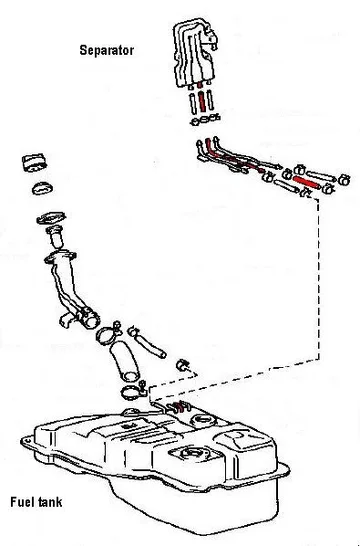
How did you decide on this particular separator line (coloured in red) for your fuel-return?

FuelReturn.webp

Isolated the problem to the fact that I had a 5 year old 'helper' sitting in the front - she must've knocked the transfer lever into neutral.
Went and put it into H2 and gears engaged now.
Will have to wait till the morning to start it up and move it out - cant wait.

Ha.... Funny about the knocked transfer stick ....

You'll probably be up right now (as I type this, since it's 8.30am here and we're at least a couple of hours ahead of you) with a big grin all over your face and your family complaining of the noise and related diesel fumes..

:beer:
FuelReturn.webp
 
G'day Tom,

Funny you mention that, I was up at 6:30 for our youngest, but thought that I would not be the most popular if I was to head out to the shed and fire it up - oh well, got out there a few hours later and moved it out of the shed. Now the job tonight will be to finish the alternator wiring, swap the top radiator hose, as I noticed a small leak, and then bolt the hood/bonnet back down.

With regard to the selection of the return fuel line.

My understanding of the purpose of those lines is for fuel evaporation/separation, so my logic thought that the fumes will work to the highest point and any condensation will run back to the lowest point. So I basically hedged my bets and nominated the middle hose.

I kept all the original hoses, and have enough length in the hose to allow me to swap it around if required. I guess it will be a bit of trial and error, once it is back out on the road, I'll get it up in the hills for a decent run.

Dan

 
....
With regard to the selection of the return fuel line.

My understanding of the purpose of those lines is for fuel evaporation/separation, so my logic thought that the fumes will work to the highest point and any condensation will run back to the lowest point. So I basically hedged my bets and nominated the middle hose.

I kept all the original hoses, and have enough length in the hose to allow me to swap it around if required. I guess it will be a bit of trial and error, once it is back out on the road, I'll get it up in the hills for a decent run.

Dan

I don't know what others have done for their fuel-returns.

I should imagine the "fuel-pump surplus/return flow" is quite significant and I suspect it could back up in the separator and create fumes or perhaps even cause an overflow :meh:.

Did you consider using the bigger spigot for filler-tube-vent?

That only gets used when you're filling up with fuel (to help the tank burp out air) AFAIK. And you're engine would always be off during refueling.

Anyway ... unless I'm being silly ... that could be another option.

:beer:
 
Tom,
Don't you reckon the fuel would stream into the tank by gravity? If it did back up to the canister, wouldn't it just run back on through one of the other pipes? Or do you think it would pressurise the tank?
Josh
 
Tom,
Don't you reckon the fuel would stream into the tank by gravity? If it did back up to the canister, wouldn't it just run back on through one of the other pipes? Or do you think it would pressurise the tank?
Josh

I'm sure gravity would make it favour draining into the tank Josh but I'm just a bit worried (possibly needlessly) that the flow/pressure might be too great causing it to bank up in the separator and perhaps come out the separator's vent pipe as well (wherever that goes?).

I don't have the advantage of having a closeup inspection of a separator in expressing this worry so it may well be completely unfounded.

But I believe the fuel pumps inside rotary IPs move (at all times when the engine's running) way more fuel than is needed for injection purposes.

:beer:

PS. And I wondered why the larger filler-vent tube wasn't considered for returning fuel. (Or does this have risks that I haven't figured out?)

And I'm just pondering it all with no background experience/knowledge ... because I have never installed a return line on a BJ40/BJ42 myself and I haven't a clue what others (who've repowered with engines having rotary IP's) have done.
 
I can see your point. I guess Dan will know soon enough. I can't recall where the petrol unit runs the return line but I'm almost certain it's one of those as the tank is no different.
 
I can see your point. I guess Dan will know soon enough. I can't recall where the petrol unit runs the return line but I'm almost certain it's one of those as the tank is no different.

Well that's news to me Josh!

So an FJ40 has a fuel return line back to the tank! :eek:

Pardon my ignorance ... but why?

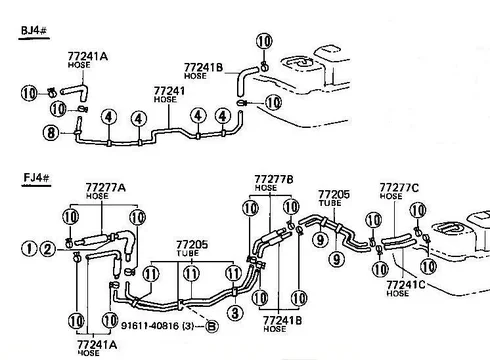
Looking at the EPC, sure enough, it shows 2 lines .... but neither tees into a separator line (nor does one tee into the filler vent either for that matter). The TUBE SUB-ASSY, FUEL TANK SUCTION (or what I'd call "fuel pickup") is different between the FJ4# and BJ4#.

FuelLines.webp

So there's another option for Dan ... Fitting an FJ40 Fuel pickup.

:beer:
FuelLines.webp
 
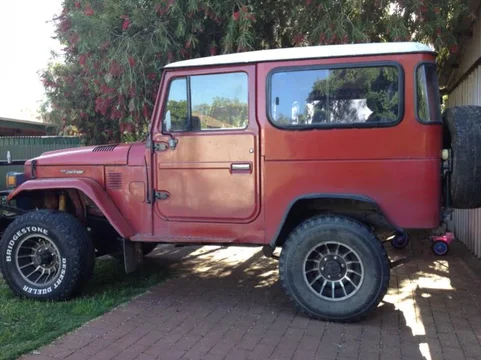
Well I got it out of the shed, and i gave it a wash, but didn't get anything else done on it this weekend.


image-1497819642.webp
 
The fuel return line keeps the petrol circulating and prevents vapour lock. I think the evap canister is different though.
When I put the vortec 350 in my hj47 I used one of those return lines but I can't recall which.
Good to see Lucy out in the sun again. Can't wait for a driveabilty report. Up to Lofty?
Josh
 
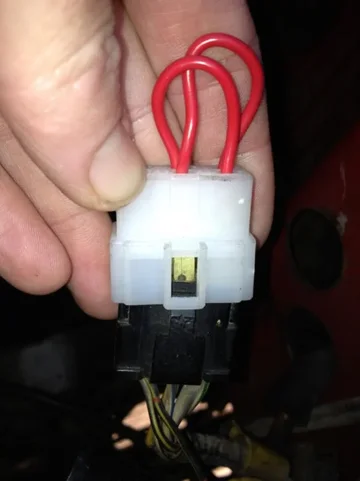
The alternator that was attached to the engine was the original one from the Hilux.

27060-58010 70A

image-1450652412.webp

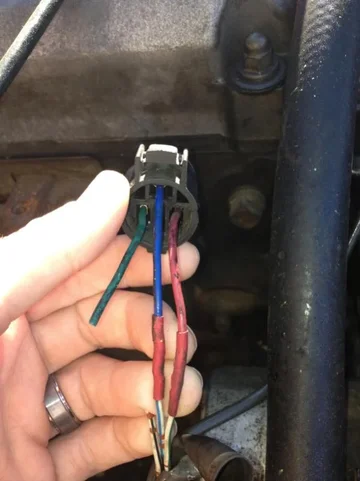
Wiring up the alternator, I have reused the existing loom where I can, but have had to run a separate wire for the IG.

Which is my job for tonight.


image-4075648005.webp
image-1450652412.webp
image-4075648005.webp
 
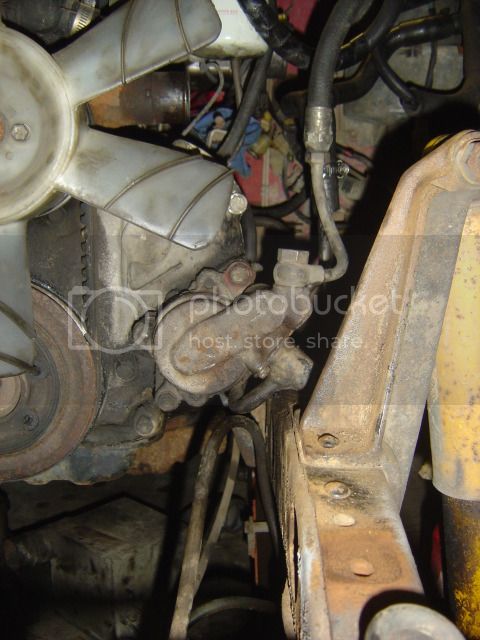
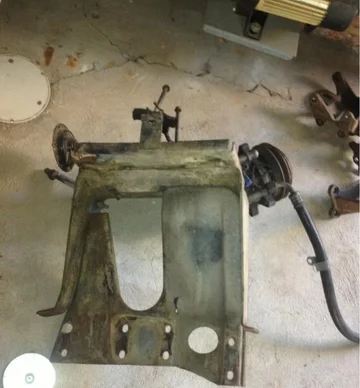
Next job will be to try to work out the main (cranking) battery tray, I have to modify the lower section so that I can fit it in and around the power steering pump - which is driven from the timing chain.

DSC02524.jpg


image-257423327.webp
 
The alternator that was attached to the engine was the original one from the Hilux.
27060-58010 70A ....

Hi Dan.

My info says that's the 14B alternator and that it's got a 45A rating.

AlternatorRating.webp


Errrr. But perhaps my Toyota info is wrong because a google search shows up an Asian-copy 70A alternator with the same part number????

:beer:
AlternatorRating.webp
 
Tom,


I did further searches also, which indicated that it is a 14b alternator, however, as you also found, the rating is varied from 35A through to 70A.

I'll see if my neighbour can confirm - he's an auto-electrician.
 
Tom,


I did further searches also, which indicated that it is a 14b alternator, however, as you also found, the rating is varied from 35A through to 70A.

I'll see if my neighbour can confirm - he's an auto-electrician.

Maybe the size of the pulley can vary the amp-rating? :meh:
 
I wouldn't think so because then the RPM of the engine would also vary it. I think (though I am not a sparkey) the amp rating has to do with the way or amount of copper spooling inside the alternator.

I think the size of the pulley is just to keep it above a minimum RPM. Chevy (Holden) uses the same alternator casing for their 80 amp and 200 amp alternator - it's just the guts which are different.

Josh
 
Hi Dan, if it's any help I swapped my battery tray from the left hand side of the engine bay to the right hand side. I had to drill a few holes and modify some of the existing ones but it worked well.
 
BEE-JAY42 said:
Hi Dan, if it's any help I swapped my battery tray from the left hand side of the engine bay to the right hand side. I had to drill a few holes and modify some of the existing ones but it worked well.

Thanks bee-jay, I have a dual battery setup, so currently the cranking battery is sitting on the drivers side tray. I'd like to retain the other tray if possible so that the distance to the starter is shorter.

Did you notice the update to the online manuals in the diesel forum - was it any help?

Dan
 
Ok, on the way to drop the 40 off at the exhaust shop this morning... Front wheel fell off... WTF!

Dogs went crazy last night, I should have got up to check things, but didn't...

No real damage, as it fell off as I pulled into the drive, disc got scuffed, but no damage.

Needless to say, I checked all other wheel nuts when I got it back together.


Exhaust should be done this morning, then I can swing past Dynamic Engineering so I can get Chris to make up some brackets etc.
 
Thanks for the info mate, still need that timing spec though. I'll be interested to see what your fuel economy is like, I suspect my engine is a bit thirsty which is why I have my doubts about my timing.

On a side note I nearly had the same thing happen to me with the wheel coming off a few years ago, I came out in the morning and someone had stolen my dirty old seat covers from my cruiser, I didn't think anything of it and drove that car around to my mums house to wash it, while washing it luckily I noticed my front wheel only had two wheel nuts left on it. I'm not sure how they think they are going to get the wheel off the car or why they think one dirty old land cruiser wheel is worth stealing?
 
Back
Top Bottom