

Hood Ventilation Idea.

This site may earn a commission from merchant affiliate
links, including eBay, Amazon, Skimlinks, and others.

I wanted to have my louvers punched into the new truck's hood. There is a large louver company right here in Richmond so I contacted them to see if they could just punch the hood. No dice :-/
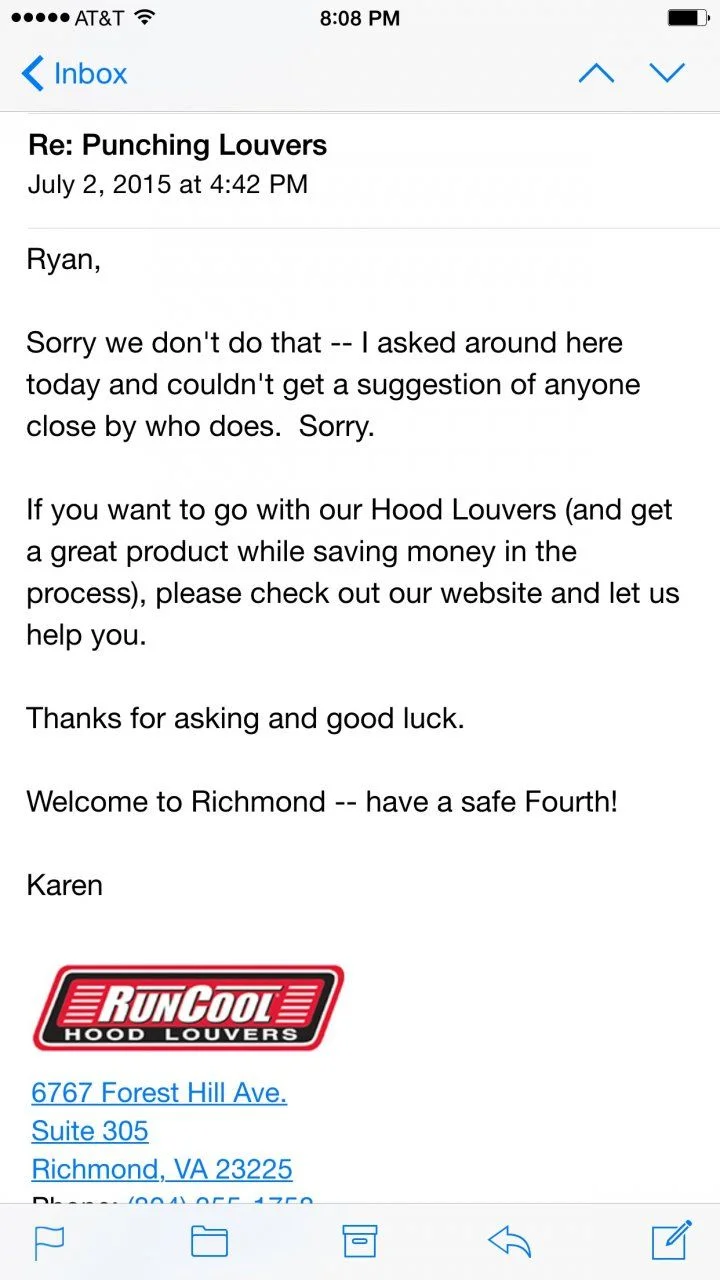
image.webp
 
I wanted to have my louvers punched into the new truck's hood. There is a large louver company right here in Richmond so I contacted them to see if they could just punch the hood. No dice :-/

View attachment 1101425
They do have weld in louvers list on their site.
 
@Rusco it looks like genright has mapped out some of the issues you describe...has anyone done this for an 80 series? Has this been done and buried somewhere 1,000 pages of overheating threads?

View attachment 1101469

I have these louvers, just need the time to figure out where to install them, I have the 3 package set. I was planning on one on each side and one up near the radiator. I am trying to figure out how to fit the radiator one with minimal impact to the hood bracing. When I find time to install them I will start a thread for others to comment on the hood bracing. I need to cut some holes or slits in the bracing to allow the heat to rise but not sure what the best method might be.
 
I think the general consensus is that vents towards the front of the hood near the radiator work well at highway speeds, while vents towards the windshield work well at slow speeds. What worries me is affecting the flow of air under the hood so that the radiator wouldn't get proper airflow. I think the two Genright louvers that are long and skinny would work well for the sides of the hood.
 
I wanted to have my louvers punched into the new truck's hood. There is a large louver company right here in Richmond so I contacted them to see if they could just punch the hood. No dice :-/

View attachment 1101425

Treeroot found a hotrod shop in Loveland CO to punch his louvers.
 
I think the general consensus is that vents towards the front of the hood near the radiator work well at highway speeds, while vents towards the windshield work well at slow speeds. What worries me is affecting the flow of air under the hood so that the radiator wouldn't get proper airflow. I think the two Genright louvers that are long and skinny would work well for the sides of the hood.


I really don't think this is a concern with the genright louvers, the way they are stamped the air flow flows backwards, so there is really no way it would effect the airflow to the radiator.
 
One thing to think about is the ability to block them off in winter. My Liberty takes longer than it did before to get to operating temp in cold weather. Not a real big deal for me in Austin but other it may be a concern.
 
My 80 takes about 3.5-4 min to get to operating temp in the winter (20-30 degrees. Not sure the lovers would affect that much.
 
@Rusco it looks like genright has mapped out some of the issues you describe...has anyone done this for an 80 series? Has this been done and buried somewhere 1,000 pages of overheating threads?

View attachment 1101469

I like that a lot...... As far as finding the hot spots in the 80 hood, lots of AC guys are carrying infrared temp guns to ck for leaks in ducts, etc. Heck, I've even got an ancient TI temp sensor with a bunch of different probes that would work.... slowly, but it would work.
Re the possible slow warm-up with louvers, if the engine thermostat works correctly, warm-up times should be unaffected.
Re possible airflow changes through the radiator: seems to me that anything done to decrease underhood pressure will enhance flow through the radiator because the high pressure in front of the radiator will remain the same. Worst case: I could visualize a situation where the vehicle, at speed, might possibly create a higher pressure area under the front end than that in front of the vehicle, but that's usually confined to street cars. I've been involved with a Miata in the 24hrs of Lemons that had that issue (we think- the aerodynamics were pretty messed up due to some earlier contact with a barrier). Until we could fix the nose, we had to run with the front of the hood up about an inch to get air through the radiator, but I just can't see that happening with an 80.
 
Back
Top Bottom