Hofflarr's Restoration of Little Devil

This site may earn a commission from merchant affiliate
links, including eBay, Amazon, Skimlinks, and others.

Chamba,,

The previous owner said that the bed was stored upside down.

I think that was a good idea as it kept any surface rust at bay from the inside of the box. That is one of the reasons I think this is a great candidate for restoration because the bed of the box is not pitted as you see many times on these trucks. However, I would have expected more surface rust under the rail.

Not sure if it was stored at an angle, maybe it was as the back seems to have more rust-through than the front. This is a pic near the front.

DSC02218.webp


DSC02218.webp
 
Last edited:
Been a while, but I finally got some progress to post.

I have finally got my extra split rims back together and new (read "used") tires put on. In the process of changing out the wheels, I realized that I have disc brakes on the front.

DSC02479.webp

I'm guessing that since the front end was in a collision and written off, the front end was taken from a 40 and installed on this truck and that is why I have discs up front.

So, first question is: do I have the original master cylinder, or has that been changed as well?

DSC02493.webp

DSC02479.webp


DSC02493.webp
 
Last edited:
I know that there were parts used from at least two cruisers used for the repair as the hood and right fender were originally yellow and the left fender was originally green. I actually have the vin plate from the right fender showing that it indeed was from a 40.

DSC02491.webp

So, the second question is whether or not the engine is original to the 45 or from some other 40.

Here is the engine number 2F 189424

DSC02492.webp


And for those of you who just want to see what the new wheels look like.​

DSC02477.webp

DSC02491.webp


DSC02492.webp


DSC02477.webp
 
Last edited:
Rims look good Larry (although I am not a fan of the splitties myself...). The engine is the right vintage to be from a '77, but as far as I know there is no way to know what specific engine came from Toyota originally. Others may know better. Have you looked at the 2F serial number thread?

532 is mustard colour, isn't it?
 
My FJ40 is a 10/76: 233589 with 2F 119577

In the 2F serial number thread, there is a June 77 with 2F 177888

There is a Sept 77 with 2F 199013

Sent from my iPhone using IH8MUD at 85mph in an FJ40
 
Last edited:
Thanks Subali. It looks like from the Mustard VIN, that donor was a 1975and judging by the 2F serial numbers you provided, it looks like the engine is between June and Sept 1977, so I guess we can assume that the engine is original to the '45 since the production date of the '45 is July 1977.
 
I have a 77 fj40 with disc brakes standard up front. Master looks similar.
 
So after calling a few mechanics I finally gave up on trying to get my truck passed with the cracked windshield and rusted tailpipe.

I decided to try my luck at taking out the windshiled and after a bit of trying and research on Mud, I figured it out.

I read a post here about using bicycle tire levers and I remembered that I had a couple of sets from a long, long time ago when I was into biking. It turns out they work just fantastic. Like I said, I had two sets, which is six in total and I think that helped. And as the other post stated they didn't cause any damage because they are plastic.

The other thing I liked about them is they have just a slight curve to hook behind the windshield frame.

So originally when I started I didn't have the levers, just a couple of screwdrivers and some old paint can openers and it seemed like I would have to take off the heater vent guides to get the rubber off. I punched the centers out of the vent guides only to find out they were still somehow attached. So I then thought I had to take off the upper dash pad. I took out all of the screws and it seemed like it was still attached as well. That's when I came to Mud.

I found that the dash pad would be hard to get off but also found the thread about the tire levers. So I decided to put the screws back into the dash pad and not take it out.

I started with the tire levers in the right bottom corner. I had three of the levers right in the corner and another two on each side of that and slowly the windshiled gave way.

I contiued to pry out the windshield on the right side and on the bottom. Once I got to the left bottom corner and got that freed, the windshield was easy to push out by hand.

Pic of the levering in the top right corner:

DSC02509.webp

On the bottom I actually ended up using the heater vent guides to leverage the rubber. I used a piece of plastic lamitate to protect the guide though because I first used the paint can opener and did some slight damage to the guide with it so I did not want to tae any chances with the tire levers.

DSC02510.webp

And now to get a new windshield cut and intstall it.​

DSC02509.webp


DSC02510.webp
 
Last edited:
I've always just kicked out the old screen and used clothesline to put the new one in. Be sure to get new weather strip from Toyota. Makes install a breeze.
 
Josh, kick the window out...Yikes! That sounds too much like a movie where the windshield gets shot out and they have to kick it out! It sounds like it would work well and maybe next time I will try it. But in this case I didn't want to damage the window or anything else so I took it slow. Even though the window is crackd it is otherwise in good shape and I want to use it for a template for the new glass.

I will use the rope method to get the new window in, but I don't think I will buy new rubber as this one is in great shape, very flexible and not cracked at all.
 
Finally Legal!

OK, so a bit of an update on the Little Devil.

I took a while but I have finally got the windshiled replaced and the exhaust fixed. It took a while because my glass guy was not as quick as he said he was going to be and I had to go out of town to work and then when I did get it ... I broke it trying to install it, so one more time. The first time I was taking too easy on the weatherstripping and too hard on the windshield. The second attempt went very well and I had the windshiled in within an hour. This time I took it easy on the windshield and manhandled the weatherstrip. I used the rope method and put it in by myself. I did not find it difficult. I placed the gasket on the windshiled and the rope in the groove fitting the body. I actually used three pieces of rope as I did not have one piece that was long enough. I then placed the windshiled in position and lined uo the sides, using the fade marks on the paint as a referece to where it was. From the rirst attempt I found it easier to have the doors closed and the windows open. That way one hand can pull the rope on the inside through the window while the other puts pressure on the windshield.

I think having three pieces of rope actually helped me. Two points of the rope met on the bottom near each corner and the last piont where they met was at the top in the middle. The reason this helped me was because I could work the bottom a bit and both corners at the same time. Pulling the rope through tended to move the windshield if there was nothing to stop it on the other side, so being able to work both sides at the same time allowed me to get the windshield positioned well so that I could pull the rope through with as much force as needed.

DSC02577.webp

The exhaust I did not do myself. I had a shop do it and I think they did a pretty good job. The guy at the counter thought I was crazy for wanting to keep the old rusted muffler, but I wanted to keep it because it is the actual Toyota muffler and if...IF I there is a chance of finding one, I will know what to look for. Anyway, I think that made the installer aware of how I wanted it to look as original as possible. So they found a similar size muffler and the exhaust was routed out the back. Not sure if that is the correct exit location, but that is what my brochure shows so that is what I went with. I made sure they kept the original flange in front of the muffler. There was another flange behind the muffler, but I wasn't going to go as far as to make them put in a flange just to match the old.​

DSC02578.webp


DSC02579.webp

I also had a slight issue where I drove with the parking brake on and thought I broke it so I ended up taking that apart just to find out that all I had to do was readjust the brake ... **** staked nuts!​

I'm also looking for a "new" front bumper so that I can install my winch. The bumper that I have is too bent up to mount the winch to.​

DSC02577.webp


DSC02578.webp


DSC02579.webp
 
Last edited:
Can you post more pics of the exhaust system? Who did it and how much $?

I just noticed the extra metal on the bottom of your frame, right under the muffler. Do you know anything about that?
 
Kevin,

I had the exhaust done at Speedy Automotive on 97 st. I chose them because they are literally 10 blocks from my house. The whole thing cost $350 and it only took them about 3 hours to have it done.

Here is a pic of the full exhaust.

DSC02593.webp

The arrow in the picture points to the original hanger behind the muffler and they were able to actually use it. There must have been a hanger at the back originally, but there was nothing there so they put one on as you can see.​

And here is a pic from the 1977 brochure (although I've been informed that it is a pic of a 1976 model). You can just see the tailpipe sticking out the back.​

brochure.webp

Here are some more pics of the frame mods. The mods were from the previous owner as this truck had a picker deck on it for most of its life and was used to tow wrecked vehicles around their yard (See post #3). The box that is on the truck now is not original and that is why it is rusted more than the cab. I'm not sure when or where the PO got the box but it may be a different year from the truck as the front mounts don't seem to line up (See post #4).​


DSC02596.webp

What concerns me about these frame mods is that they may have been done because the PO cracked the frame with their picker deck and towing vehicles around and then fixed it. It may be hiding behind that plate that I highlighted in the photo. Alternatively, they may have known there was going to be a lot of stress on the frame and reinforced it before they added the picker deck. I hope the latter is the case. I'm probably going to take the box off and then go visit the PO to see if he has any more info. If the frame is cracked, I will have to deal with it.​

Also note the homemade shackle in the pic. It is like 6" long. I think the springs are still original so I just have to find some original shackles. Right now my rig keeps its ass end stuck up in the air...I kinda like it though. It's funny because when my truck is parked on my sloping driveway, the box is actually level!​

brochure.webp


DSC02596.webp


DSC02593.webp
 
Last edited:
Before it fell off, the tail pipe on mine exited to the side behind the drivers side rear wheel. I don't know if it was the orginal, but it was hung on what looked like stock hangers.

I have a schematic somewhere that shows it exiting at the side.
 
I have a 1965 parts catalog that shows it exiting out the rear as well. I know that this is 12 years earlier than my truck, but I happen to have it handy. Obviously things change over the years and between 77 and 78 there appear to have been some significant changes, so maybe they changed the routing of the exhaust as well. It's all semantics anyway because I bet that 99.5% of people will not know or care what the stock exhaust looks like.

Muffler Diagram.webp

:cheers:

Muffler Diagram.webp
 
Last edited:
I'd bet it didn't change in Canada until '79 when the tank was moved to between the frame rails. In the US it didn't change on the pre-'79 40 until the introduction of the catalytic converter and I don't think you lads got cats until the 80s, right?
 
Lo and behold, I do have a diagram of the 1977 exhaust. I guess I had been looking into it earlier and forgot I saved it.

This diagram does show all of the hangers and I see the one I am missing should be bolted to the frame rail. I'll have to check if that bracket (17030S) is still bolted to the frame and then maybe I can still get the cushion (17430T) which looks to be available according to toyotapartsoverstock.com, where I got the diagram from.

Shoulda had this all figured out before I got the exaust fixed :doh: ... oh well.

1977 Ehaust System Resized.webp

1977 Ehaust System Resized.webp
 
Last edited:
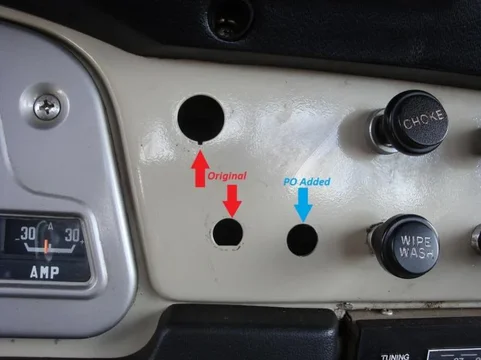
What was in these holes?

Anyone know what was originally in these holes marked in Red?

DSC02598.webp

I believe that two of them are OEM and one was drilled by the PO. I also think that the two OEM holes were plugged.

I have a 1978 PDF owners manual showing the dash, but the dash in that area changed in '78 to put the seatbelt and brake warning light there, so it is not much help.

Does anyone know definitively if these holes originally had plugs?

DSC02598.webp
 
Last edited:
Back
Top Bottom