


Thanks, Andrew. This helps.Craig
Engine cover doesn’t trap enough heat to make the problem worse.
Preface slow moving operation up-hill under load- The DS header and cat heat the fuel lines, the Y pipe heats the front side of the tank, and the muffler and exhaust heats the side of the tank. Those are the major contributors to heat sink and build up of vapor pressure.
The passenger side header and cat is right next to the Transmission lines- this heats the fluid- heats the radiator- engine runs hotter- and the cycle continues.
My 02- The evap can’t keep up with excessive vapor pressure with higher content of ethanol compared to original design- insulating fuel lines and tank skid (front and side) has shown to reduce the boil condition. I’d also consider wrapping the transmission hard lines by the header and cat.
Navigation
Install the app
How to install the app on iOS
Follow along with the video below to see how to install our site as a web app on your home screen.
Note: This feature may not be available in some browsers.
More options
Style variation
You are using an out of date browser. It may not display this or other websites correctly.
You should upgrade or use an alternative browser.
You should upgrade or use an alternative browser.
Gas tank building excessive pressure & fuel smell. Dangerous for sure! Why does this happen?
- Thread starter 2001LC
- Start date
This site may earn a commission from merchant affiliate
links, including eBay, Amazon, Skimlinks, and others.

I finally replaced this valve this year. Took almost 6 months to receive from an order last summer, then I waited through the winter before installing it. Finally took it on a high altitude pass this week (Red Cone 12,800 ft). When I stopped at the beginning of the trail to air down and disconnect sway bars, I could hear from the evap canister the tell tale sign of higher pressure(like a bumble bee). But it was not nearly as bad as previous years. Ambient temp was in the 80s. I've had it worse at lower temps. This is the only step I've taken thus far to correct this issue and I think it made an improvement. I only get this type of venting when the engine is shut off. In the past I could smell fuel from under the hood while it was still running.( I also replaced my radiator a couple years ago with a moshimoto but not for this reason) Engine temps avg around 195.Mine vents under the hood from the Canister if i don't vent it from the gas cap. And it takes forever. When this does happen i have to make a decision which is more dangerous. We really need to find the correct solution to this ASAP.
Has anyone considered or replaced the valve between the charcoal Canister and the intake which is supposed to vent the gas? Mine is mounted on the intake right on top. There is supposed to be a check engine light if this isn't working properly but then again we should all be getting evap DTCs as well. View attachment 2744708
Interestingly in my 2001 tacoma, I never have this problem. same fuel, pretty much same conditions. But on my taco, there is no valve like this. Instead there is a hose that runs from the evap canister straight to the air box, and is effectively sucked in continuously.
I tried disconnecting the LCs hoses between the evap canister and intake in a couple of places to see if I could detect any blockages. There were none. If however, I pull off the line that runs to this valve from the canister, and block it with my finger (with engine shut off), I can hear the evap canister leaking from somewhere else(bumble bee sound again), so I know the pressure is an issue between these locations.
I'm considering either bypassing this valve all together and seeing how it changes drivability, or possibly removing my cats to reduce the heat under the body.
I'm returning to this thread to update my battle. After following @J1000 's advice I haven't had fuel boiling since insulating all my lines.
I still have venting. I think they are two seperate issues with similar symptoms. The boiling has to be due to outside heat getting in the system. The venting seems to be a poorly designed (I know it's blasphemy) purge system by the Toyota Engineers. An issue that has plagued the 80 series, 100 series, and I'm hearing 200 series and I know my 2UZ on my GX470 vents too.
On a recent trip to Engineer Pass (in the GX470)I finally started to vent when descending into lake city. It takes a LOT of driving in 4LO and climbing to get the GX to vent (it has never boiled) because I think the fuel is kept cooler. When I smelt the gas in the cabin, I locked it into 1st Gear 4-LO and crawled with medium/high RPMs. The theory being that maybe the purge valve will open and/or if it was open, the RPMs would give me better vacuum to pull out the fumes and balance the tank pressure.
Sure enough, after a short time of driving like, this I put it back to Drive and crawled at low RPM. The fuel smell was gone and it never came back.
Contrast that to my LX which can take over 30 minutes to finish venting out the gas cap (but at least it's not boiling anymore).
I'm starting to think like @Brandon Ryder and I'm curious what would happen if I wheeled with the purge valve omitted from the loop (always venting into the throttle body). I'm worried about fumes building up under the hood though, so maybe we can design a switch and manually open the purge valve from the cabin, rather than from the ECU?
I still have venting. I think they are two seperate issues with similar symptoms. The boiling has to be due to outside heat getting in the system. The venting seems to be a poorly designed (I know it's blasphemy) purge system by the Toyota Engineers. An issue that has plagued the 80 series, 100 series, and I'm hearing 200 series and I know my 2UZ on my GX470 vents too.
On a recent trip to Engineer Pass (in the GX470)I finally started to vent when descending into lake city. It takes a LOT of driving in 4LO and climbing to get the GX to vent (it has never boiled) because I think the fuel is kept cooler. When I smelt the gas in the cabin, I locked it into 1st Gear 4-LO and crawled with medium/high RPMs. The theory being that maybe the purge valve will open and/or if it was open, the RPMs would give me better vacuum to pull out the fumes and balance the tank pressure.
Sure enough, after a short time of driving like, this I put it back to Drive and crawled at low RPM. The fuel smell was gone and it never came back.
Contrast that to my LX which can take over 30 minutes to finish venting out the gas cap (but at least it's not boiling anymore).
I'm starting to think like @Brandon Ryder and I'm curious what would happen if I wheeled with the purge valve omitted from the loop (always venting into the throttle body). I'm worried about fumes building up under the hood though, so maybe we can design a switch and manually open the purge valve from the cabin, rather than from the ECU?

I thought I'd posted these pictures in this thread but apparently not.
I took a trip to Moab in late july this year. One of the days, we did Dome Plateau, which is quite a long day on its own.
With all the heat shielding added on the side of the tank, AND extending the cat heat shield passed the fuel lines on the frame, AND insulating the fuel lines under the hood, AND adding dual electric radiator fans with the pressure switch override wired in (this worked a treat BTW - kept the engine coolant around 185 and kept my AC blowing nice and cold while OAT was around 105), I STILL had a fuel boiling/non-start issue. When I got home, I added this:


It's an oil cooler off Amazon that I plumbed into the fuel return line to ensure there isn't much pressure run through it. I think I paid about 100$ for the cooler plus another $50ish for the braided lines and fittings. I cut the quick disconnect fittings out of the OEM nylon hoses and inserted them into the braided lines, and use some crap angle aluminum to build mounts for this thing.
Unfortunately, I do not have a temperature sensor for my fuel system, nor have I been back to Moab since the last boil incident. I can say that since this thing is now in front of the radiator, the rad fans should help keep my fuel cool when not moving, and normal airflow should help when I'm moving fast enough.
Fingers crossed this solves the issue but only time will tell.
I took a trip to Moab in late july this year. One of the days, we did Dome Plateau, which is quite a long day on its own.
With all the heat shielding added on the side of the tank, AND extending the cat heat shield passed the fuel lines on the frame, AND insulating the fuel lines under the hood, AND adding dual electric radiator fans with the pressure switch override wired in (this worked a treat BTW - kept the engine coolant around 185 and kept my AC blowing nice and cold while OAT was around 105), I STILL had a fuel boiling/non-start issue. When I got home, I added this:
It's an oil cooler off Amazon that I plumbed into the fuel return line to ensure there isn't much pressure run through it. I think I paid about 100$ for the cooler plus another $50ish for the braided lines and fittings. I cut the quick disconnect fittings out of the OEM nylon hoses and inserted them into the braided lines, and use some crap angle aluminum to build mounts for this thing.
Unfortunately, I do not have a temperature sensor for my fuel system, nor have I been back to Moab since the last boil incident. I can say that since this thing is now in front of the radiator, the rad fans should help keep my fuel cool when not moving, and normal airflow should help when I'm moving fast enough.
Fingers crossed this solves the issue but only time will tell.


- Thread starter
- #905
Once we either over-fill gas tank or boil fuel. We dump raw fuel in Charcoal Canister, in models where CC in rear near and at level of gas tank (03-07 100 series). That CC must be replaced! The 98-02 are more forgiving, but can also be flooded.
I've found, after all done to correct boil. Be it correcting hot running engine, hot transmission fluid, shielding excessive radiant heat, we stop over filling gas tank or combination. We'll often still get fumes (AKA venting). Often the fumes smell putrid. Like old gas, that has gone bad sitting in that lawn mower for years. That is smell of a contaminated CC, which is surely clogged. We replace CC, and it clears up fumes.
These CC when removed, are noticeable heaver than new. That's due to raw fuel it's soaked up contaminating them.
If CC clogged, the fuel tank builds excessive pressure.
We must corrected reason the CC was contaminated, before replace CC. Or we risk damaging CC again.
I've found, after all done to correct boil. Be it correcting hot running engine, hot transmission fluid, shielding excessive radiant heat, we stop over filling gas tank or combination. We'll often still get fumes (AKA venting). Often the fumes smell putrid. Like old gas, that has gone bad sitting in that lawn mower for years. That is smell of a contaminated CC, which is surely clogged. We replace CC, and it clears up fumes.
These CC when removed, are noticeable heaver than new. That's due to raw fuel it's soaked up contaminating them.
If CC clogged, the fuel tank builds excessive pressure.
We must corrected reason the CC was contaminated, before replace CC. Or we risk damaging CC again.
Last edited:


Just hear me out... I like the idea of a fuel cooler to solve this issue but I think that type of heat exchanger is a bad choice, especially where it is positioned... very vulnerable in a front end collision. It has at least 30 joints that can fail in an accident. That could mean a fiery crash... Hollywood style. Might be okay for diesel but not gasoline.I thought I'd posted these pictures in this thread but apparently not.
I took a trip to Moab in late july this year. One of the days, we did Dome Plateau, which is quite a long day on its own.
With all the heat shielding added on the side of the tank, AND extending the cat heat shield passed the fuel lines on the frame, AND insulating the fuel lines under the hood, AND adding dual electric radiator fans with the pressure switch override wired in (this worked a treat BTW - kept the engine coolant around 185 and kept my AC blowing nice and cold while OAT was around 105), I STILL had a fuel boiling/non-start issue. When I got home, I added this:
View attachment 3519344
View attachment 3519345
It's an oil cooler off Amazon that I plumbed into the fuel return line to ensure there isn't much pressure run through it. I think I paid about 100$ for the cooler plus another $50ish for the braided lines and fittings. I cut the quick disconnect fittings out of the OEM nylon hoses and inserted them into the braided lines, and use some crap angle aluminum to build mounts for this thing.
Unfortunately, I do not have a temperature sensor for my fuel system, nor have I been back to Moab since the last boil incident. I can say that since this thing is now in front of the radiator, the rad fans should help keep my fuel cool when not moving, and normal airflow should help when I'm moving fast enough.
Fingers crossed this solves the issue but only time will tell.
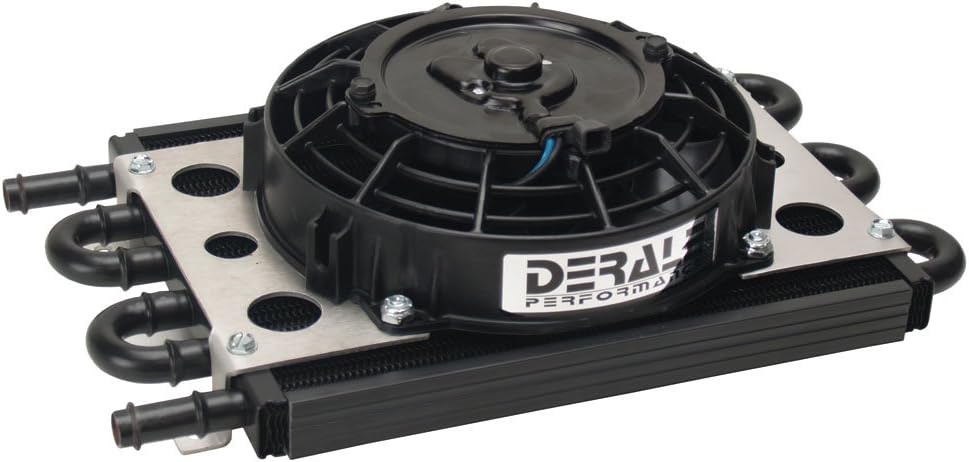
The kind of fuel cooler you would want is a tube and fin cooler. You could twist it like a fuel line but it would still hold up.
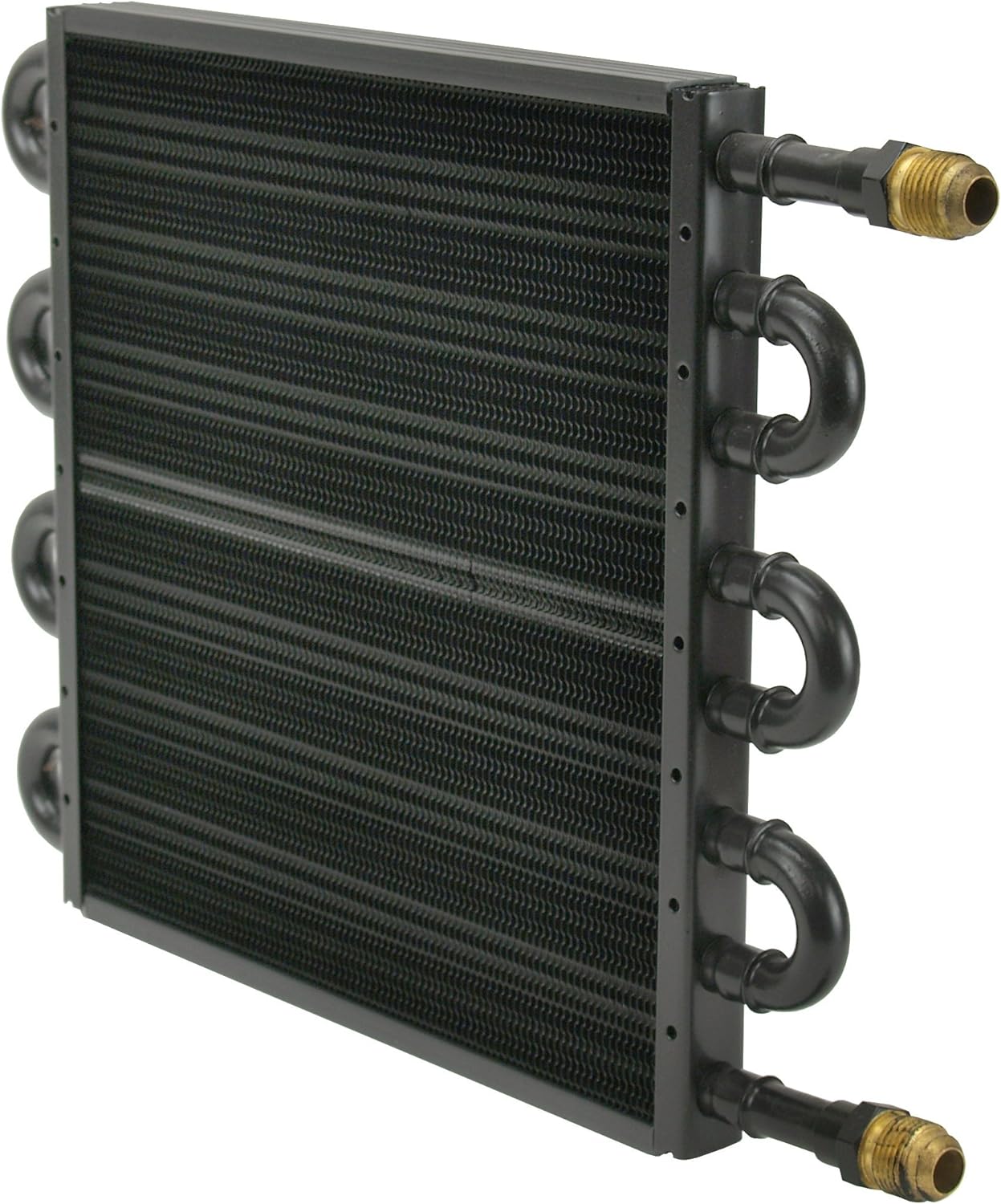
Safer but obviously, it won't cool as well as the type of heat exchanger you have installed. So maybe something like this. 6 passes with an electric fan. Turn the fan on only when you need it. Could also be mounted in a less vulnerable area, which I'm not really sure given the dimensions.
- Width: 12-3/4"
- Height: 7-5/8"
- Depth: 3-3/4"

I would recommend trying the fuel pump relay delete and seeing if that helps. Pretty much solved my hot starting issues and overall driveability.I thought I'd posted these pictures in this thread but apparently not.
I took a trip to Moab in late july this year. One of the days, we did Dome Plateau, which is quite a long day on its own.
With all the heat shielding added on the side of the tank, AND extending the cat heat shield passed the fuel lines on the frame, AND insulating the fuel lines under the hood, AND adding dual electric radiator fans with the pressure switch override wired in (this worked a treat BTW - kept the engine coolant around 185 and kept my AC blowing nice and cold while OAT was around 105), I STILL had a fuel boiling/non-start issue. When I got home, I added this:
View attachment 3519344
View attachment 3519345
It's an oil cooler off Amazon that I plumbed into the fuel return line to ensure there isn't much pressure run through it. I think I paid about 100$ for the cooler plus another $50ish for the braided lines and fittings. I cut the quick disconnect fittings out of the OEM nylon hoses and inserted them into the braided lines, and use some crap angle aluminum to build mounts for this thing.
Unfortunately, I do not have a temperature sensor for my fuel system, nor have I been back to Moab since the last boil incident. I can say that since this thing is now in front of the radiator, the rad fans should help keep my fuel cool when not moving, and normal airflow should help when I'm moving fast enough.
Fingers crossed this solves the issue but only time will tell.
I describe it in the 2nd half of this post: Builds - 2007 LX470 Super Cruiser build with Elate Mfg Supercharger - https://forum.ih8mud.com/threads/2007-lx470-super-cruiser-build-with-elate-mfg-supercharger.1288831/post-15150326
Just hear me out... I like the idea of a fuel cooler to solve this issue but I think that type of heat exchanger is a bad choice, especially where it is positioned... very vulnerable in a front end collision. It has at least 30 joints that can fail in an accident. That could mean a fiery crash... Hollywood style. Might be okay for diesel but not gasoline.
Yeah it's certainly not the ideal location for something full of fuel, but I'll just make sure to never have a crash! (/s in case anyone thinks I'm serious). Unfortunately, for best cooling, out front is ideal. The fan-mounted one you shared is great but I'm struggling to find places to conveniently add more relays, let alone a whole cooler and fan! That was my first plan but I couldn't find anywhere to put it.
As for the possible weld failures, well, that's more or less why I went for an oil cooler (which should handle 80+ psi fine) and only ran return line fuel through it. There won't be more than a few PSI in the cooler ever, so even crappy welds are unlikely to ever cause an issue.
Given my other hobbies, I rate the front-end fuel cooler as pretty unlikely to be the cause of my sudden demise. Should it happen, I'll try to ghost post a "you were right" on the forums!
I would recommend trying the fuel pump relay delete and seeing if that helps. Pretty much solved my hot starting issues and overall driveability.
I describe it in the 2nd half of this post: Builds - 2007 LX470 Super Cruiser build with Elate Mfg Supercharger - https://forum.ih8mud.com/threads/2007-lx470-super-cruiser-build-with-elate-mfg-supercharger.1288831/post-15150326
I had not seen that, thank you for the link. One of the times I had a non-start issue I tried to figure out how to jump the pump with the engine off but failed to figure it out in moab when it was around 110 degrees outside. Sorting that out in my garage sounds a little easier!
Earlier this year, my BMW cooling fan mount cracked and the plastic fan blade met with the oil cooler. It put two good sized holes in it. Oil was everywhere! That's just plastic vs aluminum. And it was a high quality, $500 oil cooler! On mild to moderate collisions, the engine doesn't shut off. Gas will just keep pouring out until the engine is shutdown. I'm just saying....


I had two unexplained stalls while running at altitude. Since I replaced the fuel pump three years ago it hasn't happened again. Even after a week of 110+ in Palm Springs and several other similarly hot trips. 2006 LC fwiw.
- Thread starter
- #911
06-07, bad fuel pump symptom. Typically symptom is mostly seen on hot days. After running engine in higher RPM (ascending, passing, etc.), let off gas pedal RPM drop and engine stalls.I had two unexplained stalls while running at altitude. Since I replaced the fuel pump three years ago it hasn't happened again. Even after a week of 110+ in Palm Springs and several other similarly hot trips. 2006 LC fwiw.
Heat = resistance. Resistance = heat.
High RPM = fuel pump runs at high speed.06-07, bad fuel pump symptom. Typically symptom is mostly seen on hot days. After running engine in higher RPM (ascending, passing, etc.), let off gas pedal RPM drop and engine stalls.
Heat = resistance. Resistance = heat.
RPM drops = fuel pump runs at low speed.
When hot and driving for hours the fuel pump resistor gets hotter and hotter. As resistor gets hotter, fuel pump voltage reduces. Eventually fuel pump voltage is too low and performance suffers or the engine stalls.
Solution: bypass fuel pump resistor so the fuel pump runs at battery voltage all the time.
- Thread starter
- #913
That's one solution.High RPM = fuel pump runs at high speed.
RPM drops = fuel pump runs at low speed.
When hot and driving for hours the fuel pump resistor gets hotter and hotter. As resistor gets hotter, fuel pump voltage reduces. Eventually fuel pump voltage is too low and performance suffers or the engine stalls.
Solution: bypass fuel pump resistor so the fuel pump runs at battery voltage all the time.
 But is it a good one, for what this threads is about?
Jimmy, I respect the creative work you do. From retrofit with electric motor!. Modified fuel systems, to run on pure ethanol. Heat shielding, to prevent fuel boiling and vapor lock. Supper charged VVT. Even this fuel resistor bypass you've done. You're a creative pioneer!
For those that don't have time to read this long post. Here's the last few words, from Bing Chat A.I: "If the fuel pump speed is too high, it will deliver more fuel than the engine needs, and the excess fuel will be sent back to the tank through the return line. This creates unnecessary heat , "
 Heat!
Heat!This thread is about why fuel tank building excessive pressure "Fuel boiling" as it known.
Some say: "All land cruiser boil fuel" This simply is not true, IMHO! It's the things owners, drives, builders and mechanics do and or don't do. That increases likelihood of fuel boiling.
I agree fuel resistor gets hot. Which Toyota place heat sink fins on it, for that reason.
I've been monitoring the resistors temperature, of various 03-07 100 series. Seeing 135F-198F.
Running fuel pump with full 12V current at all times, may overcome some of the effects of resistance on wiring & pump. We've heat/resistance from end to end, even when FP resistor is not bypassed and working as it should. Keeping current/volts at max, by bypass FP resistor. Can over come low fuel flow at low RPM, by keeping fuel flow at max pump can produce. Sound good! But is resistor the root cause of lean condition stall, perhaps. But why then, does replacing fuel, solve the low RPM lean stall.
But is this just issue at resistor creating to much resistance:
If so, replacing fuel pump only, would not cure. Certainly not in the long run. But it does cure, and cures for long term! I've document in just one 06 alone, over 120K miles since fuel pump alone replaced, and not one stall. Cumulative mileage in the dozen or so 06-07 I've replaced fuel pump on, is more than 300K miles. Not one had resistor replaced, just fuel pump. Non have fuel pump low flow stall issues since. I've replaced a lot of Fuel pumps, in all years. Not one resistor or bypass of resistor in any of them. Not one issue of leaning running stall, afterwards. One creative young man. Placed his FP resistor in the air box, to cool. Which he reported, did cool it somewhat. But did not help his fuel issues (fuel boiling or stalls).
In my first (Snowy) that I learned of how to spot the symptom:
It was by studying its service History. Where customer (PO) keep complaining of vapor-lock (service manager was writing up as vapor lock), driving up to Eisenhower tunnel. It took that Toyota Dealership (Stevenson West), ~6 times into shop over first 100k miles period. Before they cured, by just replacing fuel pump. It's now has 120K more miles since replacement of fuel pump alone, without a stall.
The second was my 07 (GrayGal), I'd just purchased while driving back to Denver June 29th 2019. It stalled 3 time (Vail pass, Eisenhower tunnel and near Idaho springs). I was plugged into tech steam and logging data on my phone during the drive. As soon as stall happened, I read codes, before turning IG key off. I'd get BK1 & BK2 lean. I replaced it's fuel pump, then took on same HWY drive on a day with even higher OAT in mid July. No issue than or to this day, with stall or lean condition.
I've monitor fuel pump resistor temperatures, with IR gun:
I monitor fuel pump resistor, with IR gun for a few years. In the 03-07. Which 03-05 have different P/N than 06-07, for resistor and fuel pumps. I also recorded OAT, IAT, ECT, IR temp at fender near resistor, IR temp thermostat housing. I also note weather (sunny, cloudy, wet, etc.) and driving condition (i.e. stop & go, HWY, mtn passes, etc.) All FP resistors get hot. I see temp on days, where OAT above 90F, from 183f to 198F. The highest reading, was ones pushed the hardest on the hottest days, to test. One being the same one, stalled do to lean condition, that I replaced FP on. Still running strong today. But even on others, like my 03 w/315K. I get temps ~198F. Which it still has factory fuel pump and FP resistor, without issue.
? Why did Toyota even install a resistor or variable speed fuel pump. Bing Chat A.I. states:
Toyota uses a variable speed fuel pump in the Land Cruiser to improve fuel efficiency and performance. A variable speed fuel pump can adjust the fuel pressure and flow according to the engine’s needs, reducing fuel consumption and emissions. A variable speed fuel pump also helps to prevent vapor lock, which is a condition where the fuel vaporizes in the fuel line due to high temperatures, causing the engine to stall or run poorly
? Since fuel pressure if controlled by fuel pressure regulator. How does slowing fuel pump speed increase fuel efficiency Bing Chat A.I. states:
Slowing down the fuel pump speed can increase fuel efficiency by reducing the amount of fuel that is wasted or returned to the tank. The fuel pressure regulator maintains a constant pressure in the fuel rail, regardless of the fuel pump speed. If the fuel pump speed is too high, it will deliver more fuel than the engine needs, and the excess fuel will be sent back to the tank through the return line. This creates unnecessary heat
Last edited:
I'm definitely not an expert. But I am a convert to the church of fuel pump. My two events were at 7000' on 80 degree days after having done a lot of high rpm climbing. First was at 80mph coasting down Donner Pass. Second was in line to get into Lassen National Park. Neither was at all convenient.
So can I just ask the mechanical engineers out there, does a low viscosity fluid generate heat through friction? My (low-ranking) high school physics class of yore says not really(?). My experience in military aviation (also low budget) tells me more fuel flow would keep the lines cooler. Somewhat related to why turbine engines use the oil to preheat the fuel except we have the opposite problem:
Anyway, having previously read and forgotten (apologies) all 46 pages above, is it at all possible that when the pump slows down (for good or bad reasons) the fuel could actually be picking up more heat (as it more slowly moves past the cats and whatnot)? And in the case of a failing pump or heating resistor this all self-inflicts more wound with the resulting heat increase spiraling to even slower moving fuel?
No point exactly aside from maybe we're all at least pointing at the design flaw that surely exists?
Feel free to all-caps "no" me.
So can I just ask the mechanical engineers out there, does a low viscosity fluid generate heat through friction? My (low-ranking) high school physics class of yore says not really(?). My experience in military aviation (also low budget) tells me more fuel flow would keep the lines cooler. Somewhat related to why turbine engines use the oil to preheat the fuel except we have the opposite problem:
Anyway, having previously read and forgotten (apologies) all 46 pages above, is it at all possible that when the pump slows down (for good or bad reasons) the fuel could actually be picking up more heat (as it more slowly moves past the cats and whatnot)? And in the case of a failing pump or heating resistor this all self-inflicts more wound with the resulting heat increase spiraling to even slower moving fuel?
No point exactly aside from maybe we're all at least pointing at the design flaw that surely exists?
Feel free to all-caps "no" me.
I'd like to see a source about how more fuel flow increases friction so much that it causes heat problems. In my view it's the opposite. Our trucks have trouble with hot fuel as is.
More voltage to the pump will make the pump run cooler. It will transfer less heat to the fuel in the tank and more fuel flow through it will keep it cooler, longer.
A pump that has been running hot will have weaker magnets so changing it will make a difference in low voltage operation.
More fuel flow will keep the fuel rails and return lines under the hood from transferring so much heat to the returning fuel. More fuel flow will reduce or eliminate vapor lock.
The resistor indeed has a heat sink but at slow speed there is not enough air flow to keep it cool enough. Slow speed, low RPM is when fuel boils and vapor locks on these trucks.
I don't think anyone knows why the resistor is there except Toyota. I think it's probably due to NVH. Would love to see a source explaining the reason.
More voltage to the pump will make the pump run cooler. It will transfer less heat to the fuel in the tank and more fuel flow through it will keep it cooler, longer.
A pump that has been running hot will have weaker magnets so changing it will make a difference in low voltage operation.
More fuel flow will keep the fuel rails and return lines under the hood from transferring so much heat to the returning fuel. More fuel flow will reduce or eliminate vapor lock.
The resistor indeed has a heat sink but at slow speed there is not enough air flow to keep it cool enough. Slow speed, low RPM is when fuel boils and vapor locks on these trucks.
I don't think anyone knows why the resistor is there except Toyota. I think it's probably due to NVH. Would love to see a source explaining the reason.
I'm definitely not an expert. But I am a convert to the church of fuel pump. My two events were at 7000' on 80 degree days after having done a lot of high rpm climbing. First was at 80mph coasting down Donner Pass. Second was in line to get into Lassen National Park. Neither was at all convenient.
So can I just ask the mechanical engineers out there, does a low viscosity fluid generate heat through friction? My (low-ranking) high school physics class of yore says not really(?). My experience in military aviation (also low budget) tells me more fuel flow would keep the lines cooler.
My unscientific observation of my kids fish tank is the canister filter/pump increases the water temp by 3-4 degrees over ambient temp… but it has a high flow rate, like 150 gph.

I'd like to see a source about how more fuel flow increases friction so much that it causes heat problems. In my view it's the opposite. Our trucks have trouble with hot fuel as is.
More voltage to the pump will make the pump run cooler. It will transfer less heat to the fuel in the tank and more fuel flow through it will keep it cooler, longer.
A pump that has been running hot will have weaker magnets so changing it will make a difference in low voltage operation.
More fuel flow will keep the fuel rails and return lines under the hood from transferring so much heat to the returning fuel. More fuel flow will reduce or eliminate vapor lock.
The resistor indeed has a heat sink but at slow speed there is not enough air flow to keep it cool enough. Slow speed, low RPM is when fuel boils and vapor locks on these trucks.
I don't think anyone knows why the resistor is there except Toyota. I think it's probably due to NVH. Would love to see a source explaining the reason.
FWIW, my experience was on the interstate and seemed to coincide with downshifts to maintain speed in the rockies.
Don't think I ever got vapor lock tho... just smelled like gas in the cabin.

for every toyota lexus that vvti pump is in, not all of them have resistors. So it's not a, preserve fuel pump life issue. Early forums from the 90s always said it was a sound issue. No one should run around with ten year old pumps or radiators, you're asking to die on the road.
Bypassing the resistor is a good thing. There should be no denying that prolonging the travel rate at the hottest part of the travel path will always increase temp in the sink.
Resistors should immediately give you blisters if you touch it in the upper low range of spec. Same with the daytime running light resistor with halogen bulbs right next to it.
Toyota uses a variable speed input fuel pump in the Land Cruiser. to improve fuel efficiency and performance false. A variable speed fuel pump resistor can adjust affect the fuel pressure and flow rate according to the engine’s needs. reducing fuel consumption and emissions, false.
If they could affect pressure, the field book would not maintain the same PSI spec throughout. The resistor affects flow rate and amp draw/potential. Does not affect consumption or emissions.
at the end of the day, I want less amps, smaller diameter wire, a single speed pump, less heat, as fast as it can go. That 300 degree F resistor on your fender isn't helping your fuel rail temps.
If you like the resistor measure it accurately and at exact temp. 1ohm max @68f. Toyota's just been lucky with those compared to Chrysler.
Bypassing the resistor is a good thing. There should be no denying that prolonging the travel rate at the hottest part of the travel path will always increase temp in the sink.
Resistors should immediately give you blisters if you touch it in the upper low range of spec. Same with the daytime running light resistor with halogen bulbs right next to it.
Toyota uses a variable
If they could affect pressure, the field book would not maintain the same PSI spec throughout. The resistor affects flow rate and amp draw/potential. Does not affect consumption or emissions.
at the end of the day, I want less amps, smaller diameter wire, a single speed pump, less heat, as fast as it can go. That 300 degree F resistor on your fender isn't helping your fuel rail temps.
If you like the resistor measure it accurately and at exact temp. 1ohm max @68f. Toyota's just been lucky with those compared to Chrysler.
Last edited:
i had the same issue; after 2 hour of driving with the AC on, it would choke and just shut off. Always have to wait at least 45 minutes or so and it’ll start right up again.
Rear driver side would smell like gasoline.
My mechanic removed the gas tank and found leakage in the lines. Replaced all the fuel lines, replace pump, replace pump housing. Been driving it all afternoon in 80 degrees temperature. Praying this will last.
Rear driver side would smell like gasoline.
My mechanic removed the gas tank and found leakage in the lines. Replaced all the fuel lines, replace pump, replace pump housing. Been driving it all afternoon in 80 degrees temperature. Praying this will last.

Physics. I deal with pumps at work all the time. The largest is 4,000HP. If you recycle discharge back to suction and the delta P across the pump is high, due to the inefficiency of the pump and adiabatic heating, the fluid heats up. Our fuel pumps are small scale but they can eventually increase fuel temperature.
Better explanation HERE
Better explanation HERE