

Steering arm close call

This site may earn a commission from merchant affiliate
links, including eBay, Amazon, Skimlinks, and others.

Joined
Apr 24, 2011
Threads
35
Messages
239
Location
Orange County, CA
After a nice camping and wheeling weekend in Borrego springs I found this while airing up.
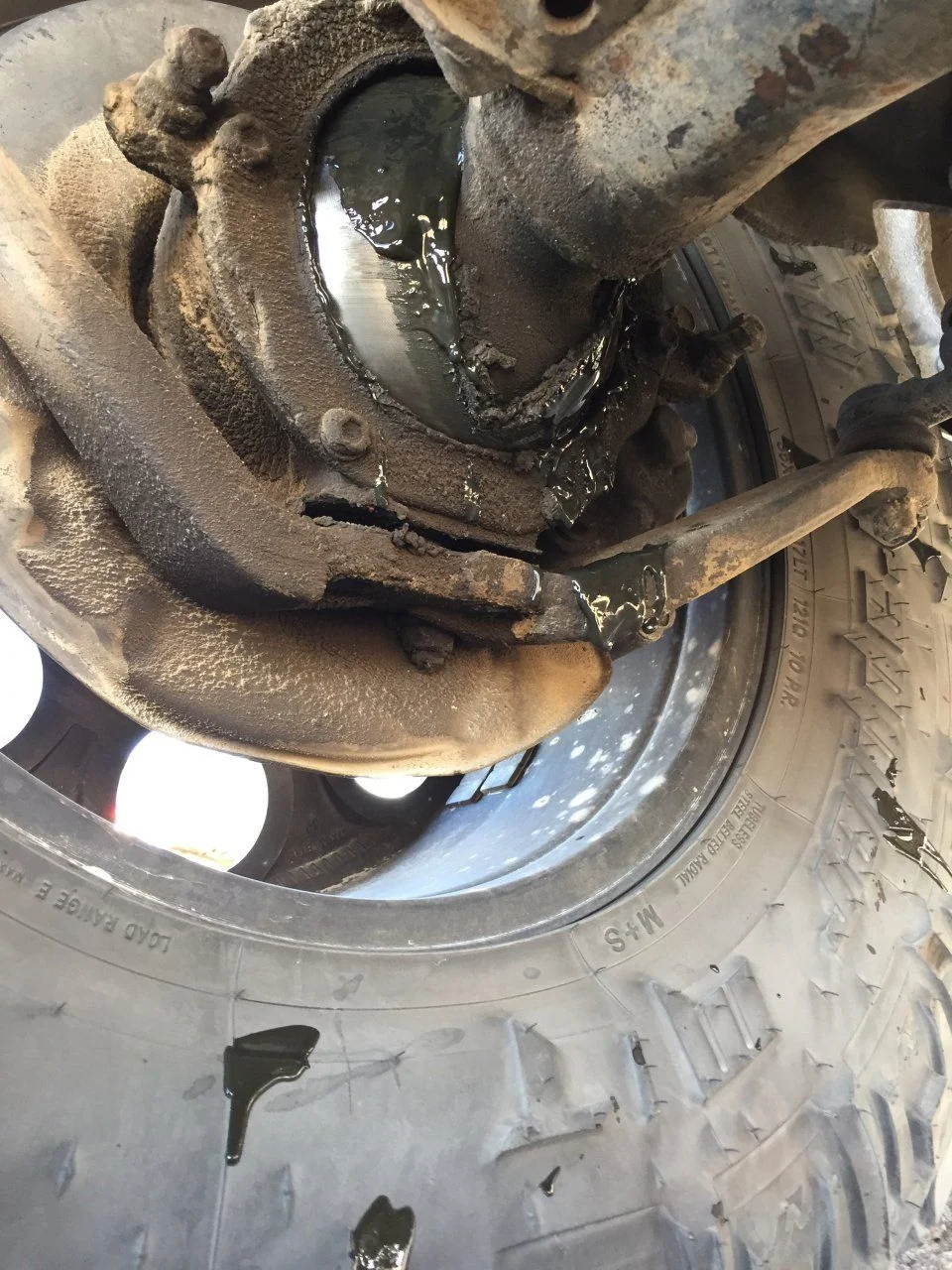

image.webp


Just before getting on a 140 mile drive home with my two boys and wifie I noticed a little grease on the inside of the tire. After a quick inspection noticed the steering arm basically hanging by one damaged stud and bolt. Three of them missing and looks like half the studs are still inside.

Even though it took about nine hours to get us on a tow truck and home from the trail, I feel lucky to have noticed before something really bad happened and that we had phone signal. Specially because it is so spotty in the area and it was getting dark.


Anyway, why would this have happened and what recommendations regarding getting it fixed, possibly upgraded and while we are there what to replace besides bearings studs and grease seals.
What to check for possible collateral damage and why would it have started to blow grease (although it was good becaus that's what made me look)

Thanks in advanced
 
Glad you saw this :eek:. I don't think anyone could be happier with birf soup than you! This has come up twice in the last 6 weeks or so. I think the consensus last time was to lock-tite it.
 
Either the studs weren't torqued or the nuts weren't. I read in a recent issue of TLCA that all 80 owners should carry a set of knuckle studs, cones and nuts in their rig. For this exact reason. Glad you caught it when you did.
 
It seems to be happening more & more. When I do my front axle seals, I WILL be using loctite & torqueing properly. Scary deal.
 
I think the issue is that these studs and nuts also set pre-load on the knuckle bearings. If they start to fail, the joint gets loose and a lot of forces are put on the studs that would not normally be there, they are sideloaded instead of in tension once that happens. When mine was letting go, the bearings on the knuckles on that side were flattened, crushed and pitted. I was down to one stud and nut just like this one and got the birf soup. Don't ignore the soup!

The new studs got loctite and a good torque setting. I'm still not sure that will prevent failure if the bearings let go though.
 
It seems to be happening more & more. When I do my front axle seals, I WILL be using loctite & torqueing properly. Scary deal.

How is that done exactly? I mean, using Loctite lowers the required torque by an unknown amount, so you run the risk of yielding the studs, which just makes the problem worse... I don't want to sound like a d!ck, I just don't think Loctite is the solution. Some guy spent a lot of time calculating and testing the torque in the FSM for a reason; so it doesn't come loose. When you run larger than 31" tires you change the load inputs to those studs and you should check them often.

I believe the best solution is to check the steering arm nuts before and after every wheeling trip or every 5,000 miles whichever comes first. This is a basic maintenance item.

I set the studs with loctite and torqued the nuts dry. I did not want any loctite in the cone washers.
 
How is that done exactly? I mean, using Loctite lowers the required torque by an unknown amount, so you run the risk of yielding the studs, which just makes the problem worse... I don't want to sound like a d!ck, I just don't think Loctite is the solution. Some guy spent a lot of time calculating and testing the torque in the FSM for a reason; so it doesn't come loose. When you run larger than 31" tires you change the load inputs to those studs and you should check them often.

I believe the best solution is to check the steering arm nuts before and after every wheeling trip or every 5,000 miles whichever comes first. This is a basic maintenance item.
Meh. Never seen concrete proof. I truly don't believe loctite makes a big difference in torque settings.
 
I think the issue is that these studs and nuts also set pre-load on the knuckle bearings. If they start to fail, the joint gets loose and a lot of forces are put on the studs that would not normally be there, they are sideloaded instead of in tension once that happens. When mine was letting go, the bearings on the knuckles on that side were flattened, crushed and pitted. I was down to one stud and nut just like this one and got the birf soup. Don't ignore the soup!

The new studs got loctite and a good torque setting. I'm still not sure that will prevent failure if the bearings let go though.

That makes sense. If the bearing starts going out then the side load will affect the studs. I'm my case there was no soup previous to this. There was some old grease but the soup is what alerted me to check. I'm glad it was there now.
 
That makes sense. If the bearing starts going out then the side load will affect the studs. I'm my case there was no soup previous to this. There was some old grease but the soup is what alerted me to check. I'm glad it was there now.

Yeah, mine souped up so bad the truck started smoking from the soup hitting the exhaust. Could smell sulfur burning from the diff oil. I've noticed that most of these seem to be on the passenger side, probably because the extra forces from the other wheel also loading it sideways. Mine had sheared a stud off completely.
 
I learned about this potential disaster after i did my front axle rebuild. I didn't bother checking when I did it but I had a stud loosen up after the job. Had to go back in and I just replaced them with nice Torx studs, cone washers and nuts. If there isn't one yet, in the FAQ for 80 owners there should be a "Check your studs" link. It also could be mentioned in the Front axle rebuild that after disassembly of your knuckle, one should check the lower studs in case one or more came loose when taking off the nuts. Better yet, rebuild kits should just come with a full set. Not an end all fix, but emphasizes the importance.

On top of that, it's always on my pre trip checklist.
 
Last edited:
Yeah, mine souped up so bad the truck started smoking from the soup hitting the exhaust. Could smell sulfur burning from the diff oil. I've noticed that most of these seem to be on the passenger side, probably because the extra forces from the other wheel also loading it sideways. Mine had sheared a stud off completely.

Scary! This one has three sheered off and one stretched out barely holding.

I learned about this potential disaster after i did my front axle rebuild. I didn't bother checking when I did it but I had a stud loosen up after the job. Had to go back in and I just replaced them with nice Torx studs, cone washers and nuts. If there isn't one yet, in the FYI, there should be a "Check your studs" link. It also could be mentioned in the Front axle rebuild that after disassembly of your knuckle, one should check the lower studs in case one or more came loose when taking off the nuts. Better yet, rebuild kits should just come with a full set. Not an end all fix, but emphasizes the importance.

On top of that, it's always on my pre trip checklist.

It definitely should be part of the kit and is now part of my regular pre trip check. What else do you check in the steering system.
 
These threads make me nervous.

Did a little digging into this issue recently and decided that when I install my new birfs and go through the front end I am going to use red loc-tite on the studs where they go into the knuckle. Yes, I'll need heat any time I need to remove them but this should realistically cut down on removal if they don't keep loosening up in the first place..

Thoughts?
 
Easy. The bolts were not torqued properly.

Worn axle seal or worn axle. Mine actually sucks grease into the axle housing. Dont know why.

Your axle is creating vacuum, check your breather.


The OP's problem happens a lot with those who rebuild their own front axles. Proper torque is one thing. but a dot or two of blue locktite makes all the difference. And after a rebuild you should check at 500mi, 1000, mi 2000 mi 5000 mi.
 
These threads make me nervous.

Did a little digging into this issue recently and decided that when I install my new birfs and go through the front end I am going to use red loc-tite on the studs where they go into the knuckle. Yes, I'll need heat any time I need to remove them but this should realistically cut down on removal if they don't keep loosening up in the first place..

Thoughts?

They shear off in some cases (like mine). With red loctite, won't be easy to get the remains out.
 
Nothing wrong with using a bit of loctite on the replacement studs when you install them an do them up man tight.
Not so sure about using it when rebuilding the knuckle.
Would strongly recommend using the correct torque settings and checking 500 miles later to be sure nothing is loose.

I have done several rebuilds in the last 200k kms on my truck with no problems so far.
Hope this doesn't jinx me.
 
In the faq it mentions hitting the arm with a hammer after torquing up and then retorquing. I tried this on the weekend when doing a knuckle rebuild on a friends 105 and got about another 1/8th of a turn on each nut.
 
Back
Top Bottom