Serious safety issue! -Master cylinder mods

This site may earn a commission from merchant affiliate
links, including eBay, Amazon, Skimlinks, and others.

The residual valves for the NA 4wheel drum spec hold a higher residual pressure than the ones for disc brakes. Disc brakes do not have the same spring mechanisim that drum brakes and therefore do not push back as hard. The 10lb valves can, not always, cause issues with disc brakes not returning to rest due to line pressure remaining too high. You can either remove the one for the circuit that runs disc brakes (NOT THE DRUMS!) without problem. A 2lb valve is available to replicate for discs what the 10lb valve does for drums.

At least that's what I have read.

I know what you're saying. -Perhaps the NA spec mastercylinders have "valves" that do indeed maintain a "residual pressure" in the brake lines.

But mine don't/can't. So my valves can't be assigned any "pressure rating" at all. (They are not 1 psi, 2 psi, 5 psi or anything like that.)
 
I'm trying to alert anyone who may have thrown away the same type of valves

see, you are making the wrong assumption here - I would never throw anything away that came out of my cruiser ;p
 
about the plastic ones .i think it is the same principal as the ones you have, the plastic part has 4 holes thought it then a little spring holding a metal disc to it that has one hole in it . it just doesn't have the big spring .i think, can't remember if there was the big spring in there . flows more one way than the other .
 
However if you were to be driving a vehicle with a mastercylinder like mine where the "toyota valves" have been removed with the same level of air contamination, you would never ever ever ever (enough evers?) achieve the "pedal pressure" and "braking force" result you would be desperately striving to get.

This is where you went wrong..

Even in a brake system that has no residual valves in it "pumping" the brakes to aleviate air issues works fine.
 
see, you are making the wrong assumption here - I would never throw anything away that came out of my cruiser ;p

Don't get me wrong DSTRDR. It's quite possible no-one has made the mistake I refer to (ie -of throwing away the same type of valves that I have found fitted to my mastercylinder).

I just think it is wise for me (as a friendly/helpful fellow MUD-member) to issue a "warning" based on what I've discovered and based on the feedback I'm getting.

Better safe than sorry as they say!
 
about the plastic ones .i think it is the same principal as the ones you have, the plastic part has 4 holes thought it then a little spring holding a metal disc to it that has one hole in it . it just doesn't have the big spring .i think, can't remember if there was the big spring in there . flows more one way than the other .

Certainly sounds like this type may not leave any residual pressure in the brake lines either. (Obviously if they have a straight-through hole that never gets blocked - then they can't leave any residual pressure.)

Perhaps the brake problems people have had (if any) with "my type" of valve was caused by "crud" blocking that vital hole? I certainly had a lot of crud around mine (and I doubt anyone is more finnicky than me regarding brake fluid cleanliness/changing).

:cheers:
 
This is where you went wrong..

Even in a brake system that has no residual valves in it "pumping" the brakes to aleviate air issues works fine.

Thanks Mace. I already suspected that someone with "minor air contamination" may well succeed with "pumping the brakes" even with the "valve thingies" removed. And what you say proves this. (I got carried away with my earlier post of "never ever ever ever achieving pedal pressure". Forgive me.)

However, the "valve thingies" ensure there are FIVE different outflow paths but only ONE inflow path. This ensures your "pedal pumping" activity will be MUCH more effective at getting fluid/air into the brake lines (to build up pressure there).

Without the "valve thingies", every time your panic-driven right foot is on its upstroke, much more of your previous downstroke efforts will be lost by fluid/air returning (relatively unhindered) to the reservoir.
 
Last edited:
drum drum vs disc drum

http://www.hotrodheaven.com/tech/brakes/brakes.htm


Could your valves could be metering valves? have a look at the link and tell us what you think ---they make sure the rear brakes engage first in a dis/drum combo

This link does a good job of explaining what is needed for a drum disc, disc disc, or drum drum sys an so on

the residual valves are different for all these combinations as well as the master cylinders--don't just convert to discs and use a drum master cylinder!

residual valves are usualy 10 lbs for drum and 2 for disc so i you changed to front discs w/ changing the residual valve you would be dragging the front brakes all the time--maybe not all that noticeably

bottom line is make sure the whole system is designed to work together.

you may have done something different and it works ok--working ok is not meeting the designed safety standards for the system, it might seem alright but is it?

This is a good post might not be a bad idea to have a safety forum-some things we do are known comprimises but there should not be any unknown comprimises if you know what I mean

This post is not specifically for the original topic but I thought the web link and info might be good for anyone looking to do brake mods
 
Thanks bsmith. I had a quick look at that site. Lots of interesting stuff there. (Must spend more time on it.)

Could your valves could be metering valves?

I don't think so. Only because the front and rear valves are identical.

(I'm getting well out of my depth here but I suspect any "proportioning" is done simply by having "8 pistons with BIG drums on the front" and just "4 pistons with much smaller drums on the back".)

---they make sure the rear brakes engage first in a dis/drum combo

Ah well -- Which end gets the fluid first (if any) is beyond me. But since my front and rear valves are identical - I don't think they can influence this.


I thought the web link and info might be good for anyone looking to do brake mods

I agree.

My summary: In my Toyota manual, they call my valves "check valves" but I have discovered they are neither true check valves (because they allow flow in BOTH directions) nor "residual valves" (because they don't LEAVE residual pressure). I've just given my theory on why I think they are there - based on how they are designed and on how that design would affect the flow of brake fluid.
 
do you have a photo of the valve you are concerned about?

the little white/black dealio in this pic is what I removed from mine...in 2002...

residvalve.jpg
 
do you have a photo of the valve you are concerned about?

the little white/black dealio in this pic is what I removed from mine...in 2002...

residvalve.jpg


Those same valves were in my 78 with disk/drum. If you look really close (almost need a magnifing glass) you can make out a 2 or 6. The 2 was in the front (disk) and the 6 in the rear (drum). When I converted to rear disks, I put a 2 from an older master in place of the 6. As I understand the system, there is residual pressure in the lines to help balance the ratio of braking front to rear. along with a proportioning valve. Since disk brakes have no adjustments some pressure in the line is needed to keep the cups from being pushed all the way back into the caliper. There is always a slight amount of drag on disk brakes. The #2 valve hold the pad just off the disk. The #6 applies to much pressure and the friction causes overheated disks on the rear.
 
do you have a photo of the valve you are concerned about?

the little white/black dealio in this pic is what I removed from mine...in 2002...

There is a photo earlier in this post showing my "valve" . It looks markedly different to yours but MAY operate the same. (I can't tell how yours works without seeing more internal details or how it was mounted in your housing.)

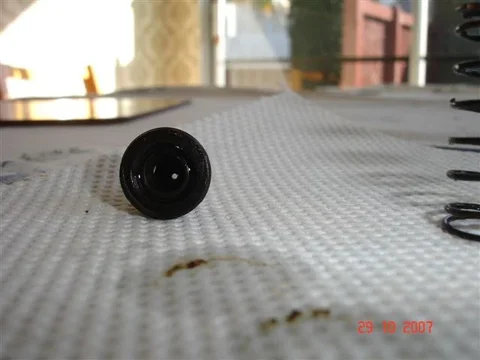
Here is another photo that clearly shows the hole in mine that allows in/out flow to occur ALL-THE-TIME (which means it can't leave RESIDUAL pressure).

MainBleedHole.webp
MainBleedHole.webp
 
as to removing the valves, i've done multiple disc conversions and never had a problem locking up the tires without the valves there. i don't see a safety issue.

and yes, if you don't remove them, they will lock up the discs...ask me how long it took me to figure that one out when i coverted magoo and forgot to pull the valve:doh:

x2000

I bought a new factory MC for a '78 from Toyota and it took me months to figure out that it had 10lb valves front and rear. I took out the front one. Now my brakes work great. I'd test a 2lb valve if I had one around when I was rebleeding for any reason.
 
Since disk brakes have no adjustments some pressure in the line is needed to keep the cups from being pushed all the way back into the caliper.

This is where I get lost. What force is present to push the calliper pistons way back into their cylinders? I can't see any.

There are "spring clips" but they just encourage the pistons to go back a millimetre or two at most. Also if disc warpage/runout is present (which it shouldn't be), that too would make them go back a tiny bit. But what else is there?

I thought that was one of the main advantages of disc brakes over drum brakes. (No need for "adjusters" to hold the pads close to the moving brake surface.)
 
This is such a fun looking discussion I thought that I'd have a go at it. :grinpimp:

Just curious where everyone thinks the returning force is coming from for the calipers? I can think of only one main force that would apply to our 40's.

The rotor run-out will push the pads/pistons back till they just touch at the high points. I don't know of any significant springs in the system trying to push the pistons back beyond this point. Now some may argue that there's a small vacuum created in hydraulic system as the master cylinder piston returns, or there is some small thermal expansion in the hydraulic system. I could see those as being a reason for using the 2psi residual valves.

So there we go, my personal opinion. What do you guys think?

Jeff :popcorn:
 
Last edited:
This is such a fun looking discussion I thought that I'd have a go at it. :grinpimp:

Just curious where everyone thinks the returning force is coming from for the calipers? I can think of only one main force that would apply to our 40's.

The rotor run-out will push the pads/pistons back till they just touch at the high points. I don't know of any significant springs in the system trying to push the pistons back beyond this point. Now some may argue that there's a small vacuum created in hydraulic system as the master cylinder piston returns, or there is some small thermal expansion in the hydraulic system. I could see those as being a reason for using the 2psi residual valves.

So there we go, my personal opinion. What do you guys think?

Jeff :popcorn:

Gosh! Music to my ears!!!! We must have been typing away together on this Jeffery.
 
Well, sometimes I get something right. At least partly! :doh:

Jeff
 
Well, sometimes I get something right. At least partly! :doh:

Jeff

The distinction between right and wrong has always been rather blurry for me Jeff :)!
 
Summary:

lostmarbles makes the point that removal of the residual valve from the master cylinder might make stopping under brake failure conditions more difficult.
Example: Let's say that you puncture a soft front brake line. If you knew the line was punctured you wouldn't drive until you fixed it. But you don't know it's punctured . . .yet. Then, you try to stop for the children crossing the street at the bus stop, but the pedal goes soft because your brake fluid is being squirted out the puncture hole. So you pump the pedal extra times to pressurize the system. Pumping might give you just enough hydraulic pressure to save your life (or someone else's in this example), perhaps by making just one stop.​

I don't know what Toyota's intent was when it put the valve in the MC, but lostmarbles' point is that it takes more pumping to pressurize the system without the check valve than it does with a check valve, regardless of how "big" the valve is. Thus, he concludes, it is more dangerous to have a MC without valves because you'll have to pump more in the emergency situation that all of us hope never to encounter. It makes sense.

Personally, I removed the valve when I did my FDB conversion years ago. We've all been conditioned to do this because it's part of Cruiser Modification Lore. Everything has been fine, but then I've never been in an emergency situation with failing hydraulics. So I'll monitor the system, fluid levels, etc. a little more carefully now. And next time I do a complete fluid change, I'll look for a replacement valve to re-install.
 
"There are "spring clips" but they just encourage the pistons to go back a millimetre or two at most."

Yes there are spring clips that do just that, except as the pad wears down those clips will encourage the piston to go back to the non worn position, increasing the gap between the disk and pad. and the brake pedal gets lower and lower, till you feel a need to pump the brakes
 
Back
Top Bottom