how do I extend the frame and keep it straight?

This site may earn a commission from merchant affiliate
links, including eBay, Amazon, Skimlinks, and others.

Joined
Sep 5, 2007
Threads
460
Messages
12,546
Location
lenexa, ks
Well, how the heck do I do this? Working in a cement floor garage, not perfectly flat, but i figure flat enough over 12".

Here is my thought.
1. Put it on the ground with 4 equal tires at same tire pressure.
2. Chock the front wheels so they don't move.
3. Make a temporary "jack" that is heavy square tube cut to fit between floor and frame just in front of the cut spot, weld in place.
4. cut the frame as planned,
5. move rear section back the desired length -- measure both sides to be same additional length between two fixed points on frame not near cut.
6. sleeve and weld on new section


Any measurements I should be taking before or after to make sure that it is straight?
 
Extending an 80 series about 12". Making a truck out of an 80. We call it the UTE project. Need a longer wheelbase, so extending is not an option.

Thread.

Father, Son, and the Unholy UTE

Here is wheelbase stock after one of these conversions.

images.webp


Here it is extended.
extra-cabs-09.webp
 
Here is how @Waggoner5 shortened his 60 project.

I plan to add a section right where the rear LCA mount is. That is actually where the frame has a junction point anyway. Plan to cut that mount out (it will act like fish plate afterwards), then add the section there. It is almost parallel with the car there, with very little taper.


IMAG0092.webp
IMAG0090.webp
IMAG0091.webp
 
Here is some crazy Auzzie thing....

However, this is the company that does all sorts of LC conversions. Crazy work done on brand new 200 series rigs!

lazy-axle-05.webp
 
4 sets of jack stands to get the whole thing off the ground supported under the frame and the frame alone. Use plywood under the Jack stands for fine tuning to get it level side to side and front to rear. Once this is achieved, define the cut line. Mark the garage floor 12" rearward of your rear 2 sets of jack stands mark the jack stands to the frame. Then remove the forward most set and place them under the frame at that 12" mark and whim them until tight and check for level. Then it's a matter of cutting the frame and moving the rear section back to the jack stands at the 12" mark, measure the gap on both sides and level up the rear section...make sure when you level it all out that you're using the frame and mark the frame and level so you can get the level from the same spots. Or do it be less complicate way. Cut each frame rail measure 12" apart insert your new scanner piece and take 6 or so 24" sections of heavy angle iron, tack them to the bottom, top and outside of the frame rail and everything should line up.
 
Sounds like I need a better level. mine will not be that precise.
 
Sounds like I need a better level. mine will not be that precise.
Did you just say you need to go buy a sweet new digital level for a project? I concur and if the old lady gives you crap you just tell her if she has a problem with it she can come talk to me lol.
 
80-frame1.jpg


If you can cut it in a section that is parallel it will be simplest
Looks like about where the LCA bracket is.
I'd remove the bracket and reattach later if it made it possible to cut the frame where it's parallel.
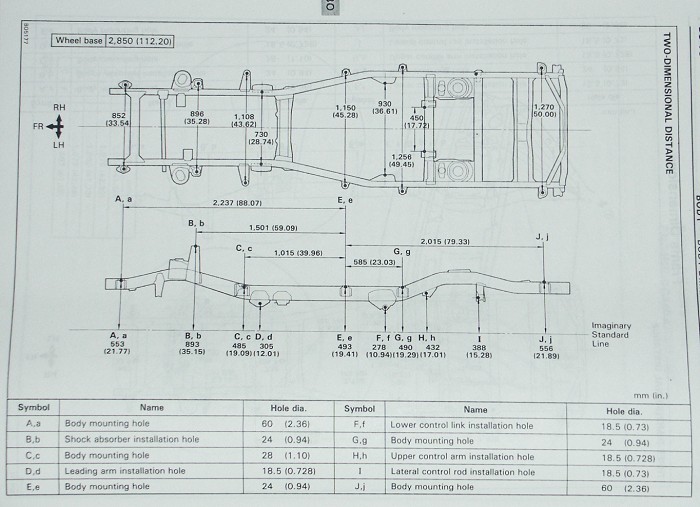
When you put it back together, measure between points on the chassis that you know are the same to be sure you get both rails extended the same amount. Say from point C to G on the diagram above
Also make some diagonal measurements from points on the chassis to be sure you have the frame square and straight again.
Point C to G diagonally.
You can also measure from a baseline up to various points to check you have the chassis straight horizontally as well.
If your floor is not flat you could use some string lines to create a horizontal baseline to measure to.

I'd also tack a bit of tube, or angle between the left and right chassis rail both forward and rearward of where you cut the rails to stop the rails from springing when you cut them
 
Do you know anybody with a theodolite?
Really? That's a little much, he's not building the grand Cooley, a sky scraper, infrastructure or a house even...it's just a frame lengthening people! Lol. But seriously wouldn't that perfect for surveying and marking up your garage floor
 
How about a rotating laser level like used for hanging false ceilings.

The fabrication shops I work with either build a "flat table" that they level and square within a few thousandths or they raise everything off the floor and shim to level, then work from fixed points, but you do NOT move your support points once started.

Basically like @mudgudgeon stated. Choose where you want to section first. Much planning will save future headaches. Definitely weld in cross and diagonal supports BEFORE cutting it apart. All frames have "locked in heat stress" from welding unless they have been annealed after the welding process, but that is counter productive for the strength of frames.

As soon as you cut, it will want to spring out of shape, so brace on both sides of where you plan to make your cuts.

Good luck! What a tremendous undertaking!
 
Really? That's a little much, he's not building the grand Cooley, a sky scraper, infrastructure or a house even...it's just a frame lengthening people! Lol. But seriously wouldn't that perfect for surveying and marking up your garage floor

Not overkill if you know someone that has one and can use it for free. All it does is help you measure angles along horizontal and vertical planes eliminating the need for a perfectly level table or an expensive level. Tac your pieces in place, check with the theodolite, adjust as necessary - finished in minutes.
 
80-frame1.jpg


If you can cut it in a section that is parallel it will be simplest
Looks like about where the LCA bracket is.
I'd remove the bracket and reattach later if it made it possible to cut the frame where it's parallel.
When you put it back together, measure between points on the chassis that you know are the same to be sure you get both rails extended the same amount. Say from point C to G on the diagram above
Also make some diagonal measurements from points on the chassis to be sure you have the frame square and straight again.
Point C to G diagonally.
You can also measure from a baseline up to various points to check you have the chassis straight horizontally as well.
If your floor is not flat you could use some string lines to create a horizontal baseline to measure to.

I'd also tack a bit of tube, or angle between the left and right chassis rail both forward and rearward of where you cut the rails to stop the rails from springing when you cut them

Amazing bits of information. I am continually humbled by the giving nature of this community.

Thanks!
 
I am thinking this is getting too technical for me with the engineers stuff. I have tried to level a pool table before, it is very difficult to perfectly level a large surface like this. Once I cut it in half, I will have 4 more points to level. I wonder if I am overthinking this. I keep looking at videos like this...

about 2:20 on this video


not as much detail on this one.


Anyway, note that there is not fancy frame table, just pretty simple cut roll and splice. The post above from @mudgudgeon got me thinking about using string to measure at four points above a string line , see orange lines below before and after to make sure she is straight. This done not help for a twist, so I would have to first level the car side to side.

Thoughts?


80-frame1.webp
 
I think you are on the right track.
I welded 2-55 frames together to make the wheel base 118" and had good results. I used a center punch to mark the spots for measurements before I cut the frames. Garage floor tape measure and plum bob along with a long level and dial degree wheel. When you do your welding go slow so you don't pull the rails in wrong directions going side to side. After I finished I took it to a frame shop and in most spots it was only 2 mm out with one rear corner at 6mm. The guy said I did a great job most frames are a max upper limit of 6mm. Which is about 1/4" over the length of the frame. If you take your time and constantly measure and cross measure your progress while you are welding you can get it dead on. Again weld slow meaning short beads and let it cool as you go. Plenty of tacks to hold it in place is a must. Good luck
 
@2fpower their situatuion is an easy one, they use a drive on service lift which is one large flat surface to work on. That's why I was suggesting using the jack stand, level and shim method to level out your garage and make things a little easier in the long run. It not highly technical as much as time consuming, but then again, the frame extending process can be.
 
@2fpower their situatuion is an easy one, they use a drive on service lift which is one large flat surface to work on. That's why I was suggesting using the jack stand, level and shim method to level out your garage and make things a little easier in the long run. It not highly technical as much as time consuming, but then again, the frame extending process can be.

Sorry, I did not mean to discount your thoughts at all. I have tried to level things similar to this before and it is not as easy as it sounds. I get your point..... just don't like what I think it will take to apply the theory.
 
Just go for it! Wing it. Calibrate with BFH if it doesn't come out exactly perfect.

I've already said I think having a buddy bring a theodolite will be the easiest, cheapest, fastest way to do it, but the human eye easily detects variations down to 1/8 of an inch. So just go for it! What's the worst that could happen?
 
Back
Top Bottom