

Navigation
Install the app
How to install the app on iOS
Follow along with the video below to see how to install our site as a web app on your home screen.
Note: This feature may not be available in some browsers.
More options
Style variation
You are using an out of date browser. It may not display this or other websites correctly.
You should upgrade or use an alternative browser.
You should upgrade or use an alternative browser.
fuse on the ammeter circuit
- Thread starter texfj40
- Start date
This site may earn a commission from merchant affiliate
links, including eBay, Amazon, Skimlinks, and others.


- Joined
- Jan 5, 2004
- Threads
- 143
- Messages
- 6,764
- Location
- Paint Lick, KY
- Website
- www.globalsoftware-inc.com
Welcome to MUD!
What year FJ40?
What year FJ40?
- Joined
- Jan 5, 2004
- Threads
- 143
- Messages
- 6,764
- Location
- Paint Lick, KY
- Website
- www.globalsoftware-inc.com
Between the alternator B+ terminal and the WL cable would be a great place.
You could also put it between the battery cable and the W wire at the starter.
Instead of a fuse consider a resettable Circuit breaker.
Waytek Wire carries the Hi-Amp brand of circuit breakers in many different amp ratings.
These breakers have stud mounts for the wires making it super simple to install since the WL and W wires terminate in ring terminals. If the breaker kicks, you simple reset it instead of having to replace a fuse. You can also manually open the circuit when you need to pull the dash cluster out.


A fusible link on the main power line from the battery would be a good idea. An amp capacity equal to the sum total of the fuses in the fuse box would be a good estimate of the rating. I'm not sure that a circuit breaker on the alternator would do much more than a fusible link would. The chances of the stock alternator putting out more power than the wiring can handle seems remote.
- Joined
- Jan 5, 2004
- Threads
- 143
- Messages
- 6,764
- Location
- Paint Lick, KY
- Website
- www.globalsoftware-inc.com
Thanks Coolerman...your schematic sites are terrific! Thank you. What amp rating would you suggest?
Thanks again
Disclaimer: The odds of a short developing in a properly taped and tied down OEM functional and non hacked up harness are small. However if you have a PO hacked up harness, have experienced a harness melt down, or are just a bit anal about wiring protection read on!
The power distribution in an early FJ40 harness is a little more complicated than it first appears. The OEM harness has a WL 10 ga wire coming from the alternator to a multi-wire splice right in the middle of the harness under the dash. From this splice there are four wires :
A 14ga BR wire to the key switch then on to the switched side of the fuse box.
A 12ga WL wire to the un-switched side of the fuse box.
A 16ga GR wire to a separate in-line fuse then on to the Hazard switch.
A 10 ga WL wire that continues on to the AMP gauge.
Of these four wires only the GR Hazard switch wire is protected with a fuse.
A direct short anywhere in ANY of the other three wires or on the supply side of the GR wire will result in smoke and a lot of it! In addition a lot of other wires around the shorted wire will be severely damaged.
To properly protect these wires, ideally you would install three breakers, or fuses or fusible links to completely protect the power distribution wiring:
One 40 amp (mounted close to the alternator) in the WL wire between the alternator and the amp gauge. (Like when a wrench accidentally hits the B+ terminal and welds itself to it.
) One 40 amp in between the W starter/battery terminal and the amp gauge, for the same reason as above.
One 30 amp in the BR wire between the splice and the key switch. (I know this is a 14ga wire but it is only about 2' long so can carry a lot of current before it overheats)
One other circuit that one should put a fuse in is the + hot wire to the ignition coil close to the harness splice. The fuse size would be 10 amps.
Doing all of that would be a lot of work but it would protect all the power circuits on the early Cruisers.

This has been your Cruiser Electrical lesson for the day.
I now return you to your regularly scheduled forum.

Cooler man - - I am trying to get the ghost out of my AM circuit. I am pretty sure my WL from splice to Fuse is burned up.
Below is a quick sketch of the ignition circuit. (note: color in box outside of wire line indicates wire color used on my FJ -- just to make sense of this mess) This is based on the the diagram in the "1958-7-70_body_chassis_manual.PDF"
I am showing a dotted line where PO put a wire from Switch (AM post) to Fuse Block, on my vehicle. Is this correct?
Questions:
1) You say "A 14ga BR wire to the key switch then on to the switched side of the fuse box". The diagram and chart in the above mentioned .PDF do not have this.
2) Do I have switched and Un Switched side of Fuse box label correctly in my diagram below?
I plan to rebuild the AM circuit portion with WL (10 gau.), WL (12 gau.), and BR (14 gau.), also add the circuit breakers you suggest.
Thanks for you post, this has been a huge help! My FJ starts, but then dies as soon as I let go of the key. I plan to layer this new AM circuit on top of old and test. I am just unsure of where BR wire connect to fuse block.
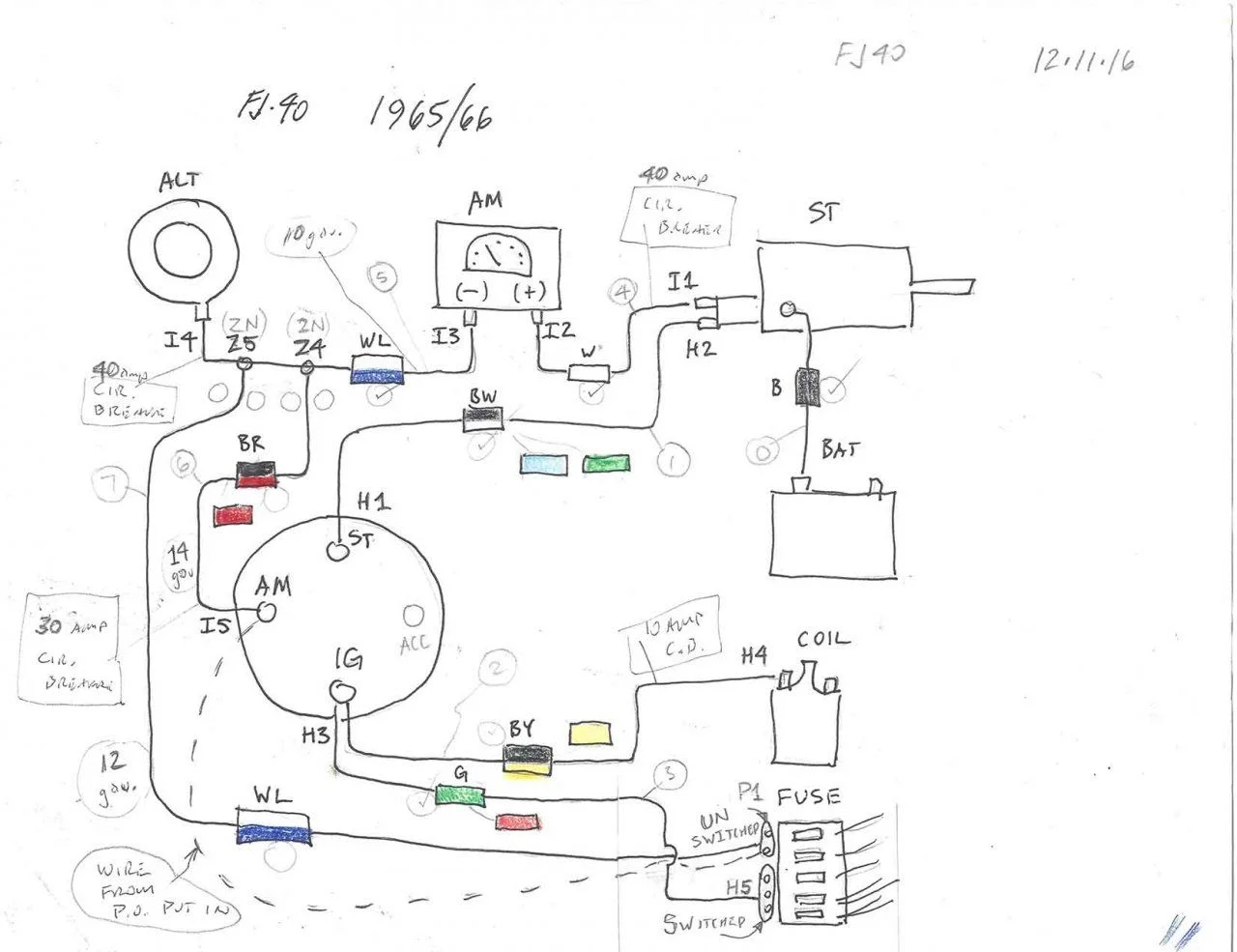
Below is a quick sketch of the ignition circuit. (note: color in box outside of wire line indicates wire color used on my FJ -- just to make sense of this mess) This is based on the the diagram in the "1958-7-70_body_chassis_manual.PDF"
I am showing a dotted line where PO put a wire from Switch (AM post) to Fuse Block, on my vehicle. Is this correct?
Questions:
1) You say "A 14ga BR wire to the key switch then on to the switched side of the fuse box". The diagram and chart in the above mentioned .PDF do not have this.
2) Do I have switched and Un Switched side of Fuse box label correctly in my diagram below?
I plan to rebuild the AM circuit portion with WL (10 gau.), WL (12 gau.), and BR (14 gau.), also add the circuit breakers you suggest.
Thanks for you post, this has been a huge help! My FJ starts, but then dies as soon as I let go of the key. I plan to layer this new AM circuit on top of old and test. I am just unsure of where BR wire connect to fuse block.
My FJ starts, but then dies as soon as I let go of the key. I plan to layer this new AM circuit on top of old and test. I am just unsure of where BR wire connect to fuse block.
It an FJ40; not an FJ Cruiser.
If it dies when you let off the key, this is typically due to a bad / open ballast resistor.
It an FJ40; not an FJ Cruiser.
If it dies when you let off the key, this is typically due to a bad / open ballast resistor.
----
It is a '65/'66, it had a external US made resistor mounted on the firewall when I acquired it. When I replaced the coil I went with an internal resistor. Might the swap to internal resister be the cause for the 'Start, then Dies, when the key is let go'? Can the 1F engine be run on a coil with an internal resistor? Could/should I put the old resistor back in line with my new internal resistor coil?
If you used the wrong wire for the ignition wire it would still die when you let off the key. You want the wire that is hot with the key on. In later years, this is a larger gauge black wire with a yellow stripe. It is not fused. It is the one that originally attached to the ballast resistor and not the coil.
Pin_Head, Yes, the BY wire is 'hot' when switch in ON position (and starts, but does not stay on).
I'll try to run the BY wire (currently wired to Coil + side) into Ballast Resistor. Then a 12 gauge wire from other lead on Ballast Resistor to Coil + side. My coil already has an Internal Resistor--any idea if something will get weird-ed out?
I will try this and let you know what I find out. Thanks
You only need the one BY wire that is hot when the key is on. If it won't run with this wire hooked up maybe the key switch is bad.
You don't run a ballast resistor with a non-ballast coil. It may not run at all.
Cruisers that had a ballast resistor had another, smaller BY wire that runs from the starter solenoid that is only hot during engine cranking. If you had a ballast resistor and its corresponding coil, this wire would hook up directly to the coil + lug.
The only point of the ballast resistor set up is to improve cold weather starting.
- Joined
- Jan 5, 2004
- Threads
- 143
- Messages
- 6,764
- Location
- Paint Lick, KY
- Website
- www.globalsoftware-inc.com
Your diagram is spot on!
The PO may have installed that wire to bypass the bad WL wire. However that means the BR wire is now carrying ALL the current for the un-switched fuses AND the switched fuses. That is a fire just waiting to happen!
You plan to replace the whole AM circuit so you will get rid of that mess.
The comment I made stating the BR wire goes to key switch then on to fuse block meant that the BR wire goes to the AM terminal on the key switch, then comes out of the key switch on the IG terminal, and on to the switched side of the fuse block.
Here is the always on power wiring on a 69-71 FJ40

Do not run a ballast resistor if your coil has an internal resistor. That would drop the voltage at the coil to about 5 volts! I agree that the key switch may be bad unless of course you have the coil tied to the ST not the IG terminal. IG should remain hot with the key in the on position.
The PO may have installed that wire to bypass the bad WL wire. However that means the BR wire is now carrying ALL the current for the un-switched fuses AND the switched fuses. That is a fire just waiting to happen!
You plan to replace the whole AM circuit so you will get rid of that mess.
The comment I made stating the BR wire goes to key switch then on to fuse block meant that the BR wire goes to the AM terminal on the key switch, then comes out of the key switch on the IG terminal, and on to the switched side of the fuse block.
Here is the always on power wiring on a 69-71 FJ40
Do not run a ballast resistor if your coil has an internal resistor. That would drop the voltage at the coil to about 5 volts! I agree that the key switch may be bad unless of course you have the coil tied to the ST not the IG terminal.
IG should remain hot with the key in the on position.You only need the one BY wire that is hot when the key is on. If it won't run with this wire hooked up maybe the key switch is bad.
You don't run a ballast resistor with a non-ballast coil. It may not run at all.
Cruisers that had a ballast resistor had another, smaller BY wire that runs from the starter solenoid that is only hot during engine cranking. If you had a ballast resistor and its corresponding coil, this wire would hook up directly to the coil + lug.
The only point of the ballast resistor set up is to improve cold weather starting.
--------------
Too late, I tried adding the Ballast Resistor, to my coil which already had an Internal Resistor in the coil. Again it Started, Ran, the died. Plus I got SMOKE at the Ballast Resistor. See my post at
I bought a 1966 (6/65) FJ40L 'parts car' to restore
Your diagram is spot on!
The PO may have installed that wire to bypass the bad WL wire. However that means the BR wire is now carrying ALL the current for the un-switched fuses AND the switched fuses. That is a fire just waiting to happen!
You plan to replace the whole AM circuit so you will get rid of that mess.
The comment I made stating the BR wire goes to key switch then on to fuse block meant that the BR wire goes to the AM terminal on the key switch, then comes out of the key switch on the IG terminal, and on to the switched side of the fuse block.
Here is the always on power wiring on a 69-71 FJ40View attachment 1376796
Do not run a ballast resistor if your coil has an internal resistor. That would drop the voltage at the coil to about 5 volts! I agree that the key switch may be bad unless of course you have the coil tied to the ST not the IG terminal.
I think my volts dropped to 1.7 or 1.8. Weird but it did start, run & die.
Thanks Coolerman, I appreciate the diagram. Let me study it, as I am all thumb when is come to electrical. BTW I did replace the entire AM circuit, (I am happy it worked!!) and again same issue...Started, Ran, Died when key released. Plus I had Ballastic Resistor and Internal Resistor in line when I fired it up....got SMOKE at the Ballast Resistor. I'll have check if it is toast...what should ohms read? I did put in the circuit breakers you had mentioned, so may have saved my arse, don't know. I had a question on those Circuit Breakers, does it matter which way the BAT post an AUX post are? I think mine where BAT post was closest to AM side. I appreciate your and Pin_head's help!
The ballast resistor results are meaningless, as you don't have the proper circuit. It only indicates that the coil can run at half of the normal voltage. Resistors smoke after they sit and get dust and dirt on them. No big deal.
Either you have the coil inappropriately wired to the ST post of the key switch (This would be more likely if it always cuts out with the starter motor)
Or
There is some strange problem with the ignition switch that it loses contact when you let up on the starter. (Less likely)
Either you have the coil inappropriately wired to the ST post of the key switch (This would be more likely if it always cuts out with the starter motor)
Or
There is some strange problem with the ignition switch that it loses contact when you let up on the starter. (Less likely)