Charging system issues

This site may earn a commission from merchant affiliate
links, including eBay, Amazon, Skimlinks, and others.

Pin Head,

In the passed i have always had at least 14.3volts at my auxiliary battery in the tray which runs our fridge.

I discovered this 'issue' because when running the fridge, even with the engine running i was getting voltages as low as 12.5V at the fridge - again when in the passed its been 14.2.

Couple that with the ammeter bouncing all around the place and into the -ive makes me really believe something is wrong.

.....................

The reason for bypassing the ammeter seems pretty logical, its not acting normal so i thought perhaps it might be 'broken'. The reason for simply removing one wire from one terminal and bolting it up with the other is it is the safest and simplest way of bypassing the ammeter without have a full power active wire 'loose' behind the dash taped up.

Once im sure it is not contributing to the problem i will wire it back up properly.

...................

Our old alternator and even this new one has on many occasions easily powered the vehicle, headlights and spotlights (say 30-35Amps) at 14-14.5volts which i expect. Dropping to 13volts while the engine is running at speed is not ok with a load well within the specs of the alternator.

Monitoring the field wires voltage seems to correlate with whats going on. When it is working 'right' and supplying enough power to run the spotlights at 14+ volts the field wire is "X" volts... When the output seems to be acting up the field wire is a completely different voltage.

tbc
 
Hi Travis,

So far all your readigs are OK. It's what Pin_Head says:
As long as the voltage stays above the battery voltage and the net amp flow is zero or charging the battery most of the time, you are fine. Of course this is at rpm's higher then idle.

What bothers me is this part of your posting:


1st. You said, you saw your running lights flickering, which means to me that your light switch was not fully depressed in the "off" position.
I had my headlights turned on when i noticed this happening - the lights were meant to be on its just looking into the park lights i could see they were flickering, as the ammeter was jumping all over the place.

Maybe you have to check this. Or maybe there is a relay in between which has a bad internal spring so it's living his own life.
2nd. I used two VR's myself. The stock mechanical one and a solid state one. The solid state (from Bosch) was a pure 2 position switch. On / off. Charge / no charge. This caused my Ammeter to jump like crazy. With the stock one I can see a little movement when the battery is fully charged. This is the switching from the VR from full charging to trickle charging.
Here is a video I made for another thread with the Bosch VR. At 1.08 you'll see the idiot behaviour of the Ammeter needle caused by the hard switching of this VR. The Volt meter is connected to the cigarette lighter.
amp_gauge-1.AVI - YouTube
This VR was sold to me as an electronic one so I expected that when Vign goes up, Vfield goes down. Unfortunately that was not the case. While running with the Bosch VR I had time to clean up and adjust the old one and now everyting is fine.
Here is another video about the behaviour of the Ammeter under load when the engine is off.
amp_gauge_2.AVI - YouTube

Is your Ammeter bouncing with the stock or the solid state one? Or both?

Both of my VR's are mechanical types. The old one is a genuine original. The new one is made by NewEra Japan.

I have noticed they both behave differently, and neither behave consistently 'normally' both have done / do on occasion.

The old one tends to show a continuous +ive current draw on the ammeter whenever the engine is running above idle. It does sometimes go into the -ive region of the ammeter, usually once ive been driving and i come to a stop at some traffic lights etc. (Headlights off).

It behaves the same with the old alternator as it does with the new alternator.

The new VR tends to cause the ammeter to jump around a hell of a lot more then the old VR. It is also much more consistent in causing the ammeter to go into the -ive zone during idle.

When the new VR seems to be working well the voltages were more consistent then that from the old VR. It held a continuous voltage level at rev's with no load and then with full load and back to no load, and at idle with no load (voltage remained in the low- mid 14V range IIRC).

Its only done this a few times, and usually when the engine is cold ie. first testing for the day when the car hasnt been driven yet.

Good luck.

Rudi

I spent a good 3 hours late today cleaning the engine bay, it had not been cleaned since our Simpson trip late last year + all the High country trips over Xmas + the Australia Day long weekend trips in late Jan... Long, long overdue! Im hoping the old girl might forgive me now and start behaving ;)

Travis.
 
Rudi, i watched your videos, good videos BTW.

My amp meter does not go anywhere near as crazy as yours does in video 1.

Generally if it is bouncing around it is only within the +ive region of the ammeter. It kind of 'flicks' back and forth. Say yours moves at ie. 10flicks a second, mine would be 2 or 3 in comparison - im just making up a number here to compare how quickly yours moves around the numbers dont actually indicate the number of flicks).

When mine goes into the -ive region of the ammeter it just slowly moves into the -ive zone and stops around the -10Amp mark and remains there until i increase the rev's on the engine.

I still feel like this has to have something to do with the VR.

Am i correct in saying the alternator will produce / push as much power as it can based on the resistance in the circuit. IE, flat battery = low resistance so it will receive everything the alternator will produce.

The amount produced depends on the voltage of the field wire.

If there was something wrong with the B+ wire (as i found one of the plugs had melted) could this potentially alter the resistance seen / felt by the alternator? Same with the ammeter, if it was 'broken' could this alter the resistance seen by the alternator?

If there was some sort of crazy backflow of power through Ground, could this potentially enter the VR maybe heating it up and altering its performance? (BOTH the old and new VR's are quite HOT to touch after driving for 15minutes). I honestly cannot remember how warm, or if the old one used to get warm at all during use.

Travis.
 
Am i correct in saying the alternator will produce / push as much power as it can based on the resistance in the circuit. IE, flat battery = low resistance so it will receive everything the alternator will produce.

The power output depends on the magnetization of the rotor and the speed of the rotor. The mechanical VR has a set of points that switches in a resistor to cut the alternator output when V exceeds the set point. It does not act like a linear variable resistor, but rather switches rapidly in and out to limit the field wire current.

The problem is that at idle speed these old alternators cannot put out enough power to keep the voltage much above the battery voltage if you have a lot of accessories running. You can check the maximum possible power output at idle by applying full battery voltage (temporarily) directly to the F terminal, bypassing the VR. If this V is significantly higher than the V output when the VR is driving the alternator, then there may be a problem with the VR or its wiring circuit. If there is no change, then this rules out the VR as the problem.

If your alternator could maintain 14.5 V at idle while running a refridgerator, then you had a really exceptional alternator. Mine never did that and I never had a problem with it keeping the battery charged for 15 years, but I didn't run a refrigerator. I did do some winching with it and that really drained the battery, but it eventually charged back up.
 
Thanks Pin Head,

Sorry about this, its doing my head in... ive been up till nearly 3am the last few nights just reading about anything potentially related.

Somewhere back in this thread i did exactly what you mentioned here with our OLD alternator.

I jumped the Field terminal at the back of the alternator with the B+ terminal with the engine running at idle.

IIRC the voltage went pretty much straight to 15.6,7,8,9V and continued to climb. We shut the engine off at 16V. Again, engine was at idle. (Thus at the time i deemed the old alternator good.......... but i bought a new one a few days later anyways because the old one was getting pretty old and there was a little play in the bearings so i want to get it rebuilt as a spare.) The new alternator is a re manufactured job in a ND case. Its rated at 55Amp.

With regards to our Fridge, when all of this started the first thing i checked was the Aux battery. Then the fridge itself. Ive benchtested our fridge and monitored its power draw and duty cycles and reasonably accurately calculated it draws 27.XX Amps per 24Hours (however there are lots of variables ie. ambient temp), which i already kinda knew given in the passed we had gotten X amount of time from the Aux battery before it reached 'X' volts (50%) SOC. (Fridge draws around 2Amps running the compressor when the compressor is running, depending on the fridge setting).

Since this stuff has been playing up we were getting not even 1/2 that, and now that ive pinpointed the charging system i can only assume that even through we may say drive for 6,7,8hours a day the fridge was consuming battery power the entire time instead of running off the alternator while at the same time the aux battery receives charge.

I was reading last night about alternator circuit types, 'A' - 'B' - 'I' circuits.
Wondering with regards to backfeeding power via the Ground and into the VR what effect this could have.

I would really like to purchase a little digital DCA clamp meter so i can watch exactly what is coming out of the alternator / and compare that with what we see at the ammeter but im still searching for a reasonable price.

If the ammeter is working perfectly (and im sure that it is) then something has to cause the crazy quick 'surges' in the power output. If one alternator brush was to ground and the ground was receiving backfeed power could this cause the crazy surges??? (Again im getting very sleep deprived so i very may well be talking crap and dont realize it!)

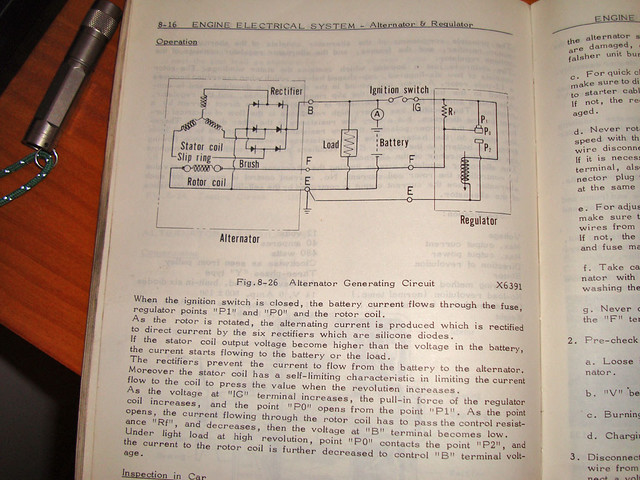
What does the coil with the arrow through it represent in this schematic (in the VR section)?

6851565665_13d42eba97_z.jpg


Travis.
 
I cannot believe it but after disconnecting the ammeter yesterday (purely a coincidence im sure!) but now my starter motor has started acting up.

Basically what is happening is every single time ive started the engine since then the starter motor sounds like it continues to run for 2 or so seconds after ive released the key from the start position. The first couple of times is was more like 0.5seconds additional run time so i wasnt sure it was really acting up but today i was out and had to start the car about 5-6times and now it sounds like its running for a good couple of seconds beyond what it should!

Ive never heard of this happening before, any advice on what i should do???

Travis.
 
Could be the ignition switch. They are cheap and easy to replace. If yours is original, I'd replace it on principle.
In theory it could be a sticky starter solenoid, but they usually stick the other way (they want to stay disengaged, rather than sticking engaged).
 
Hi Ed! Thanks for the replay re: our starter motor.

I had it out of the steering column the other day when i was testing contacts and voltages etc as mentioned earlier in this thread.

I guess it should be as simple as monitoring the trigger wire on the starter motor relay. If it goes dead as soon as the ignition / key is released from the start position then that should rule out the ignition?

Travis.
 
That should be a reasonable test.
But as I said, I think it cost $20. If it's original, I'd spend no time trying to figure out if it is ok.
If it's not broken now, it will be soon at almost 35 years old.
 
I jumped the Field terminal at the back of the alternator with the B+ terminal with the engine running at idle.
IIRC the voltage went pretty much straight to 15.6,7,8,9V and continued to climb. We shut the engine off at 16V. Again, engine was at idle. (

What does the coil with the arrow through it represent in this schematic (in the VR section)?

If the voltage increases significantly when you hot wire the field terminal, then the VR circuit may have too high a resistance or a bad connection. Try hot wiring the Ign terminal of the VR with battery voltage and see if it climbs. If so, then you have a bad connection upstream toward the battery, like the fuse block, ignition switch, fusible link etc. If not then the VR may be bad. It acts like a switch, so when the V is low there should be full voltage to the field winding. When the V rises to the set point, then the points open dropping current to the field.

The coil with arrow in the diagram is a solenoid. It pulls the contact points open to decrease the field current.
 
G'day guys, sorry for the delay in reply.

Basically ive been waiting for my DC Clamp Meter to arrive, and you guessed it - it arrived today!

Over the last week ive continued to monitor what been going on with regards to the battery voltages running, under load and also the field wire voltages with and without loads and when the problem exists.

.........................

I have now reconnected the ammeter. Disconnecting it resulted in zero difference with this intermittent problem.

While away over the last weekend (Deer Stalking trip) i found the following;

Having run our fridge for 24-36hours the auxiliary battery was depleted such that with the engine running there was an obvious load for the alternator (in the passed ive just used turning on the headlights and spotlights to create a load for the alternator).

So i ran the engine at fast idle and everything seemed good.

The ammeter was sitting still around the +20Amp mark and the field wire to the alternator was around 12-13volts. Battery voltage was around the low 14volt mark. (perfect)

Then if i 'bliped' the throttle, the ammeter would drop off to the 0 mark and swing around back and forth a little, Voltage would drop to 13.2V and falling slowly and the field wire voltage dropped to 2-3volts.

I as able to get this to happen pretty consistently, id drop the revs to idle, slowly increase the revs and then all of a sudden everything would come good.

Change the rev's and it would go bad once again. I tried applying different loads etc and sometimes switching on the load would cause the problem to stop, and other times it seemed to trigger the problem to appear again ie. headlights on/ off. Brake lights on/ off. Heater fan on / off. All of these things both 'triggered' and 'fixed' the problem at different times so i dont not believe any of these 'circuits' are obviously at fault.

When it was 'working' right i started going around the car and jiggling the wires / connections around the place ie. under the dash and around the engine bay and i was not able to bring about the 'problem'.

.................

Once more focusing on the Voltage Regulator i cannot understand why / what would cause it to output such a low field voltage to the alternator.

Murphys Law of course right now, having returned home from the weekend out bush, testing everything in the garage i cannot get the 'problem' to appear right now!

Im sure i just need to go for a drive but in the mean time does anyone have any suggestions for what i should be testing with the DC clamp meter?

FWIW - i was playing around with the clamp meter just for fun:

Engine running no other loads ammeter in dash shows Zero = Current from the alternator is 6,7,8Amps. (Leaning in to connect the clamp meter on the B+ wire at the back of the alternator, one needs to be really careful not to touch the red hot exhaust manifold with the back of their hand!!! I learned the hard way lol!)

Engine running headlights on, ammeter in dash shows Zero = Current from the alternator is 20amps

Engine running headlights on plus the spotlights, ammeter in dash shows around +20Amps = Current from the alternator is 38Amps.

I guess the supply for the ignition and unswitched circuits branches off the B+ wire before the dash ammeter?

Travis.
 
OK, well i really am at a loss.

Brushing everything aside and starting over... while this problem remains intermittent i dont know where to look.

Ive checked everything i can think of. The same thing happens with IMO 2 Good Alternators and 2 Good Voltage Regulators. The dash ammeter also appears to work perfectly and does show a true and correct account of what is going on with the battery. So the problem must lie within the wiring somewhere.

The problem is the output from the alternator intermittently 'shuts down'.

ie. Battery is somewhat drained and with the engine running the alternator starts putting out 30Amps-50Amps into the battery at 14.1ish Volts. Within the first few minutes of starting the current will taper off to around 30-35Amps and continue to fall over time as it should as the battery's state of charge increases.

This is all well and good however completely out of the blue the alternator seems to 'shut down' and stop producing power. Well not entirely, in the above scenario with a depleted battery it seems like the alternator cuts in and out. You can clearly hear the engine load changing as the alternator does this, and the output go's from 14+ volts and 30+ amps to 13volts and 5 amps (however the ammeter in the dash pulsates back and forth). Then a few seconds later, sometimes minutes later if nothing it touched at all, everything just go's back to normal and the alternator starts producing power again.

...........................

Another example is while stationary with the engine at idle, sometimes the voltage drops down to 13volts and the ammeter in the dash moves around the -10Amp region.

..........................

During both of these scenarios the Voltage Regulator's output (field wire) to the alternator shows the same effect. When all is good the voltage is between 6 and 13volts depending on the state of charge and or loads applied, and when the alternator appears to stop working the voltage is around 2-3volts.

Ive tried monitoring the supply voltage at the VR while the problem intermittently occur's but i cannot detect any change in the voltage level just prior to the 'problem' triggering it, all of a sudden the field wire voltage just drops...

.........................


So, if there was an issue with back feeding power through ground... Can i test for this by simply connecting a wire from the negative battery terminal directly to the housing of the voltage regulator? This way providing a direct route to ground without any back feed power running through the voltage regulator????

However given this happens with no other circuits active other then the running of the engine (no headlights, tailights, indicators, stop lights on) i cannot see what would potentially back feed power. Unless there was a problem with the engine itself, and the coil etc...???????

I guess other then doing the above my other option is to run all new wires, source 12V for the VR, then the Ground and Field wires between the VR and the alternator and see if this stops the intermittent problem from surfacing!

Does anyone have any idea's for me, anything would be greatly appreciated.

Travis.
 
Hey guys, sadly this update isnt to say ive solved the problem.

Since my last post ive just let things be and tried to wait it out...

We've been on a few camping trips etc and ive paid close attention to everything along the way.

As it stood, the setup has been the new alternator + the new voltage reg.

For the last few weeks it hasnt been to bad, only a handful of times has the ammeter moved into the negative region.

Not having had any time to investigate any further until now -today i decided i would replace the fusible link wire on the B+ wire from the alternator to the battery.

As best i can tell, the old fusible wire appeared to be 17-18AWG / 1mm^2 however while researching online i decided this really is a little to small.

The factory B+ wire looks to be around 10AWG / 6mm / 4.5mm^2 which is generally accepted as having a 50A rating. Applying the rule of having a fusible link wire 4 Gauges smaller would result in the fusible link being around 14AWG / 2mm^2.

I only had a new length of 1mm^2 Fusible link wire so i cut it in half and made up some new connections etc. and connected the two pieces together in parallel to form the equivalent of a 2mm^2 wire.

I connected everything back up and fired the old girl up and obviously the old girl felt like messing with me.......... right away the ammeter started going ape s***. Flickering back and forth right across the +ive region then back and right into the -ive region. Its hard to say, but i think its now moving around worse then it ever has before!

At the same time i had the DMM and Clamp meter connected and went around checking everything.

The Clamp meter connected to the B+ wire at the Battery mirrored what the In-Dash ammeter was showing, the current was jumping all over the place +20A, +2A, -10A, +15A etc............... The voltage at the battery remained fairly consistent at 14.1-14.2Volts.

The source wire voltage at the VR remained fairly consistent too, around 13.8V. The Field wire from the VR was all over the shop.

Im not really happy with my 2x 1mm^2 wires joined in parallel, and to compound my unhappiness i used 'standard' one wire connectors which have smaller terminals then the original Toyota ones ie. the spade terminal is only around 5mm wide V's closer to 10mm wide on the original Toyota connectors. The smaller connectors showed no sign of heat after testing everything today, however if i can find some larger connectors, along with some 14AWG fusible link wire i think ill re-do it.

Any thoughts on the recent case of the ammeter bouncing around like made after replacing the fusible link - i was hoping it was going to solve the problem not trigger it again :)

Travis.
 
Latest update. Since installing the new fusible link the 'problem' has become much more obvious. I have no idea if or how the new fusible link could be related, maybe its purely a coincidence.

Basically now the ammeter in the dash constantly moves around even while driving, and it also moves into the negative region while im driving sometimes.

So today i went out and disconnected everything and started looking at the wires again.

I disconnected (unplugged) the grounds on the battery.
I disconnected " " the alternator, at the alternator.
I disconnected " " the voltage regulator at the voltage regulator.
I disconnected " " the fusible link at the battery.

I then tested the wiring between the voltage regulator and the alternator, the wires being the field wire and the ground wire. The wires are completely isolated, no shorts between these two there. The ground wire does form a circuit to the chassis tho - i wasnt expecting that given it was unplugged from the voltage reg, i thought it would get its ground through the voltage reg...

I then checked the B+ wire. With the fusible link disconnected this wire is completely isolated from ground / the chassis.

Between the B+ terminal on the alternator and the chassis i measured a resistance of around 4.62M Ohm.

Then i looked at the Source wire at the plug where the voltage regulator connects.

I found that there was a circuit between the Source wire and the Ground wire. I dont know if this is normal or not, guessing it is...?

Again i just cannot understand how replacing the fusible link would make matters worse.

Travis.
 
If the new fusible link is higher resistance (for some reason) than the old fusible link, that could explain this result. IIRC, late model ammeters effectively measure voltage drop across the external shunt resistance (the fusible link). The higher the resistance, the more sensitive the ammeter.
 
G'day Ed,

Thanks for the thought, its greatly appreciated.

It makes perfect sense with the later model ammeters, but with my older internal shunt ammeter - would one expect to see the same result?

Looking at the old fusible link, it was quite old and maybe a little fatigued but it seemed ok.

The new fusible link ive made up has double the conductor surface area, and it is almost the same length (its a little shorter) so the resistance if it could be measured id expect to be a lot less, the terminals were properly crimped and then soldered.

The old fusible link did get quite HOT if the alternator was producing 30+ amps after 10minutes etc. Whereas the new fusible link does not get anywhere near as hot - just warm.

Travis.
 
Hi Travis,
I've been reading and re-reading this thread and see a possibility but can't explain what's causing it.
Normally the P switch in the VR is switching between position P1 (full charge) and position P3 (half or trickle charge). But there is a 3rd position and that's P2. If the Voltage runs too high (higher than the set point of the VR) the VR goes in position P2 causing the Field to drop to (almost) zero. This stops the alt to produce output. When this happens the Ammeter will go nuts, because at that same moment the full load goes on the battery, dropping the Vbat, activating the VR again and so on.
As said before, I can't explain why this would happen. I only know that this position is for protection when you do a jump start and the donor truck delivers a higher voltage than the set point of your VR.

http://api.***.com/api/click?format=go&key=adf0a72d922ed160d68ae75920f384de&loc=http%3A%2F%2Fforum.ih8mud.com%2Fnewreply.php%3Fdo%3Dpostreply%26t%3D559061&v=1&libid=1333424559072&out=http%3A%2F%2Ffarm8.staticflickr.com%2F7187%2F6851565665_13d42eba97_z.jpg&ref=http%3A%2F%2Fforum.ih8mud.com%2Fnewreply.php%3Fdo%3Dpostreply%26t%3D559061&title=IH8MUD%20Forum%20-%20Reply%20to%20Topic&txt=http%3A%2F%2Ffarm8.staticflickr.com%2F7187%2F6...d42eba97_z.jpg&jsonp=vglnk_jsonp_13334245615363

If your Fluke DMM has the beep function try testing the following.
Do a continuity test in the "beep" position and start moving, bending, shaking, whatever you can do with the wire you are testing, including bending the wire right behind the connector. Short intermittent problems are not easy to follow on a digital display, the beep function will let you know immediately when you have a bad contact in your test circuit.

Hope this helps a bit,

Rudi
 
Last edited:
G'day Rudi,

Thankyou, i agree 110% with what your saying, i absolutely believe the voltage regulator is going rapidly into and out of the P2 position. Monitoring the field wire voltage surely proves this is happening.

But im completely lost as to what faults could potentially trigger the VR into the P2 state other then as you said over voltage. I do not believe over voltage is a problem here, so in my head this rules out the source wire, throughout operation the source wire voltage remains very consistent.

This pretty much leaves the ground wire. As above ive just looked at this wire and it is grounded even when disconnected from the VR and the alternator - and looking at the wiring diagram this is correct as the wire also goes on to connect to many other things???

Re: the beep function on the DMM, yes i have this function and tested each wire twice, once with the beep function and once without. However i did not wriggle and push on the wires and terminals while testing, ill have to do this. At the time i was kinda feeling like this 'problem' isnt so intermittent any more but who knows lol, bloody electrickery!

Travis.
 
Talking about grounds....
The VR is internal grounded and is attached to the firewall.
The Alt is internal grounded and attached to the engine block.
There is a "ground" wire running from the VR to the Alt to eliminate potential differences in case there is a differential between block and body.
If...... (big IF) there is a ground continuity problem between engine, frame and body (firewall) then that could be the origin of your problem.
My truck is a '78 BJ40 and I had charging problems in the past.
My ground set up is; Battery to engine, Battery to chassis and Battery to firewall. This last one is mounted to the base/casing of the VR. My problems always appeared while driving through a pothole or passing a speed bump etc. and I had to eliminate bad grounds first.
In the end it turned out I had several other bad connections but I had to start somewhere.
Maybe you can run an additional wire from the Battery negative post to the firewall?

Just my 0.02 cents,

Rudi
 
Back
Top Bottom