Charging system issues

This site may earn a commission from merchant affiliate
links, including eBay, Amazon, Skimlinks, and others.

Joined
Mar 23, 2009
Threads
8
Messages
208
Location
AUSTRALIA
G'day guys, for the last month or so ive been quietly battling some electrical demons in the ol FJ45!

Basically the symptoms were:

1. it wasnt charging like it used to.
2. the ammeter would on occasion (more often now) go into the -ive zone, something which it has never done before.

So, i started out looking in all the obvious places for bad fuses, grounds and voltage drops. The fuseable link... Ive been disconnecting plugs, terminals etc. and cleaning all of the contact surfaces.

In the last week ive gone out and purchased a new Voltage Regulator and Alternator. Nothing has really changed. My Voltage Regulator is the original mechanical type. 3 wire. Switched +ive (source / IG), -ive and field. Ammeter is the -30 / 0 / +30. B wire from the Alternator runs around through the firewall through the ammeter then back out to the battery.

Ive read literally a hundreds of posts here on anything remotely relating to what i think is the problem but cannot for the life of me sort it out.

As best i can tell my wiring is almost exactly as per Jayson Peters 1978 FJ40 wiring diagram in the Tech Links (obviously no Emissions Computer, no rear heater, seat belt warning, cooling fan or radio...) however i believe my coil is wired as shown in: Chris Kantarjiev (1971 FJ40 Wiring Diagram)

What i have found (however im not sure if these results are NORMAL or not)... i have around 1volt of voltage drop on my ignition switched (IG) circuits. Is this normal?

I do not believe anything is wired to the ACC circult on the ignition switch? I do not have a radio in the old Yota.

.................................

Today i tried documenting the different voltages. In order to get a consistent voltage level through the duration of my 'tests' i hooked the battery up to a Mains 12V DC supply.

The supply voltage was fairly fixed at 13.7Volts.

So, at the battery terminals i had 13.7V.

With the ignition switched off, on the unswitched circults (lights, stop lights, lighter etc.) i had 13.68V. Ammeter is sitting in the normal centred (0) position.

Turning the ignition to on, cause the voltage on these unswitched circuits to drop to 13.37V.

Then measuring the switched circuits showed they were at 12.75volts and the ammeter showed the usual -ive 5 to 10amps?

Im not sure if i know what all of the sources of load are but with the key in the ON position there is the Coil, the fuel solenoid and the voltage regulator. Is there anything else????????

The coil is supplied from the supply side (no fuse) of the ENGINE fuse on the fuse block and the fuel solenoid and voltage reg are supplied from the fused side of the same ENGINE fuse.

However, when removing ALL fuses, and removing the +ive wire from the coil there is still a -ive load shown on the ammeter when the key is in the ON position.

For the sake of it, i measured the load across the ENGINE fuse with the key in the ON position. 3.5A with both the voltage reg and fuel solenoid connected, and around 0.15A with just the fuel solenoid connected.

I then checked the voltages at the Ignition switch looking for a voltage drop upstream of the ENGINE fuse etc... With the key OFF the continuous active there pretty much matched the battery terminal voltage and was the same as the unswitched circuits voltage at 13.68V.

Turning the key ON saw the same terminal voltage drop to 13.14V and the IG terminal became active and had 12.97V.

I then pulled the ENGINE fuse and checked these two terminals again. The supply terminal without the engine fuse jumped up to 13.41V and the IG terminal without the engine fuse was 13.32V.

I checked the coil at the same time and it was 12.57V with the ignition switch ON, and 13.1V with the ignition switch ON and the ENGINE fuse removed.

..................................

It seems to me that something is wrong with the sense wire (IG) to the Voltage Regulator. If i start the car the voltage will slowly climb to around 14.2-14.8 volts and with some engine revs it will climb to 15.2V.

If i create a load for the alternator ie. turn on the lights and spotlights (2X100W) the voltage will sit around the 14volt mark, sometimes higher 14-14.8V. It seems like everything is kinda ok but the voltages move around a bit...

But if i go for a drive with no additional loads (headlights off) as soon as i slow down the ammeter will start showing a -ive load and the voltages on the fuse panel (both switched and unswitched are around the low 13V mark, 13.1-13.3V).

When this happens, if i check the field wire from the voltage regulator the voltage hovers around 3-4volts. With the electrical system still in this 'state' if i then turn on the lights the ammeter will go back to center and the field wire will read around 5-6volts, then if i turn on the spotlights the field wire increases to around 7-8volts.

However when the charging system appears fine, the field wire voltage is completely different. 6-8Volts with no load and 12-13volts with a large / full load??????? IIRC.

....................................

With the engine running i tried 'jumping' the source wire (IG) on the voltage regulator directly from the battery. This resulted in the alternators output becoming quite consistent, it pretty much sat at 14.1Volts. Lights on, off etc... further making me think it has something to do with the supply wire to the voltage reg.

..................................

Ive tried checking the wires between the voltage reg, the engine fuse and the voltage reg and the alternator and they all test fine. no signs of abnormal resistance anywhere. All plugs / connections are good.

I also tried connecting a ground wire directly from the battery to the voltage reg which did nothing.

...................................

IMO it doesnt make sense :bang:

Can anyone think of what else i would have connected to the ENGINE IG circuit. As above, with the fuse out and the coil itself disconnected when the ignition switch it switched to ON, there is still a -Ive load showing up on the ammeter. Even if i pull ALL fuses out of the fuse panel (and the coil disconnected) there is a -ive load on the ammeter!)

Im sorry if this is all over the place, ive tried to test everything i could think of before asking here and as a result my 'findings' are a bit all over the shop and no doubt hard to follow. Id say ive left a few things out to.

ANY thoughts would be greatly appreciated.

(My only thought right now is to disconnect the old Source wire to the voltage reg and using a relay connect a new wire, supplied from the battery, switched from the ignition and see what happens... Naturally i dont want to do this because i would rather find the cause of the problem.

Travis.
 
Put a few more hours into this again tonight.

Basically just checking and rechecking everything.

Ive pulled a few more plugs apart under the dash and continued cleaning contacts.

Determined to work out what else was drawing a load on the ENGINE circuit (supply side of the fuse) ive come to the conclusion that there is NOTHING. Im not sure what happened when i saw a load on this circuit with the coil, voltage reg and fuel solenoid disconnected because this time around... im 100% certain there is no load.

FWIW, i isolated and tested the coil for load and found it is similar to the voltage reg. It draws around 4Amps.

................................

All of the above voltages are still true. Do you think the apparent voltage drops are reasonable given the loads required to run the engine or given all circuits seem to experience some level of voltage drop does this point to a common bad connection / ground. I havent been able to work out yet exactly where the B+ wire goes once it connects to the ammeter from the alternator, i assume somewhere under the dash it must split (perhaps even a couple of times) and one end goes to the ignition (AV?) terminal and the other end goes to the battery via the fuseable link... and i guess somewhere between the ammeter and the battery it also forms the supply for the unswitched circuits.

Travis.
 
Hi PinHead,

What im seeing is when testing the charging system in the garage everything seems fine.

I can run it with no load (just the loads associated with running the engine - around 8Amps) with my batteries fully charged the alternator will produce between 14-15volts at idle. (Field wire from the voltage reg will be around 6,7,8volts.) (It floats around quite a bit, it doesnt just sit at '6' volts for example... its constantly floating back and forth in that range).

If i apply some additional load (2X100W spotlights) then the ammeter will move to the +ive side and the voltage will remain around 14volts provided the engine is running above idle. (Field wire increases to around 12,13volts)

So, this seems perfect.

However if i drive the car within a few minutes its almost like the alternator stops producing power at idle and the voltage at the battery and at the fuse panel is around 13-13.2volts and falling and the ammeter shows a -ive load (around 8-10amps) In all the time ive had the old girl the ammeter has never ever moved to the -ive side while the engine is running.

While this is happening if i check the field wire from the voltage reg i see the voltage has dropped right down to 2-3volts....... this cannot be right, but im not sure what is causing the voltage reg to do this. Personally i think both the original voltage reg and this brand new one (NewEra - Japan) are fine, the symptoms remained unchanged when i changed the voltage reg. and then again, unchanged when i installed a new alternator.

Having never really paid close attention to the voltages in the passed im not really sure what is 'normal' for a mechanical voltage regulator. With solid state voltage reg's id expect to see the voltages be a little more consistent. Maybe 2 or 3 different voltages, Idle with no load, engine above idle with no load, and with a load.

I havent been able to find much information about the field voltages from the voltage regulator but i assume the voltage levels would be pretty much the same for both mechanical types and solid state types... My belief was with no load the alternator should receive around 1/2 volts of the electrical system (12-14volts half of that is = 6-7volts on the field wire. With a load on the electrical system the field wire needs to increase in voltage so the alternator will increase its output, the voltage increases up to almost the full voltage of the electrical system, 12-14volts).

It seems like the alternator is fine, it does whatever it is told via the field wire... and the voltage reg is controlled via the source wire thus, ive been focusing on its 'source!'.

Can anyone confirm the volts on the field wire for these two states, no load and load.

Travis.
 
Last edited:
The amp meter indicating a discharge at idle isn't out of the range of normalcy as long as the voltage is above 13V and the battery stays charged when it is running at speeds above idle.

If my reading comprehension is OK, I get the fact that it didn't do this negative current at idle previously, but it still does it after replacing the alternator and regulator.

There are a couple of possibilities:

1. The ground wire between the VR and alternator is missing or bad.
2. The battery is on its way out and it takes more current to keep it charged.
 
Explanation 3 wire Voltage Regulator

Hi Travis,

Some time ago I had more or less the same problem so I had to figure it all out like you are doing now.
Let's start with what is connected.
Key in "acc" position:
Wipers and radio (if it's there)

Key in "on" position:
Gauge cluster draws +/- 1 Amp
Ignition coil draws ?? Amp (I don't have one because mine is a diesel)
The Fuel solenoid draws ?? Amp ( My diesel doesn't have one)
Voltage Regulator draws +/- 1 Amp (the regulator relay/coil)
The Field from the Alternator draws ?? Amp (I never checked this)
So with the key in the "on" position the AMPmeter will go negative to some 5 to 10 Amps or so.

The VR is double grounded. 1st by it's housing and 2nd by the white/black wire to the Alternator. This 2nd ground wire is to eliminate possible different ground levels between the firewall and the Alternator with his internal ground.
The perfect grounding is: From battery to frame, from battery to firewall and from battery to engine block (pref. to the starter housing). That's how I ended up with my problem.

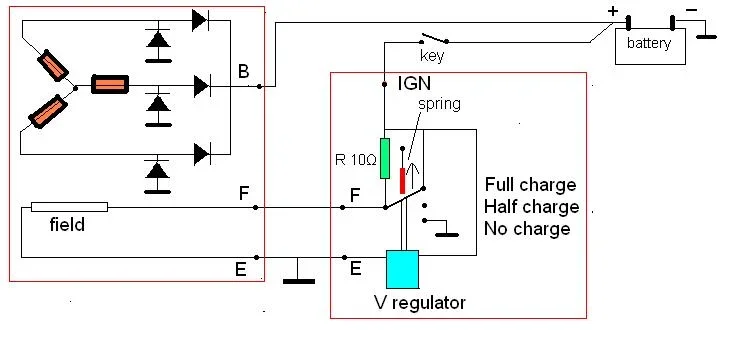
Now the Voltage Regulator see pic below.
VR 3 wire.webp
Here is how it works: The V regulator coil is watching the IGN voltage. This VR coil is a kind of a relay that fights the counter force of a spring (the black lip on top) red in the pic. When the Voltage is low the lever is in the top position so the 12V goes to the Field.
When the voltage goes up the force will increase and at a certain point (the set point of the VR) the lever moves to the middle (open) position. Now the 10 ohm resistor is in series and the Voltage to the Field is +/- 50% of the Vign which will be around 6 to 7 Volt. When the Vign goes higher then the set point of the VR, for one or some reason, the lever moves to the lower position and disconnect the Voltage to the Field to protect the battery from over charging.
Under normal circumstances the lever is doing a constant dance between the middle and upper position regulating the power to the field (thus the charging) depending on the Volts on the IGN tab which reflects the use of Amps.

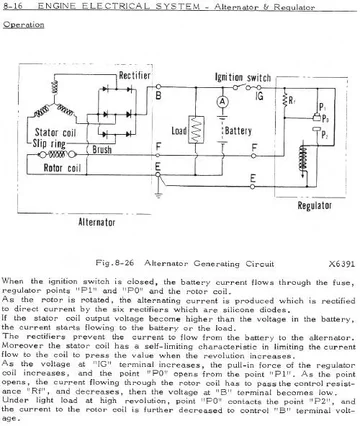
Here is the Toyota explanation.
vr operation.webp

Hope this helps a bit

Rudi
VR 3 wire.webp
vr operation.webp
 
Back to your problem. You're looking for a voltage drop?
Start the engine and pull the throttle so it runs 1500rpm or so.
1. Connect your Voltmeter between the + post battery and the + lug of the alternator. When nothing else is switched on, the loss should be less then 0.5 Volt when the battery is fully charged, a bit more when the Alternator is charging. This 0.5V is the normal loss over the wiring (including the Fusible Link) and the AMPmeter.
2. Do the following 3 tests.
A. Connect one lead from your voltmeter to the - post battery and the other one to the engine block read the meter.
B. Now from the - post battery to the frame, read the meter.
C. From the - post battery to the Firewall, read the meter.
All readings should be close to 0
If the reading(s) is (are) more then 0.5 Volt check for bad connections. Don't forget the battery clamp itself.
Also check from the center of the post to the clamp. Often there is corrosion between the two.

A is the return from the Alternator to the Battery
B is the return from the Starter to the Battery
C is the return from the VR to the Battery

In your case B is not important. But it can help you with cranking problems.

Have fun and happy :steer:

Rudi
 
Last edited:
Thanks Rudi and PinHead, the assistance is greatly appreciated.

Ive put another couple of hours into this today and it really is wearing me thin!

What i did find today was pretty shocking... a melted plug or more specific the B+ terminal within the plug. The plug was located down near the alternator. About 12" after the plug on the back of the alternator i have an additional plug on the inner guard before the wires run back to the firewall.

When i was checking for resistance in the Ground and Field wires between the voltage regulator and the alternator i simply unplugged the wires at the back of the alternator and they tested fine. 0.000Ohms.

As there was no resistance i didnt bother disconnecting the plug on the inner guard at the time.

Given the melted area was around the B+ terminal i figured this wouldnt really have much to do with the problems im experiencing right now... I cut the plug out and replaced it with a new one. As expected, nothing changed.

.....................................

I drove around a bit today with the volt meter connected and reported the following:

Start the car: Ammeter swings to the +ive for 30seconds then goes to center.
Engine running at idle no other loads = 14.2-15.2volts.
Engine running, driving around no other loads = 15-15.2volts.

Engine running, driving around, headlights on = 14-14.8volts.
Engine running, stopped (at idle), headlights on = 13-13.1volts.

Engine running, driving around, headlights off again = 14volts.
Engine running, at idle = 13volts. Ammeter now showing -ive load.

(Something has obviously happened now and the alternator isnt producing much / any power?)

I went home and started checking stuff again, without stopping the car, so sitting in the garage engine at Idle i connected a 'jumper lead' directly from the battery to the Source +ive wire on the voltage regulator. It did absolutely nothing... The voltage remained at 12.9-13V and the ammeter showed -ive 8-10Amps.

I then tried loading it up, turned on the spotlights, Ammeter returned to center and pulsated into the +ive area but the voltage remained around 13V.

I then turned the engine off and decided id swap the voltage reg for the old one again. The new voltage regulator felt pretty hot... hence i started feeling around and found the plug as mentioned at the start of this post that was very very hot... feeling around everywhere i found the plug under the dash from the steering column for the headlight switch etc. was a little warm and the fuseable link was a little warm but not 'hot' in an way.

I fixed the plug and changed the voltage regulator back to the old old (genuine) one.

Started the engine, voltage slowly climbed to 14.2-14.6volts
Revved the engine, voltage remained around the same level.

Switched on the spotlights and the voltage actually climbed a little then settled back around 13.9-14volts. With the engine running at revs (dont know how many i just use the hand throttle to increase the revs until i get maximum output from the alternator) i checked my new plug to see if it was warm and it was not.

The ammeter was bouncing around all over the place on the +ive side and i noticed the front 'park' lights were flickering just a little, but they were definitely flickering.

The ammeter has never ever 'bounced' around prior to all this starting.... except for the 'usual' indicator bounce when they were on. If i was running any load ie. my fridge, an inverter, spotlights etc..... in the passed the ammeter would just move over by the given amount on the +ive side and sit there nice and steady.

..............................

Travis.
 
1. The ground wire between the VR and alternator is missing or bad.
2. The battery is on its way out and it takes more current to keep it charged.

1. There is a ground wire that runs between the VR and the alternator.

The old VR has no additional ground terminal and i assume grounds itself via the firewall bolts. The ground there seems good. ie. Putting the multimeter on the B+ terminal at the alternator and the ground lead on the VR housing shows pretty much the same voltage as putting the multimeter on the +ive and -ive battery posts directly.

The alternator has an additional terminal on the back that i do not use. Its marked "N". I have 3 wires in use on the alternator only. The B+, the Field from the VR and the Ground to the VR.

The new VR has an additional terminal on the housing (literally a little bolt through the housing) for ground i assume but again given it grounds fine via the firewall i assume it is fine to go without using this.

2. Pretty sure the battery is good, real good. Its less then 2 years old and suffers from no voltage drop if left to sit for a week etc. It load tests perfect and the resting terminal voltage when fully charged is around 12.8-12.9V.

Travis.
 
Hi Travis,

Some time ago I had more or less the same problem so I had to figure it all out like you are doing now.
Let's start with what is connected.
Key in "acc" position:
Wipers and radio (if it's there) I have nothing powered from the ACC position.

Key in "on" position:
Gauge cluster draws +/- 1 Amp
Ignition coil draws ?? 4 Amp (I don't have one because mine is a diesel)
The Fuel solenoid draws ?? 0.150 Amp ( My diesel doesn't have one)
Voltage Regulator draws +/- 4 Amp (the regulator relay/coil)
The Field from the Alternator draws ?? Amp (I never checked this)
So with the key in the "on" position the AMPmeter will go negative to some 5 to 10 Amps or so. Yes

The VR is double grounded. 1st by it's housing and 2nd by the white/black wire to the Alternator. This 2nd ground wire is to eliminate possible different ground levels between the firewall and the Alternator with his internal ground. Yes this is exactly how mine is setup
The perfect grounding is: From battery to frame, from battery to firewall and from battery to engine block (pref. to the starter housing). That's how I ended up with my problem.I have a heavy gauge cable from the -ive battery terminal to the engine block, and from the frame/ chassis to the starter housing. I measure no voltage drop if i test ie. using a bolt through the firewall and the B+ wire V's checking the actual voltage at the battery directly at the battery terminals.


Rudi

Travis.
 
Back to your problem. You're looking for a voltage drop?
Start the engine and pull the throttle so it runs 1500rpm or so.
1. Connect your Voltmeter between the + post battery and the + lug of the alternator. When nothing else is switched on, the loss should be less then 0.5 Volt when the battery is fully charged, a bit more when the Alternator is charging. This 0.5V is the normal loss over the wiring (including the Fusible Link) and the AMPmeter.

I measure a difference of less then 0.05V between the two(DMM is a FLUKE)


2. Do the following 3 tests.
A. Connect one lead from your voltmeter to the - post battery and the other one to the engine block read the meter. 0.005V
B. Now from the - post battery to the frame, read the meter. 0.003V
C. From the - post battery to the Firewall, read the meter. 0.004V
All readings should be close to 0
If the reading(s) is (are) more then 0.5 Volt check for bad connections. Don't forget the battery clamp itself.
Also check from the center of the post to the clamp. Often there is corrosion between the two. Terminals are like brand new, zero corrosion.

A is the return from the Alternator to the Battery
B is the return from the Starter to the Battery
C is the return from the VR to the Battery

In your case B is not important. But it can help you with cranking problems.

Have fun and happy :steer:

Rudi

Do you think this could be in some way caused by something to do with a lighting circuit, be it headlights / taillights / parklights or stop lights...? Ive read about bad grounds and back feeding power but i dont really understand its potential to mess with things. It just seems that something 'triggers' the loss in output from the alternator.

With what you wrote about the VR, do you know what conditions would be required to cause the Field output to drop as low as 2-3Volts? Im assuming this is the 'trigger'.

As ive said above ive measured all sorts of outputs from the VR, the output is constantly fluctuating, but within ranges: 2,3V - 6,7,8V and 12,13V.

Thanks again Rudi, your help is greatly appreciated!

Travis.
 
I hate electrical problems and I'm not good at anything electrical. I had charging issues ( no dead battery just showed no charge at low rpms with lights on). Finally removed all lights and re- did the grounds on rear of Cruiser one weekend , problem fixed. Don't know why. Don't care what it was that fixed it. Grounds are important.

Good Luck. By the way beer helps. :-).
 
Hi Travis,

Reading all this stuff back I notice that the set point of the "old" VR is 14.2 Volt and the from the "new" one is 15.2 Volt.
You use a Fluke DMM which is fine but don't freak out on 2 digits behind the dot. Select a higher range so that you have a 1 digit behind the dot display.
The problem with DMM's is that they don't show fluctuations, the numbers are just going anywhere. This is because they are calculating many times per second, displaying the result of that precise moment but the voltage that you are meassuring is fluctuating so your reading is wrong.
For checking the voltage on the Field wire you better use an old style analog meter. Now you'll see that the voltage on the Field wire is fluctuating between 6 and 12 Volt while you play with your hand throttle.
To check amp draws without disconnecting every wire, maybe you can use an DC AMP clamp meter like this one.

DSC06280.webp

They are not that expensive, 20$ I think (I bought mine for 25 Euro's). Just clamp it around a wire that you suspect and wiggle the wires, tap on relays and switches and see what happens.

Good luck,

Rudi
DSC06280.webp
 
Last edited:
I drove around a bit today with the volt meter connected and reported the following:

Start the car: Ammeter swings to the +ive for 30seconds then goes to center.
Engine running at idle no other loads = 14.2-15.2volts.
Engine running, driving around no other loads = 15-15.2volts.

Engine running, driving around, headlights on = 14-14.8volts.
Engine running, stopped (at idle), headlights on = 13-13.1volts.

Engine running, driving around, headlights off again = 14volts.
Engine running, at idle = 13volts. Ammeter now showing -ive load.

(Something has obviously happened now and the alternator isnt producing much / any power?)

.

What probably happened is the battery is recharged to full charge after starting and there is not much demand for net power from the alternator. 13V at idle is pretty normal. Mine acted like that for 15 years with no problems. Make sure that your idle speed is set to 650 RPM. If you want a little higher voltage, you could bump the idle speed up to 700 or get a smaller diameter alternator pulley.
 
G'day guys, thanks again Pin Head and Rudi for the assistance.

OldbeachBob, thanks for the sympathy and tip. You are absolutely right grounds are very very important!

So far this 'issue' has cost me 3/4's of a bottle of Glenfiddich, helps with my back after leaning over the bloody engine bay or under the bloody dash all afternoon!

SinkingVly40, sorry to hear you are having the same problems. Personally i would advise that you hold off buying a new alternator and or voltage regulator if your symptoms are similar to mine.

...................

Today while driving i monitored the voltage again given ive now reinstalled the old voltage regulator.

While driving along with just the engine running i get a pretty consistent 14.7volts.

Pull up at a set of stop lights and the voltage drops down to around 13-13.2volts and the ammeter is moving all around the shop and into the -ive zone.

As soon as i start driving again the voltage is back into the mid high 14's.

If i turn on the headlights the voltage drops back into the low - mid 13's.

...................

So ive decided to bypass the ammeter. I have taken the wire off one terminal post and just bolted it up with the other wire on the other terminal post. (FWIW after running for 30minutes driving around the ammeter terminals were cold, if there was a problem there id have expected it to be warm to hot...)

..................


Running the engine for the first time in the garage resulted in a pretty consistent voltage around the mid 14's.

Turning on the lights, the voltage remained in the mid 14's. Turning on the spotlights as well saw the voltage once again remain in the mid 14s'.

Lights off, the voltage climbed to around 15-15.2 then i shut the engine off.

Cleaned up, then tried it one more time.

Engine running at rev's and the voltage was mid- high 13s, lights on and the voltage dropped a little, lights off and the voltage rose to 14-14.1

..................

That will do me for another day! Ill monitor the voltages again the next time i drive it (most likely tomorrow) and see if i can find a difference with the ammeter disconnected.

Rudi, i like the look of your little clap meter and i will look into buying one myself so i can check the output from the alternator while under load and also during the times when the ammeter is showing a -ive reading...

I know what you mean re: the digital meters v's the analog ones. I have a really nice old analog meter so i will use that next time and have a look again at the field wire voltage.

Rereading your post about the mechanical voltage regulators i couldnt help but think maybe something was causing the VR to go into the 'lower' position and stopping the output to the field wire (over voltage etc...) perhaps this is what i see when things go bad.

Its strange because i was originally looking for voltage drop and from my original post one can see there is always some level of voltage drop on the ENGINE circuit v's all the other unswitched circuits.

I dont think the source wire to the VR has even seen 15+ volts. And if i had a bad +ive connection somewhere id expect to see a voltage drop thus the VR should if anything tell the alternator to output more power.

Once again i cannot help but think about backfeeding power via the grounds...

The saga continues :o

Travis.
 
One other thing i thought was a little strange was i decided to bridge two circuits on the supply side at the fuse panel.

I bridged the ENGINE circuit which at the time was reading 13.9V with the headlight curcuit which at the time was reading 14.2V. Both circuits voltages then read 13.9V the same as the engine circuit... Does this mean anything lol...

Travis.
 
...................

Today while driving i monitored the voltage again given ive now reinstalled the old voltage regulator.

While driving along with just the engine running i get a pretty consistent 14.7volts.

Pull up at a set of stop lights and the voltage drops down to around 13-13.2volts and the ammeter is moving all around the shop and into the -ive zone.

As soon as i start driving again the voltage is back into the mid high 14's.

If i turn on the headlights the voltage drops back into the low - mid 13's.

..................

That is entirely normal behavior.


...................

So ive decided to bypass the ammeter. I have taken the wire off one terminal post and just bolted it up with the other wire on the other terminal post.
..................

That is not normal and serves no useful purpose.


Am I correct in assuming you think that the problem is that the alternator does not maintain a constant voltage? They don't. They just make sure the battery stays charged.

Alternators put out power, which is amps times volts. There is a limit to how much power they can make and this depends on the magnetic flux in the rotor and the speed at which the rotor rotates. At a low RPM, the alternator simply cannot put out enough power to maintain 14.7 V with a high amp load.

As long as the voltage stays above the battery voltage and the net amp flow is zero or charging the battery most of the time, you are fine.
 
Hi Travis,

So far all your readigs are OK. It's what Pin_Head says:
As long as the voltage stays above the battery voltage and the net amp flow is zero or charging the battery most of the time, you are fine. Of course this is at rpm's higher then idle.

What bothers me is this part of your posting:
The ammeter was bouncing around all over the place on the +ive side and i noticed the front 'park' lights were flickering just a little, but they were definitely flickering.

The ammeter has never ever 'bounced' around prior to all this starting.... except for the 'usual' indicator bounce when they were on.
Travis.

1st. You said, you saw your running lights flickering, which means to me that your light switch was not fully depressed in the "off" position. Maybe you have to check this. Or maybe there is a relay in between which has a bad internal spring so it's living his own life.
2nd. I used two VR's myself. The stock mechanical one and a solid state one. The solid state (from Bosch) was a pure 2 position switch. On / off. Charge / no charge. This caused my Ammeter to jump like crazy. With the stock one I can see a little movement when the battery is fully charged. This is the switching from the VR from full charging to trickle charging.
Here is a video I made for another thread with the Bosch VR. At 1.08 you'll see the idiot behaviour of the Ammeter needle caused by the hard switching of this VR. The Volt meter is connected to the cigarette lighter.
amp_gauge-1.AVI - YouTube
This VR was sold to me as an electronic one so I expected that when Vign goes up, Vfield goes down. Unfortunately that was not the case. While running with the Bosch VR I had time to clean up and adjust the old one and now everyting is fine.
Here is another video about the behaviour of the Ammeter under load when the engine is off.
amp_gauge_2.AVI - YouTube

Is your Ammeter bouncing with the stock or the solid state one? Or both?

Good luck.

Rudi
 
Last edited:
Back
Top Bottom