Charging system issues

This site may earn a commission from merchant affiliate
links, including eBay, Amazon, Skimlinks, and others.

I'm trying to think of things that would cause your symptoms. (As with the high beam indicator light.)
Whenever you have a ground path missing, the electrons will search around and take the path of least resistance back to the battery. Sometimes that path is the reverse of what the wire or device is supposed to do. It could be something like when you connect the wire from the alternator to the VR, it is providing an alternate ground path from the body to the battery possibly BACKWARDS through the coil in the VR or backwards through the field winding in the alternator. and to the engine ground through the idle solenoid. Something crazy like that could easily happen if you had a missing ground and would completely hose the normal operation of the alternator/VR.

I wouldn't start by suspecting the small ground wire from the headlights to the chassis at this point. I would be triple checking the big ground wires. Can you explain exactly how your rig is grounded? You have two batteries, a battery separator and a handful of big ground wires. What is connected to what and where?

Edit: I just read your last cross-post and I think you need to start by finding out where that main harness ground is. If that is missing, that could cause problems too.
 
Bloody hell i just lost all of the post i was typing!

Short version.

Main battery in engine bay, std position.

From the battery Negative terminal - Huge ground wire to the engine block.
From the battery Negative terminal - Super Duper Huge ground wire to winch motor housing.
Heavy gauge wire from starter motor to chassis.
Heavy gauge wire from engine to body.

Aux battery located in tray.
From the battery Negative terminal Huge ground wire to chassis.

...................

All of these have been removed and triple checked. Cleaned 110% all surfaces and bolts involved with emery paper etc.

..................

Im really hoping the problem is with the harness grounds, it makes sense. I just have to located them lol :bang::bang::bang:

Travis.
 
Hey guys, ive got an update of sorts to share.

Ive been pretty sore and stiff over the last few days and other then continuing to search like mad for any sign of a ground wire coming from the wiring loom, attached to the body of the old girl, ive done bugger all. And no, i havent found a single ground wire coming from the loom attached to the body be it under the dash or in the engine bay, anywhere!

Today i decided bugger it, im going to buy a solid state voltage regulator and see what happens.

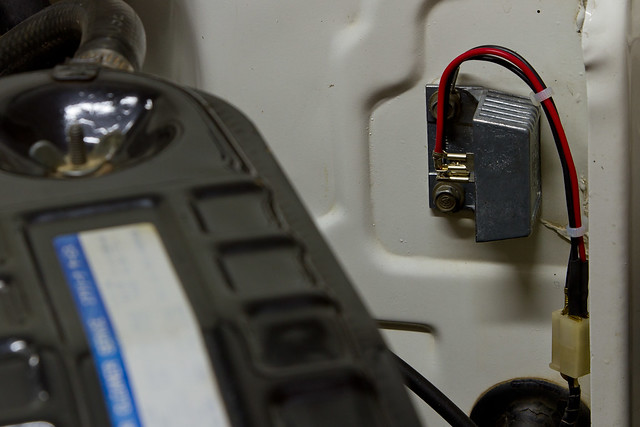
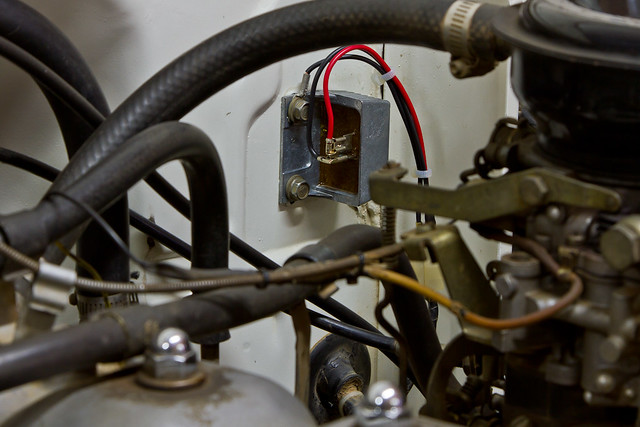
I searched around quickly and found this BOSCH unit, the RE55. It looks very very well made, and is Made in Australia!

The RE55 is a 2 wire VR, it has a Source terminal and a Field terminal. The housing is the ground. They also make a few other models, the RE57 iirc is a 3 terminal VR = Source, Field & Ground. However noone local had this VR in stock, and i vaguely recall an Auto Elec id once spoken with saying the RE55 was a good VR and used throughout the industry, extremely common. Lots of vintage car and motorbike owners make use of the RE55 today in place of the stock VRs. With one quick phone call i had found an auto shop with them in stock, so i went and bought it.

Firstly i 'bench' tested the S/S VR with the test wires id made up earlier and it looked promising.

So i set about mounting it in place of the old (New) Mechanical VR. I had to drill out the mounting holes as they needed to be elongated by about 2mm each to match the stock bolt spacing and that was pretty much it. After making up a few wires it was good to go.

It is a massive improvement over the Mechanical VR. The battery voltage is much more stable, as is the field output voltage.

The in dash ammeter still has a small amount of 'pulse' to it but nothing like it was, and it seems to remain in the +ive area.

I loaded the alternator up by turning on the headlights + the spotlights and everything was pretty good. See video (uploading it now).

I know this is just a band-aid fix, i can only assume the S/S VR is less effected by any feedback on the ground side?

I will continue to monitor everything and shall continue to search for any ground wires terminating on the body from the wiring loom. In another week or so i think ill start opening up the loom to find these ground wires if i have no luck locating them.

Hopefully the S/S VR remains to work as well as it is now, if so i will do away with the mechanical type and buy another S/S to keep as a spare (ill keep the new mechanical type in the glove box too on big trips) and ill tidy up the wiring some more and fit a proper plug at the main wiring loom connection.

6917572766_ae181a1513_z.jpg


6917573208_38b13e4ea9_z.jpg


Travis.
 
I continued to try and test few things with the headlights and the VR / Alt connections and do not understand why it behaves as it does. Obviously a sign the problem has to be ground related surely.

...............

One other thing ive noticed since fitting the S/S VR and testing everything is the COIL no longer heats up anywhere near as hot as it used to!!!!!!

Related, i have no idea!

................

Video with the S/S VR:

DMM is on the Battery
AMM is on the Field output from the VR


Headlights + Spotlights running.
(When off, the Battery voltage is still nice and constant between 14-14.2 and the field voltage sits around 6-7V iirc, either way it holds much more consistently then it used to. No sign of it bouncing all over the shop, negative current etc)


Travis.
 
Last edited:
Looking good!
You see the AMM "switching" between full and half charge. The Amp clamp meter reflects that by showing 18.6 amps.
When your battery is fully charged the AMM should drop to about 7 Volts and the ammeter to less than 10 amps. So far so good.

Now you have to solve your last problem: Where is the ground for the headlights?

Rudi
 
Makes sense. Going with a 2 wire regulator eliminated your truck using that 3rd wire as a bypass ground for the missing ground connection. I wonder where those electrons are going now? I agree with BJ that you still need to find out where the chassis ground is (or isn't).

--ed
 
Hey guys,

thanks for the continued support!

Rudi - yes its looking good!

The clamp meter is showing 18Amps +/- 1 because i have the Headlights + Spotlights turned on. (2x100w=14Amps)+ 4-5Amps load going into the battery.

You are correct re: the field voltage levels, they seem to be working perfectly. In that above video the voltage is hovering around 9V +/- 1V.

If i switch off the lights, the fV drops to around 6V and the current going into the battery at the fusible link was around 3-5A (the batteries are 90% charged).

.............................

Ed, i decided to try the S/S VR in hope, simply that perhaps its circuit would be less effected by interference.

You can see in one of the above photos, i have connected all of the factory wires as they are on the factory 3 wire mechanical VR. The WB ground wire that runs between the VR and Alt, its the black wire closest to the firewall, connected to ground via the lug terminal under the top VR mounting bolt.

Ive been racking my brain trying to understand what is going on...

Basically we know now that the headlights WB ground wire is seeking ground via. the Alternator connection or the VR connection.

However, when both the Alt and VR are unplugged, the ground wires all STILL show a path to ground. (The WB wire between the Alt and VR is not an open circuit when the plugs are disconnected, it still has a path to ground).

How or why does the headlights ground know when the Alt / VR are disconnected?

Why, when i connect a 'jumper ground wire' from the WB terminal on the headlight plugs directly to the body / ground does the interference not go away? Im assuming that somewhere in the loom, there is either a broken ground wire, or bad connection / join?

The WB wires coming off each headlight must be joined - via the entire length of the loom, given if i put a ground jumper on just one of the headlights (either side) while unplugging the VR/Alt, then both of the headlights work...

.............

From what ive found, i can not locate any ground wires terminating to the body (both of the looms shown in the threads i linked to a few posts back show at least 2-3 ground wires coming out of the loom and terminating to the body!).

Thinking about it, i guess there are 3 grounds 'in use' that we know of.

The ground from the coil, which runs down to the distributor and connects to ground via. a condenser.

The ground at the VR/Alt.

There is a ground on the back of the dash instrument panel on that big round 10? pin plug.

.............

I wont give up!

Travis.
 
Last edited:
Travis,

I just found this from Coolerman here on Mud.
Look at "B" below. It's about the critical ground for your problems.

Quick grounding tips:

1. Most lighting ground problems are in the light housings. Toyota relies on the housing to ground itself to the body/frame. Rust will eventually cause the ground to be lost or become intermittent. The lamp sockets (where the bulb goes) also get corroded. The solution is a Dremel tool with a wire brush mounted to clean the sockets and housing to body/frame contact point.

2. The wiring system on an FJ40 has a few grounding points that need to be addressed.

A. The main ground for the system is of course the battery negative cable to chassis. There should be TWO grounds: One from the battery to the frame rail, then from that point a short jumper cable to the starter mounting bolt on the engine block. This provides the frame and engine block with good solid grounds. Note that the engine is mounted to the frame with rubber isolators so the engine may not be grounded well through its mounting bolts, IE the reason for the jumper. Engine ground is really important for the starter AND the alternator to function properly. Also idle solenoid, temp sensor, and the oil sensor.

B. Next are the wiring harness grounds. The primary harness ground on older trucks is located at the external regulator. There is a WB wire that comes from the harness and attaches to the regulator E terminal. The E terminal is directly connected to the regulator case therefore the regulator case MUST be well grounded to the body! This ground is critical! It is the ground wire for the alternator, headlights, VSV, heater blower and wiper motor!

The rear chassis harness ground is located under the truck on the passenger side frame rail about where the t-case is. There is a brass ring terminal with two WB wires going to it that is bolted to the frame. This ground is only for the t-case 4WD light and the fuel gage ground.

Everything else on the FJ40 grounds to the body or chassis through its mounting bolts.

So when someone say to check the grounds now you know what to check.

Hope this hlps,

Rudi
 
Rudi/Travis this is a good find. I especially like the part about the VR Case being the primary harness ground connection. If there is paint (or rust) between the VR case and body, then the path to ground is the VR to alternator wire. I would start looking there. As an experiment, I'd try a temporary wire jumper from the case to a clean/unpainted part of the body.

--ed
 
Hi Ed,

His VR is working. He has a Solid State now.
I was refering to: There is a WB wire that comes from the harness and attaches to the regulator E terminal. The E terminal is directly connected to the regulator case therefore the regulator case MUST be well grounded to the body! This ground is critical! It is the ground wire for the alternator, headlights, VSV, heater blower and wiper motor!

That is not the white/black from the Alt to the VR.
There is a thicker (main) ground wire in the harness that ends at the bottom of the VR.

Rudi
 
Hi Ed,

His VR is working. He has a Solid State now.
I was refering to: There is a WB wire that comes from the harness and attaches to the regulator E terminal. The E terminal is directly connected to the regulator case therefore the regulator case MUST be well grounded to the body! This ground is critical! It is the ground wire for the alternator, headlights, VSV, heater blower and wiper motor!

That is not the white/black from the Alt to the VR.
There is a thicker (main) ground wire in the harness that ends at the bottom of the VR.

Rudi

I hear you. My point is that if the harness ground is connected to the regulator case and the regulator case is not well grounded to the body, then the VR to ALT ground wire will become the ground connection for the harness. That is his symptom. If that VR to ALT ground wire is disconnected, he has no headlights.
 
I have the idea that the main ground wire is broken from the ring/eye connector and that that ring fell off or was mistaken for an ordinary washer while replacing his VR.
Hmmmmm, don't know if I described that ring/eye connector correctly. This is what I'm taling about.
imagesCAAJQ4J2.webp


Rudi
imagesCAAJQ4J2.webp
 
G'day guys.

Rudi, great find re: the old post by coolerman.

However what he says doesnt really match up with what we see in the wiring loom photos, they both clearly show thicker WB wires extending out of the loom and terminating into a Lug terminal (ring terminal).


https://forum.ih8mud.com/40-55-series-tech/430560-fj40-wire-harness-reference-september-1976-a.html

https://forum.ih8mud.com/40-55-series-tech/475291-fj40-wire-harness-reference-december-1978-a.html

They show 2 or 3 'grounds'. One near the main fuse panel and one or two outside in the engine bay.

I cannot located any of these 'grounds'. I know these photos both show Left hand drive versions, and FJ40 as opposed to FJ45, but id still have expected my loom to be similar. But now with the information from Coolerman, i dont know.

..................

What coolerman has posted fits perfectly with how it seems my old cruiser is wired. To be honest i just do not believe the previous owner would have done anything not factory to the old girl. He did such a good job with the old girl - which he had for over 20years, he just didnt seem like the type to 'leave out' or remove something which is there from the factory.

.................

Re: the wires coming from the loom to the voltage regulator... There are only 3 wires coming out of the loom and they all connect to the VR. There is the BY (source), the WG (field) and WB (ground).

With the original VR, there was / is no ground wire connected to ground via a Lug terminal / ring terminal. Again, 3 wires from the loom, they all connected to the VR via a 3 wire plug as can be seen in my photos above.

However, now that i have switched to the Solid State VR - a 2 wire type, i have simply fitted a Lug terminal to the WB (ground) wire from the loom and fitted it under one of the VR mounting bolts.

Ed - ive never seen a lug / ring terminal connected at the VR. Other then the 3 wire plug, or 6 wire plug at the VR's on these cruisers the only other thing which is 'sometimes' there is a condenser fitted under one of the VR mounting bolts - other end comes from the source wire. (My old girl has never had a condenser fitted here, thus i never bothered trying one however as this problem as drawn out i did start thinking perhaps its another thing i could try).

..............................


I was going to post a little update the other day but thought ya'll might have been sick of my drama here!

Having driven the vehicle a couple of times, and also at night using the headlights etc. i was happy that the S/S VR was performing well and i would wire it up nicely with a proper plug connecting it to the plug from the wiring loom. The one half of the plug which is connected to the wiring loom is OLD and original, but its buggered so i wanted to fit a whole new plug, to both the loom and my wires connecting the S/S VR.

So i went down to the local auto parts store and purchased a 3 wire plug kit and went home. Trying to cheat a little i thought if i could remove the old terminals from the old original plug which was badly deteriorated and quite brittle etc. then it would save me having to strip the short wires there coming out of the loom and fitting new terminals etc. It really is quite a tight working space there behind the air filter housing / carby / manifold etc...

I tried and tried to get the terminals out of the old housing but in the end i had to give up. I really spent quite a bit of time trying to get the terminals out and even custom made a nice little tool by grinding down an old screw driver to try and depress the tab on the back of the terminal which keeps it inside the plastic plug. However it wasnt meant to be so i got out some big pliers and started tearing the old plug open to get the terminals out... But given the restricted working space i was only successful in removing two of the 3 terminals, so i had to just cut the old terminals off!

I then opened the new 3 wire plug kit only to find i was missing 2 terminals!!! It contained 2 male and 2 female terminals instead of 3 of each. I was seeing RED!

I was going to call it another day as i was already hurting from the fight the old girl put up as i tried to remove that old plug.... I went and made myself a little drink (whiskey and coke) then decided id better just rig it up quickly so i could drive back down to the auto parts place and ask them about the missing terminals!

The guys at the auto parts store gave me a few new terminals and i was on my way. (Note the male terminals used in these plugs are longer then what id call 'standard' terminals... i have got thousands of terminals, lugs, connectors etc - my dad is / was an electrician but again these lugs are longer hence i had to either go but another plug kit or see if the guys had any loose they would give to me).

Now the real fun would begin, i had to crimp all new terminals to the short wires coming out of the wiring loom. It was a pain in the butt but i do pride myself in being able to work in the worst and most confined spaces - it helps having little girly hands!

After blowing what seemed like half they day on what most would call an hours job i was finished, and happy with the new wiring / plug and i got ready to fire up the engine and check all the connections and function of the VR.

Engine started, all the voltages seemed sweet... THEN, i tried turning on the headlights and... i got nothing!

I really nearly threw a tantrum lol. However i pulled myself together and just started methodically going over everything.

Firstly, the obvious thought was that while working on the wires for the VR, id disturbed whatever wire / connection it was / might be thats the cause of the entire issue. With the engine on and headlights switched on (but not working) i tried pushing / pulling / squeezing the wires in and around the loom where the VR wires come out. Nothing.

Using the little ground jumper wires id made up the other day i quickly connected them up but it had no effect. I then tried checking the voltages etc. However this time i had 0V at all 3 terminals on the back of the headlights, regardless of the headlight switch position - low beam / hi beam.

Slowly i worked back to the Fuse panel. Headlight fuse, check. Looks good. Checked the voltage, good. Checked it again 0V, checked it again 12V, again 0V... WHAT THE! farken hell i couldnt believe it. Obviously the old glass fuse had broken internally. Of course, i have plenty of spares, but you bet... getting to the would be another pain in the ass!

New fuse = headlights back working perfectly!!!!!!!!!

Seems the old girl is really enjoying messing with me right now.

.............

So, the S/S VR thus far continues to work almost perfectly. The output voltage from the alternator is absolutely consistent. At idle, rev's, no load, load the voltage is always within 14.0-14.4V at the battery.

The indash ammeter is almost back to 'normal'. Driving around it holds nice and steady, with additional loads (headlight etc) it holds steady at the appropriate position in the +ive area. Only briefly every now and again, when im stationary - foot off the brakes (so no other electrical load other then just the running of the engine) the ammeter needle will just 'vibrate' a tiny bit back and forth a wee little bit (never into the negative tho).

So id say its working 99% perfect, however i am still bothered by the unknown wiring loom ground situation.

..................

Rudi, numerous times ive tried connecting a 'new' ground wire directly from the battery -ive terminal to the VR housing. This had no noticeable effect. (This was all done with the Mechanical VRs only).

Travis.

 
Last edited:
Hi Ed,

His VR is working. He has a Solid State now.
I was refering to: There is a WB wire that comes from the harness and attaches to the regulator E terminal. The E terminal is directly connected to the regulator case therefore the regulator case MUST be well grounded to the body! This ground is critical! It is the ground wire for the alternator, headlights, VSV, heater blower and wiper motor!

That is not the white/black from the Alt to the VR.
There is a thicker (main) ground wire in the harness that ends at the bottom of the VR.

Rudi

There is no other WB wire at the VR. The WB wire that comes out of the harness and attaches to the E terminal on the VR, is the same WB wire that runs down to the Alternator as best i can tell.

Travis.
 
Hi travis,

So to wrap it up.... The VR is doing fine and the headlights work fine too. Right?

Happy driving :steer:

Rudi
 
Figured i might as well update this thread;

Nothing has changed, i am still experiencing the flickering ammeter.

Facts;

Voltage is very constant now with the Solid State VR. 14.2Volts.

The ammeter flickers less when there is a bigger load applied and flickers more when there is minimal load. (Less flickering when the batteries are drained, more flickering once the batteries are fully charged).

..............................................................

Over the passed year i have tried cleaning up more contacts, and replaced connections here and there but still nothing has solved the flickering Ammeter.

..............................................................

Both my Aux and Cranking battery seem to have suffered a premature death. Cause, i dont know?

Aux battery was approx 16months old. Cranking battery 35months old.

Basically they settle to around 12.2Volts when left to rest for 12hours. EVEN if they are left on the Ctek 15A battery charger for 24hours, within 12hours of rest, they are back to 12.2Volts.

(This is with the batteries disconnected, on the benchtop so to speak... There are no parasitic drains)

Ive tried cycling them numerous times on the Ctek, and running the 'Recondition' Mode a few times but nothing has changed.

Both were wet cell Calcium / Calcium types.

Im lead to believe that perhaps the 14.2Volts from the alternator isnt quite high enough to maintain Ca/Ca batteries for the long term and they would require a regular 'Equalizing Charge' to keep their full capacities.

I will look into modifying the Bosch RE55 S/S Voltage Regulator to increase the Voltage to around 14.6Volts and would then hope that this will maintain the replacement batteries for a good full service life.

Basically im looking to cut the resistor 'bridge' on the back of the RE55 which by design increased the output by 1Volt, but this would put me at around 15.2Volts which is a little too high so im going to try cutting the bridge and soldering in a 1.5Kohm or 3Kohm resistor in place...

Travis.
 
Hi Travis,

14.2V is a good value for charging. The FSM speaks of 13.8 - 14.8V.
14.4V is only a little bit better and 14.8V is the limit.

A battery at rest (2 hours after disconnecting everything)
12.6V = Fully charged (new) battery
12.1V = Half charged battery
11.6V = Empty battery

These values reflect the acid condition. If a battery doesn't go higher than let's say 12.1V after 2 hours rest, after 8 hours of charging it means that the battery is on his way to the graveyard.
The recondition and equalization functions on your CTEK (and my B&D) are extras to squeeze the last out of a battery but when the chemical damage is done, it's done.

Now for the pulsing Ammeter..... have you thought/checked your fusible links?

Rudi
 
Back
Top Bottom