Charging system issues

This site may earn a commission from merchant affiliate
links, including eBay, Amazon, Skimlinks, and others.

Heya Rudi,

A while ago i did try running a direct ground wire from the battery to the voltage regulator as well as the standard wiring. What i mean is i left everything wired up as per normal and then simply ran new single wire directly from the -ive battery terminal and connected it to the housing of the voltage regulator (alligator clip to the mounting bolt through to the firewall).

I also did the same with the source wire to the voltage regulator. As per the ground, it was 'as well as" the original wiring / source wire. Neither the additional ground or source fixed the problem.

However i dont know what the effect is of running these wires 'as well as' the originals. My belief was if there was a bad ground - back feed power through ground going into the voltage regulator then by adding an additional ground wire directly to the battery any back feed power would take this route to ground and stop effecting the voltage regulator.

............................................

So i guess the next step is going to start fresh and actually run all new wires, and then one by one swap back to using the old wire. So ill have to do this for the Source wire, Ground, Field and maybe the B+ wire from the alternator to the battery.

With regards to running a 'new' B+ wire, will it be ok to simply disconnect the factory wire from the back of the alternator, then run a new wire from the back of the alternator directly to the battery leaving the rest of the original B+ wire in place.

My thinking is this would at least rule out something being wrong with the factory wire between the 't-off' where it splits from the alternator, one going to the Ignition feed, and the other branch going via the ammeter to the battery via the fusible link. Or not, im just not sure how i could isolate the ignition / engine running circuits from the alternator in case there is a problem with them causing the problem.

......................

Re: the DMM beep testing, i went back out to the garage before and re checked the Field wire, Ground wire and B+ wire up to the firewall, this time manipulating and wires, shaking them around, pushing on them, twisting them etc... this had no effect, no faults turned up.

....................

Ive just taken a quick video to share, it the first one ive done in a long time, so it was really just a test to make sure i was still able to upload a video to youtube with my current camera etc.

So now, if there is something anyone wants me to test and video i can show everyone the results.

Travis.


Here is my quick test video. The sound is a bit loud - engine noise. You dont need sound, you can mute it etc... or turn down the volume.

I have just started the engine, and switched the headlights + spotlights on in order to create a load for the alternator to supply. (Battery fully charaged).

First you can see the indash ammeter going crazy, followed by results of the clamp meter on the B+ wire where it connects to the battery. Then i show the DMM connected to the field wire at the alternator so you can see the voltages there, and finally the Analogue MM showing the battery voltages. (30V scale - voltage reads around 14-14.5 volts).

Travis.
 
Travis, are you still running with two batteries? If so, have you tried this with one battery as a test?
I ask this because I am currently helping out a buddy with his RV with two batteries and an automatic battery separator. These two batteries are different types (one is AGM) and have different resting voltages which is wreaking havoc with the separator.


Here is my quick test video. The sound is a bit loud - engine noise. You dont need sound, you can mute it etc... or turn down the volume.

I have just started the engine, and switched the headlights + spotlights on in order to create a load for the alternator to supply. (Battery fully charaged).

First you can see the indash ammeter going crazy, followed by results of the clamp meter on the B+ wire where it connects to the battery. Then i show the DMM connected to the field wire at the alternator so you can see the voltages there, and finally the Analogue MM showing the battery voltages. (30V scale - voltage reads around 14-14.5 volts).

Travis.


Hi Travis,
Good video. You can see clearly the relation between the switching of the VR, the going up and down of the Vfield and the fluctuating current through the DC clamp and the Ammeter in the dash.

Now here is my last shot, unless edwjmcgrath's remark cuts wood (Dutch expression).
A bad battery post! Chances are 1:10,000 but it happens sometimes. If the battery disconnects, the load drops from the Alt circuit. At that point the V-alt goes up and is clipped off by the VR going into the "ground" P2 position.
You can test this by replacing your battery but.... you can also test it with your headlights on (engine off) and move, push, pull the battery cables. If your headlights flicker you've found it.
I'm running out of ideas. :hhmm: Pffffffft.

Rudi
 
Hi Ed and Rudi.

Ed, yes im still running dual batteries, and yep... tried everything with the Aux battery disconnected and nothing changed :(

FWIW i run similar batteries, Lead Acid - Calcium/Calcium. I use an Australian made electronic isolator, basically it switches on when the Main batteries terminal voltage rises above 13.1V and after a minute or two it connects the Aux battery. If / when the Main batteries terminal voltage drops below 12.7 it switches off and disconnects the Aux battery. Touch wood its been a good product, again locally made and the business has been in business for some 25+ years.

Rudi, thanks for continuing to think outside of the box, who knows it very may well be something completely out of left field.

Im about to head back out to the garage and have another tinker. I will try playing around with the battery terminals like you said.

Keep in mind regarding the VR, the source wire voltage is very consistant. I didnt show a reading in that first video but i might do another one later depending how i get on, but while the field wires voltages is going up and down up and down, the source wire's voltage go's on almost unchanged. Less then 1volt variation except for the times when the field wire's voltage 'cuts out' then the whole system falls to the battery voltage (and we see the negative load on the in dash ammeter).

Im going to make up some temporary testing leads and replace the field and ground wires between the VR and Alt, and i will also do the same for the source wire.

Im still unsure as to what i should to do try and temporarily replace the B+ wire if it comes to that - any thoughts re: the questions in my post #41?

Travis.
 
Keep in mind regarding the VR, the source wire voltage is very consistant. I didnt show a reading in that first video but i might do another one later depending how i get on, but while the field wires voltages is going up and down up and down, the source wire's voltage go's on almost unchanged. Less then 1volt variation except for the times when the field wire's voltage 'cuts out' then the whole system falls to the battery voltage (and we see the negative load on the in dash ammeter).

The field voltage going up and down is the result of the regulating function of the VR. Your battery is full so the VR switches to P3 (half/trickle charge - 50% of the V-bat = ±7V to the field), because of the load (cluster, ignition, headlights, whatever) the V-bat goes a tiny bit down and the VR goes into the P1 (full charge = V-bat) position. So that's the regulating function. So far so good.
Normally the Ammeter hoovers just a bit on the + side.
But what I see is both Ammeters going nuts while the VR is doing it's job. You can also see that the V-field drops below 7Volts which is the P2 position (over voltage protection).
You see that the V-bat is around 14V and that the Voltage goes up in the direction of 15V and that's where the VR cut's the V-field to as low as 1. something Volt I saw in your video. I saw several values less then 6Volts in your video.

How about borrowing a battery from a neighbour, friend, wifes car, just for testing?

Rudi
 
So far... no progress, our bloody automatic garage door motor thingie has stopped working so the wife says i have to sort that out first!!! arrrrgh

Thanks agai guys.

Rudi, i cannot say exactly but it might also be worth considering the Source wire for the VR is taken from the fused side of the engine circuit, which is supplied from the ign. feed.

For whatever reason as i found right at the very start, the switched circuits have up to 0.5-1V drop, so while the volt meter at the battery showed around 14-14.5Volts, the Source wire at the VR generally would show up to 1V less.

The time i jumped the Source wire directly from the battery to give it full voltage, nothing changed...... Thats another mystery i dont understand, the source wire is always a lower value then the battery voltage with the alternator running so how does it decide how much power to produce... i assume it has something to do with the resistance in the B+ wire / battery. More loads / depleted battery = less resistance = more power from the alt......?????


My aux battery is 100% good. It was removed and tested at the battery place, load tested, and another test to get the exact capacity etc.... everything came back good. I guess i could remove the Aux battery and try that in place of the main battery.

Now back to googling this bloody garage door opener!

:o

Travis.
 
Just another thought here ...
Is there any chance the dual battery switch could be causing a feedback to the vr and essentially confusing it's ability to "read" the system voltage ?
I also would like to see a completely different battery minus the dual-switch to isolate any possible interference . Also, I'd try opening up the alt to see if there is any possible debris or issue with the field terminal . I had an externally-regulated 24v unit that drove us nuts due to a small piece of metal that intermittently shorted tne field to ground.
Sarge


Ok another quick video.

This time i have connected the old analogue MM to the Source wire for the VR. Voltage hovers around the mid to high 13's V.

The DMM is connected to the Field wire at the alternator.

The Clamp meter is connected and operating as a volt meter, showing the battery terminal voltage.

Off video i was also monitoring the current on the clamp meter and like yesterday it was constantly varying from +20A to +1-2A.

This time the engine was at idle, with no additional loads.

I dont understand why the battery terminal voltage seems so stable right now while the other two change... However this is not always the case, generally if the field voltage drops to 1-2V for more then a split second then one generally will see the battery terminal voltage quickly drop away.

The constantly changing field wire voltage has come about since i replaced the fusible link. Prior to the new link, the field voltage would still vary however it was less frequent, sometimes it would sit and work normally for 5 minutes, then go bad for a minute or two (1-2V) then come good again. Now, it never seems to stop varying.

Travis.

Sarge, the electronic dual battery isolator is meant to be some sort of 'smart' type. If it senses and sort of back feed it is meant to switch off and show fault codes etc.

The alternator is brand new, as is the VR. Basically the symptoms are the same with the old alt and VR, and or any combination of the two.
 
Last edited:
For whatever reason as i found right at the very start, the switched circuits have up to 0.5-1V drop, so while the volt meter at the battery showed around 14-14.5Volts, the Source wire at the VR generally would show up to 1V less.

The time i jumped the Source wire directly from the battery to give it full voltage, nothing changed...... Thats another mystery i dont understand, the source wire is always a lower value then the battery voltage with the alternator running so how does it decide how much power to produce... i assume it has something to do with the resistance in the B+ wire / battery. More loads / depleted battery = less resistance = more power from the alt......?????

The voltage anywhere in the loom/harness is always lower than the voltage at the Battery due to all kinds of resistances and current draw.
The fusible Link is a (small) resistor, the wiring itself is a resistor, every connector is a resistor, the Ammeter is a (shunt) resistor, every fuse in the fuse block is a resistor so with the key in the "on" position and a current draw over the same wire where the VR is hooked up the voltage at that point (V-ign) is less than when it left the Battery.


---- I'm not responsible for the outcome of both test's that I don't recommend in case you do them against my advice. ----

The V output of the Alt is higher than the V input on the field.
That's how it works, otherwise you have nothing to control it. The battery is the load that keeps it under control. You want to check this? I don't recommend this but here we go.
Connect the Volt meter to the battery clamps.
Bypass the VR by making a bridge from IGN terminal to the FIELD terminal. Start engine. Rev up the rpm's and watch the Volt meter. The voltage will go up until the point that the battery is really full and doesn't accept any more charge current so it stops at ± 18 - 19 Volts or maybe 20Volts. But be carefull, your ignition circuit, cluster and other stuff don't like this. Stop reving up when the reading is at 15Volts.
You can do the same test with the battery disconnected but I highly DON'T recommend this because the Voltage from the Alt can easily go above the 20 Volts !!!!!!
There is no real load to the Alt other than the ignition and the cluster so there is nothing to stop the climbing Voltage.

As said before..... don't do this unless you have some money to burn.

Rudi
 
Travis, can you do the same test but switch the AMM and the DMM, so the AMM is reading the field and the DMM is reading the source?

Reason is that with fast fluctuations the DMM is not that reliable in its readings due to the digital sampling frequency.
An AMM shows better what's going on.

Rudi
 
Hey guys,

Rudi - somewhere in the passed in this thread i did the test you mention re: bridging the Field terminal with the B+ terminal on the back of the alternator. (IIRC i did this to test the old alternator to make sure it was still making good power, it was, it worked fine no probs. Stop testing once the voltage climbed over 15-16V. Again we did this however i did not rev the engine at all as you said, i knew that would cause the voltage to climb rapidly, i believe it can potentially go a lot higher then 20V to...

I hear you re: the resistors... circuits etc. the Source wire comes from the Engine circuit which is IGN switched. Shares the supply with everything as you said, ammeter, coil, fuel shutoff solenoid etc. Then there is the VR / Alternator, this draws around 3-4Amps all supplied by the Source wire, thus the voltage drop.

.....................

Now an update of sorts. I have run temporary wires for the Source to VR, and new wires from the VR to the alternator.

I tried supplying the new source wire from the same place as the original wiring - engine fuse. AND i also tried it connected directly to the battery.

These were stand alone new wires, not wired 'as well as'. Surely if there was a ground problem, this would solve it...

NOTHING CHANGED!!!!!!!!!!!!!!

Well actually i ran the engine 3 times and noticed some strange behavior. Twice, everything was as its been, Vfield fluctuating all around etc... But one of the times, the Vfield stayed pretty constantly around the 0.0-1V max mark!!!!!!!!! I didnt know what the hell was going on there...

lol.

The last thing i can potentially look at is the B+ wire???????????

Ill do another video now Rudi as requested with the AMM on the field wire.

Travis.
 
Im currently uploading a couple of new videos, just waiting for that to finish then i will put the links up.

Basically while filming these with the AMM on the field wire etc... i found everything has once again gone crazy. The results do not make any sense to me. I ran the car 3 or 4 times and each time the electrical system behaved differently.

................................

So, basically next i guess ill disconnect the B+ wire at the back of the alternator and connect a new cable up and attach it directly to the battery. I will leave the battery end of the original B+ wire connected to supply the IGN. etc. Thinking about it im guessing this is going to make the indash ammeter behave differently as the Engine loads (coil) will be supplied after the ammeter and not before it as per the factory wiring.

................................

Following this, i will once again disconnect the aux battery, and its electronic isolator. And i will swap the main battery for another.

.............................

Failing that, i really dont know where else to look.

Given this problem occurs even when all of the fuses are removed bar the engine fuse, would i be correct in assuming the fault MUST be within that one circuit. This cannot be the doing of a simple bad ground on ie. a tail light etc....?

Travis.
 
This was the 3rd, or 4th time id started the ending following the 're-wiring' of the VR and Alternator field and ground wires.

It was really weird because the battery voltage increased very slowly. Id started the engine then gotten the camera out and running and the voltage was still in the high 12V's. After a minute the voltage had eventually reached around 15volts, but it 'climbed' its way there almost 0.1V at a time.

All the while, the field wire seemed to have full voltage going through it.


Then i stopped the engine, then checked the wires, then restarted.

This time the voltage went almost straight to 15V. So i switched on the headlights to see what effect it would have.... things went 'crazy' once again following that, however the 'state' of things right from the start in these two videos was just weird.


Travis.
 
Ok so this morning ive gone back out to work on the old girl.

Checking over my temporary 'new' wiring i noticed something BAD.

When i went back out last night to film the last two videos, i decided i would try and connect the N terminal on the alternator to Ground (the chassis). I did this and filmed the videos.

................

Now this morning i looked at that little length of wire i had connected to the N terminal on the alternator and connected it to the chassis with an alligator clip and the wires insulation had completely burnt out!

...............

As i mentioned earlier in this thread when i installed the new alternator, i noticed at that stage the factory wiring from the VR to the alternator only uses two wires, the Field wire and an Earth wire.

Nothing is ever connected to the N terminal at the alternator... I figured this was because the alternator is internally grounded to the chassis via the alternator housing.

Ive tried reading online and all of the toyota manuals i have but i do not understand what the N terminal is for.

...................................................................................................................

So this morning i removed the wire i had fitted to the N terminal, then went to work disconnecting the Aux Battery, and the electronic dual battery isolator.

In the end, i decided to disconnect everything from the battery except the starter motor and the B+ wire. (ie. Winch, UHF radio, Spotlights etc.)

I started the engine, and everything seemed perfect for about 30seconds then it went back to s***.

(Perfect being, 14V at the battery, a steady 20Amps going into the battery, Field Voltage constant around 12-13V).

Then all of a sudden the 20A dropped to 8, then 2, then, 20, 2, etc......... and the Field voltage went back to jumping all over the place between 1-13V.

...........................

While the engine was still running i thought id check the N terminal on the back of the alternator. Between the N terminal and the Chassis, there was 7.4Volts.

What the!!!

((Reading the toyota manual, it mentions something with regards to adjusting the VR, and it mentions checking the voltage between the N terminal and Ground "when the charge light goes out, read the voltage it should be half the regulated voltage, 6.9-7.4V" I dont have a charge light, i assume they are talking about the later 6wire VR's however obviously the voltage i found seems to be correct................ And i thought it was just another ground wire, thank god it didnt actually catch fire!))

I vaguely understand the N wire has something to do with the rectifier, but at this stage i still dont quite get it...

Travis.
 
Last edited:
N is Neutral or Star Point = Half system voltage. I dont get why the terminal is there...

Still dont understand 110%, but anyways seems no damage was done other then melting a small short bit of wire insulation.

I think its safe to say also that this had no effects on the testing at the time either. Everything is doing whats its been doing since these issues appeared 3-4months ago.

From now on, ill go back to never touching that N terminal again lol!

I still havent tried running a new B+ wire, but honestly now im really doubting any of these wires have a problem. It must be something else, feeding into the VR.

All i can think is the Coil / the distributor / points etc, that circuit. There really is nothing else that is active when the engine is running if i / when i disconnect everything else, pull all other circuit fuses.


Travis.
 
You could try installing a heavy duty diode inline to the ignition circuit and other circuits to try to isolate the issue. From the start of reading your thread, it just seems to me something is causing a backfeed into the voltage regulator and fooling it's readings....
As a side note -
I have seen in the past with my old Suzuki a strange alt issue that went away when the stock ignition coil was swapped out for a more modern, hotter unit . The OEM coils on the Japanese trucks seem to never fail but will get progressively weaker over time . I seriously wish I had that coil so an electronics guru buddy could test it to see if it was actually making some sort of feedback . As soon as that coil was replaced the voltage went to being rock-steady and the alternator worked perfectly. To top it off, this was an internally-regulated Nippondenso alt ....
Sarge
 
G'day Sarge,

Thanks for the support.

Re: the coil. It is brand new, a HD Aftermarket type... Made by Bosch, the better metal Bosch too, not the plastic ones.

However, like the Alternator & VR i believe the old ones are fine (and will be kept as spares on future big trips)... Towards the end of last year when i was chasing up issues with the engine running hotter the coil was replaced however that didnt seem to change anything and im sure the old coil is still perfectly good (a Heavy Duty / High Performance type also).

https://forum.ih8mud.com/40-55-series-tech/538293-2f-running-hot.html

I hope later today to just make up a heavy cable to run in place of the B+ wire, as a temporary test..... just to be sure, ive done all the others so i might as well finish what ive started before connecting all of the original wiring back up.

Travis.
 
Travis,
I have an idea what's going on but let's start with the latest question; the N terminal.
N stands for NULL and comes from 3 phase (AC) star motors and generators. We're talking 220 Volt and higher power systems here. The 3 phases are called R, S and T.
The star point is called N. So why Mr. T named this terminal N is beyond me.
The N terminal is used with 6 wire regulators in combination with the charge light. It's only used for a few years. The next step was the alternator with build-in IC-Regulator (Integrated Circuit).

Testing the charge circuit without other stuff connected.
You can check the charge circuit by hookup the Ignition to a second battery. So the engine runs one one battery and the charge circuit is free of other amp drawing stuff. Idea?:idea:


Back to the problem. I've studied your videos and I think the VR is the culprit. Why?
Some time ago I did the adjustment of the set point of my New Era VR-554 Voltage Regulator. First figuring out how it works compared to the FSM explanation made me draw up my own diagram as I posted earlier.
The point here is that the gap between the positions P1, P3 and P2 is very small. If you look at it you'll think it's a switch going from right position to the left position, but that's not true.
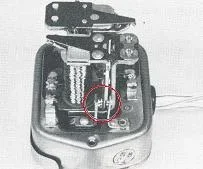
The arm goes from right position P1 to "hanging in the middle" P3 and then to the left position P2. Now when the arm is in the middle position and close to the left position it takes only some vibration to get a "rattling" contact. This "regulating" arm is moved by the (magnetic) energy in the coil (with the arrow).
When the voltage at the IGN terminal reaches a certain voltage the arm moves to the open/hanging in the middle position but can be very close to the left position. Have a look at this pic.
The pic is from a 6 wire VR but this one has a very good quality and the regulator arm is the same as in our 3 wire VR's.
VR contacts.webp
Now, our New Era Vr's are made in.... who knows, but are not the OEM Nippon Denso ones. It can be that the gap in your VR is a bit too tiny. Or out of spec so to say.
If my memory serves me well I adjusted my VR at 14.8 Volt and it took almost another volt to go into the P2 position. So the travel path of the arm leaving P1 at 14.8V and arriving at P2 needed almost one more volt.
If you have an adjustable power supply you could check this.

Rudi

PS, maybe I mixed up the Left and Right positions.
VR contacts.webp
 
Last edited:
Back
Top Bottom