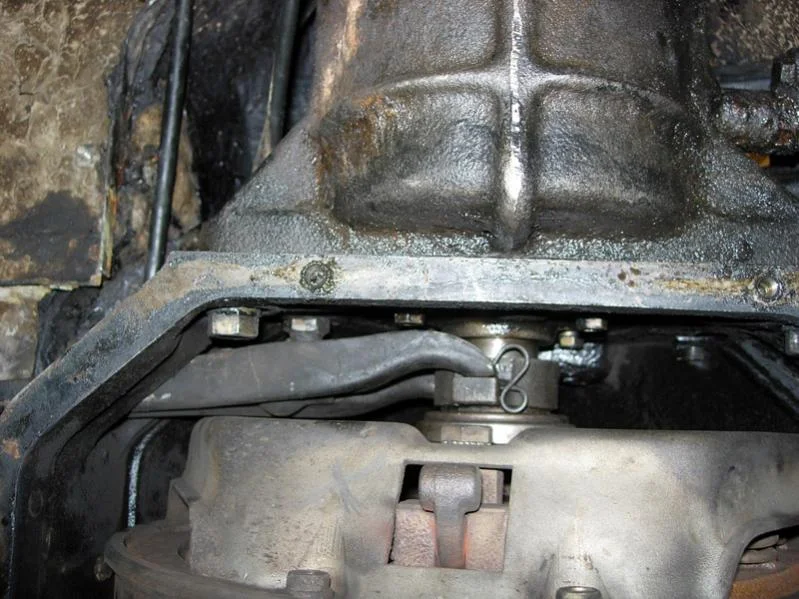
Why would this not work???

This site may earn a commission from merchant affiliate
links, including eBay, Amazon, Skimlinks, and others.

Joined
Jan 31, 2008
Threads
30
Messages
1,219
Location
Oregon
You know how every once in a while someone gets on and asks a :rolleyes: question? Well here comes another. This has been driving me nutz for a couple days but i am certain there is a good reason people arent doing it.

The Conversation has gone on for a long time about a diaphram style clutch will or will not work with a yota 4 or 3 speed. It has been stated that you must use a centerforce clutch which is sweet but the negatives are cost and a sore leg. So..... It is always the same problem or reason why it will not work which is that the slave cylinder doesnt have enough throw to fully disengage the clutch.......But people always get on and say they are doing it right now so my guess would be you possibly need good non wore parts to squeek the tolerances. I am certain the issue must be partially true being that Advanced Adapters and Downey himself state that it shouldn't be done (no disrespect intended with this Downey!!)

So my question is since it is obviously very close to working and some times does why couldn't you shim the pivot ball out a little gaining that little needed bit? Being that it is on a pivot a little shim should mean a lot??? (sorry not scentific language)

Here is a pic I stole from some one else while i was searching for this topic rather than just trying to look stupid for no reason :D

You can see this gentlemans problem his pivot ball wasnt in the indention in the fork....
pivot ball.webp
pivot ball.webp
 
clutch

I think 3 speed or 4 speed does not matter it is either the diaphragm style or the old finger style

I did put the old style on my 2f but then decided to go with the diaphragm style

You can see the Pivots and throw outs etc are different
as far as the slave cylinder? havent actually looked to see if the clutch moved okay but it felt alright from inside I dont have driveshafts yet so have not pushed to make sure it is disengaging

I found this post though

"IH8MUD Addict

Join Date: Jan 2003
Posts: 660

There does appear to be a change in 1980. Edited with Part Numbers:

1. early - 1966. clutch slave was 7/8" in diameter and used the older hose.
It appears that this cylinder is no longer available, but the repair kits are.
The part number may have merged with number 2, below.
Clutch Slave: (no longer available, use #2 below ???)
Clutch Slave Kit: 04313-35011

2. 1966-7/70 cluch slave was 3/4" in diameter and used the same older
hose as number 1, above. Tiny bleeder screw (8 mm wrench). Round it
off in no time flat.
Clutch Slave: 31470-60021
Clutch Slave Kit: 04313-60011

3. 7/70 - 8/74 - same diameter as the last one (3/4") but a different hose. The
change happened the same time as the dual brake master cylinder.
Clutch Slave: 31470-60022
Clutch Slave Kit: 04313-60011

4. 8/74 - 7/80 - diameter increased to 13/16". New clutch rod due to change
in pressure plate -- thanks Jim.
Clutch Slave: 31470-60071
Clutch Slave Kit: 04313-60020

5. 8/80 - 4/85 - diameter still 13/16", why did the PN change?
Clutch Slave: 31470-60081
Clutch Slave Kit: 04313-60020"

This was originally posted by RGentry
Fj40 Jim noted that in 74 the pushrod was changed to accomodate the new diaphragm clutch-----Longer? Shorter? or just the diameter change?
IMGP1930.webp
 
Last edited:
Hmmm interesting. Maybe all the different slave cylinders are why it works for some and not for others.... Possibly one had more throw? I am not sure about your situation being mated back to the 6 cylinder. :hhmm: I mostly have been searching 350 conversions in general. I was searching for a flywheel a second ago @ Jeggs and found this thin spacer that goes between the crank flange and the flywheel:
SPACER.gif
Just for the record I am not a big fan of spacers at all for anything but this would be such a small amount I think we are talking. :meh: Oh and i am still in favor of the shimmed pivot ball if it would work rather than this flywheel spacer

I am certain tomorrow someone will steer me back in the right direction which is fine because i can quit scratching my head at that point :clap:

Thanks BSMITH123
SPACER.gif
 
sbc

ah okay talking chevy

on shimming the pivot I think it would move the location of the arc but not the travel distance of the fork back and forth

thinking like a see saw on a tall pole or a short one if you see what I mean

still might accomplish what you want but I dont think it would increase it much just move it forward a bit

moving the pivot location up or down the fork would change the arc but of course that is not practical

Im sure someone who has been there and done that will come on and tell us!
 
Thats a flex plate spacer......
Has more to do with spacing the torque converter depth into the front pump.....
Sometimes used on std flywheel for bendix engagement problems.....

I've used the AA kit with/o the center force clutch and used the stock slave with no problems.......
 
thinking like a see saw on a tall pole or a short one if you see what I mean


I do agree and I can see where when the fork is perpendicular you would only get the depth of the washer but it seems like it would compound when at arc but ?? Thats it I am going to get the popcycle sticks out and see. :)

I've used the AA kit with/o the center force clutch and used the stock slave with no problems.......
Good to hear another instance where the GM clutch is working just fine

Thats a flex plate spacer......
Has more to do with spacing the torque converter depth into the front pump.....
Sometimes used on std flywheel for bendix engagement problems.....

Oh ok thanks! I would have swore JEGS called it a flywheel/flexplate spacer but it was late and i was hurrying..... Regardless I wouldnt want to go that route
 
ive inter changed toyota clutch parts for years on a 74 i scrapped there was a cast fork and a 3 finger clutch.the pivot balls are a little different and the clips for the to bearing are a little different.on v8 conversions i use a toyota diafram clutch by drilling and tapping the chevy flywheel.i forgot to put the cast fork in and couldnt so i put in a stamped one and it works fine .i always use the smaller diameter slave .when toyota makes a change they keep it simple and the parts almost always work together sometime with small mods good luck
 
Ok i was out of popcycle sticks :) so i sketched something out on a Paint program and my theory of a little shim behind the pivot ball would be compounded equalling greater throw on the throwout bearing seems to have proven true even though you have the exact same stationary point on the travel of the slave cylinder. However I can't post my sketch on here :meh: I think i can download a program later tonight that will allow me to make it JPEG

To all that have posted that they are running stock chevy clutches with no problem I am not ignoring you at all!! Thanks that gives me confidence but still a desire to fix or find an easy way for the ones who it didnt work for or find a little step to ensure I don't have to pull my tranny back off going :bang: because i was one of the unlucky ones......
 
pivot

I bet you could shim it faster than you can draw it! Ha ha!

Probably true eh?:grinpimp: Hope it works in any case;)
 
are you talking about a v8 conversion if so what adapter are you using? an aluminum bellhousing or an old cast iron bellhousing and an adaptor plate? if a downey bellhousing they have moved the pivot ball abit to alow more throw of the fork .if using chevy bellhousing with adaptor plate you need to use the cast fork and mount the push rod in the inner most hole . and do you have a low profile diaghram preasure plate .? . if not talknig V8 disregard.
mine works using 1978 master and slave . how was your pilot bearing? also if you have a misaligned bellhousing it will make shifting a nightmare . i had an old plate adaptor with bad alignment and it would always drag ,would never fully disengage and would destroy the pilot bearing and clutch disc hub would become loose .just typing out loud

:cheers:
 
Last edited:
I bet you could shim it faster than you can draw it! Ha ha!

Probably true eh? Hope it works in any case

Ha! After several late nights sitting infront of the computer covered in bondo dust trying to build my own set of plans for a 32x60 pole barn only to be denied because it is to big and having to redo them to 24x48 I have picked the speed up a little.... :D


are you talking about a v8 conversion if so what adapter are you using? an aluminum bellhousing or an old cast iron bellhousing and an adaptor plate? if a downey bellhousing they have moved the pivot ball abit to alow more throw of the fork .if using chevy bellhousing with adaptor plate you need to use the cast fork and mount the push rod in the inner most hole . and do you have a low profile diaghram preasure plate .? . if not talknig V8 disregard.
mine works using 1978 master and slave . how was your pilot bearing? also if you have a misaligned bellhousing it will make shifting a nightmare . i had an old plate adaptor with bad alignment and it would always drag ,would never fully disengage and would destroy the pilot bearing and clutch disc hub would become loose .just typing out loud

My planned scenario is:

Yes v8 conversion
Advanced adapters
Cast fork
low profile diaghram
1976 master and slave
Havent attempted it yet - still in the v8 conversion so pilot is new
Larger fj throwout bearing

Here is an exagerated example. As you can tell I made it excessive to show however i am only thinking a fairly thin shim just enough to ensure it works :meh:
clutchdoc.webp
clutchdoc.webp
 
you could also try an adjustable pivot ball , by Lakewood or MR. gasket . see link

Adjustable Clutch Fork Pivot Ball

also if you where having to use the chevy TO bearing they have them available in different lenghts

Adjustable Clutch Fork Pivot Ball - Thanks good find same theory. The way our fj's are set up that particular one would be a little harder to mod in but good info!!
Chevy TO bearings have different lengths - Good to know thanks!

When the time gets here (next week) I will put a small shim behind the stock pivot ball and see what happens :meh: I wont be able to fully test it for another month or so though :rolleyes:

Thanks for all the thoughts and info!
 
my $0.02 on all this

I have used the low profile GM clutches with success.

I used a 10" 3-finger pressure plate behind a mid 70's carb'd 350 SBC and an 11" diaphragm-style pressure plate behind a late 70's carb'd 400 SBC. These both used the old version Downey V8 to 4-speed SBC conversion (cast GM bellhousing with machined steel plate using cast GM release arm and GM TO bearing).

early style V8 belhousing..webp

These were both in 75 FJ40 and I used the stock hydraulic clutch MC and slave cylinder. I had no problems whatsoever with this arrangement. I bought the clutch PP and disk at the local independent auto parts store.

Being away from FJ40's for many years, when I got back in and went through all this on my current '75 VJ40, I opted to just buy the Centerforce as I got a good deal and wanted to try it. The major difference I see is the amount of force it takes to push on the clutch pedal has increased and the engagement point is different. On the CF it is right at the start of the pedal throw while the 3-finger and diaphragm were considerably closer to the floor. Not scientific but astute observations nonetheless.

Plus as I get older I have less tolerance for dicking around with the potential problems just to save a few bucks. I have never heard of anyone using the CF that has disengagement problems as experienced by so many with the generic low-profile GM stuff. Maybe I just got lucky.

If asked, my advice would be to use the CF. If one wants to do it the other way my recomnedation is to go with Jake's advice of the adjustable pivot ball and location. He's got the GM # on the pressure plate too.
early style V8 belhousing..webp
 
Last edited:
The major difference I see is the amount of force it takes to push on the clutch pedal has increased and the engagement point is different. On the CF it is right at the start of the pedal throw while the 3-finger and diaphragm were considerably closer to the floor.

Agreed

I would like not to use the extra force to push and have my disengagement closer to the CF's


Plus as I get older I have less tolerance for dicking around with the potential problems just to save a few bucks. I have never heard of anyone using the CF that has disengagement problems as experienced by so many with the generic low-profile GM stuff. Maybe I just got lucky.

I agree that everyone could spend the extra money, purchase a CF, and not have a single problem. However I would all ways be annoyed with the stiffness not performance but stiffness of the clutch if it was anything like my last two CF's(minitruck yota and f150). Plus if I keep spending the extra dollars on everypart I purchase my full restoration is going to have to double as my HOUSE :D
 
If one wants to do it the other way my recomnedation is to go with Jake's advice of the adjustable pivot ball and location. He's got the GM # on the pressure plate too.

I had gotten the part number from one of Jakes other thread posts so that is what i have right now.

Thanks! :cheers:
 
Sounds to me like you want the best of both worlds. Let us all know how to do that and I don't think your idea of altering the pivot height is going to make all that much difference.
 
I’d recommend a conversion bel housing to ensure you have proper dowel alignment (Trans-Engine). Otherwise It’ll keep eating clutches. The cost will become insignificant it avoids premature clutch failures.
 
Back
Top Bottom