
wheel spacers.....?

This site may earn a commission from merchant affiliate
links, including eBay, Amazon, Skimlinks, and others.

Joined
Jan 9, 2007
Threads
15
Messages
261
Location
Kansas City, Kansas
Website
www.palmerknives.com
How many of you guys are using wheel spacers......?

And how are they doing...................?
[are they holding up under DD and off-roading conditions]


I am thinking of purchasing some to bring my tires farther out to meet evenly with the fender flares and wanted some opinions/feedback.....!


thanks.......:beer:
 
I know there are several people running wheels spacers. I've been looking at this for a while now and there are several threads talking about wheel spacers. Try the search feature and I'm sure you can find some answers. But the short answer is that quite a few guys are running them with good results.
 
I did a search and got some results....but, some people are saying they have a wheel adapter....? verses a wheel spacer.....?

I didn't know there was a difference......is there.......?
 
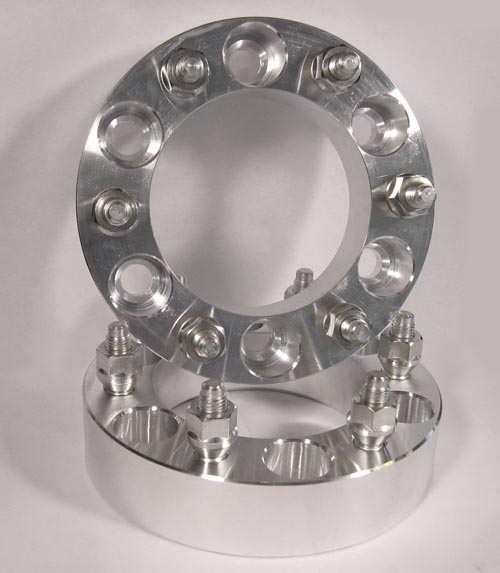
pretty sure they're talking about the same thing. Most of the good quality spacers will have their own studs (like a wheel adapter would). You bolt the spacer on using the factory wheel studs and mount your wheel to the studs on the spacer.

Like these......

wheelspacers_500.jpg
 
yeah i went with some 1.25" spacers from Marlin Crawler.....great quality and they have their own studs as mentioned above.

I currently run mine with 255/85 Bfg MTs and it gets them right out to the edge of the fender where the flat top of the tire is inside the fender...but the buldge of the tires sidewall is slightly out of the fender... much better look than stock fit.

So far with MT's, slee shortbus bumper, metaltech sliders and some batts....im still pulling 14mpg city and 16hwy and it handles great. Very happy so far.
 
I've thought about getting those too, but I'm still needing a few hundred more dollars for my lift/tires.


And since it's my DD and I drive constantly, how do they affect handling or other aspects of driving?


Do NOT tell me to search.
 
...
And since it's my DD and I drive constantly, how do they affect handling or other aspects of driving?
...

On the road I don't notice them at all, they may increase stability in extreme cornering? On the front they increase the scrub circle, which can make the steering harder to turn, increasing the load on steering componits in some situations, probably only noticeable offroad.

By pushing the wheels out they increase the load in the wheel bearings. But, the 80's bearings are very stout, if properly maintained and run with plenty of preload it shouldn't be an issue.

Also, by having two sets of studs and contact surfaces, you double the chances of a wheel coming loose. Make sure that you follow the correct torquing procedure when installing them.
 
...
I am thinking of purchasing some to bring my tires farther out to meet evenly with the fender flares and wanted some opinions/feedback.....!

If you push the tires flush, make sure that you have the proper bump stop spacers to keep the tires from hitting the flairs/fenders. When they flex it isn't a problem, but if you hit a big bump, where the whole axle moves it can be.

I have ~5" of lift and 1.25" wheel spacers, with the stock rims and 295 tires it's never been a problem, no bump stop spacers, no rub. With the Tundra rims and 37's it is a problem, without the bump stop spacers I can make them contact relatively easily, front and/or rear. The Tundra rims have more backspace, so the spacers on that setup are effectively equal to 3/4" on stock rims, I'm swapping them out for a set of 1" spacers.
 
I am running the 1.5" TG's on mine with stock rims and 305's.

Went up 3" figured I would go out 3" for stability.

I like the way if fills out the wheel well and I have had no problems during heavy wheeling. But with too much weight in the back and improper springs, I was rubbing the inner part of the flares when flying through the desert.

Since I put the 4" comps in the back, I have not had any issues.

I can post a pic if you like.
 
I’m running Performance Wheel & Tire’s 1.5 inch spaces on stock wheels w/ 35-inch BFG ATs with Slee Off-road’s 6-inch kit. No complaints so far, they have never come louse or caused any handling problems.

Performance Wheel & Tire
4095 S. Santa Fe Dr.
Sheridan, CO 80110
P: 303-934-2929
W: www.performancewheel.com
 
Spacers are great. I have been running mine on my mini for well over a year without anything coming loose. As mentioned earlier they will increase your scrub radious causing a slight increase in wheel scrub/turning effort (exacerbated on wider tires). I plan on running a set for the 80 as soon as tires and lift are affordable to me.

And dont let the safety nazi's tell you they are unsafe. Use red locktite (I used blue) and hit them with the impact at every oil change/tire rotationa and you will be fine.

One thing worth mentioning though is the alluminum spacers and the stock alluminum wheels may not "clamp down" nearly as hard as its steel rim counterpart. So pay very close attention to your wheel and spacer tightness on a regular basis if your not using steel rims. yes people have had tires go sailing into intersections becasue they neglected to check this simple yet vital component.
 
...

And dont let the safety nazi's tell you they are unsafe. Use red locktite (I used blue) and hit them with the impact at every oil change/tire rotationa and you will be fine.

...

Doing the final tightening on lug nuts with an impact is a very bad practice. The proper torque for conical lug nuts is 109 ft-lbs and 76 ft-lbs for the flange type. Tightening them more than that or unevenly will weaken the mounting connection and stretch, weaken the studs.

Follow the spacer manufactures directions when installing them. For mine it was, clean the hub mounting surface, install the spacer with the conical nuts, torque to 109 ft-lbs, install the wheel and torque to 76 ft-lbs. Drive ~100 miles, pull the wheels and retorque the spacer nuts.

Lock-tite is a great product, but lug nuts aren't a good application. A properly installed lug nuts will not loosen, fall of on their own. Most all cases can be traced to stretched, damaged studs, under or over torqued nuts, dirty/rusty/even thickly painted hub mounting surface. In other words the nut doesn't turn, if the studs are stretched they stretch more or debris, uneven mounting surface allows the mounted part to move reducing the clamping force. Once it moves it's game over, next time it will move easier, repeat, shortly the wheel is off.

If lock-tite is used retorque readings are useless, the nut is glued to the stud, it could be 25 ft-lbs and you would never know. Also if it is used and the nut needs to be removed, the torque needed is likely to damage, twist, stretch the stud, possibly leading to issues later.

haha thank for making my point. I suppose my "bad practice" has caused my spacers to stay firmly clamped to my truck for the past five years by chance. Lug nuts = impact....wheel spacers....impact.... thread stretch is an important factor but Like you mentioned a clean mating surface is most important above all else. The loctite is never a bad idea, after initial install my spacers have NEVER budged upon re-torque.


But a torque wrench is important, and a calibrated one is even more important.
 
Back
Top Bottom